Chinese Journal of Tissue Engineering Research ›› 2026, Vol. 30 ›› Issue (19): 5072-5081.doi: 10.12307/2026.282
Previous Articles Next Articles
Exosomes promote diabetic wound healing: a visual analysis of research hotspots and evolutionary trends
Jian Xichao, Shao Jingjie, Tang Shihan, Qi Fang, Deng Chengliang
- Department of Burns and Plastic Surgery, Affiliated Hospital of Zunyi Medical University, Zunyi 563003, Guizhou Province, China
-
Received:2025-09-23Accepted:2025-12-08Online:2026-07-08Published:2026-02-24 -
Contact:Deng Chengliang, MD, Chief physician, Department of Burns and Plastic Surgery, Affiliated Hospital of Zunyi Medical University, Zunyi 563003, Guizhou Province, China -
About author:Jian Xichao, MS candidate, Department of Burns and Plastic Surgery, Affiliated Hospital of Zunyi Medical University, Zunyi 563003, Guizhou Province, China -
Supported by:National Natural Science Foundation of China, No. 82160379 (to QF)

CLC Number:
Cite this article
Jian Xichao, Shao Jingjie, Tang Shihan, Qi Fang, Deng Chengliang. Exosomes promote diabetic wound healing: a visual analysis of research hotspots and evolutionary trends[J]. Chinese Journal of Tissue Engineering Research, 2026, 30(19): 5072-5081.
share this article
Add to citation manager EndNote|Reference Manager|ProCite|BibTeX|RefWorks
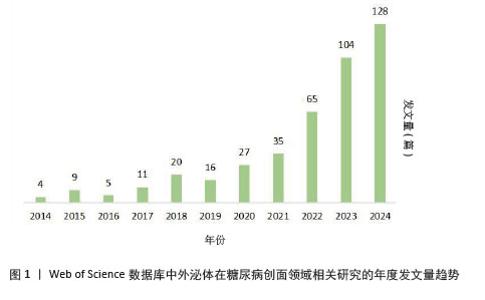
2.1 年度发文量分析 根据检索策略,共纳入424篇关于外泌体促进糖尿病创面愈合的研究。从每年出版数量的增长速度来看,整个时期可以分为2个部分:第一阶段(2014-2019年)和第二阶段(2020-2024年)。外泌体在糖尿病创面愈合中的研究和开发在第一阶段处于萌芽阶段,文章数量相对较少,第二阶段论文发表量年增长率稳步快速上升,2024年发文总量达到128篇(图1)。"

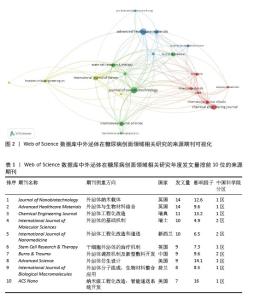
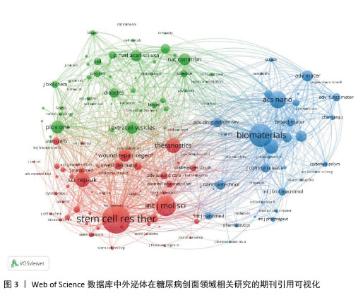
2.2 期刊分析 有199个期刊发表了外泌体促进糖尿病创面愈合的相关研究(图2)。表1列举了发文量排名前10的期刊,共发表了101篇文献。其中,《Journal of Nanobiotechnology》和《Advanced Healthcare Materials》发表的论文最多(n=14),其次是《Chemical Engineering Journal》(n=11)(图2,表1)。排名前10的期刊中,《ACS Nano》影响因子最高(IF=16,中科院1区),其次是《Advanced Science》(IF=14.1,中科院1区)。期刊共被引网络结果显示,《Stem Cell Research & Therapy》《Biomaterials和International Journal of Molecular Sciences》等期刊具有活跃的引用关系(图3)。 "

"

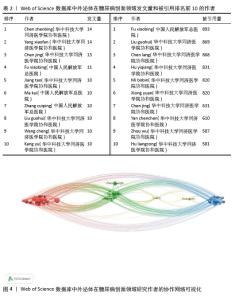
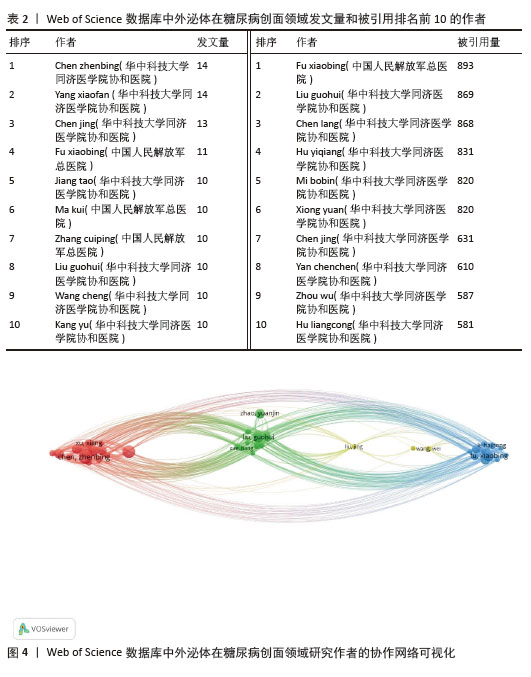
2.3 作者分析 共有2 883名作者研究外泌体在糖尿病创面中的作用。在发文量排名前10的作者中,有4位作者发表10篇以上的论文,分别是Chen zhenbing、Yang xiaofan、Chen jing和Fu xiaobing(表2)。有6位作者发表的文献被引用超过800次,其中Fu xiaobing被引次数最高(893次),其次是Liu guohui(869次)。作者构建协作网络显示(图4),Chen jing、Chen zhenbing、Chen lang和Fu xiaobing的节点最大,因为他们发表的相关研究最多。此外,还观察到多位作者之间的密切合作,如Fu xiaobing与Chen zhenbing、Liu guohui等合作积极。作者共被引网络图显示(图5),在不同的共同被引作者之间也存在活跃的引用关系,例如Xiong yuan、Armstrong DG和Zhang bing等。这些共同被引作者的研究为此领域提供了理论基础(如糖尿病足溃疡的流行病学和病理机制),是核心参考文献的来源。 "

"

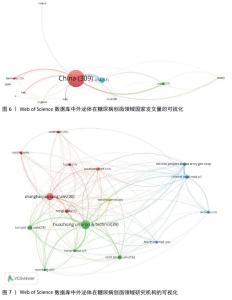
2.4 国家和机构分析 纳入分析的文献包含46个国家和437个机构。对46个国家构建可视化网络(图6),结果显示发文量在10篇及以上的国家有4个,其中中国发文量最多,高达309篇以上,其次是美国(51篇)。此外,从可视化网络图可以看出,中国与美国、德国、日本、印度和意大利等国家均有合作。其中,中国与美国的合作最为密切(连线最粗),合作发文数量占美国发文量的24%,研究方向主要以机制探究为主。机构构建协作网络结果显示(图7),发文量在15篇及以上的机构有5个,发文量10-15篇的机构有11个。其中,发文量最多的机构是华中科技大学(39篇),其次是上海交通大学(30篇)。此外,还观察到许多机构之间的合作。例如,温州医科大学与华中科技大学和上海交通大学等合作密切。 "

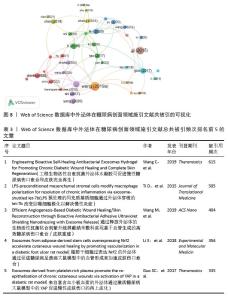
2.5 施引文献共被引分析 施引文献是指纳入文献的所有后续研究论文,反映学术影响力。施引文献共被引分析通过统计这些后续论文之间的共被引关系,揭示研究前沿动态和知识扩散路径,追踪领域发展趋势,识别新兴方向并评估目标文献的持续影响。基于VOSviewer生成的施引文献共被引网络图谱显示(图8),该研究所纳入的文献中被引用频次超过100的有44篇,Wang(2019a)和Ti(2015)的研究在网络中节点最大,表明这两项研究对后续的研究工作产生了广泛影响。时间分布上,2019-2022年的施引文献占比最高(62%),说明外泌体在伤口愈合中的应用研究在近年来持续受到高度关注。表3列举了总被引用频次排名前5的文献,研究内容均是探索不同外泌体促进糖尿病创面愈合的临床前研究。其中被引用最高的是Wang等2019年发表在《Theranostics》杂志的"Engineering Bioactive Self-Healing Antibacterial Exosomes Hydrogel for Promoting Chronic Diabetic Wound Healing and Complete Skin Regeneration”,被引用615频次。该研究因创新性地将外泌体与自修复水凝胶结合,开发出具有抗菌、促血管再生多功能的新型敷料系统而被广泛引用。其次是Ti等2015年发表在《Journal of Translational Medicine》杂志的“LPS-preconditioned mesenchymal stromal cells modify macrophage polarization for resolution of chronic inflammation via exosome-shuttled let-7b”,被引用505频次,这项研究因首次阐明外泌体递送let-7b调控巨噬细胞极化的分子机制,为慢性伤口炎症控制提供了关键靶点而获得高度关注。这些研究分别从材料工程和机制解析2个维度推动了外泌体治疗领域的发展。"

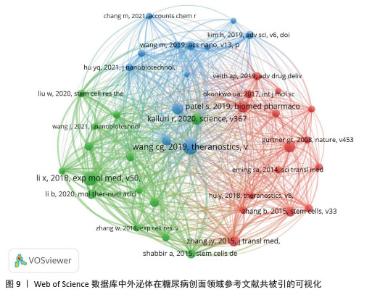
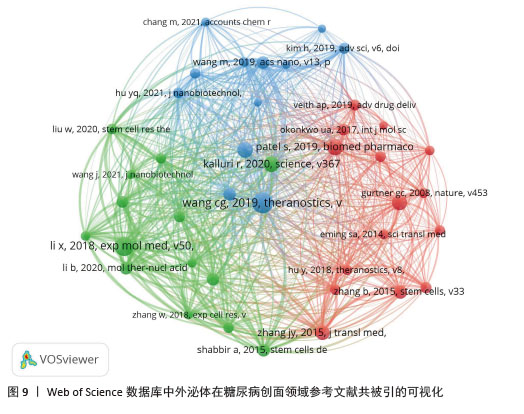
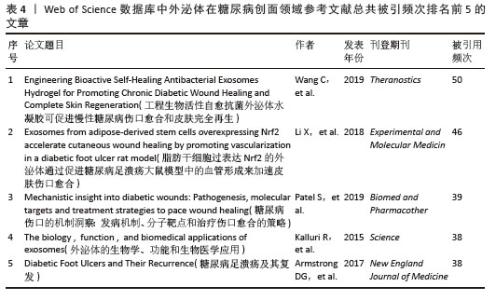
2.6 参考文献共被引分析 参考文献是指纳入文献中引用的已有文献,构成研究的理论基础。参考文献共被引分析通过统计多篇论文共同引用的文献关系,揭示该领域的知识基础和研究流派,识别出经典文献、核心理论和学科知识结构。基于VOSviewer构建的参考文献共被引网络图谱显示(图9),该网络由41个节点和728条连线构成,分红、绿、蓝3个簇,3个簇之间形成错综复杂的交互网络,体现了基础研究与临床转化的相互交融。节点大小与被引频次呈正相关,其中Wang CG等(2019,Theranostics)和Li X等(2018,Exp Mol Med)作为最大节点,表明被引用频次最高,这也说明了二者的研究不仅具有极高的价值,而且是该领域内的先行者和领军人物。表4列举了参考文献总共被引频次排名前5的文章,其中被引用最高的是Wang等2019年发表在《Theranostics》杂志的“Engineering Bioactive Self-Healing Antibacterial Exosomes Hydrogel for Promoting Chronic Diabetic Wound Healing and Complete Skin Regeneration”,被引用50频次,该文献在施引文献中也排名第一。其次是Li等2018年发表在《Experimental and Molecular Medicin》杂志的“Exosomes from adipose-derived stem cells overexpressing Nrf2 accelerate cutaneous wound healing by promoting vascularization in a diabetic foot ulcer rat model”,被引用46频次,该文献在施引文献中排名第四。其余3篇均是经典综述文献,具有重大的影响。Patel S等的综述主要讨论了细胞因子(与生长因子)的分子级联反应和导致伤口愈合延迟的旧因子、分子靶点以及完全愈合与治愈的最新进展。Kalluri R等则是对外泌体的生物发生、内含物、生理功能和生物医学应用等方面进行了详细阐述,为后续研究提供了基础理论支持。Armstrong DG等发表的文章则是围绕糖尿病足溃疡及其复发展开了系统性讨论,涵盖流行病学、病理机制、临床管理及预防策略,并为后续研究提供了多方面的支持依据。聚类图谱显示(图10),聚类结构显著(Q=0.642>0.3),聚类结果合理可信(S=0.845 7>0.7)。根据时间轴可以看出,参考文献的近期研究集中在#0 redox homeostasis(氧化还原稳态调控)、#1 glycoengineering(糖基化工程)、#2 amniotic membrane(羊膜衍生材料)和#4 immune microenvironment(免疫微环境重塑)4个聚类,且各聚类间具有显著的联系,表明近年来糖尿病创面研究领域从分子机制到临床应用的完整知识体系,呈现出多学科交叉融合的发展趋势。"
"


"

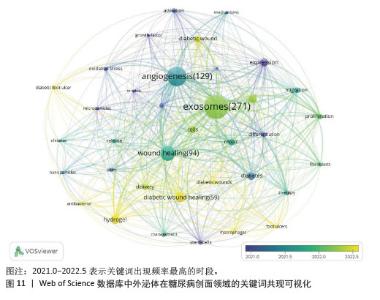
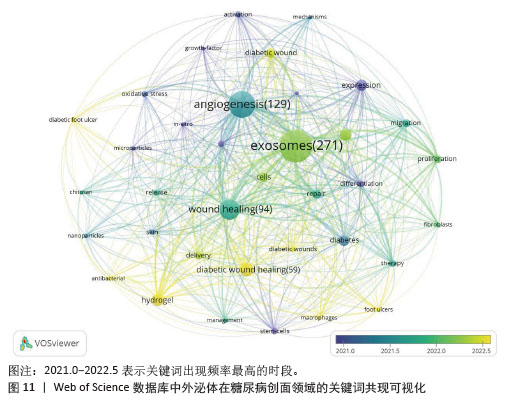
2.7 关键词分析 2.7.1 关键词共现分析 关键词共现是通过统计高频共现术语,揭示研究领域内的核心主题、热点方向及知识结构。具体而言,关键词共现网络可通过节点大小(频次)、连线(共现强度)及颜色(时间演变)3个维度,系统呈现该领域的知识关联与动态变化。关键词共现分析显示(图11),exosomes(外泌体)以271次的最高出现频次成为网络中最突出的节点,其次是angiogenesis(血管生成,129次)和wound healing(创面愈合,94次)。此外,diabetic wound healing(糖尿病创面愈合,59次)和hydrogel(水凝胶)等关键词也显示出较高的出现频次。节点间的连线表明这些关键词之间存在密切关联,特别是外泌体与血管生成、伤口愈合之间的强共现关系。图谱中关键词的颜色从蓝色渐变至黄色代表了研究热点的时序变化,结果显示,早期(2021年5月之前)的研究主要是集中在activation(激活)、mechanisms(机制)和growth factor(生长因子)等基础性问题;近期(2022年之后)的研究则更侧重于delivery(递送)、therapy(治疗)和management(管理)等应用性问题。值得注意的是,随着基础研究的深入和科学技术的发展,出现了许多新兴治疗策略,如Hydrogel(水凝胶)、nanoparticles(纳米颗粒)和stem cells(干细胞)等关键词在近期研究中出现频率明显增加,是目前的一些研究热点方向。此外,fibroblasts(成纤维细胞)、macrophages(巨噬细胞)、proliferation(增殖)、migration(迁移)和differentiation(分化)等关键词与外泌体紧密相连,表明这些细胞和生物学过程在外泌体相关研究中占据重要地位。 "
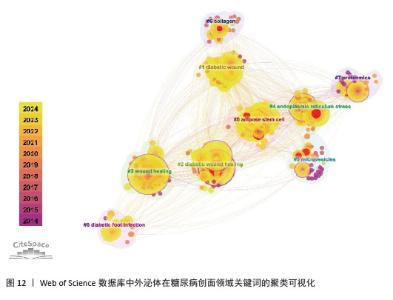
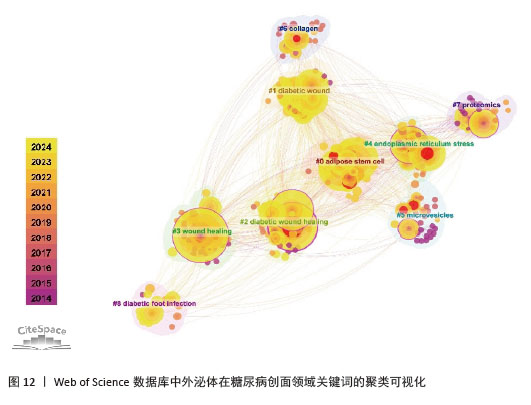
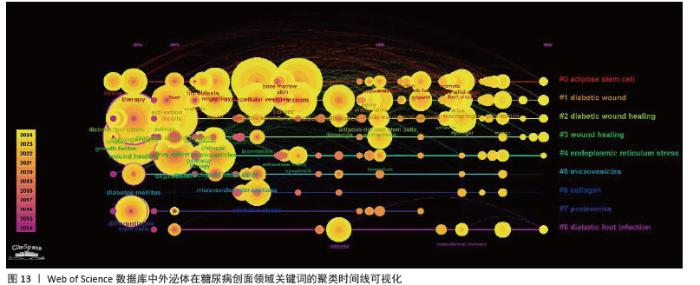
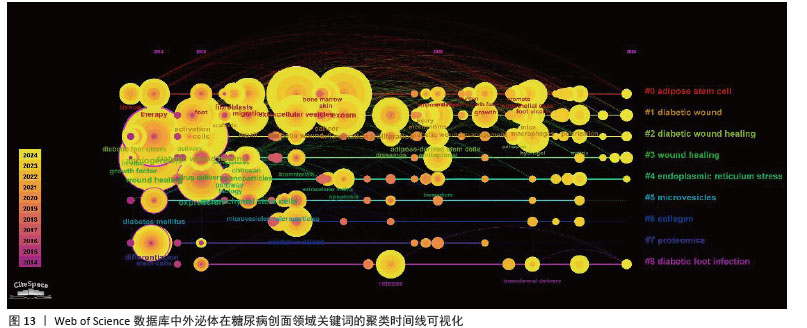
2.7.2 关键词聚类分析 聚类是将数据集分组或分类的过程,使组内的数据点相似度高而组间数据点相似度低。通过关键词聚类可以识别出该领域内的研究热点和趋势。在关键词共现基础上,通过CiteSpace对关键词进行聚类分析(图12),其中聚类结构显著(Q=0.398 4>0.3),聚类结果合理可信(S=0.729 8>0.7)。纳入文献的关键词可形成9大聚类:#0 adipose stem cell(脂肪干细胞)、#1 diabetic wound(糖尿病创面)、#2 diabetic wound healing(糖尿病创面愈合)、#3 wound healing(创面愈合)、#4 endoplasmic reticulum stress(内质网应激)、#5 microvesicles(微泡)、#6 collagen(胶原蛋白)、#7 proteomics(蛋白组学)和#8 diabetic foot infection(糖尿病足感染)。各聚类间连线密集,说明各聚类之间存在密切联系。其中聚类#0 adipose stem cell(脂肪干细胞)是最受关注的聚类,脂肪干细胞及其衍生物是近年来糖尿病创面领域的研究热点;聚类#1和#8主要讨论的是糖尿病创面及其并发症,包括慢性难愈性、易感染性和高截肢风险等问题;聚类#2、#3、#4、#5和#6讨论的是正常创面与糖尿病创面愈合的差异,重点关注微泡、氧化应激和胶原蛋白在糖尿病创面修复中的作用;聚类#7主要是讨论如何运用蛋白组学分析糖尿病创面的分子特征。进一步的聚类时间线图显示(图13),除了聚类#5、#6和#7,其余聚类均持续至2024年。节点颜色从紫色逐渐到黄色,表明聚类的研究主题在不同时间段均保持活跃。关键词节点的大小反映出现频次,其中diabetic wound healing(糖尿病创面愈合)和wound healing(创面愈合)等关键词节点较大,说明这些主题在研究领域中占据重要地位,是临床长期存在的重要问题。 "
"
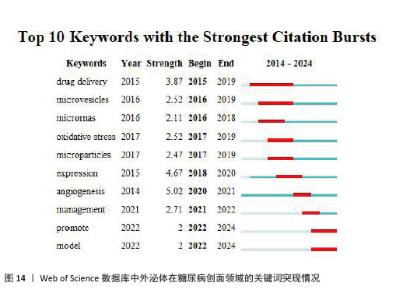
2.7.3 关键词突现分析 关键词突现是指在短时间内某个或某些关键词的频次明显增加,可以表明该时间段内关注度较高的研究,进而判断研究领域的热点和趋势。图14展示了突现强度排名前10的关键词分布情况,其中,angiogenesis(血管生成,强度5.02)、expression (表达,强度4.67)和drug delivery(药物递送,强度3.87)是具有最高突现强度的3个关键词。2020年后新出现的突现词包括angiogenesis(血管生成)、management(管理)、promote(促进)和model(模型)。promote(促进)主要关联的是外泌体对创面再上皮化和血管生成等促进机制研究,model(模型)则是糖尿病小鼠创面模型的构建和应用。各突现词的时间分布显示,早期的研究热点主要集中在drug delivery(药物递送)、microvesicles(微泡)、micrornas(微小RNAs)和oxidative stress(氧化应激)等方向,侧重于糖尿病创面的机制研究;然而,近期则转向angiogenesis(血管生成)、management (管理)、promote(促进)和model(模型)等主题,说明研究重点从机制的探究转向促进创面修复和患者综合管理。突现词的持续时间不等,其中angiogenesis(血管生成)的突现期跨度最长,至今仍是研究热点方向。management(管理)、promote(促进)和model(模型)三者出现时间较晚(2021-2024年),这表明在未来可能会有更多的相关研究。 "

| [1] GBD 2021 DIABETES COLLABORATORS. Global, regional, and national burden of diabetes from 1990 to 2021, with projections of prevalence to 2050: a systematic analysis for the Global Burden of Disease Study 2021. Lancet. 2023; 402(10397):203-234. [2] JIAO YR, CHEN KX, TANG X, et al. Exosomes derived from mesenchymal stem cells in diabetes and diabetic complications. Cell Death Dis. 2024;15(4):271. [3] PEÑA OA, MARTIN P. Cellular and molecular mechanisms of skin wound healing. Nat Rev Mol Cell Biol. 2024;25(8):599-616. [4] 聂鹏鹃,杨小凡,陈振兵.外泌体在糖尿病创面修复中的研究进展[J].中国医药,2025, 20(7):1106-1110. [5] CRAWFORD AL, LAITEERAPONG N. Type 2 Diabetes. Ann Intern Med. 2024;177(6): ITC81-ITC96. [6] GE L, WANG K, LIN H, et al. Engineered exosomes derived from miR-132-overexpresssing adipose stem cells promoted diabetic wound healing and skin reconstruction. Front Bioeng Biotechnol. 2023;11:1129538. [7] ARMSTRONG DG, TAN TW, BOULTON AJM, et al. Diabetic Foot Ulcers: A Review. JAMA. 2023;330(1):62-75. [8] O’BRIEN K, BREYNE K, UGHETTO S, et al. RNA delivery by extracellular vesicles in mammalian cells and its applications. Nat Rev Mol Cell Biol. 2020;21(10):585-606. [9] KALLURI R. The biology and function of extracellular vesicles in immune response and immunity. Immunity. 2024;57(8):1752-1768. [10] ZHOU C, ZHANG B, YANG Y, et al. Stem cell-derived exosomes: emerging therapeutic opportunities for wound healing. Stem Cell Res Ther. 2023;14(1):107. [11] WU J, CHEN LH, SUN SY, et al. Mesenchymal stem cell-derived exosomes: The dawn of diabetic wound healing. World J Diabetes. 2022;13(12):1066-1095. [12] LI Y, ZHU Z, LI S, et al. Exosomes: compositions, biogenesis, and mechanisms in diabetic wound healing. J Nanobiotechnology. 2024;22(1):398. [13] SONG Y, YOU Y, XU X, et al. Adipose-Derived Mesenchymal Stem Cell-Derived Exosomes Biopotentiated Extracellular Matrix Hydrogels Accelerate Diabetic Wound Healing and Skin Regeneration. Adv Sci (Weinh). 2023; 10(30):e2304023. [14] FAN MH, PI JK, ZOU CY, et al. Hydrogel-exosome system in tissue engineering: A promising therapeutic strategy. Bioact Mater. 2024;38:1-30. [15] BAKADIA BM, QAED AHMED AA, LAMBONI L, et al. Engineering homologous platelet-rich plasma, platelet-rich plasma-derived exosomes, and mesenchymal stem cell-derived exosomes-based dual-crosslinked hydrogels as bioactive diabetic wound dressings. Bioact Mater. 2023;28:74-94. [16] WENG J, CHEN Y, ZENG Y, et al. A novel hydrogel loaded with plant exosomes and stem cell exosomes as a new strategy for treating diabetic wounds. Mater Today Bio. 2025;32:101810. [17] LI W, WU S, REN L, et al. Development of an Antiswelling Hydrogel System Incorporating M2-Exosomes and Photothermal Effect for Diabetic Wound Healing. ACS Nano. 2023; 17(21):22106-22120. [18] HUANG J, YU M, YIN W, et al. Development of a novel RNAi therapy: Engineered miR-31 exosomes promoted the healing of diabetic wounds. Bioact Mater. 2021;6(9):2841-2853. [19] ZHAO X, FU L, ZOU H, et al. Optogenetic engineered umbilical cord MSC-derived exosomes for remodeling of the immune microenvironment in diabetic wounds and the promotion of tissue repair. J Nanobiotechnology. 2023;21(1):176. [20] HUANG W, GUO Q, WU H, et al. Engineered Exosomes Loaded in Intrinsic Immunomodulatory Hydrogels with Promoting Angiogenesis for Programmed Therapy of Diabetic Wounds. ACS Nano. 2025;19(14): 14467-14483. [21] LIANG W, WU H, TAN L, et al. Porcine pericardial decellularized matrix bilayer patch containing adipose stem cell-derived exosomes for the treatment of diabetic wounds. Mater Today Bio. 2024;30:101398. [22] NIU SH, LI B, GU HC, et al. Knowledge mapping of extracellular vesicles in wound healing: A bibliometric analysis (2002-2022). Int Wound J. 2023;20(8):3221-3240. [23] SYNNESTVEDT MB, CHEN C, HOLMES JH. CiteSpace II: visualization and knowledge discovery in bibliographic databases. AMIA Annu Symp Proc. 2005;2005:724-728. [24] TOMASZEWSKI R. Visibility, impact, and applications of bibliometric software tools through citation analysis. Scientometrics. 2023; 128(7):4007-4028. [25] LANG X, LI L, LI Y, et al. Effect of Diabetes on Wound Healing: A Bibliometrics and Visual Analysis. J Multidiscip Healthc. 2024;17: 1275-1289. [26] WORSLEY AL, LUI DH, NTOW-BOAHENE W, et al. The importance of inflammation control for the treatment of chronic diabetic wounds. Int Wound J. 2023;20(6):2346-2359. [27] GAO S, ZHANG W, ZHAI X, et al. An antibacterial and proangiogenic double-layer drug-loaded microneedle patch for accelerating diabetic wound healing. Biomater Sci. 2023;11(2): 533-541. [28] WU Y, WANG Y, FU Z, et al. Peptide RL-QN15 promotes regeneration of epidermal nerve fibers and recovery of sensory function in diabetic skin wounds. FASEB J. 2023;37(4): e22892. [29] RODRIGUES M, KOSARIC N, BONHAM CA, et al. Wound Healing: A Cellular Perspective. Physiol Rev. 2019;99(1):665-706. [30] HE S, WALIMBE T, CHEN H, et al. Bioactive extracellular matrix scaffolds engineered with proangiogenic proteoglycan mimetics and loaded with endothelial progenitor cells promote neovascularization and diabetic wound healing. Bioact Mater. 2021;10:460-473. [31] LI D, WU N. Mechanism and application of exosomes in the wound healing process in diabetes mellitus. Diabetes Res Clin Pract. 2022;187:109882. [32] 马强,王承芳,李乃树,等.ADSCs外泌体调控糖尿病小鼠损伤细胞的分子机制研究[J].齐齐哈尔医学院学报,2025,46(12): 1113-1118. [33] SHIEKH PA, SINGH A, KUMAR A. Exosome laden oxygen releasing antioxidant and antibacterial cryogel wound dressing OxOBand alleviate diabetic and infectious wound healing. Biomaterials. 2020;249:120020. [34] ZHANG Y, LI M, WANG Y, et al. Exosome/metformin-loaded self-healing conductive hydrogel rescues microvascular dysfunction and promotes chronic diabetic wound healing by inhibiting mitochondrial fission. Bioact Mater. 2023;26:323-336. [35] HU N, CAI Z, JIANG X, et al. Hypoxia-pretreated ADSC-derived exosome-embedded hydrogels promote angiogenesis and accelerate diabetic wound healing. Acta Biomater. 2023;157: 175-186. [36] 邵罗成,陶克.缺氧条件下骨髓间充质干细胞来源的外泌体微小RNA-4645-5p通过恢复角质形成细胞自噬促进糖尿病创面愈合[J].中华烧伤与创面修复杂志,2025,41(2):194. [37] ZHANG W, WANG L, GUO H, et al. Dapagliflozin-Loaded Exosome Mimetics Facilitate Diabetic Wound Healing by HIF-1α-Mediated Enhancement of Angiogenesis. Adv Healthc Mater. 2023;12(7):e2202751. [38] WANG P, THEOCHARIDIS G, VLACHOS IS, et al. Exosomes Derived from Epidermal Stem Cells Improve Diabetic Wound Healing. J Invest Dermatol. 2022;142(9):2508-2517.e13. [39] XIONG Y, CHEN L, LIU P, et al. All-in-One: Multifunctional Hydrogel Accelerates Oxidative Diabetic Wound Healing through Timed-Release of Exosome and Fibroblast Growth Factor. Small. 2022;18(1):e2104229. [40] YAN C, CHEN J, WANG C, et al. Milk exosomes-mediated miR-31-5p delivery accelerates diabetic wound healing through promoting angiogenesis. Drug Deliv. 2022;29(1):214-228. [41] YIN D, SHEN G. Exosomes from adipose-derived stem cells regulate macrophage polarization and accelerate diabetic wound healing via the circ-Rps5/miR-124-3p axis. Immun Inflamm Dis. 2024;12(6):e1274. [42] CHEN C, YANG J, SHANG R, et al. Orchestration of Macrophage Polarization Dynamics by Fibroblast-Secreted Exosomes during Skin Wound Healing. J Invest Dermatol. 2025; 145(1):171-184.e6. [43] YANG H, XU H, WANG Z, et al. Analysis of miR-203a-3p/SOCS3-mediated induction of M2 macrophage polarization to promote diabetic wound healing based on epidermal stem cell-derived exosomes. Diabetes Res Clin Pract. 2023;197:110573. [44] YANG P, JU Y, SHEN N, et al. Exos-Loaded Gox-Modified Smart-Response Self-Healing Hydrogel Improves the Microenvironment and Promotes Wound Healing in Diabetic Wounds. Adv Healthc Mater. 2025;14(7): e2403304. [45] YANG J, WANG D, YU H, et al. Lauric acid-mediated gelatin/hyaluronic acid composite hydrogel with effective antibacterial and immune regulation for accelerating MRSA-infected diabetic wound healing. Int J Biol Macromol. 2025;290:138792. [46] WANG Z, LI W, FAN Y, et al. Localized Surface Plasmon Resonance-Enhanced Photocatalytic Antibacterial of In Situ Sprayed 0D/2D Heterojunction Composite Hydrogel for Treating Diabetic Wound. Adv Healthc Mater. 2024;13(29):e2303836. [47] ZHAO Y, ZHAO Y, XU B, et al. Microenvironmental dynamics of diabetic wounds and insights for hydrogel-based therapeutics. J Tissue Eng. 2024;15: 20417314241253290. [48] LIU H, HE L. Intelligent hydrogel-based dressings for treatment of chronic diabetic wounds. World J Diabetes. 2025;16(5): 104937. [49] GAO Y, CHEN X, HE C, et al. Stimulus-responsive hydrogels for diabetic wound management via microenvironment modulation. Biomater Sci. 2025;13(12):3192-3212. [50] YANG X, CHAI L, HUANG Z, et al. Smart photonic crystal hydrogels for visual glucose monitoring in diabetic wound healing. J Nanobiotechnology. 2024;22(1):618. |
| [1] |
Dong Chunyang, Zhou Tianen, Mo Mengxue, Lyu Wenquan, Gao Ming, Zhu Ruikai, Gao Zhiwei.
Action mechanism of metformin combined with Eomecon chionantha Hance dressing in treatment of deep second-degree burn wounds#br#
#br#
[J]. Chinese Journal of Tissue Engineering Research, 2026, 30(8): 2001-2013.
|
| [2] | Pan Zhiyi, Huang Jiawen, Xue Wenjun, Xu Jianda. Advantages of MXene-based flexible electronic sensors and their application in monitoring diabetic foot wounds [J]. Chinese Journal of Tissue Engineering Research, 2026, 30(8): 2023-2032. |
| [3] | Li Zhenyu, Zhang Siming, Bai Jiaxiang, Zhu Chen. Osthole improves osteogenic differentiation function of bone marrow mesenchymal stem cells under high-glucose conditions [J]. Chinese Journal of Tissue Engineering Research, 2026, 30(7): 1641-1648. |
| [4] | He Jiale, Huang Xi, Dong Hongfei, Chen Lang, Zhong Fangyu, Li Xianhui. Acellular dermal matrix combined with adipose-derived stem cell exosomes promotes burn wound healing [J]. Chinese Journal of Tissue Engineering Research, 2026, 30(7): 1699-1710. |
| [5] | Wang Baiyan, Yang Shu, Wang Yiming, Wu Mengqing, Xiao Yu, Guo Zixuan, Zhang Boyi, Feng Shuying. Exosome-delivered CRISPR/Cas system enables gene editing in target cells [J]. Chinese Journal of Tissue Engineering Research, 2026, 30(7): 1839-1849. |
| [6] | Huang Jie, Zeng Hao, Wang Wenchi, Lyu Zhucheng, Cui Wei. Visualization analysis of literature on the effect of lipid metabolism on osteoporosis [J]. Chinese Journal of Tissue Engineering Research, 2026, 30(6): 1558-1568. |
| [7] | Pan Hongfei, Zhuang Zhenbing, Xu Baiyun, Yang Zhangyang, Lin Kairui, Zhan Bingqing, Lan Jinghan, Gao Heng, Zhang Nanbo, Lin Jiayu. Inhibitory effects of different concentrations of auranofin on M1 macrophage function and its therapeutic potential in diabetic wound healing [J]. Chinese Journal of Tissue Engineering Research, 2026, 30(6): 1390-1397. |
| [8] | Peng Zhiwei, Chen Lei, Tong Lei. Luteolin promotes wound healing in diabetic mice: roles and mechanisms [J]. Chinese Journal of Tissue Engineering Research, 2026, 30(6): 1398-1406. |
| [9] | Wen Fan, Xiang Yang, Zhu Huan, Tuo Yanfang, Li Feng. Exercise improves microvascular function in patients with type 2 diabetes [J]. Chinese Journal of Tissue Engineering Research, 2026, 30(5): 1225-1235. |
| [10] | Wen Xiaolong, Weng Xiquan, Feng Yao, Cao Wenyan, Liu Yuqian, Wang Haitao. Effects of inflammation on serum hepcidin and iron metabolism related parameters in patients with type 2 diabetes mellitus: a meta-analysis [J]. Chinese Journal of Tissue Engineering Research, 2026, 30(5): 1294-1301. |
| [11] | Yan Chengbo, Luo Qiuchi, Fan Jiabing, Gu Yeting, Deng Qian, Zhang Junmei. Effect of type 2 diabetes mellitus on orthodontic tooth movement and bone microstructure parameters on the tension side in rats [J]. Chinese Journal of Tissue Engineering Research, 2026, 30(4): 824-831. |
| [12] | Peng Hao, Chen Qigang, Shen Zhen. A visual analysis of research hotspots of H-type vessels in various bone diseases [J]. Chinese Journal of Tissue Engineering Research, 2026, 30(3): 760-769. |
| [13] | Wang Fei, Wang Hangping, Dai Rongjuan, Gong Lingxuan. Visual analysis of the research literature on plantar fasciitis [J]. Chinese Journal of Tissue Engineering Research, 2026, 30(24): 6410-6420. |
| [14] | Wang Ting, Yang Yang, Li Yuping, Yang Lin. Association between environmental exposure to endocrine disrupting chemicals and the risk of type 1 diabetes [J]. Chinese Journal of Tissue Engineering Research, 2026, 30(23): 5964-5971. |
| [15] | Qu Bolin, Ciren Lunzhu, Guo Jinyang, Meng Hanlu, Ding Guanxiang, Sang Hongpeng. Osteoporotic vertebral compression fractures: a visual analysis of current status and emerging trends [J]. Chinese Journal of Tissue Engineering Research, 2026, 30(23): 6040-6050. |
| Viewed | ||||||
|
Full text |
|
|||||
|
Abstract |
|
|||||