Chinese Journal of Tissue Engineering Research ›› 2026, Vol. 30 ›› Issue (15): 3791-3800.doi: 10.12307/2026.152
Previous Articles Next Articles
Two internal fixation methods for Sanders type II-IV calcaneal fractures: a 2-year clinical follow-up and finite element analysis
Xiang Hao1, Li Yuwan2, Xu Zhi3, Li Guichuan1, Liao Wei1, Cai Peng1, Zhu Chengxing1, Yan Ling1
- 1Emergency Trauma Surgery, Zunyi First People's Hospital (The Third Affiliated Hospital of Zunyi Medical University), Zunyi 563000, Guizhou Province, China; 2Department of Orthopedics, The First Affiliated Hospital, Zhejiang University School of Medicine, Hangzhou 310009, Zhejiang Province, China; 3Department of Orthopedics, Zhangjiagang Fifth People's Hospital, Zhangjiagang 215600, Jiangsu Province, China
-
Accepted:2025-06-06Online:2026-05-28Published:2025-11-05 -
Contact:Yan Ling, MD, Chief physician, Emergency Trauma Surgery, Zunyi First People's Hospital (The Third Affiliated Hospital of Zunyi Medical University), Zunyi 563000, Guizhou Province, China -
About author:Xiang Hao, Doctoral candidate, Attending physician, Emergency Trauma Surgery, Zunyi First People's Hospital (The Third Affiliated Hospital of Zunyi Medical University), Zunyi 563000, Guizhou Province, China -
Supported by:Youth Science Foundation of National Natural Science Foundation, No. 82302853 (to LYW); Guizhou Province Science and Technology Plan Project, No. LC2025031 (to YL)

CLC Number:
Cite this article
Xiang Hao, Li Yuwan, Xu Zhi, Li Guichuan, Liao Wei, Cai Peng, Zhu Chengxing, Yan Ling. Two internal fixation methods for Sanders type II-IV calcaneal fractures: a 2-year clinical follow-up and finite element analysis[J]. Chinese Journal of Tissue Engineering Research, 2026, 30(15): 3791-3800.
share this article
Add to citation manager EndNote|Reference Manager|ProCite|BibTeX|RefWorks
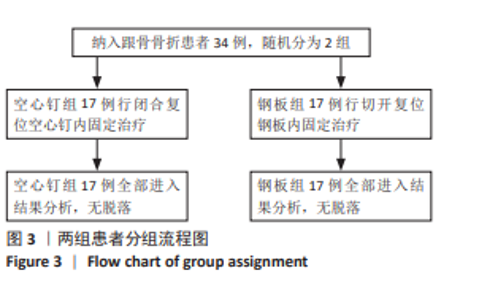
2.1 临床试验结果 2.1.1 参与者数量分析 共纳入34例Sanders Ⅱ-Ⅳ型跟骨骨折患者,随机分为2组,每组17例,随访时间为7-24个月。由于严格的入排标准及良好的随访管理,确保了无患者脱落,保证了研究数据的完整性和可靠性,按意向性分析,所有患者均进入最终的结果分析阶段。 2.1.2 试验流程图 见图3。"
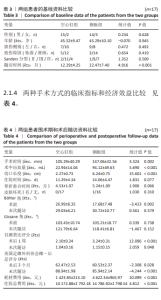
2.1.3 基线资料比较 两组患者在性别、年龄、损伤侧别、致伤原因以及Sanders分型方面均无显著性差异(P > 0.05),结果表明两组患者的基线特征均衡可比,可用于后续分析。此外,随访时间方面,空心钉组的平均随访时间为(12.29±4.25)个月,而钢板组为(22.47±7.40)个月,虽然存在差异,考虑到空心钉组康复周期较短,其差异对结果无实质性影响,见表3。"
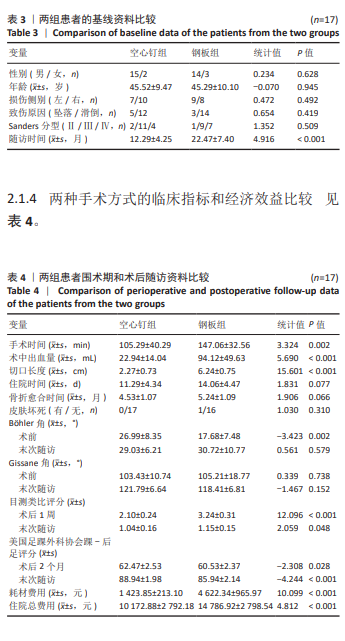
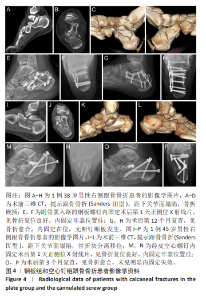
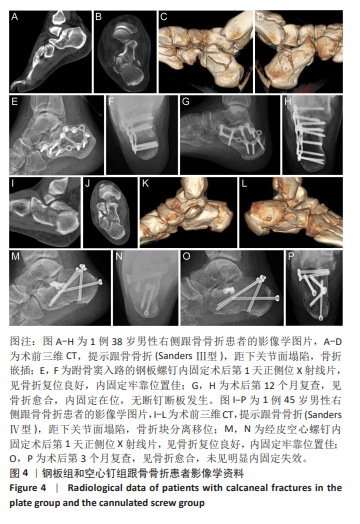
空心钉组患者手术时间较短(P=0.002),术中出血量较少(P < 0.001),切口长度较短(P < 0.001),但两组患者在住院时间、骨折愈合时间和皮肤坏死并发症方面差异均无显著性意义(P > 0.05)。 影像学指标显示无论是采用空心钉固定还是锁定钢板固定,在经过规范化治疗后两组末次随访的Gissane角和B?hler角相比差异均无显著性意义(P > 0.05)。术后空心钉组的目测类比评分和美国足踝外科协会踝-后足评分始终优于钢板组(P < 0.05),提示空心钉固定方案在改善疼痛和恢复患肢功能方面的具备一定的优势。 经济效益比较中可见空心钉组患者的术中耗材费用及住院总费用均显著低于钢板组(P < 0.001),提示空心钉固定方案在降低患者经济负担方面更具优势。典型病例影像资料见图4。"
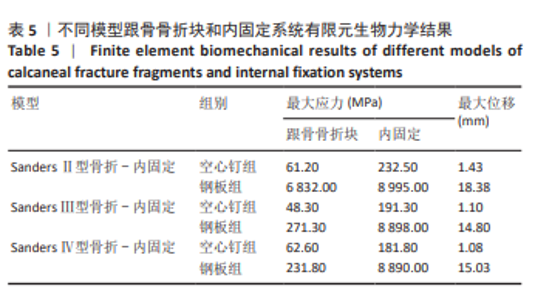
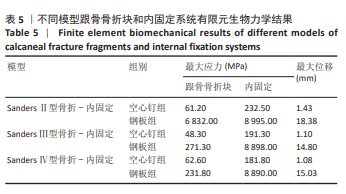
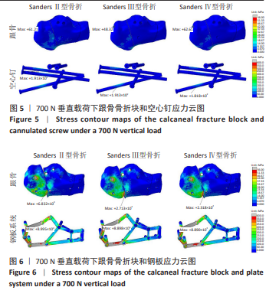
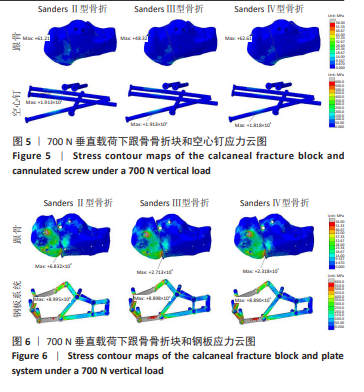
2.1.5 不良事件 此次研究对所有接受治疗的34例患者进行了详细的术后随访和不良事件监测。空心钉组和钢板组均未报告严重的植入物相关不良事件,未见两组患者出现植入物周围感染、过敏反应、免疫反应或排斥反应,表明两种内固定方式的生物相容性良好。空心钉组中无皮肤坏死(0/17),而钢板组中有1例(1/16)报告了轻微的皮肤坏死,但通过保守治疗得到了控制。此外,两组均未发现螺钉松动或断裂的情况。提示经皮空心钉内固定和跗骨窦入路钢板内固定均为安全可靠的治疗方法。 2.2 有限元分析结果 2.2.1 不同模型跟骨骨折块和内固定系统应力比较 如表5及图5,6所示,Sanders Ⅱ型跟骨骨折-空心钉模型跟骨、Sanders Ⅲ型跟骨骨折-空心钉模型跟骨、Sanders Ⅳ型跟骨骨折-空心钉模型跟骨的最大应力均出现在跟骨后突近端隧道孔入口处,最大数值分别为61.2,48.3和62.6 MPa。应力云图显示跟骨骨折块整体应力水平较低,大部分区域的应力水平低于56 MPa,故发生病理性骨折的风险较低,应力水平相对较高的区域分布于跟骨后突与中段骨折块的骨折线附近。在上述3个模型中的空心钉最大应力出现在矢状面方向交叉螺钉中后段的上表面,数值大小分别为232.5,191.3和181.8 MPa。与股骨应力分布的规律相似,空心钉表面整体的应力水平较低,所有区域的应力均小于600 MPa,因此该结构排布空心钉发生断裂的风险较小。Sanders Ⅱ型跟骨骨折-钢板系统模型跟骨、Sanders Ⅲ型跟骨骨折-钢板系统模型跟骨、Sanders Ⅳ型跟骨骨折-钢板系统模型跟骨的最大应力均出现在跟骨后突骨折块与中段骨折块接触的远端骨折面上,最大数值分别为6 832.0,271.3和231.8 MPa。应力云图显示3个模型跟骨后突骨折块和中段外侧骨折块后方以钉道为中心放射到周边区域的大范围高应力区,其中后突骨折块近端钉道口和骨折面接触部位发生疲劳性骨折的风险较高。在上述3个模型中的锁定钢板最大应力均出现在靠近后方骨折线的近端螺钉孔上,数值大小分别为8 995,8 898和8 890 MPa。锁定钢板的后突一侧发生较大形变,该侧钢板主体大部分区域应力高于600 MPa,提示该区域在实际场景中或已断裂失效。"
"
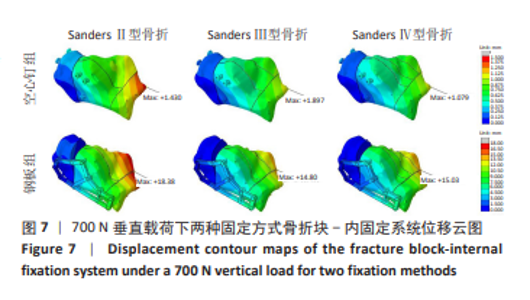
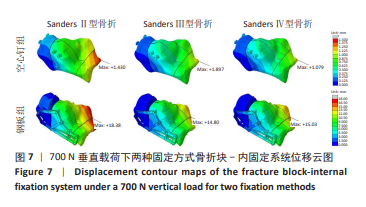
2.2.2 不同模型骨折-内固定系统位移比较 如表5及图7所示,Sanders Ⅳ型跟骨骨折-空心钉模型、Sanders Ⅲ型跟骨骨折-空心钉模型、Sanders Ⅳ型跟骨骨折-空心钉模型最大位移均出现在跟骨前突骨折块近端内侧,3个模型最大位移数值波动范围有限,分别为1.43,1.10和1.08 mm,空心钉组的3个模型位移云图的分布规律相似,越靠近跟骨前缘位移幅度越大。Sanders Ⅱ型跟骨骨折-钢板系统模型、Sanders Ⅲ型跟骨骨折-钢板系统模型、Sanders Ⅳ型跟骨骨折-钢板系统模型最大位移均出现在跟骨前突骨折块与中段骨折块接触的骨折面内缘上,其位移最大数值较相对应的空心钉组模型显著增加,分别为18.38,14.80和15.03 mm,钢板组的3个模型位移云图分布规律亦相似,越靠近跟骨前方骨折面内缘位移幅度越大。与钢板组整体位移水平相比较,空心钉组的稳定性更高。"
| [1] 孔德伟, 宋超, 吴亮, 等. 三维组架螺钉与微创钢板固定SandersⅢ型跟骨骨折的有限元分析[J]. 中国组织工程研究,2024,28(33): 5289-5294. [2] BIZ C, REFOLO M, ZINNARELLO FD, et al. A historical review of calcaneal fractures: from the crucifixion of Jesus Christ and Don Juan injuries to the current plate osteosynthesis. Int Orthop. 2022;46(6):1413-1422. [3] STEINHAUSEN E, MARTIN W, LEFERING R, et al. C-Nail versus plate osteosynthesis in displaced intra-articular calcaneal fractures-a comparative retrospective study. J Orthop Surg Res. 2021;16(1):203. [4] ALAJMI T, SHARIF AF, MAJOUN MA, et al. Minimally Invasive Sinus Tarsi Approach for Open Reduction and Internal Fixation of Calcaneal Fractures: Complications, Risk Factors, and Outcome Predictors. Cureus. 2022;14(1):21791. [5] BUZZI R, SERMI N, SOVIERO F, et al. Displaced intra-articular fractures of the calcaneus: ORIF through an extended lateral approach. Injury. 2019;50(2):2-7. [6] BLÄSIUS FM, STOCKEM LE, KNOBE M, et al. Predictors for wound healing complications and prolonged hospital stay in patients with isolated calcaneal fractures. Eur J Trauma Emerg Surg. 2022;48(4): 3157-3163. [7] 王建锋, 钱建军. 跗骨窦微创切口与外侧L形切口治疗跟骨关节内骨折的疗效研究[J]. 浙江创伤外科,2022,27(1):50-51. [8] DRIESSEN M, EDWARDS M, BIERT J, et al. Long-term results of displaced intra-articular calcaneal fractures treated with minimal invasive surgery using percutaneous screw fixation. Injury. 2021;52(4):1054-1059. [9] 张海鹏, 王晓辉, 张烽强, 等. 关节镜直视下SandersⅡ-Ⅲ跟骨骨折复位内固定[J]. 中国矫形外科杂志,2023,31(14):1312-1315. [10] 曹源, 许翔宇, 郭琰, 等. 闭合复位后经皮空心钉与微创纵向入路接骨板内固定治疗跟骨关节内舌型骨折的疗效比较[J]. 中华创伤骨科杂志,2022,24(8):658-665. [11] WILMSEN L, NEUBERT A, WINDOLF J, et al. Screw fixation in the treatment of displaced intra-articular calcaneus fractures: a systematic review protocol. Syst Rev. 2022;11(1):199. [12] 李子强, 余黎, 王显勋. 经跗骨窦切口钢板与空心螺钉内固定治疗SandersⅡ型跟骨骨折的疗效比较[J]. 骨科,2025,16(2):163-166. [13] 顾文奇, 宋国勋, 施忠民, 等. 跟骨微创锁定接骨板联合螺钉辅助固定治疗SandersⅡ型跟骨关节内骨折的三维有限元分析[J]. 中华骨与关节外科杂志,2024,17(4):300-306. [14] SONG G, GU W, SHI Z, et al. Finite element analyses of three minimally invasive fixation techniques for treating Sanders type II intra-articular calcaneal fractures. J Orthop Surg Res. 2023;18(1):902. [15] 张宁,康颂科,李伟延,等.三种空心钉构型踝关节融合的有限元分析[J].中国矫形外科杂志,2024,32(8):744-749. [16] 徐志, 刘子铭, 李豫皖, 等. 多孔结构设计人工踝关节衬垫生物力学的优化方案[J]. 中国组织工程研究,2024,28(30):4817-4824. [17] LI Y, TONG J, WANG H, et al. Investigation into the effect of deltoid ligament injury on rotational ankle instability using a three-dimensional ankle finite element model. Front Bioeng Biotechnol. 2024;12:1386401. [18] 徐志, 李豫皖, 邹刚, 等. 人工踝关节弹性化改良衬垫的有限元分析[J]. 中国修复重建外科杂志,2023,37(11):1361-1369. [19] WU J, ZHANG L, SHEN C, et al. Comparative 3D finite element analysis of intramedullary fixation versus locking plate fixation in calcaneal fractures using micro-CT image technology. BMC Musculoskelet Disord. 2024;25(1):1044. [20] 李泳聪, 谢庆祥, 曾广龙, 等. 传统手法结合距下关节镜复位与经跗骨窦入路治疗SandersⅡ型跟骨骨折的疗效比较[J]. 广州中医药大学学报,2023,40(9):2218-2225. [21] DE BOER AS, TJIOE RJC, VAN DER SIJDE F, et al. The American Orthopaedic Foot and Ankle Society Ankle-Hindfoot Scale; translation and validation of the Dutch language version for ankle fractures. BMJ open. 2017;7(8):017040. [22] 林三军, 陈庚, 张长虹, 等. 3D打印辅助跗骨窦入路空心钉内固定治疗SandersⅡ、Ⅲ型跟骨骨折[J]. 临床骨科杂志,2024, 27(4):580-583. [23] KONG D, FAN X, SONG C, et al. A Comparative Analysis of Between Percutaneous Cannulated Screw Fixation and Traditional Plate Internal Fixation in Treatment of Sanders II and III Calcaneal Fractures. J Foot Ankle Surg. 2024;63(3):327-332. [24] 潘红元, 孔德伟, 刘粤, 等. 三维组架螺钉与环形钢板治疗Sanders ⅢAB型跟骨骨折的有限元分析[J]. 医用生物力学,2024, 39(3):435-441. [25] WANG J, HAN W, SU Y, et al. Comparison of Robot-Assisted Percutaneous Cannulated Screws Versus Open Reduction and Internal Fixation in Calcaneal Fractures. Orthop Surg. 2023;15(3):724-730. [26] 董政麟, 马捷, 顾剑华, 等. 空心钉联合跗骨窦入路与外侧L型入路钢板固定治疗Sanders Ⅱ、Ⅲ型跟骨骨折的疗效比较[J]. 中国微创外科杂志,2023,23(7):511-516. [27] KIRBY KA. Subtalar joint axis location and rotational equilibrium theory of foot function. J Am Podiatr Med Assoc. 2001;91(9):465-487. [28] WEI Y, LIU H, XU C. The reliability of talonavicular uncoverage to indicate forefoot abduction in progressive collapsing foot deformity: a finite element analysis. J Orthop Surg Res. 2025; 20(1):143. [29] XU M, LI R, CHEN G, et al. Arthroscopy-assisted reduction and simultaneous robotic-assisted screw placement in the treatment of fractures of the posterior talar process. Int Orthop. 2024;48(2):573-580. [30] LONG ZS, GONG FP, DONG XP, et al. Clinical application of multiple 3D-printed guide plates for precise reduction and fixation of comminuted patellar fractures. J Int Med Res. 2020;48(11): 300060520972088. [31] TRISOLINO G, MENOZZI GC, DEPAOLI A, et al. In Situ Fixation and Intertrochanteric Osteotomy for Severe Slipped Capital Femoral Epiphysis Following Femoral Neck Fracture: A Case Report with Application of Virtual Surgical Planning and 3D-Printed Patient-Specific Instruments. J Pers Med. 2025;15(1):13. [32] 孔德伟, 范鑫斌, 宋超, 等. 组合式全螺纹空心钉与传统钢板内固定治疗Sanders Ⅱ型和Ⅲ型跟骨骨折的疗效[J]. 国际骨科学杂志, 2023,44(6):392-398. [33] 朱康, 王晓桐, 尹金旺. 两种内固定治疗Sanders Ⅱ型跟骨骨折的疗效比较[J]. 临床骨科杂志,2025,28(1):122-126. [34] 石学文, 李胜堂, 高余, 等. 跟骨骨折术后切口并发症发生的危险因素及防治策略[J]. 中国矫形外科杂志,2022,30(8):717-721. [35] CHONGMUENWAI A, WONGFUKIAT O, CHOOVONGKOMOL K. Postoperative 3D computed tomographic evaluation of 92 calcaneal fracture reduction using the sinus tarsi technique and fixation with 3.5 mm cortical screws. Eur J Orthop Surg Traumatol. 2024;34(6):2957-2962. [36] WANG C, XU C, LI M, et al. Patient-specific instrument-assisted minimally invasive internal fixation of calcaneal fracture for rapid and accurate execution of a preoperative plan: A retrospective study. BMC Musculoskelet Disord. 2020;21(1):407. [37] YANG H, ZHANG S, ZHONG Q, et al. Subtalar joint arthroscopic-assisted reduction and cannulated screw fixation versus open reduction and internal fixation for treating displaced intra-articular calcaneal fractures. J Orthop Surg Res. 2025;20(1):270. [38] 赵涛. 经皮撬拨闭合复位空心钉与切开复位钢板内固定治疗SandersⅡ、Ⅲ型跟骨骨折疗效比较[J]. 实用手外科杂志,2024, 38(2):219-222. [39] GÜLTEKIN A, ACAR E, UĞUR L, et al. The importance of Böhler’s angle in calcaneus geometry: A finite element model study. Jt Dis Relat Surg. 2021;32(2):420-427. [40] FAN B, ZHOU X, WEI Z, et al. Cannulated screw fixation and plate fixation for displaced intra-articular calcaneus fracture: A meta-analysis of randomized controlled trials. Int J Surg. 2016;34:64-72. |
| [1] | Zhang Nan, Meng Qinghua, Bao Chunyu. Characteristics and clinical application of ankle joint finite element models [J]. Chinese Journal of Tissue Engineering Research, 2026, 30(9): 2343-2349. |
| [2] | Cheng Qisheng, Julaiti·Maitirouzi, Xiao Yang, Zhang Chenwei, Paerhati·Rexiti. Finite element analysis of novel variable-diameter screws in modified cortical bone trajectory of lumbar vertebrae [J]. Chinese Journal of Tissue Engineering Research, 2026, 30(9): 2162-2171. |
| [3] | Wu Hongxu, Liu Xuanyu, Wang Taoyu, Wang Shiyao, Cheng Jingyi, Zhang Mingwen, Zhang Yinxia, Liu Zhihua, Wang Xiaojie. Finite element simulation of scoliosis with muscle unit introduction: verification of correction effect under bidirectional load [J]. Chinese Journal of Tissue Engineering Research, 2026, 30(9): 2172-2181. |
| [4] | Liu Jiafu, Ren Ruxia, Liao Zhouwei, Zhou Xiali, Wu Yihong, Zhang Shaoqun. Three-dimensional finite element analysis of cervical spine biomechanical characteristics in a rat model of cervical vertigo [J]. Chinese Journal of Tissue Engineering Research, 2026, 30(9): 2182-2190. |
| [5] | Zhou Daobin, Wang Kehao, Xie Yang, Ning Rende. Biomechanical characteristics of volar locking plate only versus combined dorsal mini-plate fixation of distal radius fractures with dorsal ulnar fragment [J]. Chinese Journal of Tissue Engineering Research, 2026, 30(9): 2255-2261. |
| [6] | Zhang Zizheng, Luo Wang, Liu Changlu. Application value of finite element analysis on unicompartmental knee arthroplasty for medial knee compartmental osteoarthritis [J]. Chinese Journal of Tissue Engineering Research, 2026, 30(9): 2313-2322. |
| [7] | Zhao Feifan, Cao Yujing. Risk factors and coping strategies of internal fixation failure in treatment of intertrochanteric fracture with proximal femoral nail antirotation [J]. Chinese Journal of Tissue Engineering Research, 2026, 30(9): 2323-2333. |
| [8] | Zhang Xianxu, Ma Zhong, Liu Xin, Huang Lei, Shen Wenxiang, Luo Zhiqiang . Lumbar fusion combined with unilateral fixation for lumbar degenerative diseases: biomechanics, technical evolution, and clinical applications [J]. Chinese Journal of Tissue Engineering Research, 2026, 30(9): 2334-2342. |
| [9] | Chen Huiting, Zeng Weiquan, Zhou Jianhong, Wang Jie, Zhuang Congying, Chen Peiyou, Liang Zeqian, Deng Weiming. Tail anchoring technique of vertebroplasty in treatment of osteoporotic vertebral compression fractures with intravertebral cleft: a finite element analysis [J]. Chinese Journal of Tissue Engineering Research, 2026, 30(9): 2145-2152. |
| [10] | Zeng Xuan, Weng Rui, Ye Shicheng, Tang Jiadong, Mo Ling, Li Wenchao. Two lumbar rotary manipulation techniques in treating lumbar disc herniation: a finite element analysis of biomechanical differences [J]. Chinese Journal of Tissue Engineering Research, 2026, 30(9): 2153-2161. |
| [11] | Liu Wenlong, Dong Lei, Xiao Zhengzheng, Nie Yu. Finite element analysis of tibial prosthesis loosening after fixed-bearing unicompartmental knee arthroplasty for osteoporosis [J]. Chinese Journal of Tissue Engineering Research, 2026, 30(9): 2191-2198. |
| [12] | Zheng Wangyang, Fei Ji, Yang Di, Zhao Lang, Wang Lingli, Liu Peng, Li Haiyang. Finite element analysis of the force changes of the supraspinatus tendon and glenohumeral joint during the abduction and flexion of the humerus [J]. Chinese Journal of Tissue Engineering Research, 2026, 30(9): 2199-2207. |
| [13] | Cai Qirui, Dai Xiaowei, Zheng Xiaobin, Jian Sili, Lu Shaoping, Liu Texi, Liu Guoke, Lin Yuanfang. Mechanical effects of Long’s traction orthopedic method on cervical functional units: quantitative analysis of biomechanical model of head and neck [J]. Chinese Journal of Tissue Engineering Research, 2026, 30(9): 2208-2216. |
| [14] | Rao Jingcheng, Li Yuwan, Zheng Hongbing, Xu Zhi, Zhu Aixiang, Shi Ce, Wang Bing, Yang Chun, Kong Xiangru, Zhu Dawei. Biomechanical differences between the new proximal femoral stable intramedullary nail and traditional intramedullary nail#br# [J]. Chinese Journal of Tissue Engineering Research, 2026, 30(9): 2217-2225. |
| [15] | Chen Long, Wang Xiaozhen, Xi Jintao, Lu Qilin. Biomechanical performance of short-segment screw fixation combined with expandable polyetheretherketone vertebral body replacement in osteoporotic vertebrae [J]. Chinese Journal of Tissue Engineering Research, 2026, 30(9): 2226-2235. |
| Viewed | ||||||
|
Full text |
|
|||||
|
Abstract |
|
|||||