Chinese Journal of Tissue Engineering Research ›› 2014, Vol. 18 ›› Issue (20): 3158-3164.doi: 10.3969/j.issn.2095-4344.2014.20.009
Previous Articles Next Articles
Stromal cell-derived factor-1 and endothelial progenitor cells improve neovascularization
Wu Yuan-bing1, Wang Yu-qi2, Fu Wei-guo2, Zhu Yun-feng1, Ge Hong-wei1
- 1Department of Vascular Surgery, the Third Affiliated Hospital of Soochow University, Changzhou 213003, Jiangsu Province, China; 2Department of Vascular Surgery, Zhongshan Hospital Affiliated to Fudan University, Shanghai 200032, China
-
Received:2014-02-23Online:2014-05-14Published:2014-05-14 -
About author:Wu Yuan-bing, M.D., Associate chief physician, Department of Vascular Surgery, the Third Affiliated Hospital of Soochow University, Changzhou 213003, Jiangsu Province, China

CLC Number:
Cite this article
Wu Yuan-bing, Wang Yu-qi, Fu Wei-guo, Zhu Yun-feng, Ge Hong-wei . Stromal cell-derived factor-1 and endothelial progenitor cells improve neovascularization[J]. Chinese Journal of Tissue Engineering Research, 2014, 18(20): 3158-3164.
share this article
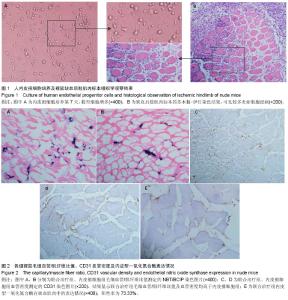
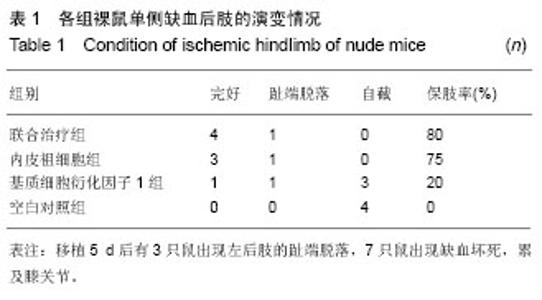
2.1 实验动物数量分析 4组共纳入20只裸鼠,死亡2只,原因为1只静脉注射内皮祖细胞时注液过多导致心衰死亡,另一只死亡原因不明。 共18只裸鼠进入结果分析,联合治疗组、内皮祖细胞组、基质细胞衍化因子1组及空白对照组分别为5,4,5,4只。 2.2 人内皮祖细胞的培养 单个核细胞多数呈小圆细胞形态,经内皮条件下培养,48 h后出现贴壁,培养第3天可见部分贴壁细胞呈梭形或不规则形,以后贴壁细胞逐渐变大变圆,至第7天梭形细胞增多(图1A)。20 mL外周血可分离得到单个核细胞约5×10⁶个。 2.3 裸鼠缺血后肢演变情况 18只裸鼠缺血下肢演变情况见表1。 移植后3 d缺血的左后肢皮温较低,5 d后有3只鼠出现左后肢的趾端脱落,7只鼠出现缺血坏死,累及膝关节。坏死处未见明显感染迹象。标本经苏木精-伊红染色发现,有缺血坏死的后肢肌肉标本苏木精-伊红染色可见较多炎症细胞浸润(图1B)。"
"
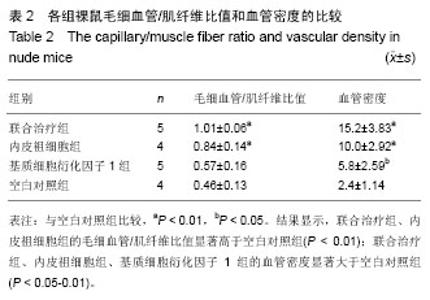
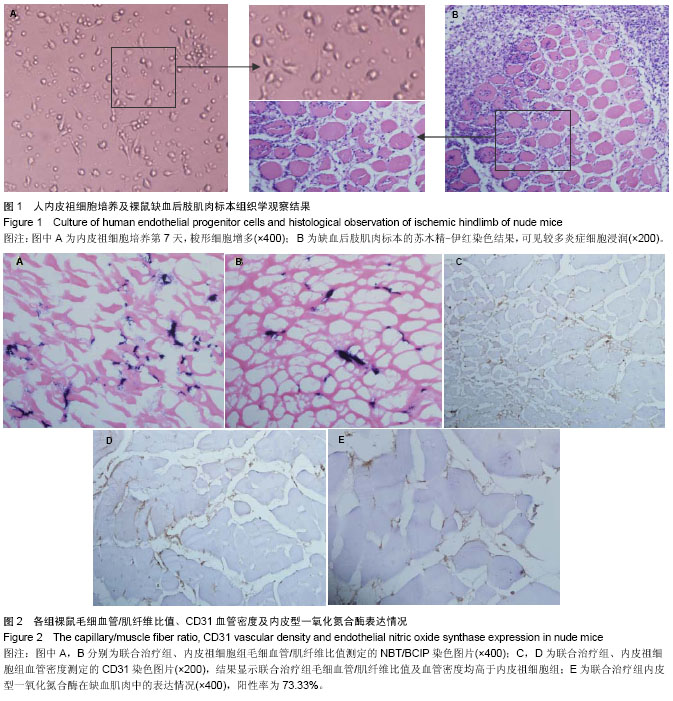
2.3 毛细血管/肌纤维比值的测定 在骨骼肌中有生命力的毛细血管内皮细胞表达内源性碱性磷酸酶,当NBT/BCIP作为底物显色时,有生命力的内皮细胞即显示蓝紫色颗粒(图2A,B)。 方差分析显示联合治疗组、内皮祖细胞组、基质细胞衍化因子1组和空白对照组毛细血管/肌纤维比值差异有显著性意义。两两比较联合治疗组、内皮祖细胞组显著高于空白对照组(P < 0.01),基质细胞衍化因子1与空白对照组差异无显著性意义。联合治疗组高于内皮祖细胞组、内皮祖细胞组高于基质细胞衍化因子1组(P < 0.05,表2)。 2.4 血管密度检测 以CD31染色阳性表示血管密度。在细胞膜和细胞浆出现棕黄色颗粒为CD31阳性(图2C,D)。在200倍光镜下,每张切片随机计数5个视野内的棕黄色管状数,取其平均值。经检验,联合治疗组和内皮祖细胞组显著大于空白对照组(P < 0.01),基质细胞衍化因子1组显著大于空白对照组(P < 0.05),联合治疗组显著大于内皮祖细胞组、内皮祖细胞组显著大于基质细胞衍化因子1组(P < 0.05,表2)。"
| [1] Norgren L, Hiatt WR, Dormandy JA, et al. Inter-society consensus for the management of peripheral arterial diseases. J Vasc Surg. 2007; 1(suppl):S5A-S67A. [2] Hill JM, Zalos G, Halcox JPG, et al. Circulating endothelial progenitor cells, vascular function and cardiovascular risk. N Engl J Med. 2003; 348:593-600. [3] Tateishi-Yuyama E, Matsubara H, Murohara T, et al. Therapeutic angiogenesis for patients with limb ischemia by autologous transplantation of bone-marrow cells: a pilot study and a randomised controlled trial. Lancet. 2002; 360: 427-435. [4] Iwaguro H, Yamaguchi J, Kalka C, et al. Endothelial progenitor cell vascular endothelial growth factor gene transfer for vascular regeneration. Circulation. 2002; 105: 732-738. [5] Murohara T, Ikeda H, Duan J, et al. Transplanted cord blood-derived endothelial precursor cells augment postnatal neovascularization. J Clin Invest. 2000; 105:1527-1536. [6] Sakamoto M, Nakamura T, Torimura T, et al. Transplantation of endothelial progenitor cells ameliorates vascular dysfunction and portal hypertension in carbon tetrachloride-induced rat liver cirrhotic model. J Gastroenterol Hepatol. 2013;28(1):168-178. [7] Peichev M, Naiyer AJ, Pereiva D, et al. Expression of VEGFR-2 and AC133 by circulating human CD34+ cells identifies a population of functional endothelial precursors. Blood. 2000; 95:952-958. [8] 吴元兵,王玉琦,符伟国,等.基质细胞衍化因子-1对人内皮祖细胞迁移的影响[J].基础医学与临床,2009,29(3):283-286. [9] 李泳雪,林松,陆晓,等.生理性缺血训练对冠心病患者循环血管内皮祖细胞的影响[J].中国康复医学杂志, 2012,27(4): 293-299. [10] Ward MR, Thompson KA, Isaac K, et al. Nitric oxide synthase gene transfer restores activity of circulating angiogenic cells from patients with coronary artery disease. Mol Ther. 2011; 19(7): 1323-1330. [11] Vasa M, Fichtlscherer S, Aicher A, et al. Number and migratory activity of circulating endothelial progenitor cells inversely correlate with risk factors for coronary artery disease. Circ Res. 2001;89:E1-7. [12] Huang P, Huang S, Chen Y, et al. Increases circulating CD31+/annexin V+ apoptotic microparticles and decreased circulating endothelial progenitor cell levels in hypertensive patients with microalbuminuria. J Hypertens. 2010;28(8): 1655-1665. [13] Yamaguchi J, Kusano KF, Masuo O, et al. Stromal cell-derived factor-1 effects on ex vivo expanded endothelial progenitor cell recruitment for ischemic neovascularization. Circulation. 2003;107:1322-1328. [14] Segal MS, Shah R, Afzal A, et al. Nitric oxide cytoskeletal-induced alterations reverse the endothelial progenitor cell migratory defect associated with diabetes. Diabetes. 2006; 55:102-109. [15] Nakamura Y, Ishikawa H, Kawai K, et al. Enhanced wound healing by topical administration of mesenchymal stem cells transfected with stromal cell-derived factor-1. Biomaterials. 2013;34(37):9393-9400. [16] Yu J, Li MC, Qu ZL, et al. SDF-1/CXCR4-mediated migration of transplanted bone marrow stromal cells toward areas of heart myocardial infaction through activation of PI3K/Akt. J Cardiovasc Pharmacol. 2010; 55:496-505. [17] Zheng H, Dai T, Zhou BQ, et al. SDF-1α/CXCR4 decreases endothelial progenitor cells apoptosis under serum deprivation by PI3K/AKT/eNOS pathway. Atherosclerosis. 2008;201:36-42. [18] Macarthur JJ, Cohen JE, McGarvey J, et al. Preclinical evaluation of the engineered stem cell chemokine stromal cell-derived factor 1-alpha analogue in a translational ovine myocardial infarction model. Circ Res. 2013. [19] Virani S, Edwards AK, Thomas R, et al. Blocking of stromal cell-derived factor-1 reduces neoangiogenesis in human endometriosis lesions in a mouse model. Am J Reprod Immunol. 2013;70(5):386-397. [20] Asahara T, Murohara T, Sullivan A, et al. Isolated of putative progenitor endothelial cells for angiogenesis. Science. 1997; 275:964-967. [21] Hiasa K, Ishibashi M, Ohtani K, et al. Gene transfer of stromal cell-derived factor-1 enhances ischemic vasculogenesis and angiogenesis via vascular endothelial growth factor/endothelial nitric oxide synthase-related pathway. Next-generation chemokine therapy for therapeutic neovascularization. Circulation. 2004; 109: 2454-2461. [22] Zhou J, Cheng M, Liao YH, et al. Rosuvastatin enhances angiogenesis via eNOS-dependent mobilization of endothelial progenitor cells. PLoS One. 2013;8(5):e63126. [23] Cui B, Huang L, Fang Y, et al. Transplantation of endothelial progenitor cells overexpressing endothelial nitric oxide synthase enhances inhibition of neointimal hyperplasia and restores endothelium-dependent vasodilatation. Microvasc Res. 2011;81(1):143-150. [24] Chen X, Gu M, Zhao X, et al. Deterioration of cardiac function after acute myocardial infarction is prevented by transplantation of modified endothelial progenitor cells overexpressing endothelial NO synthases. Cell Physiol Biochem. 2013;31(2-3):355-365. [25] Kawamoto A, Iwasaki H, Kusano K, et al. CD34-positive cells exhibit increased potency and safety for therapeutic neovascularization after myocardial infarction compared with total mononuclear cells. Circulation. 2006; 114: 2163- 2169. [26] De Falco E, Porcell P, Torella AR, et al. SDF-1 involvement in endothelial phenotype and ischemic-induced recruitment of bone marrow progenitor cells. Blood. 2004; 104:3472- 3482. [27] Jujo K, Ii M, Sekiguchi H, et al. CXC-chemokine receptor 4 antagonist AMD3100 promotes cardiac functional recovery after ischemia/reperfusion injury via endothelial nitric oxide synthase-dependent mechanism. Circulation. 2013;127(1): 63-73. [28] 吴春朋,张潜,方宁,等.骨髓间充质干细胞移植促进糖尿病大鼠后肢缺血血管的新生[J].中国组织工程研究, 2012,16(1): 76-80. [29] Fuster V, Sanz J. Gene therapy and stem cell tnerapy for cardiovascular disease today: a model for translational research. Nat Cli Pract Cardiovas Med. 2007;4(suppl 1): 1-8. [30] Kalka C, Masuda H, Takahashi T, et al. Vascular endothelial growth factor(165) gene transfer augments circulating endothelial progenitor cells in human subjects. Circ Res. 2000; 86:1198-1202. [31] Brunt KR, Wu J, Chen Z, et al. Ex vivo Akt/HO-1 gene therapy to human endothelial progenitor cells enhances myocardial infarction recovery. Cell Transplant. 2012;21(7): 1443-1461. [32] Wang Y, Yan W, Lu X, et al. Overexpression of osteopontin induces angiogenesis of endothelial progenitor cells via the avβ3/PI3K/AKT/eNOS/NO signaling pathway in glioma cells. Eur J Cell Biol. 2011;90(8):642-648. [33] MacArther JW, Purcell BP, Shudo Y, et al. Sustained release of engineered stromal cell-derived factor 1-α from injectable hydrogels effectively recruits endothelial progenitor cells and preserves ventricular function after myocardial infarction. Circulation. 2013;128(11 Suppl 1):S79-86. [34] Sobhan PK, Seervi M, Joseph J, et al. Immmortalized functional endothelial progenitor cell lines from umbilical cord blood for vascular tissue engineering.Tissue Eng Part C Methods. 2012;18(11):890-902. [35] Nakamura Y, Ishikawa H, Kawai K, et al. Enhanced wound healing by topical administration of mesenchymal stem cells transfected with stromal cell-derived factor-1. Biomaterials. 2013;34(37):9393-400. [36] Plummer PN, Freeman R, Taft RJ, et al. MicroRNAs regulate tumor angiogenesis modulated by endothelial progenitor cells. Cancer Res. 2013;73(1):341-352. [37] Tecilazich F, Dinh T, Pradhan-Nabzdyk L, et al. Role of endothelial progenitor cells and inflammatory cytokines in healing of diabetic foot ulcers. PLoS One. 2013;8(12):e83314. |
| [1] | Chen Xiao, Guo Zhi, Chen Lina, Liu Xuanyong, Zhang Yihuizhi, Li Xumian, Wang Yueqiao, Wei Liya, Xie Jing, Lin Li. Factors affecting the mobilization and collection of autologous peripheral blood hematopoietic stem cells [J]. Chinese Journal of Tissue Engineering Research, 2021, 25(19): 2958-2962. |
| [2] | Li Xiangze, Bu Xianmin, Li Dongmei, Chi Yulei, Su Qiang, Jin Xintong, Zhao Jian, Zhang Gaotian, Wu Bin, Meng Chunyang . Stem cells, cytokines, hormones, neuropeptides and genes in traumatic brain trauma to promote fracture healing [J]. Chinese Journal of Tissue Engineering Research, 2021, 25(19): 3057-3063. |
| [3] | Sun Weixing, Zhao Yongchao, Zhao Ranzun. Mesenchymal stem cell transplantation in the treatment of myocardial infarction: problems, crux and new breakthrough [J]. Chinese Journal of Tissue Engineering Research, 2021, 25(19): 3103-3109. |
| [4] | Cao Linlin, Ding Kaiyang, Song Hao, Wu Guolin, Hu Maogui, Fan Dandan, Zhou Chenyang, Wang Cuicui, Feng Yuanyuan. Efficacy and influencing factors of autologous hematopoietic stem cell transplantation in the treatment of malignant lymphoma [J]. Chinese Journal of Tissue Engineering Research, 2021, 25(13): 1993-1998. |
| [5] | Zhang Wenjian, Ma Lingfu, Wang Zhimin, Mo Wenjian, Zhou Ruiqing. Muscle mass evaluation and influencing factors of sarcopenia in allogeneic hematopoietic stem cell transplantation patients [J]. Chinese Journal of Tissue Engineering Research, 2021, 25(13): 1999-2004. |
| [6] | Qian Nannan, Zhang Qian, Yang Rui, Ao Jun, Zhang Tao. Mesenchymal stem cells in the treatment of spinal cord injury: cell therapy and combination of new drugs and biomaterials [J]. Chinese Journal of Tissue Engineering Research, 2021, 25(13): 2114-2120. |
| [7] | Yu Chenghao, Zhang Yi, Qi Chao, Chen Jinli, Gao Jiake, Yu Tengbo. Effect of cytokines and platelet-rich plasma on tendon derived stem cells [J]. Chinese Journal of Tissue Engineering Research, 2021, 25(1): 133-140. |
| [8] | Chen Ganghong, Zeng Chaoming, Chen Ziming, Liao Junxing, Ma Yuanchen, Zheng Qiujian . Intra-articular injection of optimal concentration of bone marrow mesenchymal stem cells for treating rabbit cartilage defects [J]. Chinese Journal of Tissue Engineering Research, 2020, 24(7): 996-1001. |
| [9] | Wang Guoyu, Cheng Zhijian, Yang Baohui, Li Haopeng, He Xijing. Olfactory ensheathing cell transplantation promotes the ultrastructure repair at the lesion site of rat models of spinal cord injury [J]. Chinese Journal of Tissue Engineering Research, 2020, 24(5): 699-703. |
| [10] | Shang Qingqing, Zhou Jianye. Combination of hyaluronic acid hydrogel and bone marrow mesenchymal stem cells promotes cardiac function after myocardial infarction in rats (II) [J]. Chinese Journal of Tissue Engineering Research, 2020, 24(34): 5559-5563. |
| [11] | Zhang Suping, Sun Ling, Wan Dingming, Cao Weijie, Li Li, Liu Changfeng, Liu Yufeng, Wang Dao, Guo Rong, Jiang Zhongxing, Xie Xinsheng. Effectiveness of unrelated peripheral blood stem cell transplantation in the treatment of severe aplastic anemia [J]. Chinese Journal of Tissue Engineering Research, 2020, 24(31): 4994-5001. |
| [12] | Wei Jianghong, Jia Aijun, Ma Libing, Wang Yueling, Qiu Lulu, Xiao Bing. Th-17 regulatory cytokines promote interleukins-17A and 17F production by neutrophils during asthma [J]. Chinese Journal of Tissue Engineering Research, 2020, 24(31): 5044-5051. |
| [13] | Wang Wenhong, Li Yanjun, Cui Caiyun. Factors influencing differentiation of stem cells from the apical papilla into odontoblasts [J]. Chinese Journal of Tissue Engineering Research, 2020, 24(31): 5071-5078. |
| [14] |
Hou Xiaolin, Liang Jun, Yang Cheng, Cui Meihua.
Co-transplantation of adipose mesenchymal stem cells and endothelial progenitor cells in ulcerative colitis mice [J]. Chinese Journal of Tissue Engineering Research, 2020, 24(25): 3981-3987. |
| [15] | Yang Ying, Yan Nan, Tian Wei, Han Cao, Zhang Xiaoyan, Zheng Xin, Liu Shidan, Zhang Shuo, Wang Zhengdong. Transplantation of bone marrow mesenchymal stem cells for denervated muscular atrophy [J]. Chinese Journal of Tissue Engineering Research, 2020, 24(25): 4000-4005. |
| Viewed | ||||||
|
Full text |
|
|||||
|
Abstract |
|
|||||