Chinese Journal of Tissue Engineering Research ›› 2026, Vol. 30 ›› Issue (33): 8829-8837.doi: 10.12307/2026.397
Previous Articles Next Articles
Role of m6A methylation modification in the treatment of steroid-induced osteonecrosis of the femoral head and its regulation by traditional Chinese medicine
Zhang Mianyu1, Han Jie2, Chai Yuan3
- 1Graduate School of Guangxi University of Chinese Medicine, Nanning 530000, Guangxi Zhuang Autonomous Region, China; 2Ruikang Hospital Affiliated to Guangxi University of Chinese Medicine, Nanning 530011, Guangxi Zhuang Autonomous Region, China; 3Graduate School of Nanjing University of Chinese Medicine, Nanjing 210008, Jiangsu Province, China
-
Received:2025-08-18Revised:2025-10-17Online:2026-11-28Published:2026-06-18 -
Contact:Han Jie, MS, Chief physician, Ruikang Hospital Affiliated to Guangxi University of Chinese Medicine, Nanning 530011, Guangxi Zhuang Autonomous Region, China -
About author:Zhang Mianyu, MS candidate, Graduate School of Guangxi University of Chinese Medicine, Nanning 530000, Guangxi Zhuang Autonomous Region, China -
Supported by:National Natural Science Foundation of China, Nos. 82260858 (to HJ), 82460872 (to HJ); Guangxi Natural Science Foundation, No. 2024GXNSFAA010243 (to HJ); Pilot Project for High-Level Key Discipline Construction of Traditional Chinese Medicine in Guangxi, No. Guizhongyiyaokejiaofa13 (to HJ); Guangxi Key Research Laboratory of Traditional Chinese Medicine Construction Project, No. Guizhongyiyaokejiaofa9 (to HJ); Guangxi Youth Qihuang Scholar Training Project, No. Guizhongyiyaokejiaofa13 (to HJ); The "Qihuang Project" High level Talent Team Cultivation Project of Guangxi University of Chinese Medicine, No. Guizhongyidadang3 (to HJ)

CLC Number:
Cite this article
Zhang Mianyu, Han Jie, Chai Yuan. Role of m6A methylation modification in the treatment of steroid-induced osteonecrosis of the femoral head and its regulation by traditional Chinese medicine[J]. Chinese Journal of Tissue Engineering Research, 2026, 30(33): 8829-8837.
share this article
Add to citation manager EndNote|Reference Manager|ProCite|BibTeX|RefWorks
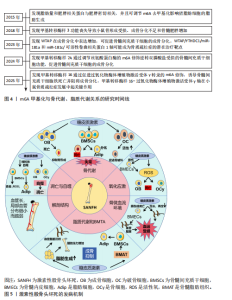
2.1 m6A甲基化与骨代谢、脂质代谢关系的研究时间线 通过查阅并归纳相关文献,作者将m6A甲基化及骨代谢、脂质代谢联系的相关研究进行时间线总结,其研究时间线见图4。2015年,发现脂肪量和肥胖相关蛋与肥胖密切相关,并且可调节m6A去甲基化,影响猪脂肪细胞的脂肪生成[11-12]。2018年,发现METTL3功能丧失导致小鼠骨形成受损、成骨分化不足和骨髓肥胖增加[13]。同年METTL14被发现能抑制破骨细胞,帮助绝经后骨质疏松症患者维持骨量[14]。2023年,发现WTAP在成骨分化中表达增加,可促进骨髓间充质干细胞成骨分化,WTAP/YTHDC1/miR-181a和miR-181c/可溶性卷曲相关蛋白1轴可能成为骨质疏松症的潜在治疗靶点[15]。2024年,发现METTL7A通过调节丝氨酸蛋白酶的m6A修饰逆转双膦酸盐受损的骨髓间充质干细胞功能,促进骨髓间充质干细胞的成骨分化[16]。2025年,发现METTL16通过促进过氧化物酶体增殖物激活受体γ转录的m6A修饰诱导骨髓间充质干细胞铁死亡并阻碍成骨分化,METTL16-过氧化物酶体增殖物激活受体γ轴在小鼠骨质疏松症发展中起关键作用[17]。 2.2 激素性股骨头坏死的发病机制 激素性股骨头坏死临床表现为髋关节的疼痛、活动受限、股骨头塌陷等[18-19]。激素性股骨头坏死与糖皮质激素存在剂量相关性,糖皮质激素累积剂量越高,激素性股骨头坏死的发病风险提高[20]。目前激素性股骨头坏死的发病机制尚未达成共识,但主流观点认为糖皮质激素可能通过影响骨代谢、氧化应激、脂质代谢、细胞凋亡和自噬、骨微血流环境等多种途径促进激素性股骨头坏死的发生发展[21];此外,股骨头特殊的解剖结构液可导致激素性股骨头坏死的发生发展(图5)。在这些机制中,骨代谢和脂质代谢被认为是关键因素之一,该文针对这些方面重点探讨。 2.2.1 骨代谢 骨代谢是一个动态过程,涉及骨形成、吸收和重建,其中,成骨细胞负责骨形成,破骨细胞负责骨吸收,二者之间的动态平衡即为骨重建,这一平衡是维持骨骼完整性和强度的关键。然而,当骨代谢失衡,即骨形成速度低于骨损伤速度时,骨骼结构会逐渐受损,在长期应力作用下骨小梁可能出现坏死和断裂,股骨头血供受阻,最终可能导致激素性股骨头坏死的发生[22]。糖皮质激素是影响骨代谢的重要因素之一,它通过抑制骨形成和促进骨吸收来打破骨代谢平衡。在细胞实验中,地塞米松显著抑制MC3T3-E1成骨细胞的生长,通过提升p53蛋白的表达来诱导成骨细胞凋亡[23],p53是一种重要的肿瘤抑制蛋白,参与细胞周期调控和细胞凋亡。研究发现,维生素D3类似物艾地骨化醇通过激活Notch和Wnt/糖原合成酶激酶3β/β-catenin信号通路显著逆转地塞米松对MC3T3-E1细胞成骨分化和矿化的抑制作用,同时显著提升成骨相关因子表达水平[24]。此外,通过抑制蛋白激酶B/哺乳动物雷帕霉素靶蛋白信号通路能够对抗糖皮质激素诱导的MC3T3-E1成骨细胞凋亡和分化[25]。在促进骨吸收方面,糖皮质激素主要通过增强破骨细胞的分化和成熟来实现的[26]。糖皮质激素通过抑制骨保护素合成增加核因子κB受体活化因子配体的表达,促进破骨细胞的分化和活性,从而加速骨吸收[27]。成骨功能障碍是激素性股骨头坏死发展的关键病理机制之一,与骨髓间充质干细胞凋亡、成骨分化能力受损密切相关[28]。骨髓间充质干细胞为成骨细胞的前体细胞,该细胞凋亡会导致成骨细胞数量减少,从而限制成骨功能。TANG等[29]通过大鼠实验证实,骨髓间充质干细胞的成骨和成脂失衡会加速激素性股骨头坏死的进展。 综上所述,糖皮质激素通过抑制成骨细胞分化、促进破骨细胞分化打破骨代谢平衡,导致骨质受损和激素性股骨头坏死;p53、Notch、Wnt/糖原合成酶激酶3β/β-catenin、蛋白激酶B/哺乳动物雷帕霉素靶蛋白、骨保护素/核因子κB受体活化因子配体等信号通路在骨代谢过程中发挥着重要作用;骨髓间充质干细胞凋亡和成骨分化功能障碍也是激素性股骨头坏死发生发展的关键机制之一。因此,促进成骨功能、抑制破骨活动、促进骨髓间充质干细胞的成骨分化以及减少骨髓间充质干细胞凋亡,是治疗激素性股骨头坏死的关键策略。 2.2.2 脂质代谢和骨髓脂肪组织 脂质代谢包括脂肪生成、脂肪分解和胆固醇代谢。众所周"
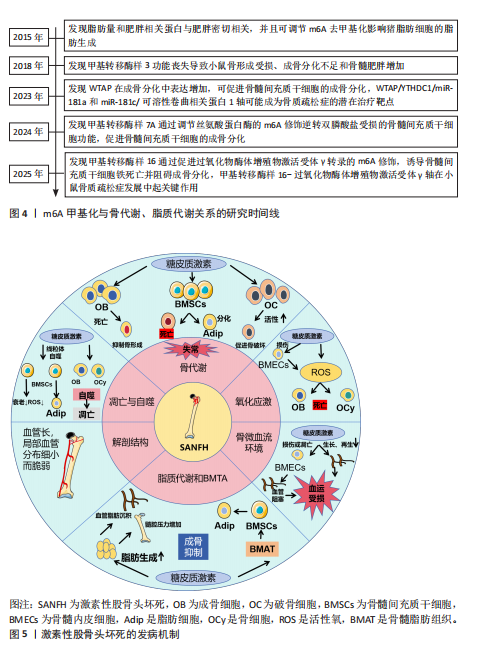
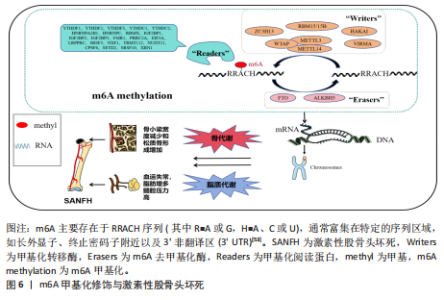
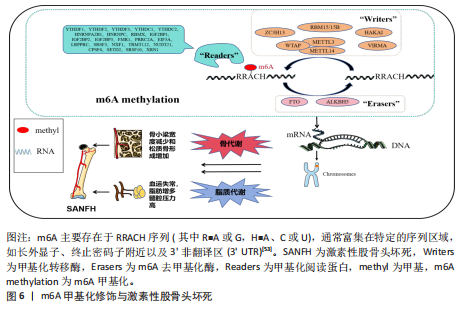
知,糖皮质激素会引起肥胖和血脂异常,该机制主要由糖皮质激素受体介导,调控脂肪分解和脂肪生成[30]。糖皮质激素引起的脂代谢紊乱是激素性股骨头坏死的重要发病机制之一,长期使用糖皮质激素会导致脂肪沉积并增加骨髓肥胖,增加激素性股骨头坏死的发生风险。糖皮质激素可导致血脂升高,增加股骨头内脂肪沉积,进而压迫血管,减少骨组织血供;此外,髓内脂肪增多可导致髓内压升高,增加毛细血管和小静脉的回流阻力,进一步加重骨组织缺血。 骨髓脂肪组织是存在于骨髓腔内的一种脂肪组织,它通过影响骨髓间充质干细胞的功能调节骨形成和骨吸收。成骨细胞从骨髓间充质干细胞分化而来,同时骨髓间充质干细胞也具有分化为脂肪细胞和软骨细胞的能力,产生的脂肪细胞越多,成骨细胞就越少,这是因为成脂因子(如过氧化物酶体增殖物激活受体γ)对成骨信号产生很强的抑制作用。研究发现,糖皮质激素促进骨髓间充质干细胞向脂肪细胞的分化,导致激素性股骨头坏死的发生发展[31],这可能与糖皮质激素诱导促炎M1巨噬细胞显著增加,抑制骨髓间充质干细胞的成骨分化有关[32]。此外,过量的糖皮质激素会抑制Wnt蛋白的产生,导致骨髓间充质干细胞分化为脂肪细胞而不是成骨细胞[33]。最近一项研究发现,11β-羟基类固醇脱氢酶1型可激活局部糖皮质激素信号通路,导致高脂饮食喂养的雄性小鼠出现骨质流失和肥胖,而特异性敲除成骨细胞中的11β-羟基类固醇脱氢酶1型,或者使用针对骨骼的11β-羟基类固醇脱氢酶1型抑制剂,可以显著改善高脂饮食雄性小鼠的骨质流失、代谢紊乱和肥胖问题[34],表明成骨细胞中的11β-羟基类固醇脱氢酶1型是调节肥胖和激素相关的骨丢失和脂质代谢紊乱的关键靶点,但具体机制有待进一步研究。 2.2.3 氧化应激 研究发现,糖皮质激素可诱导骨髓内皮细胞损伤,从而产生过多的活性氧自由基,过量的活性氧自由基会攻击细胞内的脂质、蛋白质和DNA,导致细胞损伤和死亡;骨髓内皮细胞损伤可引起局部血液高凝和微血管血栓形成,导致血管损伤或栓塞,最终引起局部血供中断[35]。氧化应激直接损伤成骨细胞和骨细胞导致成骨功能障碍,进而促进激素性股骨头坏死的发生发展。研究发现,抗氧化剂Taxifolin能够减轻地塞米松诱导的活性氧自由基和NADPH氧化酶基因过表达,降低氧化应激水平;此外,Taxifolin可缓解地塞米松诱导的成骨细胞凋亡,该机制与激活核因子红细胞2相关因子2通路有关[36]。GENG等[37]发现抗氧化剂虾青素通过抑制氧化应激导致的DNA损伤和骨细胞衰老等,促进成骨细胞骨形成并抑制破骨细胞骨吸收。由此可见,氧化应激在激素性股骨头坏死的发生和发展中扮演着重要角色。 2.2.4 骨微血流环境和解剖结构 骨微血流环境是骨组织内微血管系统血液流动状态的综合体现,它负责为骨组织提供营养并排出代谢废物,是维持骨组织正常生理功能和代谢平衡的关键因素。然而,糖皮质激素的使用会对这一环境产生显著负面影响,进而促进激素性股骨头坏死的发生发展。研究发现糖皮质激素能够诱导骨髓内皮细胞损伤和凋亡,导致血管壁坏死和管腔阻塞,进而影响股骨头的血液灌注[10];此外,长期使用糖皮质激素还会抑制毛细血管的正常生长和再生,进一步破坏骨微血流环境,导致股骨头血管闭塞,加重骨组织的缺血缺氧状态。从解剖结构来看,股骨头的血管结构具有独特性,血管较长且供血范围较大,血管分布细小而脆弱,难以形成有效的侧支循环,这些特点使得股骨头更容易出现血液供应不足和微血栓形成,从而进一步加剧缺血缺氧情况。由于股骨头内存在大量微血管,长期使用糖皮质激素会降低股骨头内低氧诱导因子1α、血小板衍生生长因子BB、血管内皮细胞生长因子、血管生成素等因子的表达以及骨微血管内皮细胞活性,进而引发血管生成受损和抑制,使得股骨头微血管血运受损、成骨减少,最终导致激素性股骨头坏死的发生[38]。有研究认为补肾复脉方能够通过促进骨与血管的形成来改善激素性股骨头坏死,该机制可能与上调低氧诱导因子1α/血管内皮生长因子A/血管内皮生长因子受体2信号通路中相关因子表达增强成血管-成骨偶联作用有关[39]。因此,微血流环境受损是激素性股骨头坏死发生的关键因素之一,特殊的解构结构则是激素性股骨头坏死发生发展的有利条件。 2.2.5 细胞凋亡和自噬 细胞凋亡和自噬是激素性股骨头坏死发生的重要生物学基础。研究表明,激素性股骨头坏死与成骨细胞和骨细胞凋亡密切相关,糖皮质激素通过激活自噬和内质网应激相关蛋白诱导成骨细胞和骨细胞凋亡,导致骨小梁微骨折和股骨头塌陷[40]。另外,糖皮质激素过度激活成骨细胞的自噬,会降低细胞的成骨活性。自噬抑制剂可以抑制受糖皮质激素诱导的成骨细胞和骨细胞凋亡,从而降低激素性股骨头坏死的发生风险。WANG等[41]研究发现,锂通过磷脂酰肌醇3激酶/蛋白激酶B/哺乳动物雷帕霉素靶蛋白信号通路减少糖皮质激素诱导的成骨细胞过度自噬、提高成骨活性,并在激素性股骨头坏死大鼠模型中得到证实。研究发现诱导线粒体自噬可抑制骨髓间充质干细胞衰老,抑制骨髓间充质干细胞及线粒体内活性氧的产生,而抑制线粒体自噬则出现相反的结果[42]。另有研究表明,线粒体自噬可降低骨髓间充质干细胞的成骨分化并增加成脂分化[43]。有趣的是,线粒体自噬在骨髓间充质干细胞成骨分化中的作用存在矛盾:一方面,诱导线粒体自噬可抑制骨髓间充质干细胞衰老并减少活性氧,通常有利于维持骨髓间充质干细胞的成骨分化能力;另一方面,线粒体自噬会降低成骨分化并增加成脂分化,这种矛盾可能源于线粒体自噬在不同细胞环境、刺激因素及作用阶段对骨髓间充质干细胞分化的复杂调控机制。线粒体自噬在调节能量代谢、维持内稳态、清除损伤线粒体等方面发挥重要作用,这些因素均与骨髓间充质干细胞分化方向密切相关。因此,线粒体自噬对成骨分化的影响是多因素、多途径共同作用的结果,需要进一步研究其机制和调控网络。 综上所述,激素性股骨头坏死的发病机制复杂,与使用糖皮质激素有关,涉及骨代谢失衡、脂质代谢紊乱、氧化应激、细胞凋亡和自噬等多种因素。糖皮质激素通过抑制成骨、促进破骨、影响血运失常和脂质生成、诱导氧化应激和细胞凋亡等途径,导致骨质受损和股骨头坏死;此外,线粒体自噬作为成骨分化的双刃剑,源于它在不同细胞环境下的复杂调控机制,需要进一步阐明。 2.3 m6A甲基化与激素性股骨头坏死的关系 2.3.1 m6A甲基化概述 m6A是一种在真核生物mRNA和某些非编码RNA分子中常见的化学修饰,是真核生物mRNA上最丰富的内部修饰[44]。1974年,科学家们首次在mRNA中检测到腺嘌呤的N6位点可以发生甲基化,并将这种经过甲基化修饰的碱基称为m6A[45]。m6A修饰的动态可逆过程涉及多种蛋白质,主要有甲基化转移酶、m6A去甲基化酶以及甲基化阅读蛋白[46]。整个m6A修饰过程可以概括为:特定的靶基因mRNA上的腺嘌呤碱基被甲基化转移酶添加m6A修饰,之后m6A去甲基化酶可以移除这些修饰,最终m6A修饰的RNA分子被甲基化阅读蛋白识别[47]。这些蛋白通过特异的识别和结合功能改变RNA的三维结构、稳定性、降解以及与其他细胞成分的相互作用,调节RNA的代谢过程[48]。 m6A甲基转移酶是负责在RNA分子上添加m6A修饰的一类酶,以复合物的形式存在,有研究发现它是由 METTL3、METTL14、WTAP、VIRMA、RBM15/15B、ZC3H13和HAKAI等组成[49]。其中METTL14和METTL3是甲基转移酶的核心分子[50],METTL3是具有催化甲基转移酶活性的亚基,METTL14没有甲基转移酶活性,但它的作用是对于底物的识别。WTAP已被证实能起到稳定异质二聚体(由METTL3和METTL14组成[51])的作用[52]。此外,研究认为甲基转移酶中的其他单个蛋白质可能具有特定功能,如VIRMA介导3’UTR和终止密码子附近的优先m6A mRNA甲基化。RBM15和RBM15B结合富含U的RNA共有基序,它们在复合体中起到调节作用,影响m6A修饰的效率和特异性,但目前每个成分的确切作用尚未确定。m6A去甲基化酶是负责在RNA分子上去除m6A修饰的一类酶,主要涉及的已知两种酶是FTO和ALKBH5。FTO能够特异性地去除RNA上的m6A修饰。ALKBH5是另一种具有m6A去甲基化活性的酶,通过氧化的方式将m6A修饰转化为反式m6A,进而影响RNA的代谢和功能。这两种去甲基化酶在RNA的m6A修饰动态调控中起着关键作用,它们参与调控RNA的稳定性、剪接、翻译等多种生物学过程。甲基化阅读蛋白能够识别并结合m6A修饰的RNA,从而影响RNA的代谢和功能。目前已知的m6A阅读蛋白包括YTHDF1、YTHDF2、YTHDF3、YTHDC1、YTHDC2、HNRNPA2B1、HNRNPC、RBMX、IGF2BP1、IGF2BP2、IGF2BP3、FMR1、PRRC2A、EIF3A、LRPPRC、SRSF3、NXF1、TRMT112、NUDT21、CPSF6、SETD2、SRSF10、XRN1等。m6A甲基化修饰可影响骨代谢和脂质代谢,与激素性股骨头坏死的发病机制密切相关(图6)。"
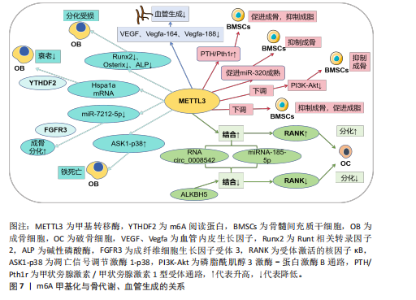
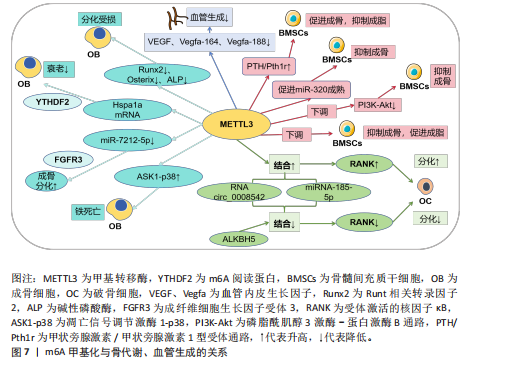
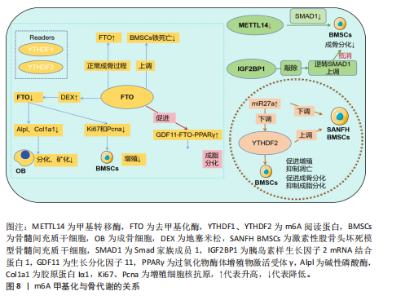
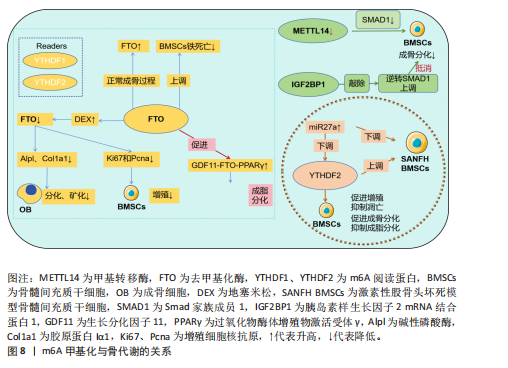
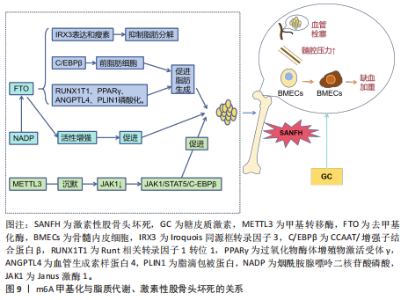
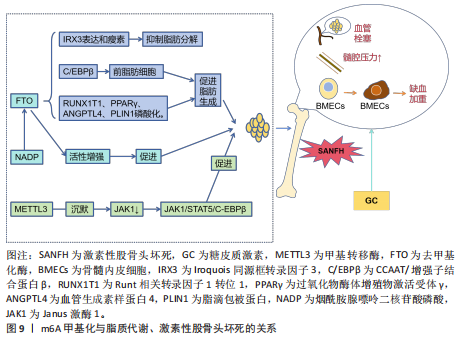
2.3.2 m6A甲基化与激素性股骨头坏死 (1)m6A甲基化与骨代谢:m6A甲基化在成骨细胞分化中起着关键作用,它调控机制复杂且因细胞类型和模型不同而存在差异。一方面,METTL3通过抑制miR-7212-5p的成熟促进成骨细胞分化,miR-7212-5p通过靶向成纤维细胞生长因子受体3抑制成骨细胞分化,表明METTL3/miR-7212-5p/成纤维细胞生长因子受体3轴在成骨分化中具有重要作用[54]。此外,METTL3通过m6A修饰增强Hspa1a mRNA的稳定性,进而抑制成骨细胞衰老,而YTHDF2在此过程中发挥稳定Hspa1a mRNA的作用,从机制上讲,METTL3依赖YTHDF2来增加Hspa1a mRNA的稳定性,从而抑制成骨细胞的衰老[55]。然而有研究发现,METTL3可激活凋亡信号调节激酶1-p38信号通路诱导成骨细胞铁死亡,敲除METTL3可减弱这种效应[56]。有趣的是,METTL3一方面通过稳定Hspa1a mRNA来抑制成骨细胞衰老,另一方面又可能通过激活凋亡信号调节激酶1-p38信号通路诱导成骨细胞铁死亡,表现出促进成骨细胞衰老的作用,这意味着在不同的环境影响下METTL3可能呈现出对成骨细胞的不同作用,但具体影响机制目前尚不清楚。 研究发现,在骨髓间充质干细胞的脂肪细胞分化过程中去甲基化酶表达上调,而在成骨细胞分化过程中去甲基化酶表达下调,进一步证实去甲基化酶促进骨髓间充质干细胞向脂肪细胞分化、抑制成骨细胞分化,该机制涉及生长分化因子11-去甲基化酶-过氧化物酶体增殖物激活受体γ信号通路抑制成骨分化并促进骨质疏松症[57]。有趣的是,另一项研究发现成骨分化过程中,地塞米松的剂量越高,去甲基化酶的表达水平就越低[58],而在正常的成骨分化过程中,去甲基化酶表达则逐渐增加,这种现象可能与受地塞米松影响有关。去甲基化酶是通过与两种m6A阅读蛋白YTHDF1和YTHDF2的相互作用来调节成骨分化,当去甲基化酶被敲低时会导致成骨细胞分化和矿化受到抑制,同时还会抑制骨髓间充质干细胞的增殖。野生型去甲基化酶的过表达能够逆转地塞米松诱导的成骨障碍,对抗地塞米松的负面影响;而突变型去甲基化酶的过表达则无法实现这种逆转。研究显示去甲基化酶在调节成骨分化的机制存在不一致性:一方面,去甲基化酶促进骨髓间充质干细胞成脂分化;另一方面,去甲基化酶表达增加可促进成骨和对抗地塞米松诱导的成骨障碍。在激素性股骨头坏死中,糖皮质激素诱导的成骨障碍是关键病理机制之一,而m6A甲基化通过调控成骨细胞的分化、衰老和凋亡可能在激素性股骨头坏死的发生和发展中发挥重要作用。但目前对于METTL3、去甲基化酶的研究似乎互相矛盾,是促进成骨还是抑制成骨,这种矛盾现象可能是受细胞类型和微环境的差异、信号通路的复杂性等多方面因素影响。例如,去甲基化酶在不同细胞类型(如成骨细胞和骨髓间充质干细胞)中表现出不同的成骨调节作用,而在不同的信号通路中,METTL3对成骨的作用也存在差异。这些现象表明METTL3和去甲基化酶在成骨过程中的作用可能受到多种因素的综合影响,目前针对这一问题的文献证据仍相对有限,尚需进一步研究来证实。 破骨细胞介导的骨吸收同样与m6A甲基化关系密切。研究发现,METTL3通过影响具有封闭环状结构的非编码RNA circ_0008542的m6A水平促进破骨细胞诱导的骨吸收,circ_0008542能够上调miRNA-185-5p的竞争性结合,从而促进靶基因RANK的表达,而RNA去甲基化酶ALKBH5则通过下调circ_0008542与miRNA-185-5p的结合抑制过度的骨吸收[59]。另外,上述提及METTL3通过抑制miR-7212-5p的成熟促进成骨细胞分化,这意味着m6A甲基化在骨代谢过程中具有复杂的调控作用,它的具体功能可能因细胞类型和作用靶点的不同而有所差异。综合来看,m6A甲基化在骨代谢中具有双向调控作用,既可以促进破骨细胞介导的骨吸收,也可能参与成骨细胞的分化过程。 骨髓间充质干细胞作为具有多向分化潜能的细胞,在骨代谢中发挥着关键作用,可分化为成骨细胞、软骨细胞和骨髓脂肪细胞。在正常生理状态下,骨髓间充质干细胞的成骨分化与脂肪分化之间存在动态平衡,这种平衡对维持骨骼健康至关重要,然而,当骨髓间充质干细胞优先分化为脂肪细胞时会导致骨髓脂肪增加、成骨细胞和骨细胞数量减少,从而增加股骨头坏死(激素性股骨头坏死)的发生风险。研究发现,条件性敲除骨髓间充质干细胞中的METTL3会导致骨质流失增加,进而使小鼠出现骨形成受损和骨质疏松症的病理特征,这一现象与甲状旁腺激素及其受体1信号轴密切相关,METTL3的敲除降低了甲状旁腺激素受体1的翻译效率,而甲状旁腺激素受体1是间充质干细胞谱系分配的关键调节因子,这种变化破坏了甲状旁腺激素诱导的促进成骨和抑制成脂效应,从而影响了骨代谢的正常进程[60]。另外,METTL3还能通过m6A甲基化调节前体miR-320,进而间接影响成骨过程,成熟miR-320水平下调促进骨髓间充质干细胞成骨分化,从而防止体内METTL3沉默诱导的骨质流失[61]。TIAN等[62]研究发现,在骨髓间充质干细胞的成骨分化过程中,METTL3表达上调,而敲低METTL3后成骨相关基因(如Runx2和Osterix)表达降低,同时碱性磷酸酶活性和矿化结节形成减少,表明成骨细胞分化能力受损。机制上讲,METTL3通过促进Runx2的m6A甲基化维持其mRNA稳定性,增加Runx2表达,从而促进成骨分化。METTL3的下调不仅抑制了骨髓间充质干细胞的成骨分化,还促进了骨髓间充质干细胞向脂肪细胞分化,并通过降低血管内皮生长因子及其关键剪接变体(血管内皮生长因子a-164和血管内皮生长因子a-188)的表达影响血管生成和成骨过程。METTL3的下调导致蛋白激酶B磷酸化减少和磷脂酰肌醇3激酶-蛋白激酶B信号通路的下调,进一步抑制了骨髓间充质干细胞的成骨分化。成骨分化和血管生成是维持骨组织健康和修复受损骨组织的关键过程,同样也是激素性股骨头坏死的关键致病因素之一。m6A修饰还参与调控骨髓间充质干细胞的铁死亡。SONG等[63]诱导大鼠骨髓间充质干细胞发生铁死亡,发现骨髓间充质干细胞中m6A修饰水平升高、去甲基化酶表达水平降低,而上调去甲基化酶表达可减轻大鼠骨髓间充质干细胞铁死亡并保护细胞活力。研究人员在激素性股骨头坏死模型中观察到骨髓间充质干细胞中miR27a表达降低和YTHDF2的m6A异常高表达,进一步研究发现miR27a敲低/过表达通过负调控关系调节YTHDF2表达,下调YTHDF2可促进细胞增殖并抑制细胞凋亡,发挥对骨髓间充质干细胞的保护作用,促进骨髓间充质干细胞成骨分化并抑制成脂分化,证实miR27a/YTHDF2可能是激素性股骨头坏死的潜在治疗靶点[64]。METTL14通过调节SMAD1的m6A修饰来抑制骨髓间充质干细胞的成骨分化,通过胰岛素样生长因子mRNA结合蛋白1介导的机制影响SMAD1的m6A修饰,进而降低其稳定性;胰岛素样生长因子2 mRNA结合蛋白1作为甲基化“读取器”,敲低胰岛素样生长因子2 mRNA结合蛋白1表达可以逆转SMAD1的上调,而SMAD1过表达可以抵消METTL14敲除对成骨分化的抑制作用[65]。这些研究结果表明,m6A甲基化及其相关酶在骨髓间充质干细胞的成骨、成脂分化、铁死亡,脂肪生成以及血管生成过程中发挥着复杂的调控作用,为激素性股骨头坏死的治疗策略提供了新的治疗方向。 综上所述,m6A甲基化在骨代谢、血管生成方面的作用关系密切(图7,8)。骨代谢失常是激素性股骨头坏死的关键致病环节,m6A甲基化参与其中并发挥重要作用,如何调控m6A甲基化进而对抗激素性股骨头坏死的发生和发展是未来的研究和治疗方向。 (2)m6A甲基化与脂质代谢:m6A甲基化通过多种机制促进脂肪生成和脂肪沉积(图9),进而影响激素性股骨头坏死的发生和发展。具体而言,去甲基化酶通过CCAAT/增强子结合蛋白β通路增强前脂肪细胞的分化,并通过改变Runt相关转录因子1转位1的选择性剪接、过氧化物酶体增殖物激活受体γ和血管生成素样蛋白4的表达以及脂滴包被蛋白的磷酸化来促进脂肪生成;此外,去甲基化酶还通过抑制Iroquois同源框转录因子3表达和瘦素通路来抑制脂肪分解,从而导致肥胖的发生和发展[66]。大剂量激素使用后,血脂水平显著升高,导致微血管内脂肪栓塞和髓腔内脂肪聚集,进而引起髓腔内压力升高;同时,脂肪分解使血液中游离脂肪酸增多,骨内和血液中前列腺素E2增加,引发股骨头内小血管炎和脂肪栓子形成,损伤血管内皮细胞,导致或加重股骨头的缺血状况;脂肪栓子容易附着于终末动脉管壁,压嵌入小血管,造成骨内微循环栓塞,使血液黏稠度增加,进一步阻碍股骨头内微循环[67]。去甲基化酶在脂肪生成中的作用与激素性股骨头坏死的病理机制密切相关,例如,去甲基化酶可以增强前脂肪细胞分化,可能导致髓腔内脂肪细胞异常增殖,进而增加髓腔内压力;此外,去甲基化酶通过抑制脂肪分解可能进一步加重脂肪沉积,导致股骨头内微循环障碍。研究发现,烟酰胺腺嘌呤二核苷酸磷酸能够直接结合去甲基化酶,并独立增强去甲基化酶活性,从而促进RNA m6A去甲基化和脂肪生成,而去除去甲基化酶会阻断烟酰胺腺嘌呤二核苷酸磷酸在3T3-L1前脂肪细胞中增强的脂肪生成,表明烟酰胺腺嘌呤二核苷酸磷酸可能通过激活去甲基化酶进一步加剧激素使用后的脂肪代谢异常,从而在激素性股骨头坏死的发生中发挥重要作用[68]。一项实验发现,沉默猪骨髓间充质干细胞中的METTL3会降低Janus激酶1 mRNA的m6A修饰水平,并通过Janus激酶1/STAT5/CCAAT/增强子结合蛋白β信号通路促进脂肪生成[69]。去甲基化酶、METTL3与脂肪生成和脂肪沉积有关,大剂量激素使用导致的血脂升高和脂肪代谢异常进一步加剧了股骨头内微循环障碍,去甲基化酶表达增强和METTL3下调可能在激素性股骨头坏死的发生和发展中起到关键作用。未来的研究可以进一步探讨去甲基化酶、METTL3在激素性股骨头坏死中的具体机制以及如何通过调节去甲基化酶活性来预防和治疗该疾病。"
"
2.4 中药干预m6A甲基化修饰 激素性股骨头坏死属于中医“骨痹”“骨蚀”的范畴,糖皮质激素属于中医病因中的“药邪”,糖皮质激素的应用导致人体气血亏虚,气虚则血液运行失畅,瘀滞脉络,进而导致筋骨失养,最终发生股骨头的缺血坏死[70]。 目前关于中药调控m6A甲基化的研究较少,主要集中在成骨方面。例如,墨旱莲提取物在体内具有抗骨质疏松作用,并在体外促进成骨细胞增殖和活性。当使用墨旱莲提取物处理骨髓间充质干细胞9 d后,与使用成骨培养基处理的对照组相比,细胞碱性磷酸酶活性和骨化水平显著增加,进一步检测发现甲基转移酶METTL3和METTL14的表达显著上升,但WTAP的表达无明显变化;当通过基因敲低技术降低METTL3表达后,墨旱莲提取物诱导的碱性磷酸酶活性、骨化水平以及骨形成相关标志物Osterix和骨钙素的mRNA表达均出现降低,这表明METTL3介导的m6A甲基化过程在其中发挥了关键作用,有助于增强成骨细胞的生成能力[71]。在骨形成过程中,脯氨酰4-羟化酶β亚基扮演着重要角色。研究发现,淫羊藿苷能够上调脯氨酰4-羟化酶β亚基的表达,进而促进骨髓间充质干细胞的成骨分化;淫羊"

藿苷能增强脯氨酰4-羟化酶β亚基的稳定性和m6A修饰,而这种m6A修饰是由METTL14介导的;当敲除METTL14后,淫羊藿苷对脯氨酰4-羟化酶β亚基m6A水平的提升以及对骨髓间充质干细胞成骨分化的促进作用均被抵消,说明淫羊藿苷可能通过METTL14介导的脯氨酰4-羟化酶β亚基m6A修饰来调节骨髓间充质干细胞的成骨分化过程[72]。LI等[73]在对牙周炎的研究中发现,姜黄炭能够抑制炎症反应、促进骨组织的愈合以及体外的成骨分化,姜黄炭的活性成分可以下调METTL3表达,进而抑制内质网应激信号转导蛋白1α mRNA的m6A修饰,降低内质网应激信号转导蛋白1α的蛋白水平;诱导内质网应激信号转导蛋白1α的过表达则能够抵消姜黄炭的作用,重新激活炎症反应,并抑制骨愈合和成骨分化的过程。大鼠实验发现,强骨汤能够显著促进骨组织生长,并上调成骨标志物Runx2、骨桥蛋白和骨钙素;此外,强骨汤还能促进骨髓间充质干细胞的成骨分化,表现为钙结节形成和碱性磷酸酶活性增加;强骨汤处理显著提高了骨髓间充质干细胞中的m6A RNA水平及METTL3表达,而通过siRNA沉默METTL3可抵消强骨汤的成骨作用,因此,强骨汤可能通过METTL3介导的m6A修饰来改善骨髓间充质干细胞的分化[74]。另外,中成药仙灵骨葆胶囊可能通过调节m6A修饰和METTL3、RUNX2、碱性磷酸酶、骨γ-羧基谷氨酸蛋白水平来增强骨质疏松模型骨髓间充质干细胞的成骨能力[75]。 综上所述,一些中药单体、中药复方和中成药在成骨方面均表现出与m6A甲基化关系密切(表1)。然而遗憾的是,目前关于中药与m6A甲基化的研究较少,尤其是在补肾、促进成骨等中药,但鉴于m6A甲基化在骨代谢中的重要作用以及中药在成骨方面的潜力,作者相信这将是一个极具前景的研究方向。未来的研究可以进一步探索中药在调控m6A甲基化方面的具体机制以及它在治疗激素性股骨头坏死等骨科疾病中的潜在应用。"

| [1] CHANG C, GREENSPAN A, GERSHWIN ME. The pathogenesis, diagnosis and clinical manifestations of steroid-induced osteonecrosis. J Autoimmun. 2020;110:102460. [2] 单彬,王进,左振柏,等.柚皮苷对大鼠激素性股骨头坏死组织修复的影响[J].中国矫形外科杂志,2025,33(9):806-814. [3] ZHAO DW, YU M, HU K, et al. Prevalence of Nontraumatic Osteonecrosis of the Femoral Head and its Associated Risk Factors in the Chinese Population: Results from a Nationally Representative Survey. Chin Med J (Engl). 2015; 128(21):2843-2850. [4] LIU N, ZHENG C, WANG Q, et al. Treatment of non-traumatic avascular necrosis of the femoral head (Review). Exp Ther Med. 2022;23(5):321. [5] VU LP, CHENG Y, KHARAS MG. The Biology of m(6)A RNA Methylation in Normal and Malignant Hematopoiesis. Cancer Discov. 2019;9(1):25-33. [6] ZACCARA S, RIES RJ, JAFFREY SR. Reading, writing and erasing mRNA methylation[J]. Nat Rev Mol Cell Biol. 2019;20(10):608-624. [7] HUANG M, XU S, LIU L, et al. m6A Methylation Regulates Osteoblastic Differentiation and Bone Remodeling. Front Cell Dev Biol. 2021;9:783322. [8] LI B, QIN K, WANG B, et al. Crocin promotes osteogenesis differentiation of bone marrow mesenchymal stem cells[. In Vitro Cell Dev Biol Anim. 2020;56(8):680-688. [9] 张亚奇,李博,汤建成,等.中医药调控PI3K/Akt通路治疗激素性股骨头坏死的研究进展[J].中国实验方剂学杂志,2025,31(5):141-149. [10] GAO Y, YOU Y, ZHANG P, et al. Cortistatin prevents glucocorticoid-associated osteonecrosis of the femoral head via the GHSR1a/Akt pathway. Commun Biol. 2024;7(1):132. [11] BEN-HAIM MS, MOSHITCH-MOSHKOVITZ S, RECHAVI G. FTO: linking m6A demethylation to adipogenesis. Cell Res. 2015;25(1):3-4. [12] WANG X, ZHU L, CHEN J, et al. mRNA m(6)A methylation downregulates adipogenesis in porcine adipocytes. Biochem Biophys Res Commun. 2015;459(2):201-207. [13] WU Y, XIE L, WANG M, et al. Mettl3-mediated m(6)A RNA methylation regulates the fate of bone marrow mesenchymal stem cells and osteoporosis. Nat Commun. 2018;9(1):4772. [14] YANG J, SUN B, WANG Z, et al. Exosome-targeted delivery of METTL14 regulates NFATc1 m6A methylation levels to correct osteoclast-induced bone resorption. Cell Death Dis. 2023;14(11):738. [15] YOU Y, LIU J, ZHANG L, et al. WTAP-mediated m(6)A modification modulates bone marrow mesenchymal stem cells differentiation potential and osteoporosis. Cell Death Dis. 2023;14(1):33. [16] JIN Y, HAN X, WANG Y, et al. METTL7A-mediated m6A modification of corin reverses bisphosphonates-impaired osteogenic differentiation of orofacial BMSCs. Int J Oral Sci. 2024;16(1):42. [17] LU L, WANG L, YANG M, et al. Role of METTL16 in PPARgamma methylation and osteogenic differentiation. Cell Death Dis. 2025;16(1):271. [18] KONARSKI W, POBOZY T, SLIWCZYNSKI A, et al. Avascular Necrosis of Femoral Head-Overview and Current State of the Art. Int J Environ Res Public Health. 2022;19(12):7348. [19] 陈志健,张苏雅,丁龙龙,等.从“病-证-方”关联视角探讨熟地强筋丸治疗激素性股骨头坏死的疗效特点和机制[J].中国实验方剂学杂志,2026,32(2):88-99. [20] CHEN K, LIU Y, HE J, et al. Steroid-induced osteonecrosis of the femoral head reveals enhanced reactive oxygen species and hyperactive osteoclasts. Int J Biol Sci. 2020; 16(11):1888-1900. [21] ZHANG J, CAO J, LIU Y, et al. Advances in the Pathogenesis of Steroid-Associated Osteonecrosis of the Femoral Head. Biomolecules. 2024;14(6):667. [22] 区志坚,李希文,邱华耀,等.基于OPG/RANKL/RANK信号通路探究“引血下行法”调控激素性股骨头坏死骨代谢表达的影响[J].实用医学杂志,2023,39(23):3058-3064. [23] ZHU J, ZHAO T, ZHU L, et al. Dexamethasone promotes osteoblast apoptosis through the Chk2/p53 signaling pathway. Adv Clin Exp Med. 2022;31(12):1365-1374. [24] RONG X, KOU Y, ZHANG Y, et al. ED-71 Prevents Glucocorticoid-Induced Osteoporosis by Regulating Osteoblast Differentiation via Notch and Wnt/beta-Catenin Pathways. Drug Des Devel Ther. 2022;16:3929-3946. [25] YANG L, LIU S, MU S, et al. Paeoniflorin Attenuates Dexamethasone-Induced Apoptosis of Osteoblast Cells and Promotes Bone Formation via Regulating AKT/mTOR/Autophagy Signaling Pathway. Evid Based Complement Alternat Med. 2021; 2021:6623464. [26] CHOTIYARNWONG P, MCCLOSKEY EV. Pathogenesis of glucocorticoid-induced osteoporosis and options for treatment. Nat Rev Endocrinol. 2020; 16(8):437-447. [27] CHEN M, FU W, XU H, et al. Pathogenic mechanisms of glucocorticoid-induced osteoporosis. Cytokine Growth Factor Rev. 2023; 70:54-66. [28] LIU Q, WU Y, LI S, et al. Ursolic acid alleviates steroid-induced avascular necrosis of the femoral head in mouse by inhibiting apoptosis and rescuing osteogenic differentiation. Toxicol Appl Pharmacol. 2023;475:116649. [29] TANG B, CHEN Y, ZHAO P, et al. MiR-601-induced BMSCs senescence accelerates steroid-induced osteonecrosis of the femoral head progression by targeting SIRT1. Cell Mol Life Sci. 2023;80(9):261. [30] OKUNO Y, FUKUHARA A, SHIMOMURA I. The role of oxidative stress, glucocorticoid receptor and ARMC5 in lipid metabolism. Endocr J. 2024; 71(12):1097-1101. [31] HINES JT, JO WL, CUI Q, et al. Osteonecrosis of the Femoral Head: an Updated Review of ARCO on Pathogenesis, Staging and Treatment. J Korean Med Sci. 2021;36(24):e177. [32] DUAN P, YU YL, CHENG YN, et al. Exosomal miR-1a-3p derived from glucocorticoid-stimulated M1 macrophages promotes the adipogenic differentiation of BMSCs in glucocorticoid-associated osteonecrosis of the femoral head by targeting Cebpz. J Nanobiotechnology. 2024; 22(1):648. [33] CHENG CH, CHEN LR, CHEN KH. Osteoporosis Due to Hormone Imbalance: An Overview of the Effects of Estrogen Deficiency and Glucocorticoid Overuse on Bone Turnover. Int J Mol Sci. 2022;23(3):1376. [34] ZHONG C, LI N, WANG S, et al. Targeting osteoblastic 11beta-HSD1 to combat high-fat diet-induced bone loss and obesity. Nat Commun. 2024;15(1):8588. [35] MA J, SHEN M, YUE D, et al. Extracellular Vesicles from BMSCs Prevent Glucocorticoid-Induced BMECs Injury by Regulating Autophagy via the PI3K/Akt/mTOR Pathway. Cells. 2022;11(13):2104. [36] JIANG H, LIN C, CAI T, et al. Taxifolin-mediated Nrf2 activation ameliorates oxidative stress and apoptosis for the treatment of glucocorticoid-induced osteonecrosis of the femoral head. Phytother Res. 2024;38(1):156-173. [37] GENG Q, WANG S, HENG K, et al. Astaxanthin attenuates irradiation-induced osteoporosis in mice by inhibiting oxidative stress, osteocyte senescence, and SASP. Food Funct. 2022;13(22): 11770-11779. [38] 马天成,马剑雄,马信龙,等.基于微血管研究激素性股骨头坏死发生机制系统综述[J].医用生物力学,2024,39(S1):630. [39] 邱静,王世轩,赵双利,等.补肾复脉方治疗激素性股骨头坏死的作用机制研究[J].海南医科大学学报,2026,32(9):697-706. [40] WANG G, ZHANG L, YAN C, et al. Upregulation of microRNA-576-5p protects from steroid-induced avascular necrosis of the femoral head by suppressing ANXA2. Cell Cycle. 2022;21(1):49-62. [41] WANG Q, YANG Z, LI Q, et al. Lithium prevents glucocorticoid-induced osteonecrosis of the femoral head by regulating autophagy. J Cell Mol Med. 2024;28(10):e18385. [42] GUO Y, JIA X, CUI Y, et al. Sirt3-mediated mitophagy regulates AGEs-induced BMSCs senescence and senile osteoporosis. Redox Biol. 2021;41:101915. [43] VIDONI C, FERRARESI A, SECOMANDI E, et al. Autophagy drives osteogenic differentiation of human gingival mesenchymal stem cells. Cell Commun Signal. 2019;17(1):98. [44] LIU Q, GREGORY RI. RNAmod: an integrated system for the annotation of mRNA modifications. Nucleic Acids Res. 2019;47(W1):W548-W555. [45] DESROSIERS R, FRIDERICI K, ROTTMAN F. Identification of methylated nucleosides in messenger RNA from Novikoff hepatoma cells. Proc Natl Acad Sci U S A. 1974;71(10):3971-3975. [46] JIANG X, LIU B, NIE Z, et al. The role of m6A modification in the biological functions and diseases. Signal Transduct Target Ther. 2021; 6(1):74. [47] AN Y, DUAN H. The role of m6A RNA methylation in cancer metabolism. Mol Cancer. 2022;21(1):14. [48] OERUM S, MEYNIER V, CATALA M, et al. A comprehensive review of m6A/m6Am RNA methyltransferase structures. Nucleic Acids Res. 2021;49(13):7239-7255. [49] HUANG W, CHEN TQ, FANG K, et al. N6-methyladenosine methyltransferases: functions, regulation, and clinical potential. J Hematol Oncol. 2021;14(1):117. [50] LIU X, QIN J, GAO T, et al. Analysis of METTL3 and METTL14 in hepatocellular carcinoma. Aging (Albany NY). 2020;12(21):21638-21659. [51] HE PC, HE C. m(6) A RNA methylation: from mechanisms to therapeutic potential. EMBO J. 2021;40(3):e105977. [52] YUE Y, LIU J, CUI X, et al. VIRMA mediates preferential m(6)A mRNA methylation in 3’UTR and near stop codon and associates with alternative polyadenylation. Cell Discov. 2018;4:10. [53] WANG T, KONG S, TAO M, et al. The potential role of RNA N6-methyladenosine in Cancer progression. Mol Cancer. 2020;19(1):88. [54] MI B, XIONG Y, YAN C, et al. Methyltransferase-like 3-mediated N6-methyladenosine modification of miR-7212-5p drives osteoblast differentiation and fracture healing. J Cell Mol Med. 2020;24(11): 6385-6396. [55] WANG Y, CHEN Y, XIAO H, et al. METTL3-mediated m6A modification increases Hspa1a stability to inhibit osteoblast aging. Cell Death Discov. 2024;10(1):155. [56] LIN Y, SHEN X, KE Y, et al. Activation of osteoblast ferroptosis via the METTL3/ASK1-p38 signaling pathway in high glucose and high fat (HGHF)-induced diabetic bone loss. FASEB J. 2022;36(3):e22147. [57] SHEN GS, ZHOU HB, ZHANG H, et al. The GDF11-FTO-PPARgamma axis controls the shift of osteoporotic MSC fate to adipocyte and inhibits bone formation during osteoporosis. Biochim Biophys Acta Mol Basis Dis. 2018;1864(12):3644-3654. [58] FENG L, ZHAO W, FAN Y, et al. RNA N6-methyladenosine demethylase FTO inhibits glucocorticoid-induced osteoblast differentiation and function in bone marrow mesenchymal stem cells. J Cell Biochem. 2023;124(11):1835-1847. [59] WANG W, QIAO SC, WU XB, et al. Circ_0008542 in osteoblast exosomes promotes osteoclast-induced bone resorption through m6A methylation. Cell Death Dis. 2021;12(7):628. [60] WU Y, XIE L, WANG M, et al. Mettl3-mediated m(6)A RNA methylation regulates the fate of bone marrow mesenchymal stem cells and osteoporosis. Nat Commun. 2018;9(1):4772. [61] YAN G, YUAN Y, HE M, et al. m(6)A Methylation of Precursor-miR-320/RUNX2 Controls Osteogenic Potential of Bone Marrow-Derived Mesenchymal Stem Cells. Mol Ther Nucleic Acids. 2020;19:421-436. [62] TIAN C, HUANG Y, LI Q, et al. Mettl3 Regulates Osteogenic Differentiation and Alternative Splicing of Vegfa in Bone Marrow Mesenchymal Stem Cells. Int J Mol Sci. 2019;20(3):551. [63] SONG M, LV K, XU Z, et al. N6 methyladenosine eraser FTO suppresses Staphylococcus aureus-induced ferroptosis of bone marrow mesenchymal stem cells to ameliorate osteomyelitis through regulating the MDM2/TLR4/SLC7A11 signaling pathway. Cell Biol Int. 2024;48(4):450-460. [64] YUAN T, LIU H, ABUDOUKADIER M, et al. YTHDF2-Mediated m6A methylation inhibition by miR27a as a protective mechanism against hormonal osteonecrosis in BMSCs. BMC Musculoskelet Disord. 2024;25(1):359. [65] HUANG C, WANG Y. Downregulation of METTL14 improves postmenopausal osteoporosis via IGF2BP1 dependent posttranscriptional silencing of SMAD1. Cell Death Dis. 2022;13(11):919. [66] YANG Z, YU G L, ZHU X, et al. Critical roles of FTO-mediated mRNA m6A demethylation in regulating adipogenesis and lipid metabolism: Implications in lipid metabolic disorders. Genes Dis. 2022;9(1): 51-61. [67] 吉万波,刘冠虹,刘锦涛,等.股密葆方对大鼠激素性股骨头坏死脂质代谢影响的实验研究[J].中国骨质疏松杂志,2016,22(12):1580-1584. [68] WANG L, SONG C, WANG N, et al. NADP modulates RNA m(6)A methylation and adipogenesis via enhancing FTO activity. Nat Chem Biol. 2020; 16(12):1394-1402. [69] YAO Y, BI Z, WU R, et al. METTL3 inhibits BMSC adipogenic differentiation by targeting the JAK1/STAT5/C/EBPbeta pathway via an m(6)A-YTHDF2-dependent manner. FASEB J. 2019;33(6):7529-7544. [70] 赫龙,高爽,李志刚,等.基于三大组学探讨从“痰、虚、瘀”论治SANFH的可行性[J].时珍国医国药,2022,33(8):1947-1949. [71] TIAN S, LI Y L, WANG J, et al. Chinese Ecliptae herba (Eclipta prostrata (L.) L.) extract and its component wedelolactone enhances osteoblastogenesis of bone marrow mesenchymal stem cells via targeting METTL3-mediated m6A RNA methylation. J Ethnopharmacol. 2023; 312:116433. [72] JIN Y, WU A, BIAN S, et al. Icariin upregulates methyltransferase-like 14-mediated prolyl 4-hydroxylase beta subunit m6A modification to promote osteogenic differentiation of bone marrow stem cells. Exp Cell Res. 2024;440(2): 114138. [73] LI L, WANG Y, GAO L, et al. Curcumin-carbon dots suppress periodontitis via regulating METTL3/IRE1alpha signaling. Crit Rev Eukaryot Gene Expr. 2025;35(1):25-35. [74] WANG Y, YU W, E Y, et al. Qianggu Decoction Alleviated Osteoporosis by Promoting Osteogenesis of BMSCs through Mettl3-Mediated m(6)A Methylation. Adv Biol (Weinh). 2024;8(12):e2400341. [75] LIAO M, HE Q, YANG J, et al. Study on the Mechanism of Xianling Gubao Capsule Regulating Runt-Related Transcription Factor 2 (RUNX2) and Promoting Osteoblast Differentiation by N6-Methyladenosine (m6A) Methyltransferase-Like 3 (METTL3). Altern Ther Health Med. 2024:AT10075. |
| [1] | Huang Jie, Zeng Hao, Wang Wenchi, Lyu Zhucheng, Cui Wei. Visualization analysis of literature on the effect of lipid metabolism on osteoporosis [J]. Chinese Journal of Tissue Engineering Research, 2026, 30(6): 1558-1568. |
| [2] | Gao Zengjie, , Pu Xiang, Li Lailai, Chai Yihui, Huang Hua, Qin Yu. Increased risk of osteoporotic pathological fractures associated with sterol esters: evidence from IEU-GWAS and FinnGen databases [J]. Chinese Journal of Tissue Engineering Research, 2026, 30(5): 1302-1310. |
| [3] | Zhang Qian, Huang Dongfeng. Weighted gene co-expression network analysis combined with machine learning to screen and validate biomarkers for osteoarthritis [J]. Chinese Journal of Tissue Engineering Research, 2026, 30(5): 1096-1105. |
| [4] | Zeng Hao, Sun Pengcheng, Chai Yuan, Huang Yourong, Zhang Chi, Zhang Xiaoyun. Association between thyroid function and osteoporosis: genome-wide data analysis of European populations [J]. Chinese Journal of Tissue Engineering Research, 2026, 30(4): 1019-1027. |
| [5] | Li Jiatong, Liang Songlin, Liu Runjia, Li Nianhu. Key role of m6A methylation in sarcopenia [J]. Chinese Journal of Tissue Engineering Research, 2026, 30(34): 9041-9047. |
| [6] | Sun Shiqiang, Li Wenhao, Du Xinran, Bai Shi, Li Zhongshan. Regulatory effect of low-frequency pulsed magnetic field on body fat composition in female athletes during high-intensity upper limb resistance training [J]. Chinese Journal of Tissue Engineering Research, 2026, 30(33): 8687-8694. |
| [7] | Zhou Zixiang, Zhao Baoxiang. Research progress in the relationship between nontraumatic necrosis of the femoral head and lipid metabolism and its treatment [J]. Chinese Journal of Tissue Engineering Research, 2026, 30(3): 680-690. |
| [8] | Wang Jingfeng, Feng Shuo, Cao Xuan, Li Xiaolin. Lycium barbarum polysaccharide-mediated intestinal flora remodeling improves glycolipid abnormalities in type 2 diabetic rats [J]. Chinese Journal of Tissue Engineering Research, 2026, 30(29): 7592-7602. |
| [9] | Hu Yingnan, Shi Wanwan, Wang Datao. Blood cells and the occurrence and progression of osteoporosis: biomarkers and emerging therapeutic strategies [J]. Chinese Journal of Tissue Engineering Research, 2026, 30(29): 7632-7638. |
| [10] | Feng Shuo, Cao Xuan, Guo Xieleiya, Wang Jingfeng, Li Xiaolin. Gut microbiota and short-chain fatty acids: mechanisms of aerobic exercise regulation in type 2 diabetes [J]. Chinese Journal of Tissue Engineering Research, 2026, 30(25): 6592-6602. |
| [11] | Zhao Fangfang, Guo Yanke, Wang Xueke, Pang Botong, Zhu Yanqiang, Qin Yang, Cui Yinglin. A new approach to intervene in Alzheimer's disease through regulating the silencing information regulator 1 signaling pathway with traditional Chinese medicine [J]. Chinese Journal of Tissue Engineering Research, 2026, 30(25): 6621-6631. |
| [12] | Zhou Fada, Long Zhisheng. Roles and mechanisms of mitochondrial dynamics in bone defect repair [J]. Chinese Journal of Tissue Engineering Research, 2026, 30(23): 5906-5914. |
| [13] | Gao Jiabin, Li Tianqi, Xu Kun, Zhu Hanmin, Zhou Xi, Li Wei. Mitophagy regulates osteoclasts: a new perspective for osteoporosis treatment [J]. Chinese Journal of Tissue Engineering Research, 2026, 30(23): 5982-5991. |
| [14] | Han Jie, Hu Tianfa, Wu Yachao, Nong Bin, Yu Kailong. Forkhead box transcription factor O3 affects bone metabolism and participates in the pathological processes of various bone-related diseases [J]. Chinese Journal of Tissue Engineering Research, 2026, 30(22): 5770-5781. |
| [15] | Li Jiayin, Sui Lei, Li Yanjing. microRNA-146a regulates bone metabolism and its application in bone tissue engineering [J]. Chinese Journal of Tissue Engineering Research, 2026, 30(18): 4702-4712. |
| Viewed | ||||||
|
Full text |
|
|||||
|
Abstract |
|
|||||