Chinese Journal of Tissue Engineering Research ›› 2026, Vol. 30 ›› Issue (36): 9453-9461.doi: 10.12307/2026.905
Previous Articles Next Articles
Du Huo Ji Sheng Decoction delays cartilage degeneration in mice with knee osteoarthritis
Ma Zhiguo1, 2, Zhou Zhengxin1, 2, Xue Song1, 2, Xiang Xinhong1, 2, Zhu Lei1, 2
- ¹The First Clinical Medical College of Anhui University of Chinese Medicine, Hefei 230031, Anhui Province, China; ²Department of Orthopedics II, The First Affiliated Hospital of Anhui University of Chinese Medicine, Hefei 230031, Anhui Province, China
-
Received:2025-10-17Revised:2026-03-08Online:2026-12-28Published:2026-05-21 -
Contact:Zhu Lei, MD, Associate chief physician, Master’s supervisor, The First Clinical Medical College of Anhui University of Chinese Medicine, Hefei 230031, Anhui Province, China; Department of Orthopedics II, The First Affiliated Hospital of Anhui University of Chinese Medicine, Hefei 230031, Anhui Province, China -
About author:Ma Zhiguo, MS candidate, The First Clinical Medical College of Anhui University of Chinese Medicine, Hefei 230031, Anhui Province, China; Department of Orthopedics II, The First Affiliated Hospital of Anhui University of Chinese Medicine, Hefei 230031, Anhui Province, China -
Supported by:Anhui Provincial Traditional Chinese Medicine Superior Specialty (Orthopedics and Traumatology of Traditional Chinese Medicine) Project (to ZZX)

CLC Number:
Cite this article
Ma Zhiguo, Zhou Zhengxin, Xue Song, Xiang Xinhong, Zhu Lei. Du Huo Ji Sheng Decoction delays cartilage degeneration in mice with knee osteoarthritis[J]. Chinese Journal of Tissue Engineering Research, 2026, 30(36): 9453-9461.
share this article
Add to citation manager EndNote|Reference Manager|ProCite|BibTeX|RefWorks
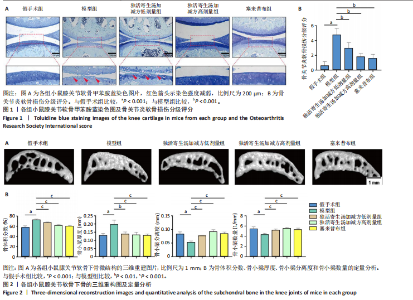
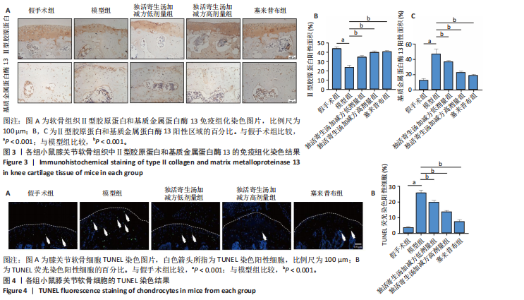
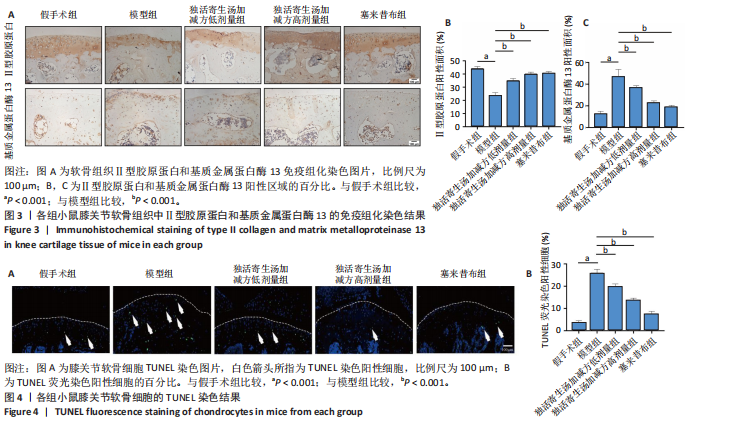
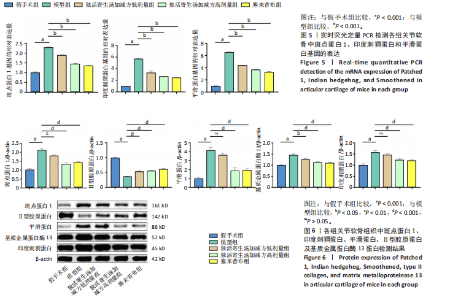
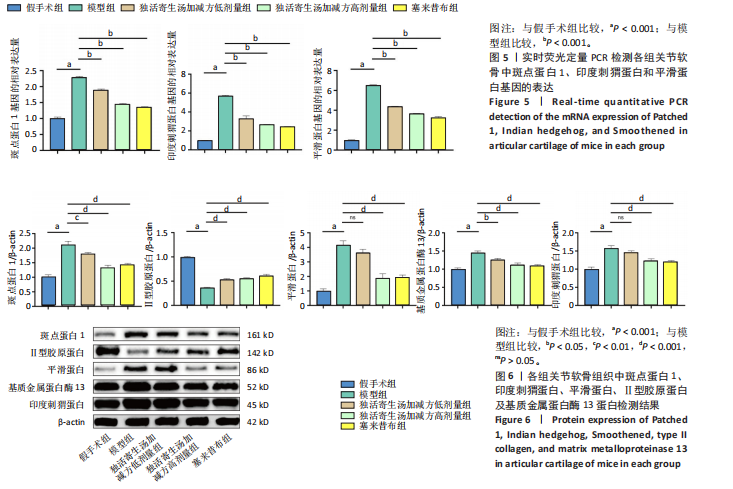
2.1 实验动物数量分析 实验选取50只C57BL/6J小鼠,随机分为假手术组、模型组、塞来昔布组和独活寄生汤加减方低、高剂量组,每组10只,实验过程中各组小鼠均未发生死亡情况,50只小鼠全部进入结果分析。 2.2 各组小鼠膝骨关节软骨甲苯胺蓝染色及骨关节炎软骨损伤分级评分情况 甲苯胺蓝染色结果(图1A)显示,假手术组小鼠关节软骨结构完整,表面形态规则,基质染色均匀深染,提示蛋白聚糖含量丰富;与之相比,模型组小鼠关节软骨呈现典型骨关节炎病理改变,包括表面侵蚀、结构紊乱、细胞排列异常及染色强度减弱,提示蛋白聚糖大量丢失,此外,模型组磨损区域软骨细胞呈现明显肥大状态,反映其受到病理损伤;经塞来昔布及独活寄生汤加减方高剂量干预后,软骨表面结构更为平整,细胞排列趋于有序,基质染色加深,磨损区域软骨细胞形态趋于正常,提示组织结构得到改善。骨关节炎软骨损伤分级评分结果进一步证实,模型组关节软骨评分较假手术组显著升高(P < 0.001),而独活寄生汤加减方各剂量组及塞来昔布组评分均显著低于模型组(P < 0.001),提示独活寄生汤加减方可有效减轻膝骨关节炎模型软骨病理损伤(图1B)。 2.3 各组小鼠软骨下骨微结构的三维重建及定量分析 采用Micro-CT技术对各组小鼠膝关节软骨下骨微结构进行三维重建及定量分析,见图2。感兴趣区域设定于软骨下骨板以下200 μm范围内的松质骨区。与假手术组相比,模型组小鼠软骨下骨呈现明显的骨硬化现象,具体表现为骨体积分数显著升高(P < 0.001),骨小梁厚度增大(P < 0.001),骨小梁分离度和骨小梁数量均显著降低(P < 0.001),提示软骨下骨发生明显的致密化重构。经独活寄生汤加减方各剂量和塞来昔布干预后,与模型组相比,各给药组的骨体积分数均显著降低(P < 0.001),骨小梁厚度减小(P < 0.01-0.001),骨小梁分离度和骨小梁数量增大(P < 0.001),表明骨小梁结构趋于正常化。上述结果提示,独活寄生汤加减方能够有效改善膝骨关节炎模型中软骨下骨的异常微结构,缓解骨硬化病理进程。 2.4 各组小鼠关节软骨Ⅱ型胶原蛋白、基质金属蛋白酶13免疫组化分析 免疫组化染色结果(图3)显示,与假手术组相比,模型组小鼠膝关节软骨中Ⅱ型胶原蛋白表达显著降低(P < 0.001),表明软骨基质合成代谢明显受损。经独活寄生汤加减方干预后,各给药组Ⅱ型胶原蛋白表达均较模型组不同程度升高,其中高剂量组的恢复效果与塞来昔布组相当。在基质分解代谢方面,模型组小鼠膝关节软骨中基质金属蛋白酶13表达较假手术组显著增加(P < 0.001),而经独活寄生汤加减方治疗后,各剂量组及塞来昔布组中基质金属蛋白酶13的表达均较模型组明显下降(P < 0.001)。上述结果提示,独活寄生汤加减方可能通过促进Ⅱ型胶原蛋白合成、抑制基质金属蛋白酶13表达,有效调节软骨细胞外基质的代谢平衡,从而延缓膝骨关节炎的疾病进展。 2.5 各组小鼠软骨细胞的TUNEL染色 TUNEL染色结果显示,与假手术组相比,模型组中TUNEL阳性细胞占比显著增加(P < 0.001)。经独活寄生汤加减方干预后,各给药组阳性细胞占比均较模型组显著减少(P < 0.001),提示该方可有效抑制膝骨关节炎进展中的软骨细胞凋亡,见图4。 2.6 各组小鼠软骨中Hh信号通路相关基因和蛋白表达 实时荧光定量PCR结果显示,与假手术组相比,模型组小鼠软骨组织中Hh信号通路关键分子印度刺猬蛋白配体、斑点蛋白1受体及平滑蛋白信号转导分子的mRNA表达均显著上调(P < 0.001),表明该通路在骨关节炎条件下被明显激活(图5)。经独活寄生汤加减方干预后,各给药组上述基因的表达均较模型组出现不同程度的下调(P < 0.001),其中高剂量组对斑点蛋白1、印度刺猬蛋白和平滑蛋白表达的抑制作用最为显著,其效果与阳性对照药塞来昔布组相当。上述结果提示,独活寄生汤加减方可能通过抑制Hh信号通路的过度激活,从而在膝骨关节炎进程中发挥软骨保护作用。 此外,通过Western blot法检测了软骨组织中斑点蛋白1、印度刺猬蛋白、平滑蛋白、Ⅱ型胶原蛋白及基质金属蛋白酶13的蛋白表达水平,模型组中斑点蛋白1、印度刺猬蛋白和平滑蛋白及基质金属蛋白酶13蛋白表达显著增加,Ⅱ型胶原蛋白表达减少,独活寄生汤加减干预后显著逆转了这一趋势,见图6。"

"
"
| [1] MAUTNER K, GOTTSCHALK M, BODEN SD, et al. Cell-based versus corticosteroid injections for knee pain in osteoarthritis: a randomized phase 3 trial. Nat Med. 2023;29(12):3120-3126. [2] KATZ JN, ARANT KR, LOESER RF. Diagnosis and Treatment of Hip and Knee Osteoarthritis: A Review. JAMA. 2021;325(6):568-578. [3] MOHAJER B, DOLATSHAHI M, MORADI K, et al. Role of Thigh Muscle Changes in Knee Osteoarthritis Outcomes: Osteoarthritis Initiative Data. Radiology. 2022; 305(1):169-178. [4] GENG R, LI J, YU C, et al. Knee osteoarthritis: Current status and research progress in treatment. Exp Ther Med. 2023;26(4):481. [5] FUJII Y, LIU L, YAGASAKI L, et al. Cartilage Homeostasis and Osteoarthritis. Int J Mol Sci. 2022;23(11):6316. [6] ZHAO X, MENG F, HU S, et al. The Synovium Attenuates Cartilage Degeneration in KOA through Activation of the Smad2/3-Runx1 Cascade and Chondrogenesis-related miRNAs. Mol Ther Nucleic Acids. 2020;22:832-845. [7] LUO P, LU L, XU R, et al. Gaining Insight into Updated MR Imaging for Quantitative Assessment of Cartilage Injury in Knee Osteoarthritis. Curr Rheumatol Rep. 2024;26(9):311-320. [8] INGHAM PW. Hedgehog signaling. Curr Top Dev Biol. 2022;149:1-58. [9] HE K, JIANG H, LI W, et al. Primary cilia mediate skeletogenic BMP and Hedgehog signaling in heterotopic ossification. Sci Transl Med. 2024;16(757):eabn3486. [10] NISHIMURA R, HATA K, TAKAHATA Y, et al. Role of Signal Transduction Pathways and Transcription Factors in Cartilage and Joint Diseases. Int J Mol Sci. 2020; 21(4):1340. [11] WU L, LIU Z, XIAO L, et al. The Role of Gli1+ Mesenchymal Stem Cells in Osteogenesis of Craniofacial Bone. Biomolecules. 2023;13(9):1351. [12] KAMALITDINOV TB, FUJINO K, KEITH LANG S, et al. Targeting the hedgehog signaling pathway to improve tendon-to-bone integration. Osteoarthritis Cartilage. 2023;31(9):1202-1213. [13] LU W, ZHENG C, ZHANG H, et al. Hedgehog signaling regulates bone homeostasis through orchestrating osteoclast differentiation and osteoclast-osteoblast coupling. Cell Mol Life Sci. 2023;80(6):171. [14] 贺自克,王上增,沈锦涛.基于Hedgehog通路探讨补肾活血方对实验性膝骨性关节炎兔退变软骨的保护作用[J].中国病理生理杂志,2020,36(4): 700-706. [15] OHBA S. Hedgehog Signaling in Skeletal Development: Roles of Indian Hedgehog and the Mode of Its Action. Int J Mol Sci. 2020;21(18):6665. [16] CHEN L, LIU G, LI W, et al. Synergistic effects of Indian hedgehog and sonic hedgehog on chondrogenesis during cartilage repair. J Mol Histol. 2021;52(2): 407-418. [17] 许肖,刘芳,刘绍灵.IHH信号转导与骨关节炎患者软骨代谢的研究进展[J].中国骨与关节杂志,2020,9(5):364-368. [18] 周志娟,王剑,赵进,等.加味独活寄生汤联合大青盐热敷治疗肝肾亏虚型骨性膝关节炎的效果研究[J].中国医学创新,2025,22(15):56-60. [19] 余皓,张洫,李雪萍,等.独活寄生汤对膝关节骨性关节炎患者膝关节功能、疼痛及血清炎症因子的影响[J].中华中医药学刊,2025,43(6):117-121. [20] 许月泠,曾兰卿,梁佩文,等.独活寄生汤治疗膝骨关节炎临床效果的系统评价再评价[J].中国医药导报,2023,20(29):125-131. [21] 刘恺文,叶元兰,郭风劲.香豆素调控SASP抑制细胞衰老缓解骨关节炎的试验研究[J].重庆医科大学学报,2024,49(12):1556-1565. [22] 杨泓毅,林龙飞,刘宇灵,等.黄酮类化合物抗骨关节炎机制研究进展[J].中草药,2023,54(24):8290-8300. [23] 王强,谭章勇,诸葛恒艳,等.基于TLR-4/NF-κB P65信号通路研究独活寄生汤对膝骨关节炎的治疗作用及机制[J].中药材,2024,47(6):1524-1530. [24] 黄璐,谭旭仪,邝高艳,等.加味独活寄生合剂对兔膝骨关节炎软骨Wnt3a及β-catenin蛋白表达的影响[J].时珍国医国药,2022,33(9):2053-2055. [25] 吴勇,袁政,张诗坤,等.基于MAPK/NF-κB信号通路探讨独活挥发油对KOA兔关节软骨的保护作用[J].徐州医科大学学报,2023,43(5):335-340. [26] ZHANG L, LI M, LI X, et al. Characteristics of sensory innervation in synovium of rats within different knee osteoarthritis models and the correlation between synovial fibrosis and hyperalgesia. J Adv Res. 2022;35:141-151. [27] SONG X, LIU Y, CHEN S, et al. Knee osteoarthritis:a review of animal models and intervention of traditional Chinese medicine. Animal Model Exp Med. 2024; 7(2):114-126. [28] 魏伟,吴希美,李元建. 药理实验方法学[M].北京:人民卫生出版社,2010: 9-72. [29] WANG X, HAN X, MA J, et al. 5-hydroxymethylfurfural attenuates osteoarthritis by upregulating of glucose metabolism in chondrocytes. Phytomedicine. 2025; 139:156499. [30] SHIVNATH N, RAWAT V, SIDDIQUI S, et al. Antiosteoarthritic effect of Punica granatum L. peel extract on collagenase induced osteoarthritis rat by modulation of COL-2, MMP-3, and COX-2 expression. Environ Toxicol. 2021;36(1):5-15. [31] CHANG CJ, CHANG TM, SUN YS, et al. Lutein attenuates rheumatoid arthritis progression by suppressing MAPK/NF-κB signaling and MMP3 and MMP13 expression in fibroblast-like Synoviocytes. Int Immunopharmacol. 2025;164:115360. [32] ROY HS, KULKARNI C, NEETHU KM, et al. Curcumin monoglucuronide protects cartilage from progressive degeneration by blocking MMP-13. Arch Pharm Res. 2025;48(7-8):765-781. [33] HUANG XS, GENG K, LUO SY, et al. Mechanism of Action of Acupotomy in Inhibiting Chondrocyte Apoptosis in Rabbits with KOA through the PI3K/Akt Signaling Pathway. Evid Based Complement Alternat Med. 2020;2020:4241917. [34] 李志刚,李剑波,张云,等.膝痹疏通汤通过调控Wnt/β-catenin信号通路影响膝骨关节炎大鼠软骨细胞凋亡的机制[J].贵州医科大学学报,2025, 50(6):857-865. [35] 万文渊,唐雄,袁尚锋,等.基于AMPK/mTOR信号通路研究补骨膏对膝骨关节炎大鼠软骨细胞自噬与凋亡的影响[J].中医药导报,2025,31(4):60-66. [36] KANG J, JIE L, FU H, et al. Adipose Mesenchymal Stem Cells Derived Exosomes Ameliorates KOA Cartilage Damage and Inflammation by Activation of PINK1-Mediated Mitochondrial Autophagy. FASEB J. 2025;39(14):e70811. [37] KONOLA VM, PARKKARI J, MULTANEN J, et al. Effects of a multicomponent exercise regimen on subchondral bone and cartilage in postmenopausal women with knee osteoarthritis: protocol for a randomized controlled trial. Trials. 2025;26(1):222. [38] 黄夏荣,王金玲,孙光华,等.电针对老年大鼠关节软骨及软骨下骨凋亡相关蛋白表达的影响[J].中医药导报,2023,29(7):46-51. [39] 黄夏荣,胡莉芝,王金玲,等.电针对KOA大鼠关节软骨及软骨下骨降解相关蛋白表达的影响[J].中医康复,2024,1(5):10-15. [40] HAGIZAWA H, KOYAMATSU S, OKADA S, et al. Chondrocyte-like cells in nucleus pulposus and articular chondrocytes have similar transcriptomic profiles and are paracrine-regulated by hedgehog from notochordal cells and subchondral bone. Front Cell Dev Biol. 2023;11:1151947. [41] CHEN L, LIU G, LI W, et al. Synergistic effects of Indian hedgehog and sonic hedgehog on chondrogenesis during cartilage repair. J Mol Histol. 2021;52(2): 407-418. [42] 单自亮,李德坤,李鑫,等.调控膝骨关节炎中骨代谢信号通路研究进展[J].解剖学研究,2024,46(1):73-76+93. [43] 于璇.Tai/NCOA2通过降低Ci/GLI与DNA的亲和力抑制Hh通路[D].济南:山东农业大学,2025. [44] EL-DEMERDASH AA, DARWISH SF, EL-DERANY MO, et al. Dapagliflozin targets the crosstalk between apoptosis, autophagy, and Hedgehog signaling pathways through AMPK activation in the adjuvant-induced arthritic rat model. Inflammopharmacology. 2025;33(6):3157-3176. [45] SUN L, WANG J, CHEN S, et al. Crosstalk Between Wnt/β-Catenin and Hedgehog Supports Gli1+ Lineage Osteogenesis in Cranial Sutures. Int J Mol Sci. 2025; 26(8):3508. [46] 黄玲玲,许茵悦,霍丽妮.天然吡喃香豆素结构多样性与药理活性研究进展[J].化学通报(中英文),2025,88(6):627-642. [47] 李家琦,高远,张文平,等.中药活性成分镇痛机制及其应用[J].生命的化学,2024,44(11):2054-2066. [48] 张仲博,郑福增,王上增,等.芍药苷对膝骨性关节炎模型大鼠炎症及NF-κB/NLRP3信号通路的影响[J].中国免疫学杂志,2025,41(8):1826-1832. [49] 王剑,周志娟.独活寄生汤加减方联合针灸对肝肾亏虚型膝关节骨关节炎疗效及炎症因子的影响[J].中国医学创新,2025,22(23):111-115. [50] CHOI YJ, JUNG JI, BAE J, et al. Evaluation of the anti-osteoarthritic effects and mechanisms of Cissus quadrangularis extract containing quercetin and isorhamnetin in a rat model of monosodium iodoacetate-induced osteoarthritis. Food Nutr Res. 2025;69:10.29219/fnr.v69.12173. [51] 王翠平,梁翼,余文景,等.消增强骨片联合西药治疗对膝骨关节炎患者疼痛症状、关节功能及氧化应激的影响[J].成都医学院学报,2023,18(6):732-735. [52] 罗孟雄,毕亦飞,王象鹏,等.桑寄生治疗骨性关节炎作用机制的网络药理学研究[J].山东中医药大学学报,2022,46(2):227-233. [53] HUANG X, YU J, GOU S, et al. CRISPR/CasRx-mediated RNA knockdown targeting β-catenin and Ihh signaling alleviates osteoarthritis. Genes Dis. 2024;12(4): 101468. [54] 段峻杰,汪涛,游荣,等.基于网络药理学的杜仲–牛膝治疗膝骨关节炎的作用机制[J].湖南文理学院学报(自然科学版),2025,37(3):83-89+94. [55] 胡翔宇,张伟夫,王子东,等.杜仲-牛膝药对调控软骨细胞凋亡和炎症反应治疗骨关节炎的分子机制[J].湖北中医药大学学报,2024,26(4):5-8. [56] 范伟,费熙,李小平,等.基于网络药理学及分子对接探讨牛膝-杜仲-桑寄生治疗膝骨关节炎的作用机制[J].湖南中医杂志,2023,39(12):157-164. |
| [1] | Chen Qiuhan, Yang Long, Yuan Daizhu, Wu Zhanyu, Zou Zihao, Ye Chuan. Peri-knee osteotomy for treatment of knee osteoarthritis: optimization of treatment strategies [J]. Chinese Journal of Tissue Engineering Research, 2026, 30(9): 2303-2312. |
| [2] | Li Linzhen, Jiao Hongzhuo, Chen Weinan, Zhang Mingzhe, Wang Jianlong, Zhang Juntao. Effect of icariin-containing serum on lipopolysaccharide-induced inflammatory damage in human chondrocytes [J]. Chinese Journal of Tissue Engineering Research, 2026, 30(6): 1368-1374. |
| [3] | Gu Fucheng, Yang Meixin, Wu Weixin, Cai Weijun, Qin Yangyi, Sun Mingyi, Sun Jian, Geng Qiudong, Li Nan. Effects of Guilu Erxian Glue on gut microbiota in rats with knee osteoarthritis: machine learning and 16S rDNA analysis [J]. Chinese Journal of Tissue Engineering Research, 2026, 30(4): 1058-1072. |
| [4] | Liu Di, Wang Minglei, Li Chun, Wang Duo, Li Long, Wu Yongli. Warm acupuncture inhibits pyroptosis and improves cartilage degeneration in rabbit knee joints [J]. Chinese Journal of Tissue Engineering Research, 2026, 30(36): 9445-9452. |
| [5] | Bei Chaoyong, Zhu Jialin, Yu Zhengze, Shi Niujin, Li Huarui, Peng Fenglin. Visualization analysis of research hotspots and trends in the treatment of knee osteoarthritis [J]. Chinese Journal of Tissue Engineering Research, 2026, 30(36): 9632-9639. |
| [6] | Wen Xing, Li Mengmeng, Jia Feiyang, Qu Mengjian, Sun Guanghua, Liu Jing, Huang Xiarong, Zhong Peirui, Wang Jinling, Zhou Jun. Transcriptomic analysis of the mechanism of electroacupuncture in alleviating early synovial inflammation in a rat model of knee osteoarthritisbr# [J]. Chinese Journal of Tissue Engineering Research, 2026, 30(35): 9198-9205. |
| [7] | Zhao Canbin, Zeng Ping, Shi Weiqi, Liu Jinfu, Ding Qiang, Guo Liang, Wang Weiwei, Tao Hongcheng, Guo Yafeng, Qin Ying. Mechanism by which luteolin regulates macrophage polarization in the treatment of knee osteoarthritis [J]. Chinese Journal of Tissue Engineering Research, 2026, 30(34): 8868-8877. |
| [8] | Chen Cai, Hong Zhongyuan, Deng Huaidong, Zeng Qin, Chen Jiancong. Therapeutic targets for knee osteoarthritis: identification via a bioinformatics approach [J]. Chinese Journal of Tissue Engineering Research, 2026, 30(34): 8878-8888. |
| [9] | Wang Yanfei, Jin Lianhai, Li Qingya, Fu Yuanfei, Tan Huangsheng, Deng Pengwei, Gao Kun. Synovial fluid exosome-mediated crosstalk between synoviocytes and chondrocytes in development and progression of knee osteoarthritis [J]. Chinese Journal of Tissue Engineering Research, 2026, 30(34): 9032-9040. |
| [10] | Wu Ruiqi, Dong Panfeng, Zhang Hongrui, Lyu Yongbin, Peng Qinglin, Zhuo Yinghong, Chen Yueping . Different physical factor therapies for knee osteoarthritis: a network meta-analysis of efficacy and safety [J]. Chinese Journal of Tissue Engineering Research, 2026, 30(34): 9056-9066. |
| [11] | Li Jianqiang, Li Feng, Kou Longwei, Shao Yunbo, Zhang Jiali, Guo Jiayi. Action mechanism of Jingu Tongxiao Pill containing serum exosomes in regulating chondrocyte autophagy [J]. Chinese Journal of Tissue Engineering Research, 2026, 30(31): 8146-8153. |
| [12] | Huang Jie, Zeng Hao, Zhang Zhenhao, Wang Wenchi, Cui Xianqin, Zhu Lifeng, Cui Wei. Body mass index and knee osteoarthritis: a bibliometric analysis based on the Web of Science Core Collection database [J]. Chinese Journal of Tissue Engineering Research, 2026, 30(31): 8282-8292. |
| [13] | Li Xiaomin, Tian Xiangdong, Wang Chaolu. High tibial osteotomy on a single plane: femorofibular angle as a reference marker for mechanical axis correction [J]. Chinese Journal of Tissue Engineering Research, 2026, 30(3): 570-576. |
| [14] | Yong Qiao, Sun Xin, Wang Guoyou, Zhang Lei, Shen Huarui, Liu Huan, Guan Taiyuan. Shaoyang Shenggu Fang inhibits oxidative stress and delays cartilage aging in rats with knee osteoarthritis [J]. Chinese Journal of Tissue Engineering Research, 2026, 30(28): 7251-7259. |
| [15] | Bai Xue, Tian Yukui, Guo Lei, Shi Mengni, Cui Xiaofeng, Wang Cheng, Li Jingxian, Zhu Qingguang, Liu Junchang. Construction of an early knee osteoarthritis rat model: CatWalk-based gait analysis and evaluation [J]. Chinese Journal of Tissue Engineering Research, 2026, 30(28): 7280-7286. |
| Viewed | ||||||
|
Full text |
|
|||||
|
Abstract |
|
|||||