Chinese Journal of Tissue Engineering Research ›› 2018, Vol. 22 ›› Issue (7): 1020-1025.doi: 10.3969/j.issn.2095-4344.0052
Previous Articles Next Articles
Short-term effectiveness of single-level Isobar TTL dynamic internal fixation in the treatment of lumbar degenerative diseases
Tian Yi-xing, Bao Zhao-hua, Zou Jun, Ji Yi-ming, Mei Xin, Pan Jun, He Wen-ye, Yang Hui-lin
- Department of Orthopedics, First Affiliated Hospital, Soochow University, Suzhou 215006, Jiangsu Province, China
-
Online:2018-03-08Published:2018-03-08 -
Contact:Yang Hui-lin, Professor, Doctoral supervisor, Department of Orthopedics, First Affiliated Hospital, Soochow University, Suzhou 215006, Jiangsu Province, China -
About author:Tian Yi-xing, Studying for doctorate, Department of Orthopedics, First Affiliated Hospital, Soochow University, Suzhou 215006, Jiangsu Province, China -
Supported by:theNational Natural Science Foundation of China, No.81472132

CLC Number:
Cite this article
Tian Yi-xing, Bao Zhao-hua, Zou Jun, Ji Yi-ming, Mei Xin, Pan Jun, He Wen-ye, Yang Hui-lin. Short-term effectiveness of single-level Isobar TTL dynamic internal fixation in the treatment of lumbar degenerative diseases [J]. Chinese Journal of Tissue Engineering Research, 2018, 22(7): 1020-1025.
share this article
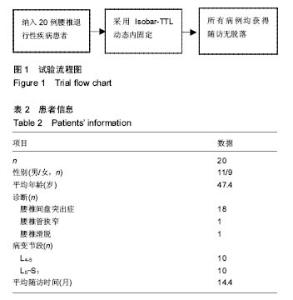
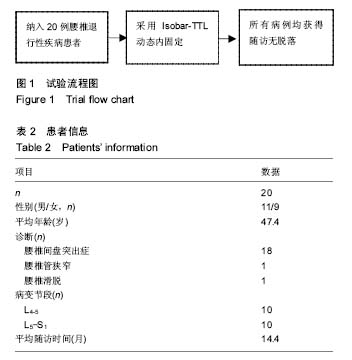
2.1 参与者数量分析 按意向性处理,纳入20例腰椎退行性疾病患者,所有病例均获得随访,无脱落,实验流程见图1。患者临床信息见表2。"
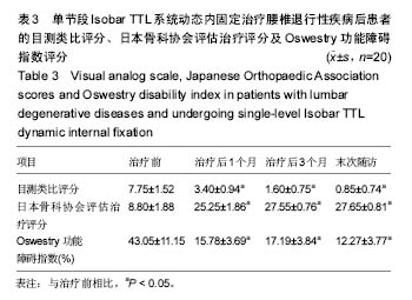
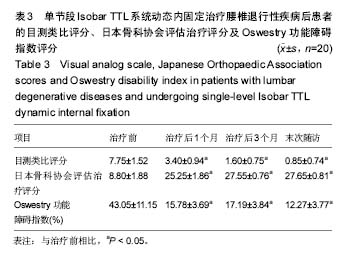
2.2 功能随访结果 随访时间为12-27个月,平均随访时间14.4个月,所有患者均顺利完成手术。患者治疗后症状得到明显改善,如表3所示,治疗后各时间点患者目测类比评分、Oswestry功能障碍指数及日本骨科协会评估治疗评分与治疗前相比,差异有显著性意义(P < 0.05)。"
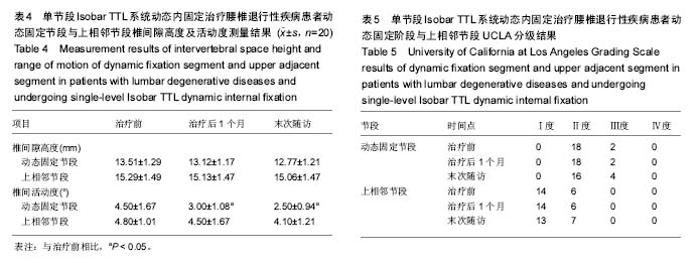
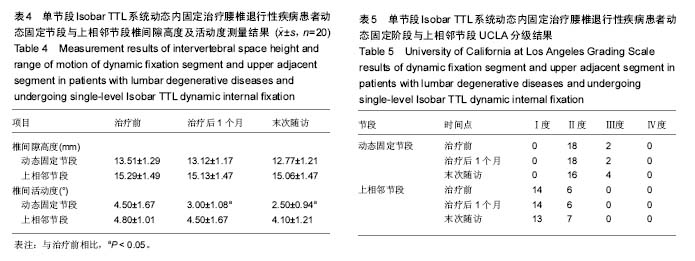
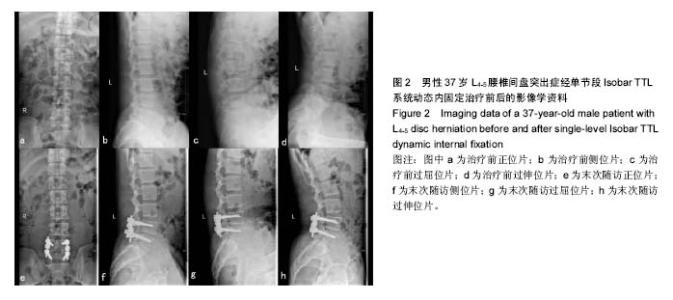
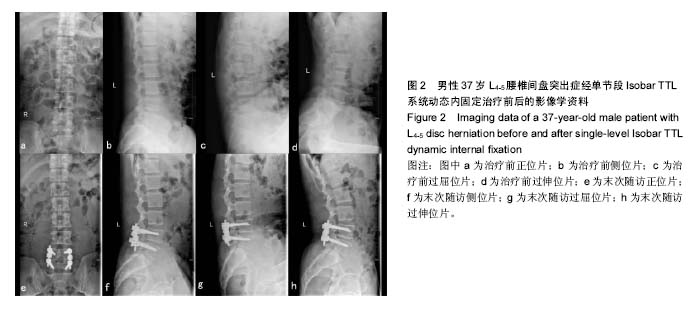
2.3 影像随访结果 20例患者治疗前及治疗后动态固定节段及上相邻节段的椎间隙高度、活动度见表4。治疗前后患者动态固定节段及上相邻节段的椎间隙高度没有明显变化(P > 0.05),而动态固定节段活动度随治疗后时间的延长而逐渐降低(P < 0.05),但上相邻节段活动度在治疗前后没有明显变化(P > 0.05)。 UCLA系统评价见表5,治疗后及末次随访动态固定节段及上相邻节段UCLA分级与治疗前差异无显著性意义 (P > 0.05)。 2.4 不良事件 所有患者均顺利完成手术,术中未出现硬膜撕裂,神经、血管损伤及等情况,术后及随访未出现内固定松动、断裂等情况。 2.5 典型病例 男性患者,37岁,因“腰痛5年余,加重伴左下肢疼痛麻木1周”入院。入院后完善相关检查,排除手术禁忌后,行L4-5 Isobar TTL动态内固定,见图2。患者治疗前及治疗1,3个月与末次随访时的目测类比评分分别为8,3,3,0,日本骨科协会评估治疗评分分别为10,21,27,28,Oswestry功能障碍指数分别为42.22%,15.56%、11.11%,8.89%。"
"
| [1] Donnally IC, Dulebohn SC. Lumbar degenerative disk disease, in StatPearls. 2017: Treasure Island (FL).[2] Sangiorgio SN, Sheikh H, Borkowski SL, et al. Comparison of three posterior dynamic stabilization devices. Spine. 2011; 36(19):E1251-1258.[3] Madan SS, Boeree NR. Comparison of instrumented anterior interbody fusion with instrumented circumferential lumbar fusion. Eur Spine J. 2003;12(6):567-575.[4] Yu SW, Yen CY, Wu CH, et al. Radiographic and clinical results of posterior dynamic stabilization for the treatment of multisegment degenerative disc disease with a minimum follow-up of 3 years. Arch Orthop Trauma Surg. 2012;132(5): 583-589.[5] Zhou ZJ, Xia P, Zhao X, et al. Can posterior dynamic stabilization reduce the risk of adjacent segment deterioration? Turk Neurosurg. 2013;23(5):579-589.[6] Kaner T, Ozer AF. Dynamic stabilization for challenging lumbar degenerative diseases of the spine: a review of the literature. Adv Orthop. 2013;2013:753470.[7] Prud'homme M, Barrios C, Rouch P, et al. Clinical outcomes and complications after pedicle-anchored dynamic or hybrid lumbar spine stabilization: a systematic literature review. J Spinal Disord Tech. 2015;28(8):E439-448.[8] Sengupta DK, Herkowitz HN. Pedicle screw-based posterior dynamic stabilization: literature review. Adv Orthop. 2012; 2012:424268.[9] Bono CM, Kadaba M, Vaccaro AR. Posterior pedicle fixation-based dynamic stabilization devices for the treatment of degenerative diseases of the lumbar spine. J Spinal Disord Tech. 2009;22(5):376-383.[10] Chamoli U, Diwan AD, Tsafnat N. Pedicle screw-based posterior dynamic stabilizers for degenerative spine: in vitro biomechanical testing and clinical outcomes. J Biomed Mater Res A. 2014;102(9):3324-3340.[11] Qian J, Bao ZH, Li X, et al. Short-term therapeutic efficacy of the Isobar TTL dynamic internal fixation system for the treatment of lumbar degenerative disc diseases. Pain Physician. 2016;19(6):E853-861.[12] Wang Y, Fu W, Zhang S, et al. CXCR-7 receptor promotes SDF-1α-induced migration of bone marrow mesenchymal stem cells in the transient cerebral ischemia/reperfusion rat hippocampus. Brain Res. 2014;1575:78-86.[13] Hudson WR, Gee JE, Billys JB, et al. Hybrid dynamic stabilization with posterior spinal fusion in the lumbar spine. SAS J. 2011;5(2):36-43.[14] Li Z, Li F, Yu S, et al. Two-year follow-up results of the Isobar TTL Semi-Rigid Rod System for the treatment of lumbar degenerative disease. J Clin Neurosci. 2013;20(3):394-399.[15] 姚欣强,蒋晖,程勇泉,等.Isobar TTL系统治疗腰椎退行性疾病的中长期随访结果[J].中国矫形外科杂志,2017,25(3):199-203.[16] Xing R, Dou Q, Li X, et al. Posterior dynamic stabilization with direct pars repair via Wiltse approach for the treatment of lumbar spondylolysis: the application of a novel surgery. Spine. 2016;41(8):E494-502.[17] Yang JY, Lee JK, Song HS. The impact of adjacent segment degeneration on the clinical outcome after lumbar spinal fusion. Spine (Phila Pa 1976). 2008;33(5):503-507.[18] Dahl B, Gehrchen P, Blyme P, et al. Clinical outcome after spinal fusion with a rigid versus a semi-rigid pedicle screw system. Eur Spine J. 1997;6(6):412-416.[19] Zencica P, Chaloupka R, Hladikova J, et al. Adjacent segment degeneration after lumbosacral fusion in spondylolisthesis: a retrospective radiological and clinical analysis. Acta Chir Orthop Traumatol Cech. 2010;77(2):124-130.[20] Kalanithi PS, Patil CG, Boakye M. National complication rates and disposition after posterior lumbar fusion for acquired spondylolisthesis. Spine. 2009;34(18):1963-1969.[21] Xia XP, Chen HL, Cheng HB. Prevalence of adjacent segment degeneration after spine surgery: a systematic review and meta-analysis. Spine. 2013;38(7):597-608.[22] Kumar MN, Baklanov A, Chopin D. Correlation between sagittal plane changes and adjacent segment degeneration following lumbar spine fusion. Eur Spine J. 2001;10(4): 314-319.[23] Morishita Y, Ohta H, Naito M, et al. Kinematic evaluation of the adjacent segments after lumbar instrumented surgery: a comparison between rigid fusion and dynamic non-fusion stabilization. Eur Spine J. 2011;20(9):1480-1485.[24] Chuang WH, Lin SC, Chen SH, et al. Biomechanical effects of disc degeneration and hybrid fixation on the transition and adjacent lumbar segments: trade-off between junctional problem, motion preservation, and load protection. Spine. 2012;37(24):E1488-1497.[25] 吕建华,唐昭惠,陈凯,等.半坚强与坚强内固定邻近节段腰椎间盘角位移及应力的比较[J].中国组织工程研究,2016,20(9): 1275-1281.[26] Cakir B, Carazzo C, Schmidt R, et al. Adjacent segment mobility after rigid and semirigid instrumentation of the lumbar spine. Spine. 2009;34(12):1287-1291.[27] Zhang L, Shu X, Duan Y, et al. Effectiveness of ISOBAR TTL semi-rigid dynamic stabilization system in treatment of lumbar degenerative disease. Zhongguo Xiu Fu Chong Jian Wai Ke Za Zhi. 2012;26(9):1066-1070.[28] 饶敏杰,钟招明,曾纪焕,等.Isobar TTL内固定系统治疗腰椎退行性疾病的临床疗效[J].中国骨与关节损伤杂志, 2013,28(3): 222-224.[29] Zhang ZM, Jin DD, Chen JT. Comparative study of dynamic fixation with rigid fixation in the management of degenerative lumbar spondylosis. Zhonghua Wai Ke Za Zhi. 2008;46(5): 346-349.[30] Gao J, Zhao W, Zhang X, et al. MRI analysis of the ISOBAR TTL internal fixation system for the dynamic fixation of intervertebral discs: a comparison with rigid internal fixation. J Orthop Surg Res. 2014;9:43.[31] Fu L, France A, Xie Y, et al. Functional and radiological outcomes of semi-rigid dynamic lumbar stabilization adjacent to single-level fusion after 2 years. Arch Orthop Trauma Surg. 2014;134(5):605-610. |
| [1] | Tang Xiaokai, Li Weiming. Role and mechanism of Nel-like molecule-1 in promoting bone fusion after spinal fusion [J]. Chinese Journal of Tissue Engineering Research, 2021, 25(24): 3914-3920. |
| [2] | Chen Jiang, Li Jinyu, Zheng Chenying, Bai Chunxiao, Zhang Fan, Liu Chuyin, Zhao Xueqian, Yuan Qiaomei, Di Xueshi, Kang Shengqian, Jia Yusong . Changes in sagittal parameters of cervical spine after double-segment artificial cervical disc replacement and anterior cervical discectomy and fusion [J]. Chinese Journal of Tissue Engineering Research, 2021, 25(15): 2341-2346. |
| [3] | Fang Yi, Zhao Wenzhi, Pan Deyue, Han Xin, Zhang Lu, He Hongtao, Shi Feng, Tian Tingxiao. Acromioclavicular joint dislocation: how to achieve anatomical reduction, sustained stability and micro-motion [J]. Chinese Journal of Tissue Engineering Research, 2020, 24(5): 796-802. |
| [4] | Cao Liangliang, Xu Jianguang, Mei Wei. Three-dimensional finite element analysis of the biomechanical changes of the lumbar spine after the combination of intervertebral fusion with dynamic internal fixation of the interspinous process in the lumbosacral region [J]. Chinese Journal of Tissue Engineering Research, 2020, 24(12): 1905-1910. |
| [5] | Fu Jiaxin, Xiao Lianping, Wang Shusen, Li Xiaodong, Han Liqiang, Wang Tonghao. Therapeutic effects of paraspinal approach combined with internal fixation through pedicle of fractured vertebra versus traditional AF screw-rod system for thoracolumbar fractures [J]. Chinese Journal of Tissue Engineering Research, 2019, 23(8): 1177-1181. |
| [6] | Qiu Zhongpeng, Li Ke, Li Gang, Liu Keyu, Du Xinhui, Meng Defeng, Shi Chenhui, Wang Weishan. Different treatments for two-part and three-part proximal humeral fractures by Neer classification: follow-up results analyzed using clinical economics [J]. Chinese Journal of Tissue Engineering Research, 2019, 23(8): 1188-1195. |
| [7] | Ke Wei, Li Ke, Wang Sibo, Du Xinhui, Qiu Zhongpeng, Kang Zhilin, Wang Weishan, Li Gang . Open reduction and plate fixation versus closed reduction and external fixation for distal radius fractures: scores and linear regression analysis [J]. Chinese Journal of Tissue Engineering Research, 2019, 23(8): 1196-1202. |
| [8] | Wang Liang, Li Lijun, Zhu Fuliang, Jiang Zhuyan, Wang Shuai, Ni Dongkui . Cortical bone trajectory screw versus pedicle screw fixation after posterior lumbar interbody fusion: a meta-analysis [J]. Chinese Journal of Tissue Engineering Research, 2019, 23(8): 1291-1298. |
| [9] | Fan Zhirong, Peng Jiajie, Zhong Degui, Zhou Lin, Su Haitao, Huang Yongquan, Wu Jianglin, Liang Yihao. Suture anchor combined with open reduction and internal fixation versus open reduction and internal fixation for ankle fracture combined with deltoid ligament injury: a meta-analysis [J]. Chinese Journal of Tissue Engineering Research, 2019, 23(8): 1307-1312. |
| [10] | Zhou Yu, Liu Yuehong, Liu Shuping, Chen Xi, Qin Wei, Li Qifeng. Spinal stability of intervertebral grafting reinforced by five or six augmenting screws versus transvertebral grafting reinforced by four augmenting screws for thoracolumbar vertebral fractures [J]. Chinese Journal of Tissue Engineering Research, 2019, 23(4): 505-511. |
| [11] | Li Qingsong, Liu Shaoyu, Yin Zongsheng. Multiple posterior lumbar interbody fusion and posterolateral fusion instrumentation for thoracolumbar kyphosis and osteoporotic fracture in older adults [J]. Chinese Journal of Tissue Engineering Research, 2019, 23(4): 512-517. |
| [12] | Li Xianzhou, Wang Qian, Zhang Cunxin . Lumbar spondylolisthesis: status and prospects of implant treatment [J]. Chinese Journal of Tissue Engineering Research, 2019, 23(4): 621-627. |
| [13] | Yin Hao, Zhou Enchang, Pan Zhengjun, Chen Guang, Jiang Hua. Finite element analysis of the four and three cannulated screws combined with buttress plate fixation for the treatment of Pauwels III femoral neck fractures [J]. Chinese Journal of Tissue Engineering Research, 2019, 23(32): 5133-5137. |
| [14] | Yi Guoliang, Wang Shankun, Song Xizheng. Biomechanical testing of the locking axial lumbosacral interbody fusion [J]. Chinese Journal of Tissue Engineering Research, 2019, 23(28): 4546-4551. |
| [15] |
Wang Lei, Li Zilong, Yuan Binbin, Wu Qingwei, Tang Fengming.
Clinical effect of locking plate versus anterograde intramedullary nail in the treatment of adult humeral shaft fractures: a meta-analysis
[J]. Chinese Journal of Tissue Engineering Research, 2019, 23(24): 3924-3930.
|
| Viewed | ||||||
|
Full text |
|
|||||
|
Abstract |
|
|||||