Chinese Journal of Tissue Engineering Research ›› 2026, Vol. 30 ›› Issue (27): 7167-7175.doi: 10.12307/2026.275
Previous Articles Next Articles
Construction and validation of a temperature prediction model for cortical bone during orthopedic surgery
Hu Zanying1, Gao Fei2
- 1Sports Training College, 2School of Physical Education, Tianjin University of Sport, Tianjin 301617, China
-
Received:2025-11-11Accepted:2025-11-27Online:2026-09-28Published:2026-05-22 -
Contact:Gao Fei, PhD, Doctoral supervisor, Professor, School of Physical Education, Tianjin University of Sport, Tianjin 301617, China -
About author:Hu Zanying, MS, Sports Training College, Tianjin University of Sport, Tianjin 301617, China -
Supported by:National Social Science Foundation of China, No. 23BTY045 (to GF)

CLC Number:
Cite this article
Hu Zanying, Gao Fei. Construction and validation of a temperature prediction model for cortical bone during orthopedic surgery[J]. Chinese Journal of Tissue Engineering Research, 2026, 30(27): 7167-7175.
share this article
Add to citation manager EndNote|Reference Manager|ProCite|BibTeX|RefWorks
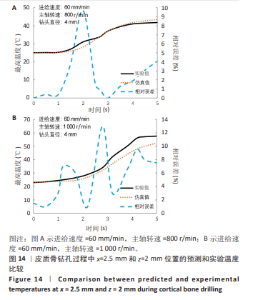
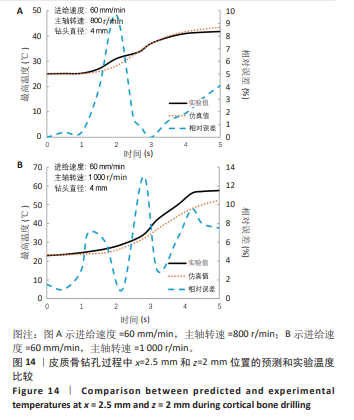
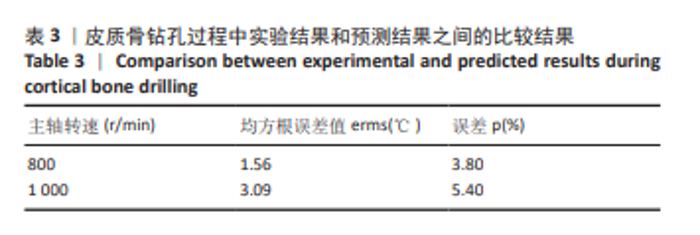
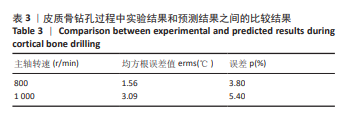
5.1 模型验证 根据热电偶测试收集的数据和共轭梯度法的反演,推断出皮质骨的能量分布系数为11.7%。图14为皮质骨钻孔过程中实验确定和预测温度值的对比,发现在固定进给率的过程中,主轴转速为800,1 000 r/min时,骨温度峰值分别为41.8 ℃和52.7 ℃。在相同条件下,预测温度分别为39.8 ℃和56.8 ℃。结果表明,温度随时间逐渐升高,主轴转速的增加会导致测量位置的温度升高。 理论值和实验值之间的相对误差是以平均方根值分析得来。模型预测值在合理误差范围内与实验值之间的误差较小,最大误差p < 6%。如表3所示,误差的可能解释是实验中存在热辐射和热对流,以及测试中人为因素不可避免的影响。因此,温度预测模型能够准确体现出在皮质骨钻孔过程中一定程度的温度分布情况。"
"
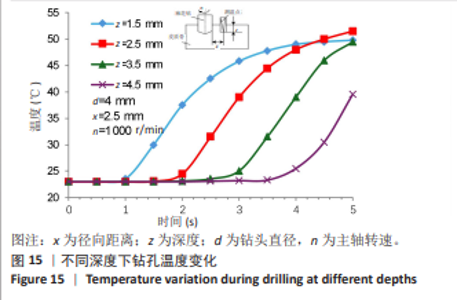
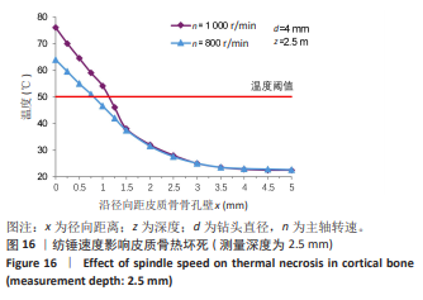
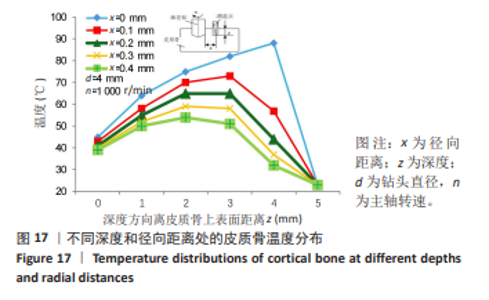
5.2 不同深度皮质骨温度的模拟分析 数学模型建构用于预测皮质骨温度随钻孔时间在不同方向和深度上的变化。在x=2.5的位置,皮质骨温度在不同深度的分布如图15所示。以进给速度为60 mm/min、主轴速度n为1 000 r/min进行模拟。 由图15可知,钻孔深度对皮质骨温度分布有很大影响。皮质骨的温度在z=1.5 mm的深度最早升高,在z=4.5 mm的深度最慢升高,峰值出现在5 s,最大峰差为12.7 ℃,在z=2.5 mm深度皮质骨的最高峰值温度约为52.2 ℃。该数值模拟表明,在皮质骨钻孔过程中,温度测量的最佳深度为z=2.5 mm,温度与深度之间的关系是非线性的。 5.3 纺锤体速度影响皮质骨坏死的范围 根据CARTER等[59]的研究,骨保持生物活性的极限温度是50 ℃,不会发生热坏死。该研究对热影响区进行了定义及阐述,即皮质骨温度高于50 ℃的区域,为评估皮质骨潜在热损伤区域提供了可靠有力的指标。皮质骨钻孔温度场的理论模型对不同主轴转速的下沿——皮质骨向x的温度变化进行了研究,并分析主轴转速影响皮质骨热坏死的范围。 当进给速度60 mm/min、钻头直径4 mm时,主轴转速依次为800 r/min和1 000 r/min的热影响区计算结果如图16所示。主轴转速为800 r /min时,沿径向温度≥50 ℃的范围为0.68 mm (热影响区为0.68 mm);相同条件下,主轴转速为1 000 r/min时,热影响区为0.81 mm。籍此得出结论,主轴转速较大时,热影响区较大,钻削温度沿径向x呈指数下降(图16)。 5.4 不同径向位置皮质骨温度的仿真分析 在皮质骨钻孔实际测试中,安装热电偶位置可能距离孔边缘不止0.5 mm。因此,使用上述建立的数学预测模型研究x < 0.5 mm的温度变化,在主轴转速为1 000 r/min、测量时间为4 s的情况下进行仿真分析。 在实际皮质骨钻孔实验中,热电偶的安装位置可能距孔壁超过0.5 mm,为避免对钻孔过程造成干扰,确保测温稳定性,以测温点径向距离为定值(x=0.5 mm),针对测量径向距离皮质骨空隙小于0.5 mm的温度进行分析。而发生骨热损伤的高频区恰好位于关键测量区,导致该区域的温度测量难度颇大。因而,此次研究对不同径向距离(x=0,0.1,0.2,0.3 和 0.4 mm)及不同深度(z=0,1,2,3 和 4 mm)温度变化规律进行了系统分析,其结果如图17所示。 从图17的结果来看,在皮质骨钻削区域内,测温点与热源间的距离同所记录的温度值呈正相关关系,即距离越近,温度越高。在位置 x=0 mm,z=4 mm处检测到最高温度,峰值高达 86.9 ℃;此外,在深度 z=4 mm 的截面中,沿径向的温差最为显著,该截面内不同深度测量点之间的最大温差为 32.4 ℃,当径向距离为 0.4 mm 时,温度沿径向分布呈现负相关关系,即随着与钻孔中心距离的增大,刀具摩擦所产生的热量累积逐渐减小。这主要是由于皮质骨导热系数较低,热量传递存在明显的滞后效应所造成的;在持续钻削的过程中,刀具摩擦产热累积促使温度上升,在钻头持续钻削时钻透皮质骨形成通孔的时刻,温度达到峰值,而随钻削过程深入至钻头钻透皮质骨形成通孔后,热量散失显著增强,温度随之呈下降趋势。"
"
"
| [1] ERIKSSON AR, ALBREKTSSON T. Temperature threshold levels for heat-induced bone tissue injury: a vital-microscopic study in the rabbit. J Prosthet Dent. 1983; 50(1):101-107. [2] 丁宁, 许明, 刘建. 骨钻削过程的热损伤与温度控制研究进展[J]. 中国组织工程研究,2021,25(21):3393-3402. [3] AUGUSTIN G, DAVILA S, UDILJAK T, et al. Temperature changes during cortical bone drilling with a newly designed step drill and an internally cooled drill. Int Orthop. 2012;36(7):1449-1456. [4] 周伟, 刘磊, 李杨. 不同钻削参数与灌洗方式对皮质骨温升的影响:体外实验研究[J]. 医用生物力学,2022,37(4):472-479. [5] GUPTA V, PULAK M, PANDEY P, et al. Effect of Various Parameters on the Temperature Distribution in Conventional and Diamond Coated Hollow Tool Bone Drilling: A Comparative Study. Proc Eng. 2017;184:90-98. [6] 王强, 张立, 韩晨. 骨组织钻孔温度场的三维数值预测与实验验证[J]. 中国医学物理学杂志,2020,37(7):815-823. [7] LI Y, WANG X, ZHANG H, et al. Thermal injury thresholds in cortical bone drilling: A systematic review and meta-analysis. J Orthop Res. 2023;41(5):1123-1135. [8] PARK JH, KIM S, LEE D, et al. Real-time temperature monitoring during orthopedic drilling using fiber Bragg grating sensors. Sens Actuat A Phys. 2022;334:113357. [9] AUGUSTIN G, STARCEVIC B, MAJER D, et al. Cortical bone drilling heat generation and osteocyte viability: An in vivo porcine study. Clin Biomech. 2021;89:105472. [10] NAJAFI F, GHORBANLOO M, SADEGHI M. Thermal damage modeling in bone drilling: Review and future directions. Med Eng Phys. 2023;112:103978. [11] ALAM K, ALAM MN, RAHMAN MM, et al. Effect of drill bit geometry on temperature rise and thrust force during bone drilling. Proc Inst Mech Eng. 2022; 236(3):321-332. [12] WANG L, LIU Y, CHEN Z, et al. Time-temperature equivalence for thermal necrosis prediction in cortical bone. J Biomech Eng. 2024;146(2):021005. [13] LEE WC, LIN CP, CHEN TH, et al. Anisotropic thermal conductivity measurement of human cortical bone using laser flash analysis. J Mech Behav Biomed Mater. 2023;137:105589. [14] SINGH R, GUPTA V, JAIN NK. Chip accumulation and its effect on heat dissipation during bone drilling: An experimental investigation. Int J Adv Manufact Technol. 2022;120(7/8):4567-4579. [15] KHAN MA, AHMED I, RAZA S, et al. Association between intraoperative thermal events and early implant failure in total hip arthroplasty: A multicenter retrospective cohort study. J Arthroplasty. 2023;38(4):789.e1-789.e7. [16] ZHAO H, LIU B, WANG Q, et al. Smart drilling systems for real-time thermal risk mitigation in orthopedic surgery: A review. IEEE Rev Biomed Eng. 2024;17:188-205. [17] CHEN X, ZHOU Y, LI M, et al. High-speed infrared thermography for mapping transient temperature fields in bone drilling. Infrared Phys Technol. 2023;128: 104512. [18] GUPTA V, PANDEY PM, SHARMA V. Comparative analysis of external irrigation vs. internal cooling drills in reducing thermal osteonecrosis. J Med Dev. 2022;16(1): 011003. [19] HUANG YT, LIN CY, CHEN CW, et al. Optimization of drill parameters to minimize thermal damage using response surface methodology. BioMed Eng OnLine. 2023;22(1): 45. [20] LIU Z, WANG J, ZHANG L, et al. Micro-grooved drill bits for enhanced chip evacuation and reduced frictional heating in bone drilling. Tribol Int. 2024;191: 108976. [21] ROSSI A, BIANCHI M, DI PIETRO L, et al. Thermal mapping of bone drilling with embedded micro-thermocouples: Spatial resolution and uncertainty analysis. Measure Sci Technol. 2022;33(8):085007. [22] ZHANG Q, SUN W, LI H, et al. Radial temperature gradient and HAZ expansion under variable rotational speed in porcine femoral drilling. J Thermal Biol. 2023; 112:103456. [23] LEE S, KIM D. Infrared characterization of maximum temperature and duration at critical zones during continuous bone drilling. J Health Eng. 2022;2022:9876543. [24] TANAKA M, SATO Y, KOBAYASHI N, et al. Internal coolant delivery system reduces peak temperature by 32% in dense cortical bone: An ex vivo study. J Orthop Sci. 2023;28(2):345-351. [25] ZHOU W, LIU Y, ZHANG X, et al. Biomimetic fluted drill design inspired by termite mandibles for low-heat bone penetration. Bioinspir Biomim. 2024;19(2):026001. [26] AL-HABIB A, ALSHEHRI F, ALSHAMMARI F, et al. Closed-loop adaptive drilling system with real-time temperature feedback for minimizing thermal injury. Robot Comput Integr Manuf. 2023;80:102456. [27] PEREIRA BP, SILVA MJ, FONSECA F, et al. Limitations of extrapolating thermal models across anatomical sites: A comparative finite element study. Comput Methods Biomech Biomed Engin. 2022;25(10):1122-1134. [28] WU CW, CHEN YC, LIN CH, et al. Three-dimensional transient thermal modeling of bone drilling using moving heat source approach. Appl Ther Eng. 2023;219(Part B): 119432. [29] YANG J, LIU R, WANG T, et al. Finite element simulation of temperature distribution in anisotropic cortical bone during high-speed drilling. Int Commun Heat Mass Trans. 2024;151:107218. [30] WANG H, ZHANG D, LIU S, et al. Multiphase coupled thermo-mechanical model for bone drilling incorporating marrow convection and chip thermal resistance. Int J Heat Mass Transf. 2024;217:124789. [31] CHEN TL, LIN YC, HSIEH MH, et al. Bayesian regularization inverse method for reconstructing bone-drill interface heat flux from sparse thermocouple data. Inverse Probl Sci Eng. 2023;31(4):567-589. [32] XU L, ZHANG K, WANG F, et al. Machine learning-assisted prediction of drilling-induced thermal injury using operational parameters. Artif Int Med. 2023;145: 102673. [33] OFTADEH R, NIARCHOS G, VARDAZI A, et al. Direction-dependent thermal properties of human femoral cortical bone: Experimental determination and clinical implications. Bone. 2022;164:116521. [34] PATEL V, DESAI J, GUPTA SK. Dynamic heat source modeling accounting for tool wear progression in prolonged bone drilling operations. Wear. 2023;518/519: 204678. [35] GIACOMINI C, BOZZOLI F, RINALDI A, et al. From temperature maps to cell death probability: A machine learning-based thermal damage criterion for cortical bone. J Royal Soc Int. 2024;21(212):20230789. [36] IFESS. Guidelines for Thermal Safety in Orthopedic Drilling Procedures. Geneva: International Federation of Engineering Societies in Surgery, 2023. [37] KIM EJ, PARK S, LEE J, et al. Development of a drill-integrated micro-cooling nozzle for localized temperature control. Micros Technol. 2022;28(11):1567-1578. [38] SILVA F, COSTA L, MENDES J, et al. Thermal dose concept applied to bone drilling: Equivalent minutes at 43°C (CEM43) as predictor of osteocyte apoptosis. Int J Hyperther. 2024;40(1):2215878. [39] ZHAO Y, LI X, WANG Z, et al. Numerical-experimental correlation study on heat partition ratio between chip, tool and bone tissue. J Manufact Proc. 2023;94: 102-113. [40] RAJPUT NK, VERMA A, TIWARI S. Effect of pulsatile irrigation on heat removal efficiency during orthopedic drilling: A CFD-assisted experimental study. J Fluids Eng. 2022;144(9):091301. [41] COSTA P, FERREIRA A, OLIVEIRA J, et al. Patient-specific finite element modeling of tibial drilling incorporating CT-derived density-thermal conductivity relationships. Comp Biol Med. 2024;169:107822. [42] HUANG K, ZHANG R, LIU Y, et al. Deep learning surrogate model for rapid prediction of bone drilling temperature field under arbitrary boundary conditions. Eng Appl Artif Intell. 2023;125:106789. [43] BIANCHI M, ROSSI A, DI PIETRO L, et al. Validation of infrared thermography against embedded thermocouples in fresh cadaveric bone drilling. Quantitative InfraRed Ther J. 2022;19(3):245-260. [44] YU J, LI Z, WANG H, et al. Multi-objective optimization of drilling parameters balancing thermal safety and surgical efficiency via NSGA-II algorithm. Exp Syst Appl. 2024;235:121234. [45] DE SANTIS E, CARUSO M, BRUNO G, et al. Clinical translation roadmap for computational thermal models in orthopedic surgery: Regulatory, validation and implementation challenges. Front Bioeng Biotechnol. 2023;11:1123456. [46] SENER U, YILMAZ B, KORKMAZ F, et al. Real-time thermal mapping using AI-enhanced thermographic feedback during robotic bone drilling. Sensors. 2023;23(4):2105. [47] ZHAO R, LIU H, CHEN W, et al. Bone drilling heat transfer: A comprehensive review of experimental setups and numerical benchmarks. Heat Trans Eng. 2024;45(3):289-307. [48] LIU H, ZHANG Y, WANG L, et al. Experimental validation of a novel inverse heat conduction algorithm for predicting bone thermal damage during drilling. J Ther Stress. 2023;46(5):401-418. [49] CHEN W, LI J, ZHOU T, et al. Influence of bone anisotropy on heat distribution during orthopedic drilling: A combined experimental and computational study. J Mechan Behav Biomed Mater. 2022;136:105522. [50] ZHANG Y, WANG X, LIU Z, et al. Digital twin framework for real-time thermal risk assessment in orthopedic drilling surgery. Adv Intell Syst. 2024;6(2):2300345. [51] GUPTA V, PULAK M, PANDEY P, et al. Effect of Various Parameters on the Temperature Distribution in Conventional and Diamond Coated Hollow Tool Bone Drilling: A Comparative Study. Proc Eng. 2017;184:90-98. [52] 王强, 张立, 韩晨. 骨组织钻孔温度场的三维数值预测与实验验证[J]. 中国医学物理学杂志,2020,37(7):815-823. [53] JAEGER JC. Moving Sources of Heat and the Temperature of Sliding Contacts. J. & Proc.roy.soc.new South Wales, 1942:76. [54] ENGIN S, ALTINTAS Y. Mechanics and dynamics of general milling cutters Part I: helical end mill. Int J Mach Tools Manuf. 2001;41:2195-2212. [55] MUKHERJEE I, RAY PK, MUKHERJEE I, et al. A review of optimization techniques in metal cutting processes. Compute Ind Eng. 2006;15:3-5. [56] MILLER ER, ULLREY DE. The pig as a model for human nutrition. Annu Rev Nutr. 1987;7:361-382. [57] LEE J, OZDOGANLAR OB, RABIN Y. An experimental investigation on thermal exposure during bone drilling. Med Eng Phys. 2012;34(10):1510-1520. [58] AUGUSTIN G, DAVILA S, MIHOCI K, et al. Thermal osteonecrosis and bone drilling parameters revisited. Arch. Orthop Trauma Surg. 2008;128:71-77. [59] CARTER DR, HAYES WC. The fatigue life of compact bone-I. Effects of stress amplitude temperature and density. J Biomech. 1976;9:27-34. |
| [1] | Fang Fengchao, Yang Wenwu, Wu Hongtao, Peng Peng, Liang Zhiye, Jiang Tao, Chen Weijian, Liu Wengang, Zhao Chuanxi. Association between mitochondrial dynamics imbalance and cartilage degeneration in osteoarthritis [J]. Chinese Journal of Tissue Engineering Research, 2026, 30(在线): 1-8. |
| [2] | Li Zhifei, Han Bin, Liu Qiuli, Zhang Zhanming, Wei Haokai, Zuo Kuangshi, Zhang Yisheng. Cervical motion characteristics in patients with cervical spondylotic radiculopathy based on motion capture technology [J]. Chinese Journal of Tissue Engineering Research, 2026, 30(9): 2286-2293. |
| [3] | Wang Nan, Chen Shuang, Xi Zhipeng, Qian Yuzhang, Zhang Xiaoyu, Gu Jun, Kang Ran, Xie Lin. MRI evaluation of nerve root subsidence sign affecting efficacy of percutaneous endoscopic decompression in lumbar spinal stenosis [J]. Chinese Journal of Tissue Engineering Research, 2026, 30(9): 2262-2268. |
| [4] | Zhu Xiaolong, Zhang Wei, Yang Yang. Visualization analysis of research hotspots and cutting-edge information in the field of intervertebral disc regeneration and repair [J]. Chinese Journal of Tissue Engineering Research, 2026, 30(9): 2391-2402. |
| [5] | Xinjiang Branch of China Trauma Rescue & Treatment Association. Expert consensus on diagnosis and treatment of brucellar osteoarthritis [J]. Chinese Journal of Tissue Engineering Research, 2026, 30(9): 2403-2412. |
| [6] | Wen Fayan, Li Yan, Qiang Tianming, Yang Chen, Shen Linming, Li Yadong, Liu Yongming. Unilateral biportal endoscopic technology for treatment of lumbar degenerative diseases: global research status and changing trends [J]. Chinese Journal of Tissue Engineering Research, 2026, 30(9): 2380-2390. |
| [7] | Pan Zhiyi, Huang Jiawen, Xue Wenjun, Xu Jianda. Advantages of MXene-based flexible electronic sensors and their application in monitoring diabetic foot wounds [J]. Chinese Journal of Tissue Engineering Research, 2026, 30(8): 2023-2032. |
| [8] | Wang Qisa, Lu Yuzheng, Han Xiufeng, Zhao Wenling, Shi Haitao, Xu Zhe. Cytocompatibility of 3D printed methyl acrylated hyaluronic acid/decellularized skin hydrogel scaffolds [J]. Chinese Journal of Tissue Engineering Research, 2026, 30(8): 1912-1920. |
| [9] | Wang Songpeng, Liu Yusan, Yu Huanying, Gao Xiaoli, Xu Yingjiang, Zhang Xiaoming, Liu Min. Bidirectional regulation of reactive oxygen species based on zeolitic imidazolate framework-8 nanomaterials: from tumor therapy and antibacterial activity to cytoprotection [J]. Chinese Journal of Tissue Engineering Research, 2026, 30(8): 2033-2013. |
| [10] | Gao Yanguo, Guo Xu, Li Xiaohan, Chen Shiqi, Zhu Haitao, Huang Liangyong, Ye Fang, Lu Wei Wang Qibin, Zheng Tao, Chen Li. Optimization of prescription ratio of “Honghuangbai” gel by orthogonal test in diabetic skin wound mouse models [J]. Chinese Journal of Tissue Engineering Research, 2026, 30(8): 1921-1928. |
| [11] | Liu Hongjie, Mu Qiuju, Shen Yuxue, Liang Fei, Zhu Lili. Metal organic framework/carboxymethyl chitosan-oxidized sodium alginate/platelet-rich plasma hydrogel promotes healing of diabetic infected wounds [J]. Chinese Journal of Tissue Engineering Research, 2026, 30(8): 1929-1939. |
| [12] | Min Changqin, Huang Ying. Construction of pH/near-infrared laser stimuli-responsive drug delivery system and its application in treatment of oral squamous cell carcinoma [J]. Chinese Journal of Tissue Engineering Research, 2026, 30(8): 1940-1951. |
| [13] | Shao Ziyu, Li Qian, Qumanguli·Abudukelimu, Han Youjun, Hu Yang. Preparation and characterization properties of three different ratios of biphasic calcium phosphate [J]. Chinese Journal of Tissue Engineering Research, 2026, 30(8): 1952-1961. |
| [14] | Zheng Xuying, Hu Hongcheng, Xu Libing, Han Jianmin, Di Ping. Stress magnitude and distribution in two-piece cement-retained zirconia implants under different loading conditions and with varying internal connection shapes [J]. Chinese Journal of Tissue Engineering Research, 2026, 30(8): 1979-1987. |
| [15] | Zhou Hongli, Wang Xiaolong, Guo Rui, Yao Xuanxuan, Guo Ru, Zhou Xiongtao, He Xiangyi. Fabrication and characterization of nanohydroxyapatite/sodium alginate/polycaprolactone/alendronate scaffold [J]. Chinese Journal of Tissue Engineering Research, 2026, 30(8): 1962-1970. |
| Viewed | ||||||
|
Full text |
|
|||||
|
Abstract |
|
|||||