Chinese Journal of Tissue Engineering Research ›› 2026, Vol. 30 ›› Issue (26): 6833-6839.doi: 10.12307/2026.232
Previous Articles Next Articles
Physicochemical properties and angiogenesis-promoting effects of copper-containing calcium sulfate bone cement
Huang Lei, Lan Tian, Zeng Hui
- Baiyun District People's Hospital of Guangzhou, Guangzhou 510080, Guangdong Province, China
-
Accepted:2025-11-09Online:2026-09-18Published:2026-03-11 -
Contact:Huang Lei, MD, Attending physician, Baiyun District People's Hospital of Guangzhou, Guangzhou 510080, Guangdong Province, China -
About author:Huang Lei, MD, Attending physician, Baiyun District People's Hospital of Guangzhou, Guangzhou 510080, Guangdong Province, China -
Supported by:Guangzhou Municipal Health Science and Technology Project, No. 20231A010075 (to HL); President's Fund of Baiyun Branch of Nanfang Hospital, Southern Medical University, No. BYYZ23009 (to HL)

CLC Number:
Cite this article
Huang Lei, Lan Tian, Zeng Hui. Physicochemical properties and angiogenesis-promoting effects of copper-containing calcium sulfate bone cement[J]. Chinese Journal of Tissue Engineering Research, 2026, 30(26): 6833-6839.
share this article
Add to citation manager EndNote|Reference Manager|ProCite|BibTeX|RefWorks
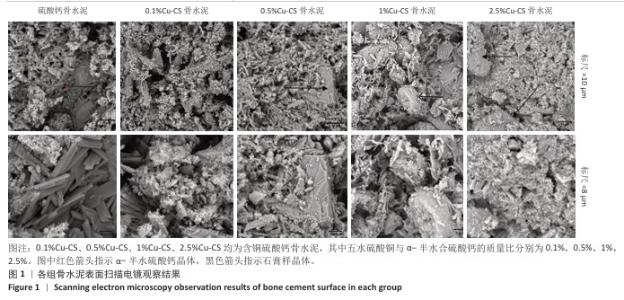
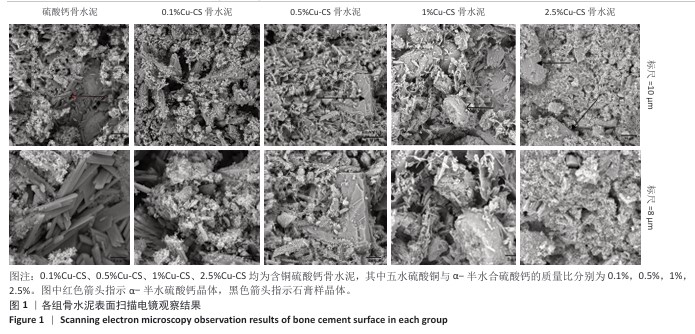
2.1 骨水泥表征结果 2.1.1 扫描电镜观察结果 硫酸钙骨水泥晶体表面多孔并聚集成毛绒状,但仍可见部分细长棒状的α-半水硫酸钙晶体(图中红色箭头所示);0.5%Cu-CS骨水泥晶体表面多孔且聚集成毛绒状,但可见板状石膏晶体(图中黑色箭头所示);2.5%Cu-CS骨水泥晶体表面结构改变最明显,表面聚集成团块状,同时板状石膏样晶体增多(图中黑色箭头所示),但晶体间仍具有孔隙状结构,见图1,表明五水硫酸铜的加入对石膏形成有促进作用。 "
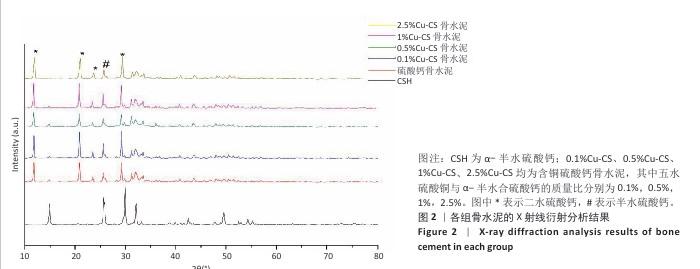
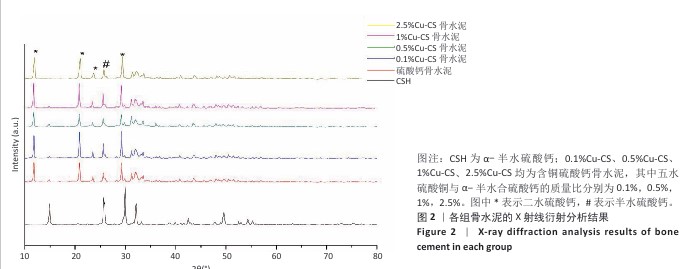
2.1.2 X射线衍射分析结果 各组骨水泥的X射线衍射图片,见图2。α-半水硫酸钙的特征性衍射峰分别出现在14.7°,25.7°,29.8°,31.9°和42.2°处,硫酸钙骨水泥与0.1%Cu-CS、0.5%Cu-CS、1%Cu-CS、2.5%Cu-CS骨水泥表面形成二水硫酸钙(CaSO4?2H2O),特征性衍射峰出现在11.6°,20.7°,29.1°,31.1°和33.4°,从特征性衍射峰偏移看出,在硫酸钙骨水泥与含铜骨水泥骨水泥晶体中α-半水相硫酸钙转化成二水相硫酸钙是主要相,部分毗邻或包裹内部未反应的半水相,也可以证明铜离子与硫酸钙结合。"
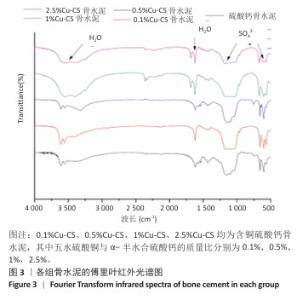
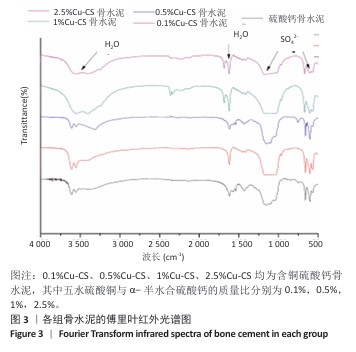
2.1.3 傅里叶红外光谱分析结果 各组骨水泥的傅里叶红外光谱图,如图3所示。在硫酸钙骨水泥中,光谱振动带出现在 3 405-3 550 cm-1范围内,对应水分子结晶中的O-H键,1 622-1 690 cm-1范围内的峰值对应O-H键弯曲,另外,600-660 cm-1和1 111-1 140 cm-1范围的峰值分别相应S-O键的拉伸和弯曲。含铜硫酸钙骨水泥的光谱与硫酸钙骨水泥完全相似,各对应峰值并未出现明显偏移,说明含铜硫酸钙骨水泥和硫酸钙骨水泥的官能团及化学键相一致。 "
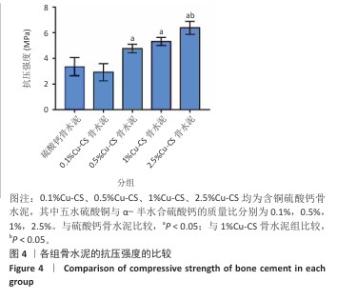
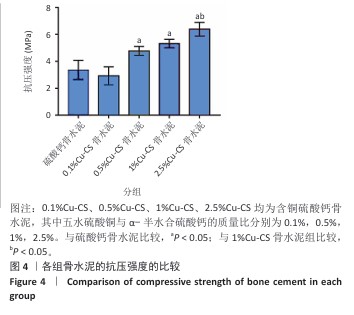
2.1.4 抗压强度检测结果 硫酸钙骨水泥与0.1%Cu-CS、0.5%Cu-CS、1%Cu-CS、2.5%Cu-CS骨水泥的抗压强度分别为(3.36±0.71),(2.93±0.66),(4.78±0.33),(5.32±0.31),(6.38±0.51) MPa。0.5%Cu-CS、1%Cu-CS、2.5%Cu-CS骨水泥的抗压强度高于0.1%Cu-CS、0.5%Cu-CS骨水泥(P < 0.05),2.5%Cu-CS骨水泥的抗压强度高于1%Cu-CS骨水泥(P < 0.05),见图4。"
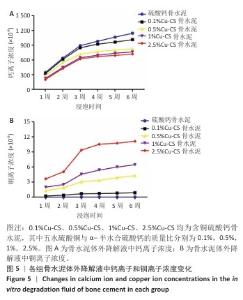
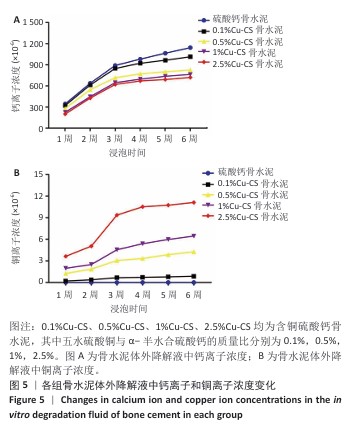
2.1.5 体外降解液中铜、钙离子累积浓度测定 各组骨水泥体外降解液中钙离子浓度检测结果,如图5A所示。硫酸钙骨水泥体外降解液中钙离子浓度大于含铜硫酸钙骨水泥,这与硫酸钙的高溶解性有关,并且随着硫酸铜质量的增加,体外降解液中钙离子浓度减少。 各组骨水泥体外降解液中钙铜离子浓度检测结果,如图5B所示。硫酸钙骨水泥体外降解液中未检测到铜离子,含铜硫酸钙骨水泥中体外降解液中均检测到铜离子,并且随着硫酸铜质量的增加,体外降液中铜离子浓度增加。"
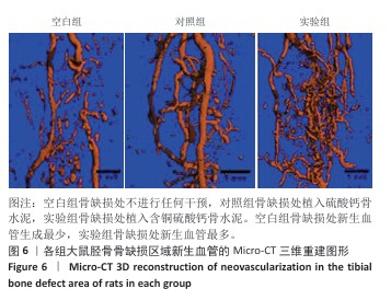
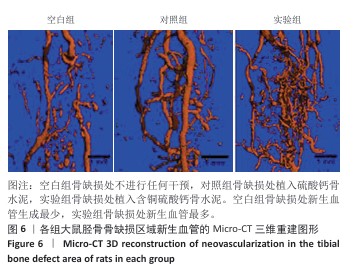
2.2 骨水泥的动物体内血管生成效应检测 2.2.1 实验动物数量分析 30只SD大鼠全部进入结果分析。 2.2.2 Micro-CT检测骨缺损区血管造影结果 各组大鼠胫骨标本新生血管的Micro-CT三维重建图像,见图6。空白组骨缺损处仅见少量新生血管生成,对照组骨缺损处新生血管数量密度高于空白组,实验组骨缺损处新生血管密度最密集。 "
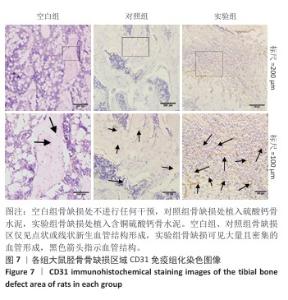
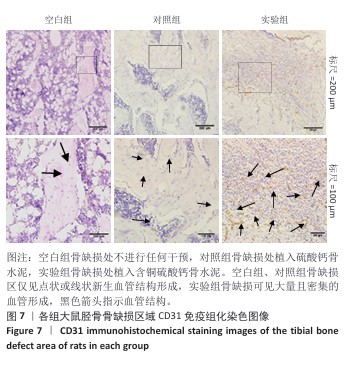
2.2.3 CD31免疫组化染色结果 各组大鼠胫骨缺损处的D31免疫组化染色图像,见图7。空白组与对照组缺损区有CD31标记物形成的黄褐色点状或线状新生血管结构的形成(图中黑色箭头所示),实验组骨缺损区可见大量且密集的血管形成(CD31标记物形成的黄褐色圆形或椭圆形结构,图中黑色箭头所示)。"
| [1] KURIEN T, PEARSON RG, SCAMMELL BE. Bone graft substitutes currently available in orthopaedic practice: the evidence for their use. Bone Joint J. 2013;95-B:583-597. [2] LUN DX, LI SY, LI NN, et al. Limitations and modifications in the clinical application of calcium sulfate. Front Surg. 2024;11:1278421. [3] KELLY CM, WILKINS RM, GITELIS S, et al. The use of a surgical grade calcium sulfate as a bone graft substitute: results of a multicenter trial. Clin Orthop Rel Res. 2001;382:42-50. [4] ORSINI M, ORSINI G, BENLLOCH D, et al. Comparison of calcium sulfate and autogenous bone graft to bioabsorbable membranes plus autogenous bone graft in the treatment of intrabony periodontal defects: a split-mouth study. J Periodontol. 2001;72(3):296-302. [5] SHI X, WU Y, NI H, et al. Antibiotic-loaded calcium sulfate in clinical treatment of chronic osteomyelitis: a systematic review and meta-analysis. J Orthop Surg Res. 2022;17(1):104. [6] GANGOLLI R, PUSHALKAR S, BEUTEL BG, et al. Calcium Sulfate Disks for Sustained-Release of Amoxicillin and Moxifloxacin for the Treatment of Osteomyelitis. Materials (Basel). 2024;17(16):4086. [7] STEADMAN W, CHAPMAN PR, SCHUETZ M, et al. Local Antibiotic Delivery Options in Prosthetic Joint Infection. Antibiotics (Basel). 2023;12(4):752. [8] SHAH KN, KAMAL RN. Bone Graft Substitutes-What Are My Options? Hand Clin. 2024;40(1):13-23. [9] CEN C, WANG C, ZHANG Y, et al. Osteoimmunomodulation unveiled: Enhancing bone regeneration with 3D-printed PLLA/β-TCP/CS scaffolds. Colloids Surf B Biointerfaces. 2025;252:114674. [10] ZHANG X, CHEN Y, FU J, et al. An injectable pH neutral bioactive glass-based bone cement with suitable bone regeneration ability. J Orthop Translat. 2022; 36:120-131. [11] GERARD C, BORDELEAU LJ, BARRALET J, et al. The stimulation of angiogenesis and collagen deposition by copper. Biomaterials. 2010;31:824-831. [12] CONFORTI RA, DELSOUC MB, ZORYCHTA E, et al. Copper in Gynecological Diseases. Int J Mol Sci. 2023;24(24):17578. [13] FINNEY L, VOGT S, FUKAI T, et al. Copper and angiogenesis: unravelling a relationship key to cancer progression. Clin Exp Pharmacol Physiol. 2009; 36(1):88-94. [14] BARRALET J, GBURECK U, HABIBOVIC P, et al. Angiogenesis in calcium phosphate scaffolds by inorganic copper ion release. Tissue Eng Part A. 2009; 15(7):1601-1609. [15] KONG N, LIN K, LI H, et al. Synergy effects of copper and silicon ions on stimulation of vascularization by copper-doped calcium silicate. J Mater Chem B. 2014;2(8):1100-1110. [16] LI Y, WANG Y, DING Y, et al. A Double Network Composite Hydrogel with Self-Regulating Cu(2+)/Luteolin Release and Mechanical Modulation for Enhanced Wound Healing. ACS Nano. 2024;18(26):17251-17266. [17] LI Y, LU Y, QIU B, et al. Copper-containing titanium alloys promote angiogenesis in irradiated bone through releasing copper ions and regulating immune microenvironment. Biomater Adv. 2022;139:213010. [18] SALVO J, SANDOVAL C. Role of copper nanoparticles in wound healing for chronic wounds: literature review. Burns Trauma. 2022;10:tkab047. [19] YANG J, HUANG Z, TAN J, et al. Copper ion/gallic acid MOFs-laden adhesive pomelo peel sponge effectively treats biofilm-infected skin wounds and improves healing quality. Bioact Mater. 2023;32:260-276. [20] NOORI A, HOSEINPOUR M, KOLIVAND S, et al. Synergy effects of copper and L-arginine on osteogenic, angiogenic, and antibacterial activities. Tissue Cell. 2022;77:101849. [21] GARIMELLA A, GHOSH SB, BANDYOPADHYAY-GHOSH S. Biomaterials for bone tissue engineering: achievements to date and future directions. Biomed Mater. 2024;5;20(1).doi: 10.1088/1748-605X/ad967c. [22] SANTORO A, VOTO A, FORTINO L, et al. Bone Defect Treatment in Regenerative Medicine: Exploring Natural and Synthetic Bone Substitutes. Int J Mol Sci. 2025; 26(7):3085. [23] KNABE C, HOUSHMAND A, BERGER G, et al. Effect of rapidly resorbable bone substitute materials on the temporal expression of the osteoblastic phenotype in vitro. J Biomed Mater Res Part A. 2008;84:856-868. [24] SHERIDAN GA, FALK DP, FRAGOMEN AT, et al. Calcium sulfate in the management of osteomyelitis: A systematic review and meta-analysis of comparative studies. Medicine (Baltimore). 2022;101(45):e31364. [25] TAYSHETYE RS, BHOLA N, DESHPANDE N, et al. Efficacy of calcium sulfate dihydrate as a bone graft substitute in odontogenic cystic defects of jaws following enucleation: A clinical study. Natl J Maxillofac Surg. 2023;14(1):125-129. [26] ZALEWSKA J, VIVCHARENKO V, BELCARZ A. Gypsum-Related Impact on Antibiotic-Loaded Composite Based on Highly Porous Hydroxyapatite—Advantages and Disadvantages. Int J Mol Sci. 2023;24(24):17178. [27] BOHNER M. New hydraulic cements based on alpha-tricalcium phosphate-calcium sulfate dihydrate mixtures. Biomaterials. 2004;25(4):741-749. [28] ISHIKAWA K, ASAOKA K. Estimation of ideal mechanical strength and critical porosity of calcium phosphate cement. J Biomed Mater Res. 1995; 29(12):1537-1543. [29] LIOLIOU MG, PARASKEVA CA, KOUTSOUKOS PG, et al. Calcium sulfate precipitation in the presence of water-soluble polymers. J Colloid Interface Sci. 2006;303(1):164-170. [30] LIAN X, XU R, LIU S, et al. The preparation and study on properties of calcium sulfate bone cement combined tuning silk fibroin nanofibers and vancomycin-loaded silk fibroin microspheres. J Biomed Mater Res B Appl Biomater. 2022; 110(3):564-572. [31] WANG S, WANG F, CHE J, et al. Study on the Performance and Mechanism of Cement Solidified Desulfurization Manganese Residue. Materials (Basel). 2023; 16(11):4184. [32] LUN DX, LI SY, LI NN, et al. Limitations and modifications in the clinical application of calcium sulfate. Front Surg. 2024;11:1278421. [33] ISHIKAWA K, MIYAMOTO Y, TAKECHI M, et al. Effects of neutral sodium hydrogen phosphate on setting reaction and mechanical strength of hydroxyapatite putty. J Biomed Mater Res. 1999;44(3):322-329. [34] WU F, SONG C, ZHEN G, et al. Exosomes derived from BMSCs in osteogenic differentiation promote type H blood vessel angiogenesis through miR-150-5p mediated metabolic reprogramming of endothelial cells. Cell Mol Life Sci. 2024;81(1):344. [35] ZENG Y, FU BM. Angiogenesis and Microvascular Permeability. Cold Spring Harb Perspect Med. 2025;15(1):a041163. [36] XU Z, LIU G, LIU P, et al. Hyaluronic acid-based glucose-responsive antioxidant hydrogel platform for enhanced diabetic wound repair. Acta Biomater. 2022; 147:147-157. [37] STROCCHI R, ORSINI G, IEZZI G, et al. Bone regeneration with calcium sulfate: evidence for increased angiogenesis in rabbits. J Oral Implantol. 2002;28(6): 273-278. [38] ZHAO Q, NI Y, WEI H, et al. Ion incorporation into bone grafting materials. Periodontol 2000. 2024;94(1):213-230. [39] KONG R, SUN G. Targeting copper metabolism: a promising strategy for cancer treatment. Front Pharmacol. 2023;14:1203447. [40] SHENG H, GU J, HUANG Y, et al. Cuproptosis-related signature predicts prognosis and indicates tumor immune infiltration in bladder cancer. Transl Androl Urol. 2024;13(10):2280-2293. [41] CONFORTI A, FRANCO L, MILANINO R, et al. Copper metabolism during acute inflammation: studies on liver and serum copper concentrations in normal and inflamed rats. Br J Pharmacol. 1983;79(1):45-52. [42] FORD ES. Serum copper concentration and coronary heart disease among US adults. Am J Epidemiol. 2000;151(12):1182-1188. [43] QIU L, DING X, ZHANG Z, et al. Copper is required for cobalt-induced transcriptional activity of hypoxia-inducible factor-1. J Pharmacol Exp Ther. 2012;342(2):561-567. [44] HUANG Y, CHEN Y, CHENG G, et al. A TA/Cu2+ Nanoparticle Enhanced Carboxymethyl Chitosan-Based Hydrogel Dressing with Antioxidant Properties and Promoting Wound Healing. Int J Nanomedicine. 2024;19:231-245. |
| [1] | Liu Yang, Liu Donghui , Xu Lei, Zhan Xu, Sun Haobo, Kang Kai. Role and trend of stimuli-responsive injectable hydrogels in precise myocardial infarction therapy [J]. Chinese Journal of Tissue Engineering Research, 2026, 30(8): 2072-2080. |
| [2] | Lai Yu, Chen Yueping, Zhang Xiaoyun. Research hotspots and frontier trends of bioactive materials in treating bone infections [J]. Chinese Journal of Tissue Engineering Research, 2026, 30(8): 2132-2144. |
| [3] | Li Qingbin, Lin Jianhui, Huang Wenjie, Wang Mingshuang, Du Jiankai, Lao Yongqiang. Bone cement filling after enlarged curettage of giant cell tumor around the knee joint: a comparison of subchondral bone grafting and non-grafting [J]. Chinese Journal of Tissue Engineering Research, 2026, 30(8): 1896-1902. |
| [4] | Jiang Xinghai, Song Yulin, Li Dejin, Shao Jianmin, Xu Junzhi, Liu Huakai, Wu Yingguo, Shen Yuehui, Feng Sicheng. Vascular endothelial growth factor 165 genes transfected into bone marrow mesenchymal stem cells to construct a vascularized amphiphilic peptide gel module [J]. Chinese Journal of Tissue Engineering Research, 2026, 30(8): 1903-1911. |
| [5] | Wang Qisa, Lu Yuzheng, Han Xiufeng, Zhao Wenling, Shi Haitao, Xu Zhe. Cytocompatibility of 3D printed methyl acrylated hyaluronic acid/decellularized skin hydrogel scaffolds [J]. Chinese Journal of Tissue Engineering Research, 2026, 30(8): 1912-1920. |
| [6] | Wang Songpeng, Liu Yusan, Yu Huanying, Gao Xiaoli, Xu Yingjiang, Zhang Xiaoming, Liu Min. Bidirectional regulation of reactive oxygen species based on zeolitic imidazolate framework-8 nanomaterials: from tumor therapy and antibacterial activity to cytoprotection [J]. Chinese Journal of Tissue Engineering Research, 2026, 30(8): 2033-2013. |
| [7] | Ding Yifan, Yin Wenjie, Zhang Li, Yuan Shuya, Sun Guoju, Zhang Naili, Zhao Dongmei, Ma Lina. Repair of segmental bone defect of rabbit radius by decalcified bone matrix loaded with adipose-derived stem cells [J]. Chinese Journal of Tissue Engineering Research, 2026, 30(7): 1679-1686. |
| [8] | Zhu Jing, Zhai Xiguo, Wu Qizhen, Wang Yupei, Lyu Ling, Hou Qinzheng. Development and application of human amniotic membrane in tissue engineering [J]. Chinese Journal of Tissue Engineering Research, 2026, 30(7): 1818-1827. |
| [9] | Wang Mingqi, Feng Shiya, Han Yinhe, Yu Pengxin, Guo Lina, Jia Zixuan, Wang Xiuli. Construction and evaluation of a neuralized intestinal mucosal tissue engineering model in vitro [J]. Chinese Journal of Tissue Engineering Research, 2026, 30(4): 892-900. |
| [10] | Yu Shiyu, Yu Sutong, Xu Yang, Zhen Xiangyan, Han Fengxuan. Advances in research and application of tissue engineering therapeutic strategies in oral submucous fibrosis [J]. Chinese Journal of Tissue Engineering Research, 2026, 30(4): 936-948. |
| [11] | Yang Hu, Zheng Yu, Jia Chengming, Wang Tong, Zhang Guangfei, Ji Yaoyao. Immune microenvironment regulates bone regeneration [J]. Chinese Journal of Tissue Engineering Research, 2026, 30(3): 701-710. |
| [12] | Zhao Zhanghong, Jin Dongsheng, Ruan Shiqiang, Huang Wenliang, Wan Yu, Tian Renyuan, Deng Jiang. In vitro osteogenic and anti-inflammatory properties of icariin sustained-release microsphere three-dimensional scaffolds [J]. Chinese Journal of Tissue Engineering Research, 2026, 30(26): 6710-6718. |
| [13] | Zhang Yibo, Li Jian, Wang Peng, Jiang Qing. Curcumin-loaded chitosan/beta-glycerophosphate sodium thermoresponsive hydrogel promotes tendon healing in rats [J]. Chinese Journal of Tissue Engineering Research, 2026, 30(26): 6779-6798. |
| [14] | Chen Qiyu, Yang Yang, Yuan Changyong, Wang Wen. Construction and performance evaluation of pre-vascularized three-dimensional porous bioprinted hydrogel [J]. Chinese Journal of Tissue Engineering Research, 2026, 30(26): 6790-6797. |
| [15] | Ma Zaichao, Maimaitiyibubaji·Abudukadier, Yang Zengqiang, Li Biao, Zhang Zheng, Cui Yong. Quantitative analysis of bone cement dispersion height and efficacy comparison in percutaneous vertebroplasty and percutaneous kyphoplasty [J]. Chinese Journal of Tissue Engineering Research, 2026, 30(26): 6826-6832. |
| Viewed | ||||||
|
Full text |
|
|||||
|
Abstract |
|
|||||