Chinese Journal of Tissue Engineering Research ›› 2015, Vol. 19 ›› Issue (48): 7752-7757.doi: 10.3969/j.issn.2095-4344.2015.48.008
Previous Articles Next Articles
Bone cement-augmented pedicle screw fixation for lumbar spondylolisthesis combined with osteoporosis: 1-year follow-up
Ding Quan, Chen Yong
- Second Department of Orthopedics, Tangshan Branch of Nanjing General Hospital of Nanjing Military Region of Chinese PLA, Nanjing 211131, Jiangsu Province, China
-
Received:2015-09-06Online:2015-11-26Published:2015-11-26 -
Contact:Chen Yong, Associate chief physician, Associate professor, Second Department of Orthopedics, Tangshan Branch of Nanjing General Hospital of Nanjing Military Region of Chinese PLA, Nanjing 211131, Jiangsu Province, China -
About author:Ding Quan, Physician, Second Department of Orthopedics, Tangshan Branch of Nanjing General Hospital of Nanjing Military Region of Chinese PLA, Nanjing 211131, Jiangsu Province, China

CLC Number:
Cite this article
Ding Quan, Chen Yong. Bone cement-augmented pedicle screw fixation for lumbar spondylolisthesis combined with osteoporosis: 1-year follow-up [J]. Chinese Journal of Tissue Engineering Research, 2015, 19(48): 7752-7757.
share this article
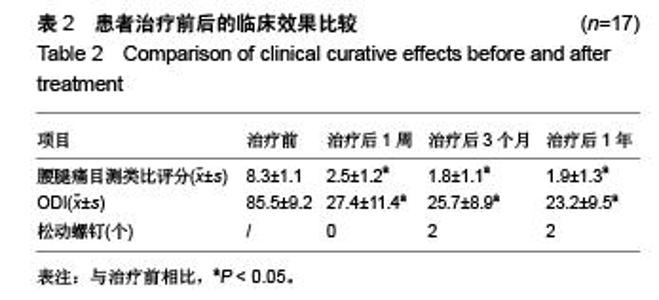
"
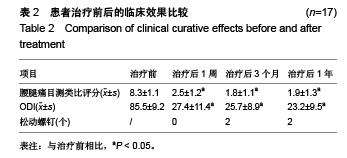
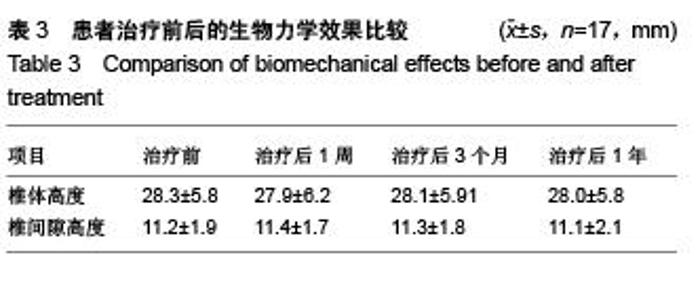
"
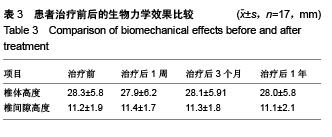
"
| [1] 李鹏,毛克亚,王岩,等.骨水泥强化椎弓根螺钉在腰椎滑脱伴骨质疏松椎体中的临床研究[J].中国骨质疏松杂志,2011, 17(11): 961-963. [2] 范海涛,申才良,董福龙,等.不同强化技术在骨质疏松椎体钉道的力学研究[J].安徽医科大学学报,2012,47(3):342-344. [3] 朱青安,李鉴铁,赵卫东,等.聚甲基丙烯酸甲酯强化和修复椎弓根螺钉的生物力学研究[J].中华骨科杂志,2010, 14(42):7951-7954. [4] 樊仕才,刘世学,邓月兴,等.强化骨质疏松椎弓根螺钉对脊柱稳定性影响的生物力学研究[J].中国修复重建外科杂志,2004, 18(3):168-170. [5] 王栋,冯杰,马超,等.骨水泥强化椎体技术在骨质疏松性脊柱后凸畸形手术治疗中的应用(16例报告)[J].中国矫形外科杂志,2013, 21(17):1792-1795. [6] Liu D, Wu ZX, Pan XM, et al.Biomechanical comparison of different techniques in primary spinal surgery in osteoporotic cadaveric lumbar vertebrae: expansive pedicle screw versus polymethylmethacrylate-augmented pedicle screw. Arch Orthop Trauma Surg. 2011;131(9):1227-1232. [7] Paré PE, Chappuis JL, Rampersaud R,et al.Biomechanical evaluation of a novel fenestrated pedicle screw augmented with bone cement in osteoporotic spines. Spine (Phila Pa 1976). 2011;36(18):E1210-1214. [8] Lee SH, Kim ES, Eoh W.Cement augmented anterior reconstruction with short posterior instrumentation: a less invasive surgical option for Kummell's disease with cord compression.J ClinNeurosci. 2011;18(4):509-514. [9] McLachlin SD, Al Saleh K, Gurr KR,et al.Comparative assessment of sacral screw loosening augmented with PMMA versus a calcium triglyceride bone cement. Spine (Phila Pa 1976). 2011; 36(11):E699-704. [10] Gao M, Lei W, Wu Z,et al.Biomechanical evaluation of fixation strength of conventional and expansive pedicle screws with or without calcium based cement augmentation. ClinBiomech (Bristol, Avon). 2011;26(3):238-244. [11] Choma TJ, Frevert WF, Carson WL,et al.Biomechanical analysis of pedicle screws in osteoporotic bone with bioactive cement augmentation using simulated in vivo multicomponent loading. Spine (Phila Pa 1976). 2011; 36(6):454-462. [12] Bullmann V, Liljenqvist UR, Rödl R,et al.Pedicle screw augmentation from a biomechanical perspective.Orthopade. 2010;39(7):673-678. [13] Liao JC, Fan KF, Keorochana G,et al.Transpedicular grafting after short-segment pedicle instrumentation for thoracolumbar burst fracture: calcium sulfate cement versus autogenous iliac bone graft. Spine (Phila Pa 1976). 2010;35(15):1482-1488. [14] Zhuang XM, Yu BS, ZhengZM, et al. Effect of the degree of osteoporosis on the biomechanical anchoring strength of the sacral pedicle screws: an in vitro comparison between unaugmentedbicortical screws and polymethylmethacrylate augmented unicortical screws. Spine (Phila Pa 1976).2010; 35(19):E925-931. [15] Masaki T, Sasao Y, Miura T, et al. An experimental study on initial fixation strength in transpedicular screwing augmented with calcium phosphate cement. Spine (Phila Pa 1976). 2009;34(20):E724-728. [16] Hu MH, Wu HT, Chang MC,et al.Polymethylmethacrylate augmentation of the pedicle screw: the cement distribution in the vertebral body. Eur Spine J. 2011;20(8):1281-1288. [17] Yu BS, Yang ZK, Li ZM,et al.Which is the preferred revision technique for loosened iliac screw? A novel technique of boring cement injection from the outer cortical shell. J Spinal Disord Tech. 2011;24(6):E49-56. [18] 陈文瑶,李新志. 骨水泥强化椎弓根螺钉固定的研究进展[J].中国矫形外科杂志,2010,18(3):226-229. [19] Moon BJ, Cho BY, Choi EY,et al.Polymethylmethacrylate- augmented screw fixation for stabilization of the osteoporotic spine:a three-year follow-up of 37 patients. J Korean Neurosurg Soc. 2009;46(4):305-311. [20] Aydogan M, Ozturk C, Karatoprak O,et al.The pedicle screw fixation with vertebroplasty augmentation in the surgical treatment of the severe osteoporotic spines. J Spinal Disord Tech. 2009;22(6):444-447. [21] Rahamimov N, Mulla H, Shani A,et al.Percutaneous augmented instrumentation of unstable thoracolumbar burst fractures. Eur Spine J. 2012;21(5):850-854. [22] Sawakami K, Yamazaki A, Ishikawa S,et al. Polymethylmethacrylate augmentation of pedicle screws increases the initial fixation in osteoporotic spine patients. J Spinal Disord Tech. 2012;25(2):E28-35. [23] Mesfin A, Komanski CB, Khanna AJ.Failure of cement-augmented pedicle screws in the osteoporotic spine: a case report. Geriatr Orthop Surg Rehabil. 2013;4(3):84-88. [24] Zhu Q, Kingwell S, Li Z,et al.Enhancing pedicle screw fixation in the aging spine with a novel bioactive bone cement: an in vitro biomechanical study. Spine (Phila Pa 1976). 2012;37(17): E1030-1037. [25] Kim HS, Kim SW, Lee WT.Spondylolisthesis accompanying bilateral pedicle stress fracture at two vertebrae. J Korean Neurosurg Soc. 2012;51(6):388-390. [26] Lubansu A, Rynkowski M, Abeloos L,et al.Minimally invasive spinal arthrodesis in osteoporotic population using a cannulated and fenestrated augmented screw: technical description and clinical experience. Minim Invasive Surg. 2012; 2012:507826. [27] Choma TJ, Pfeiffer FM, Swope RW,et al.Pedicle screw design and cement augmentation in osteoporotic vertebrae: effects of fenestrations and cement viscosity on fixation and extraction. Spine (Phila Pa 1976). 2012;37(26):E1628-1632. [28] Ying SH, Kao HC, Chang MC,et al.Fixation strength of PMMA-augmented pedicle screws after depth adjustment in a synthetic bone model of osteoporosis. Orthopedics. 2012; 35(10):e1511-1516. [29] Fölsch C, Goost H, Figiel J,et al.Correlation of pull-out strength of cement-augmented pedicle screws with CT-volumetric measurement of cement. Biomed Tech (Berl). 2012;57(6):473-480. [30] Koller H, Zenner J, Hitzl W,et al.The impact of a distal expansion mechanism added to a standard pedicle screw on pullout resistance. A biomechanical study. Spine J. 2013;13(5): 532-541. [31] Chao KH, Lai YS, Chen WC, et al. Biomechanical analysis of different types of pedicle screw augmentation: a cadaveric and synthetic bone sample study of instrumented vertebral specimens. Med Eng Phys. 2013;35(10):1506-1512. [32] Chang MC, Kao HC, Ying SH,et al.Polymethylmethacrylate augmentation of cannulated pedicle screws for fixation in osteoporotic spines and comparison of its clinical results and biomechanical characteristics with the needle injection method. J Spinal Disord Tech. 2013;26(6):305-315. |
| [1] | Chen Ziyang, Pu Rui, Deng Shuang, Yuan Lingyan. Regulatory effect of exosomes on exercise-mediated insulin resistance diseases [J]. Chinese Journal of Tissue Engineering Research, 2021, 25(25): 4089-4094. |
| [2] | Chen Yang, Huang Denggao, Gao Yuanhui, Wang Shunlan, Cao Hui, Zheng Linlin, He Haowei, Luo Siqin, Xiao Jingchuan, Zhang Yingai, Zhang Shufang. Low-intensity pulsed ultrasound promotes the proliferation and adhesion of human adipose-derived mesenchymal stem cells [J]. Chinese Journal of Tissue Engineering Research, 2021, 25(25): 3949-3955. |
| [3] | Yang Junhui, Luo Jinli, Yuan Xiaoping. Effects of human growth hormone on proliferation and osteogenic differentiation of human periodontal ligament stem cells [J]. Chinese Journal of Tissue Engineering Research, 2021, 25(25): 3956-3961. |
| [4] | Sun Jianwei, Yang Xinming, Zhang Ying. Effect of montelukast combined with bone marrow mesenchymal stem cell transplantation on spinal cord injury in rat models [J]. Chinese Journal of Tissue Engineering Research, 2021, 25(25): 3962-3969. |
| [5] | Gao Shan, Huang Dongjing, Hong Haiman, Jia Jingqiao, Meng Fei. Comparison on the curative effect of human placenta-derived mesenchymal stem cells and induced islet-like cells in gestational diabetes mellitus rats [J]. Chinese Journal of Tissue Engineering Research, 2021, 25(25): 3981-3987. |
| [6] | Hao Xiaona, Zhang Yingjie, Li Yuyun, Xu Tao. Bone marrow mesenchymal stem cells overexpressing prolyl oligopeptidase on the repair of liver fibrosis in rat models [J]. Chinese Journal of Tissue Engineering Research, 2021, 25(25): 3988-3993. |
| [7] | Liu Jianyou, Jia Zhongwei, Niu Jiawei, Cao Xinjie, Zhang Dong, Wei Jie. A new method for measuring the anteversion angle of the femoral neck by constructing the three-dimensional digital model of the femur [J]. Chinese Journal of Tissue Engineering Research, 2021, 25(24): 3779-3783. |
| [8] | Meng Lingjie, Qian Hui, Sheng Xiaolei, Lu Jianfeng, Huang Jianping, Qi Liangang, Liu Zongbao. Application of three-dimensional printing technology combined with bone cement in minimally invasive treatment of the collapsed Sanders III type of calcaneal fractures [J]. Chinese Journal of Tissue Engineering Research, 2021, 25(24): 3784-3789. |
| [9] | Qian Xuankun, Huang Hefei, Wu Chengcong, Liu Keting, Ou Hua, Zhang Jinpeng, Ren Jing, Wan Jianshan. Computer-assisted navigation combined with minimally invasive transforaminal lumbar interbody fusion for lumbar spondylolisthesis [J]. Chinese Journal of Tissue Engineering Research, 2021, 25(24): 3790-3795. |
| [10] | Hu Jing, Xiang Yang, Ye Chuan, Han Ziji. Three-dimensional printing assisted screw placement and freehand pedicle screw fixation in the treatment of thoracolumbar fractures: 1-year follow-up [J]. Chinese Journal of Tissue Engineering Research, 2021, 25(24): 3804-3809. |
| [11] | Shu Qihang, Liao Yijia, Xue Jingbo, Yan Yiguo, Wang Cheng. Three-dimensional finite element analysis of a new three-dimensional printed porous fusion cage for cervical vertebra [J]. Chinese Journal of Tissue Engineering Research, 2021, 25(24): 3810-3815. |
| [12] | Wang Yihan, Li Yang, Zhang Ling, Zhang Rui, Xu Ruida, Han Xiaofeng, Cheng Guangqi, Wang Weil. Application of three-dimensional visualization technology for digital orthopedics in the reduction and fixation of intertrochanteric fracture [J]. Chinese Journal of Tissue Engineering Research, 2021, 25(24): 3816-3820. |
| [13] | Sun Maji, Wang Qiuan, Zhang Xingchen, Guo Chong, Yuan Feng, Guo Kaijin. Development and biomechanical analysis of a new anterior cervical pedicle screw fixation system [J]. Chinese Journal of Tissue Engineering Research, 2021, 25(24): 3821-3825. |
| [14] | Lin Wang, Wang Yingying, Guo Weizhong, Yuan Cuihua, Xu Shenggui, Zhang Shenshen, Lin Chengshou. Adopting expanded lateral approach to enhance the mechanical stability and knee function for treating posterolateral column fracture of tibial plateau [J]. Chinese Journal of Tissue Engineering Research, 2021, 25(24): 3826-3827. |
| [15] | Zhu Yun, Chen Yu, Qiu Hao, Liu Dun, Jin Guorong, Chen Shimou, Weng Zheng. Finite element analysis for treatment of osteoporotic femoral fracture with far cortical locking screw [J]. Chinese Journal of Tissue Engineering Research, 2021, 25(24): 3832-3837. |
| Viewed | ||||||
|
Full text |
|
|||||
|
Abstract |
|
|||||