Chinese Journal of Tissue Engineering Research ›› 2026, Vol. 30 ›› Issue (36): 9469-9478.doi: 10.12307/2026.704
Previous Articles Next Articles
Effect of shock wave therapy combined with facilitated stretching on the electromyographic characteristics of the upper trapezius muscle in patients with varying degrees of neck and shoulder pain
Gong Xun1, Zhou Yong1, Ji Lina2
- 1Department of Rehabilitation Medicine, 2Department of Function, The Second Affiliated Hospital of Hainan Medical University, Haikou 570311, Hainan Province, China
-
Received:2025-10-13Revised:2026-03-03Online:2026-12-28Published:2026-05-22 -
About author:Gong Xun, Attending physician, Department of Rehabilitation Medicine, The Second Affiliated Hospital of Hainan Medical University, Haikou 570311, Hainan Province, China

CLC Number:
Cite this article
Gong Xun, Zhou Yong, Ji Lina. Effect of shock wave therapy combined with facilitated stretching on the electromyographic characteristics of the upper trapezius muscle in patients with varying degrees of neck and shoulder pain[J]. Chinese Journal of Tissue Engineering Research, 2026, 30(36): 9469-9478.
share this article
Add to citation manager EndNote|Reference Manager|ProCite|BibTeX|RefWorks
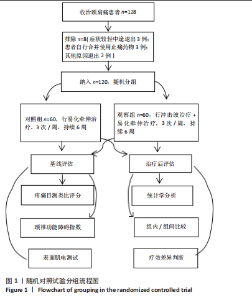
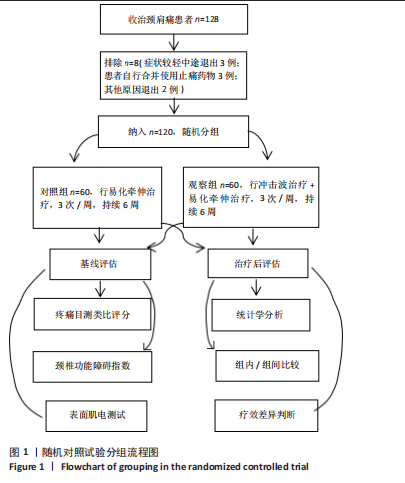
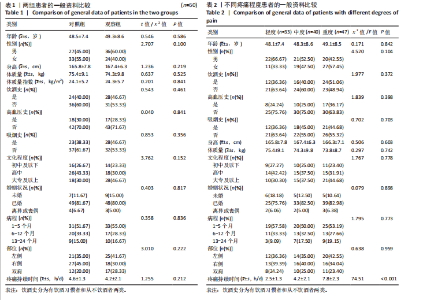
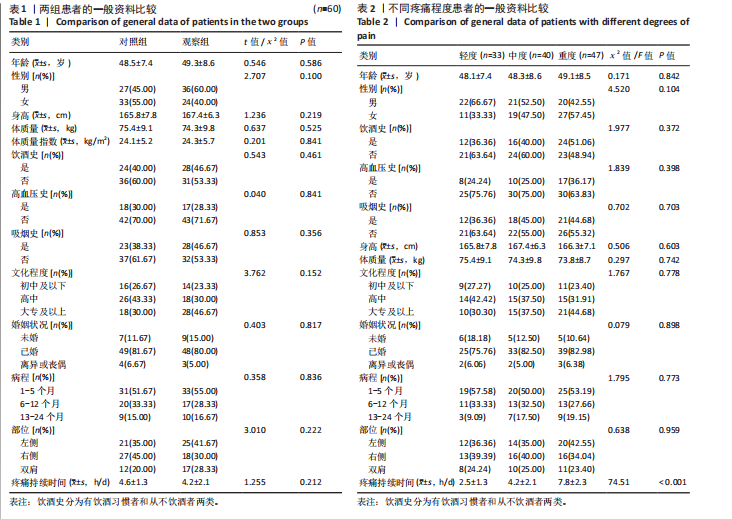
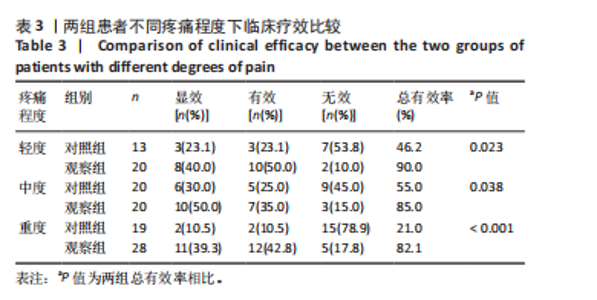
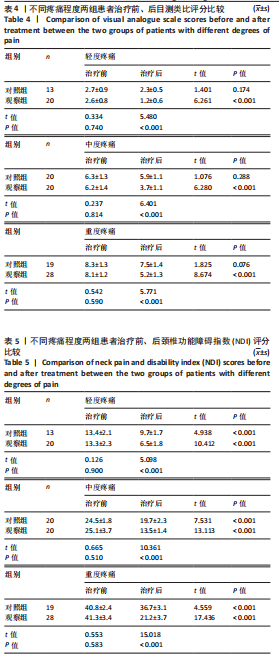
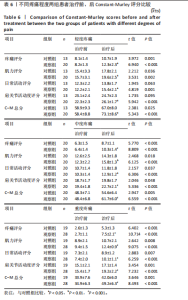
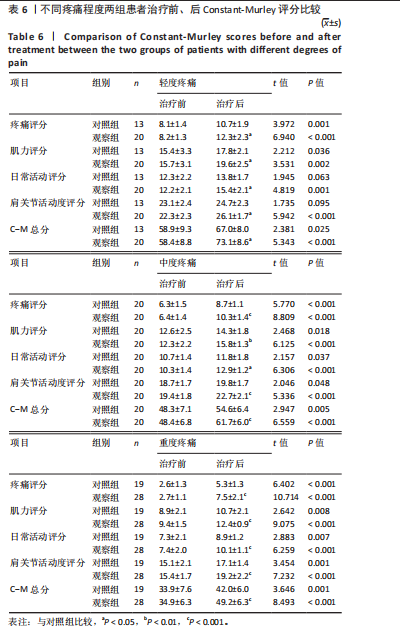
2.1 参与者数量分析 参与此项研究的120例患者治疗过程中均无脱落,全部进入结果分析。随机对照试验分组流程图见图1。 2.2 匹配前后2组患者的基线特征比较 结果显示,两组患者基线指标差异无统计学意义(P > 0.05),见表1。 2.3 不同疼痛程度患者一般资料比较 结果显示,轻度、中度、重度患者的疼痛持续时间差异有显著性意义(P < 0.05),其他指标比较差异无显著性意义(P > 0.05),见表2。 2.4 两组患者不同疼痛程度下临床疗效比较 结果显示,观察组的轻度、中度、重度患者临床疗效高于对照组的轻度、中度、重度,差异有显著性意义(P < 0.05),见表3。 2.5 两组患者不同疼痛程度治疗前后评分指标比较 对照组不同疼痛程度颈肩痛患者治疗前后目测类比评分、NDI、Constant-Murley评分差异均无显著性意义(P > 0.05);观察组患者治疗后目测类比评分、NDI较治疗前显著性下降(P < 0.01),Constant-Murley评分较治疗前显著性上升(P < 0.01),见表4-6。结果表明6周易化牵伸联合冲击波治疗能有效减轻患者的颈肩痛。"
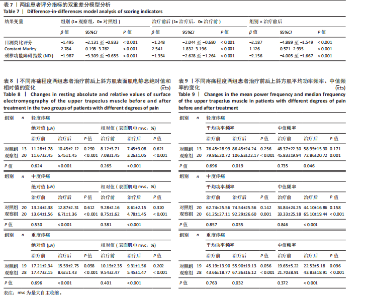
2.6 评分指标的双重差分模型分析 将目测类比评分、Constant-Murley评分、NDI评分作为因变量,将组别、治疗时间(治疗前和治疗后)以及它们的交互项作为自变量进行双重差分模型回归分析。结果显示,Constant-Murley评分在治疗前后的变化系数为2.541(P < 0.05),表明经过治疗后,患者的Constant-Murley评分有所上升;目测类比评分和NDI评分在治疗前后的变化系数为-1.248和-1.354,表明经过治疗后,患者的目测类比评分和NDI评分有所下降。组别×治疗前后的交互项对目测类比评分、Constant-Murley评分和NDI评分产生了显著影响(P < 0.05),与对照组相比,观察组患者接受治疗后,其Constant-Murley评分上升、目测类比评分和NDI评分下降的幅度更为显著,见表7。 2.7 两组患者不同疼痛程度治疗前后肌电图指标比较 观察组患者治疗后上斜方肌表面肌电静息绝对值和相对值较治疗前降低(P < 0.05),对照组患者治疗前后上斜方肌表面肌电静息绝对值和相对值差异无显著性意义(P > 0.05);观察组患者治疗后上斜方肌表面肌电静息绝对值和相对值较对照组降低,差异有显著性意义(P < 0.05),见表8。 观察组患者治疗后上斜方肌中值频率和平均功率频率都较治疗前上升(P < 0.05),对照组患者治疗前后上斜方肌中值频率和平均功率频率比较差异无显著性意义(P > 0.05);观察组患者治疗后上斜方肌中值频率和平均功率频率高于对照组,见表9。"
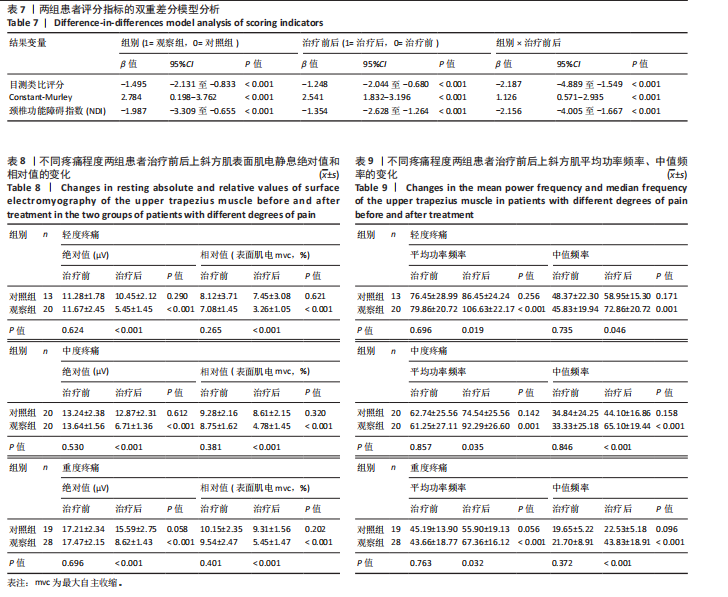
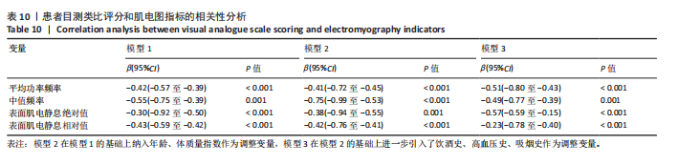
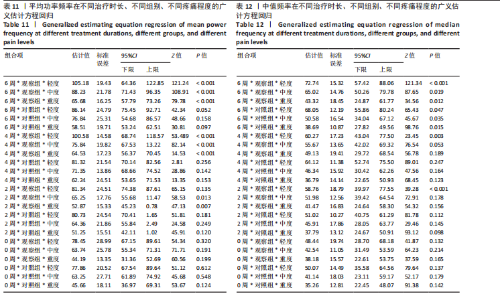
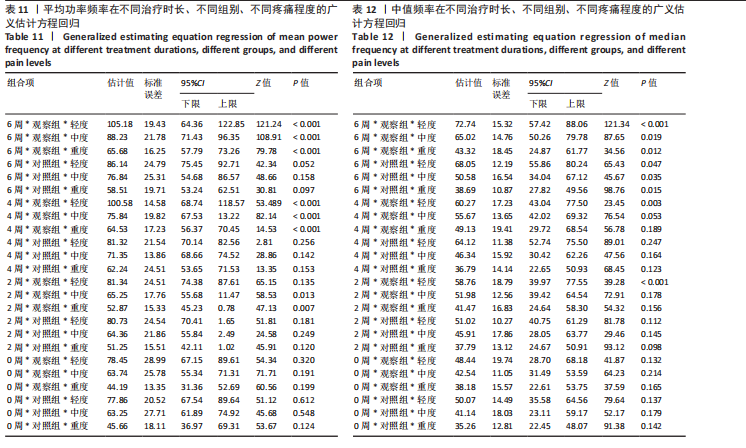
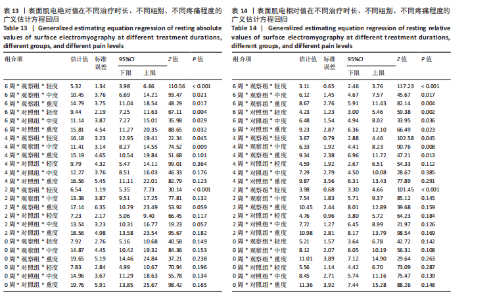
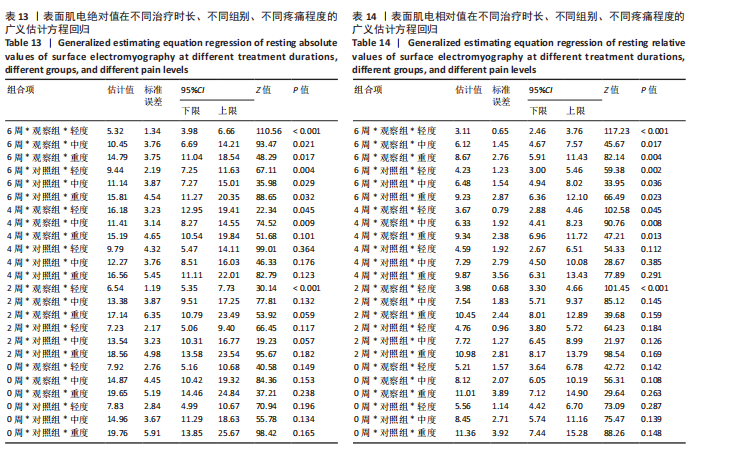
2.8 肌电图指标与目测类比评分的相关性 模型1中为未经调整的初步分析,模型2在模型1的基础上纳入年龄、体质量指数作为调整变量,模型3在模型2的基础上进一步引入了饮酒史、高血压史、吸烟史作为调整变量,进行多元线性回归分析。在模型1中,未经调整的初步分析显示,表面肌电静息绝对值、相对值与目测类比评分之间存在显著的负相关关系,平均功率频率、中值频率与目测类比评分之间存在显著的负相关关系(P < 0.05)。通过引入和调整相关混杂因素(模型2和模型3),目测类比评分和肌电图指标之间仍然存在显著相关性(P < 0.05),见表10。 2.9 肌电图指标在不同时间点、不同组别、不同程度的GEE分析 治疗6周,对观察组与对照组不同疼痛程度患者的肌电图指标影响进行比较,结果差异有显著性意义(P < 0.05)。参照系数估计值发现,治疗2周时,观察组和对照组中轻度疼痛患者的肌电图指标无显著差异,中度和重度疼痛患者在治疗2周时观察组肌电图指标的升高效果要明显优于对照组:比较治疗6周时观察组不同程度疼痛组对肌电图指标的升高效果,结果差异均有显著性意义;对照组中不同程度疼痛组对肌电图指标的升高效果,结果差异无有显著性意义,说明观察组中不同疼痛程度患者的治疗效果均优于对照组,见表11-14。 2.10 不良事件 观察组患者使用体外冲击波治疗未发生局部及"
全身不适症状,两组患者进行易化牵伸治疗,亦未发生肌肉、韧带拉伤等不良事件。"
"
"
"
"
"
| [1] GBD 2021 Neck Pain Collaborators.Global, regional, and national burden of neck pain, 1990–2020, and projections to 2050: a systematic analysis of the global burden of disease study 2021. Lancet Rheumatol. 2024;6(3):e142-e155. [2] WANG DM, LI C, HATCHARD N, et al. Lower trapezius muscle function in people with and without shoulder and neck pain: a systematic review. J Osteopath Med. 2022;123(2):73-89. [3] 崔尧, 丛芳, 黄富表, 等. 不同镜像神经元训练策略下脑与肌肉的活动特征:基于近红外光谱与表面肌电图技术[J]. 中国康复理论与实践,2023,29(7): 782-790. [4] 高竟, 王文清, 杨宗宇, 等. 超声定位下发散式冲击波治疗肩袖损伤的临床观察[J]. 中国康复医学杂志,2023,38(12):1748-1751. [5] YANG S, BOUDIER-REVERET M, YI YG, et al. Treatment of Chronic Neck Pain in Patients with Forward Head Posture: A Systematic Narrative Review. Healthcare (Basel). 2023;11(19):2604. [6] KANDA M, KITAMURA T, SUZUKI Y, et al. The Intramuscular Circulation Is Affected by Neck and Shoulder Pain. Adv Exp Med Biol. 2022;1395(2):399-403. [7] MACHINO M, ANDO K, KOBAYASHI K, et al. Associations Between Neck and Shoulder Pain and Neuropathic Pain in a Middle-aged Community-living Population. Spine (Phila Pa 1976). 2022;47(8):632-639. [8] ZHANG J, WANG H, GUO L.Investigating the brain functional abnormalities underlying pain hypervigilance in chronic neck and shoulder pain: a resting-state fMRI study. Neuroradiology. 2024;66(8):1353-1361. [9] DAHER A, DAR G. Stretching and muscle-performance exercises for chronic nonspecific neck pain: who may benefit most?. Physiother Theory Pract. 2024; 40(8):1710-1723. [10] 方莉玉, 任雅春, 曹叶凡, 等. 冲击波联合表面肌电生物反馈训练对创伤后肘关节僵硬的疗效[J]. 实用医学杂志,2024,40(10):1364-1369. [11] MAZHAR T, JAMEEL A, SHARIF F, et al. Effects of conventional physical therapy with and without proprioceptive neuromuscular facilitation on balance, gait, and function in patients with Parkinson’s disease. J Pak Med Assoc. 2023;73(6): 1280-1283. [12] 王静雯, 赵红东, 时建铨, 等. 多灶性运动神经病的临床表现及肌电图特征[J]. 癫痫与神经电生理学杂志,2021,30(2):65-70. [13] 陈俊吉, 高田糈, 刘晓龙, 等. 本体感觉神经肌肉易化训练对运动性肩袖损伤功能恢复的影响[J]. 医用生物力学,2022,37(1):174-179. [14] MELESE H, ALAMER A, GETIE K, et al. Extracorporeal shock wave therapy on pain and foot functions in subjects with chronic plantar fasciitis: systematic review of randomized controlled trials. Disabil Rehabil. 2022;44(18):5007-5014. [15] 吕峰, 朱立帆, 吴卫东, 等. 体外冲击波联合整脊手法治疗老年腰椎间盘突出症的疗效[J]. 中国老年学杂志,2024,44(11):2646-2649. [16] LIU WC, CHEN CT, LU CC, et al. Extracorporeal Shock Wave Therapy Shows Superiority Over Injections for Pain Relief and Grip Strength Recovery in Lateral Epicondylitis: A Systematic Review and Network Meta-analysis. Arthroscopy. 2022;38(6):2018-2034.e12. [17] TOGNOLO L, GIORDANI F, BIZ C, et al. Myofascial points treatment with focused extracorporeal shock wave therapy (f-ESWT) for plantar fasciitis: an open label randomized clinical trial. Eur J Phys Rehabil Med. 2022;58(1):85-93. [18] 娄路馨, 顾建明, 梁伟, 等. MRI对体外冲击波联合康复运动治疗膝关节骨性关节炎短期疗效的评估[J]. 临床放射学杂志,2024,43(10):1767-1771. [19] ZHANG HL, JIN R J, GUAN L, et al. Extracorporeal Shock Wave Therapy on Spasticity After Upper Motor Neuron Injury: A Systematic Review and Meta-analysis. Am J Phys Med Rehabil. 2022;101(7):615-623. [20] YAO H, WANG X, LIU H, et al. Systematic Review and Meta-Analysis of 16 Randomized Controlled Trials of Clinical Outcomes of Low-Intensity Extracorporeal Shock Wave Therapy in Treating Erectile Dysfunction. Am J Mens Health. 2022;16(2):15579883221087532. [21] PENEL N, BONVALOT S, LE DELEY MC, et al. Pain in desmoid-type fibromatosis: Prevalence, determinants and prognosis value. Int J Cancer. 2023;153(2):407-416. [22] ACHU-LOPES R, TSEN LC, OVSAK G, et al. Upper back, neck, and shoulder pain during labor epidural analgesia: a quality improvement initiative. Int J Obstet Anesth. 2024;60(3):104255. [23] HASHEM M, ALMOHAINI RA, ALHARBI TM, et al. Impact of Neck and Shoulder Pain on Health-Related Quality of Life in Adults in Saudi Arabia. Cureus. 2024; 16(4):e59252. [24] 邱先桃, 任建萍, 贺梦妍, 等. 社区慢性颈肩痛人群中医健康管理服务实施效果及其影响因素研究:基于目标成就评量法[J]. 中国全科医学,2022, 25(34):4292-4297. [25] 勾志静, 王淑洁, 陈靖军, 等. 苍龟探穴针法联合温灸、刺络放血治疗慢性颈肩痛疗效观察[J]. 中华中医药学刊,2023,41(9):230-233. [26] GHAFOURI B, ROLANDER B, GERDLE B, et al. Neck and shoulder pain and inflammatory biomarkers in plasma among forklift truck operators - A case-control study. Scand J Pain. 2024;24(1). doi: 10.1515/sjpain-2023-0142. [27] 沈星星, 熊玉玲, 陈伟健, 等. 慢性颈痛患者颈肩部肌肉性能差异及其与疼痛、体质量指数的相关性[J]. 中国康复理论与实践,2023,29(12):1420-1428. [28] OZMEN T, KOPARAL SS, KARATAS O, et al. Comparison of the clinical and sonographic effects of ultrasound therapy, extracorporeal shock wave therapy, and Kinesio taping in lateral epicondylitis. Turk J Med Sci. 2021;51(1):76-83. [29] ZHANG T, ZHANG C. Extracorporeal shock wave therapy for shoulder pain after stroke: A systematic review and meta-analysis. Clin Rehabil. 2023;37(6):774-790. [30] HSU CY, HSU T, LIN YN, et al. Additional Effect of Interfascial Hydrodissection With Dextrose on Shoulder and Neck Function in Patients With Myofascial Pain Syndrome: A Randomized Control Trial. Am J Phys Med Rehabil. 2024;103(9): 827-834. [31] GESSLBAUER C, MICKEL M, SCHUHFRIED O, et al. Effectiveness of focused extracorporeal shock wave therapy in the treatment of carpal tunnel syndrome: A randomized, placebo-controlled pilot study. Wien Klin Wochenschr. 2021; 133(11-12):568-577. [32] 陈智玲, 黄学成, 潘敏, 等. 基于剪切波弹性成像评价颈肩痛与斜角肌的关系[J]. 中国组织工程研究,2024,28(8):1265-1270. [33] 张润, 张全兵, 周云, 等. 不同强度体外冲击波治疗创伤性伸直型膝关节挛缩的疗效分析[J]. 中国康复医学杂志,2024,39(11):1625-1631. [34] JUN JH, PARK GY, CHAE CS, et al. The Effect of Extracorporeal Shock Wave Therapy on Pain Intensity and Neck Disability for Patients With Myofascial Pain Syndrome in the Neck and Shoulder: A Meta-Analysis of Randomized Controlled Trials. Am J Phys Med Rehabil. 2021;100(2):120-129. [35] SHAMSELDEEN NE, HEGAZY M, FAYAZ NA, et al. Instrumented assisted soft tissue mobilization vs extracorporeal shock wave therapy in treatment of myofascial pain syndrome. World J Orthop. 2023;14(7):572-581. [36] 王超, 许磊, 刘诗若, 等. 超声引导针刺联合体外冲击波对颈肩激痛点形态大小及硬度的影响研究[J]. 中国疼痛医学杂志,2024,30(3):225-230. [37] ONDA A, ONOZATO K, KIMURA M. Clinical features of neck and shoulder pain (Katakori) in Japanese hospital workers. Fukushima J Med Sci.2022;68(2):79-87. [38] ALAGINGI NK. Chronic neck pain and postural rehabilitation: A literature review. J Bodyw Mov Ther. 2022;32(8):201-206. [39] 解先念. 易化牵伸康复训练联合关节松动训练应用于冻结期肩周炎患者的效果观察[J]. 大医生,2024,9(18):49-52. [40] SILVA MC, OLIVEIRA MT, AZEVEDO-SANTOS IF, et al. Effect of proprioceptive neuromuscular facilitation in the treatment of dysfunctions in facial paralysis: a systematic literature review. Braz J Phys Ther. 2022;26(6):100454. [41] ARCANJO FL, MARTINS J, MOTE P, et al. Proprioceptive neuromuscular facilitation training reduces pain and disability in individuals with chronic low back pain: A systematic review and meta-analysis. Complement Ther Clin Pract. 2022;46(1):101505. [42] SHAN Y, ZHANG J, MA Y, et al. The effects of acupuncture combined with western medicine in the treatment of neck, shoulder, lumbar and leg pain. Am J Transl Res. 2023;15(6):4246-4254. [43] 柯竟悦, 马圣楠, 董洪铭, 等. 运动贴扎联合体外冲击波治疗足底筋膜炎的疼痛、功能活动及足底压力评估[J]. 中国康复医学杂志,2024,39(2):210-217,225. [44] KARUNANAYAKE AL, SOLOMON-MOORE E, COGHILL N. Effectiveness of Anapana, Body scan and Metta meditation techniques on chronic neck and shoulder region pain and disability in adult patients in Sri Lanka: study protocol for a cluster clinic-level randomised controlled trial. Trials. 2022;23(1):940. [45] 罗丽华, 吴东宇, 王雨生, 等. 重复经颅磁刺激联合发散式冲击波治疗创伤性脊髓损伤患者肌肉痉挛的疗效观察[J]. 中国康复医学杂志,2023,38(12): 1663-1668. [46] MAITLAND S, HALL J, MCNEILL A, et al. Ultrasound-guided motor unit scanning electromyography. Muscle Nerve. 2022;66(6):730-735. [47] MCGUIRE T, HAIG AJ. A review of electromyography techniques of the cervical paraspinal muscles. PM R. 2024;16(3):287-294. [48] LIU Q, HUANG Q, LIU L, et al. Efficacy of Dry Needling Under EMG Guidance for Myofascial Neck and Shoulder Pain: A Randomized Clinical Trial. J Pain Res. 2022;15(1):2293-2302. [49] 张冰雪, 蒋闻蔚, 凌卓然, 等. 本体感觉神经肌肉促进技术在临床康复中的研究进展[J]. 神经损伤与功能重建,2023,18(12):804-806. [50] YAMADA T, YAJIMA H, TAKAYAMA M, et al. Corrugator Muscle Activity Associated with Pressure Pain in Adults with Neck/Shoulder Pain. Medicina (Kaunas). 2024;60(2):223. [51] 肖健, 梁豪君, 纪宝尚, 等. 体外冲击波对中枢性肌肉痉挛及肌肉代谢影响的相关研究进展[J]. 中国医学前沿杂志(电子版),2022,14(11):7-14. |
| [1] | Shi Tengbo, Zhang Mengyu, Wang Xingfei, Fu Zhuo, Li Chenyang, Meng Xiangxi, Liu Hao, Guo Chaowei, He Zike, Tang Yanfeng. Shaoyao Gancao Decoction combined with shock wave therapy for treating gluteus medius syndrome: a randomized controlled trial on structural improvement of the tendon [J]. Chinese Journal of Tissue Engineering Research, 2026, 30(36): 9462-9468. |
| [2] | Zhang Jingyi, Zhi Liang, Yang Zeyu, Li Yaning, Hu Jia, Wang Jia, Wang Yulong, Long Jianjun. Extracorporeal shock wave therapy: current research status, hotspots, and trends [J]. Chinese Journal of Tissue Engineering Research, 2026, 30(28): 7410-7417. |
| [3] | Huang Sijing, Cui Rui, Geng Longyu, Gao Beiyao, Ge Ruidong, Jiang Shan. Application and molecular mechanism of extracorporeal shock wave for anti-fibrosis [J]. Chinese Journal of Tissue Engineering Research, 2026, 30(17): 4417-4429. |
| [4] | Ye Wei, Jiang Dongfu, Zhuang Jielin, Lai Huaxin. Effect of warm acupuncture combined with platelet-rich plasma injection on gait parameters and joint function recovery of knee osteoarthritis [J]. Chinese Journal of Tissue Engineering Research, 2026, 30(12): 2975-2985. |
| [5] | Zhao Dun, Qi Lingchen, Xu Jinfan, Shao Min. Visual analysis of hotspots and frontiers in knee osteoarthritis pain field [J]. Chinese Journal of Tissue Engineering Research, 2025, 29(15): 3280-3289. |
| [6] | An Dong, Liu Yang, Yang Tongjiang. Application of extracorporeal shock wave therapy in burn wound repair and post-burn scar treatment [J]. Chinese Journal of Tissue Engineering Research, 2022, 26(20): 3265-3272. |
| [7] | Li Jie, Ma Yuewen, Kang Nan, Zhang Jing, Zhang Yu. Radial extracorporeal shock wave therapy promotes the proliferation of neural stem cells in hippocampus of cerebral infarction rats and inhibits miR-124 expression [J]. Chinese Journal of Tissue Engineering Research, 2021, 25(31): 4981-4987. |
| [8] | Su Mingzhu, Ma Yuewen. Radial extracorporeal shock wave therapy regulates the proliferation and differentiation of neural stem cells in the hippocampus via Notch1/Hes1 pathway after cerebral ischemia [J]. Chinese Journal of Tissue Engineering Research, 2021, 25(19): 3009-3015. |
| Viewed | ||||||
|
Full text |
|
|||||
|
Abstract |
|
|||||