Chinese Journal of Tissue Engineering Research ›› 2014, Vol. 18 ›› Issue (13): 1981-1987.doi: 10.3969/j.issn.2095-4344.2014.13.003
Previous Articles Next Articles
Gait parameters in lower extremities of patients in sequela period after unilateral total hip arthroplasty
Zhao Jiang-li1, Wu Pei-hui2, Xu Guang-qing1, Mao Yu-rong1, Liao Wei-ming2, Huang Dong-feng1
- 1Department of Rehabilitation Medicine, 2Department of Joint Surgery, First Affiliated Hospital, Sun Yat-sen University, Guangzhou 510080, Guangdong Province, China
-
Received:2014-01-24Online:2014-03-26Published:2014-03-26 -
Contact:Corresponding author: Mao Yu-rong, Associate chief therapeutist, Department of Rehabilitation Medicine, First Affiliated Hospital, Sun Yat-sen University, Guangzhou 510080, Guangdong Province, China -
About author:Zhao Jiang-li, Physiotherapist, Department of Rehabilitation Medicine, First Affiliated Hospital, Sun Yat-sen University, Guangzhou 510080, Guangdong Province, China

CLC Number:
Cite this article
Zhao Jiang-li, Wu Pei-hui, Xu Guang-qing, Mao Yu-rong, Liao Wei-ming, Huang Dong-feng. Gait parameters in lower extremities of patients in sequela period after unilateral total hip arthroplasty[J]. Chinese Journal of Tissue Engineering Research, 2014, 18(13): 1981-1987.
share this article
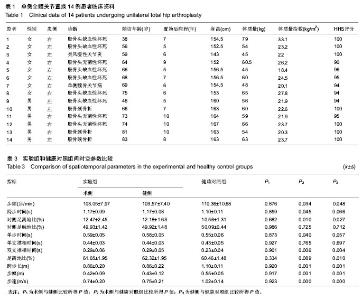
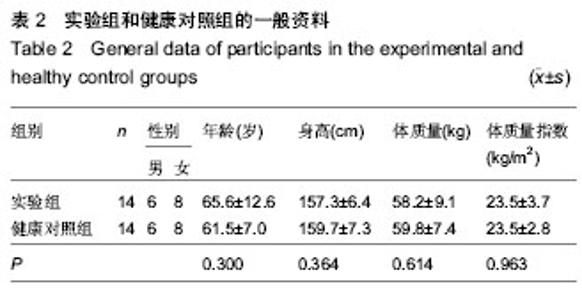
2.1 两组研究对象的基本资料比较 实验组和健康对照组的年龄、身高、体质量及体质量指数分别进行配对t 检验,结果显示差异无显著性意义(P > 0.05,表2)。 2.2 实验组术侧与健侧下肢时空参数比较 患者术侧下肢与健侧下肢各时空参数分别进行比较,结果显示差异均无显著性意义(P > 0.05,表3)。 2.3 实验组术侧与健康对照组下肢时空参数比较 实验组术侧的步频减小(图1A),步速减慢(图1B),跨步时间和单步时间增大(图1C,D),双支撑相时间延长(图1E),步幅和跨步长变短(图1F,G),对侧足离地比增大(图1H),差异有显著性意义(P < 0.05);术侧的对侧足触地比(图1I)、单支撑相时间(图1J)、足离地比(图1K)与健康对照组比较,差异无显著性意义(P > 0.05,表3)。 2.4 实验组健侧与健康对照组下肢时空参数比较 实验组健侧的步频减小(图1A),步速减慢(图1B),双支撑相时间延长(图1E),步幅和跨步长变短(图1F,G),对侧足离地比增大(图1H),足离地比增大(图1K),差异有显著性意义(P < 0.05);健侧的跨步时间(图1C)、对侧足触地比(图1I)、单步时间(图1D)、单支撑相时间(图1J)与健康对照组比较,差异无显著性意义(P > 0.05,表3)。"

"

| [1] Sinha A,Twycross-Lewis R, Small C,et al. Motion analysis as an outcome measure for hip arthroplasty.Surgeon. 2011;9(5): 284-291.[2] Jones CA, Voaklander DC, Johnston DW,et al. Health related quality of life outcomes after total hip and knee arthroplasties in a community based population.J Rheumatol. 2000;27(7): 1745-1752.[3] Wylde V, Blom AW, Whitehouse SL,et al.Patient-reported outcomes after total hip and knee arthroplasty: comparison of midterm results.J Arthroplasty. 2009;24(2):210-216.[4] Kyriazis V, Rigas C.Temporal gait analysis of hip osteoarthritic patients operated with cementless hip replacement.Clin Biomech (Bristol, Avon). 2002;17(4):318-321.[5] Mayr E, Nogler M, Benedetti MG,et al. A prospective randomized assessment of earlier functional recovery in THA patients treated by minimally invasive direct anterior approach: a gait analysis study.Clin Biomech (Bristol, Avon). 2009; 24(10): 812-818. [6] Ewen AM, Stewart S, St Clair Gibson A,et al. Post-operative gait analysis in total hip replacement patients-a review of current literature and meta-analysis.Gait Posture. 2012;36(1): 1-6. [7] Beaulieu ML, Lamontagne M, Beaulé PE.Lower limb biomechanics during gait do not return to normal following total hip arthroplasty.Gait Posture. 2010;32(2):269-273.[8] Wylde V, Blom A, Dieppe P,et al. Return to sport after joint replacement.J Bone Joint Surg Br. 2008;90(7):920-923. [9] Wright JG, Rudicel S, Feinstein AR. Ask patients what they want. Evaluation of individual complaints before total hip replacement.J Bone Joint Surg Br. 1994;76(2):229-234.[10] Nadzadi ME, Pedersen DR, Yack HJ,et al. Kinematics, kinetics, and finite element analysis of commonplace maneuvers at risk for total hip dislocation. J Biomech. 2003; 36(4):577-591.[11] Broström EW, Esbjörnsson AC, von Heideken J,et al. Gait deviations in individuals with inflammatory joint diseases and osteoarthritis and the usage of three-dimensional gait analysis.Best Pract Res Clin Rheumatol. 2012;26(3):409-422. [12] Queen RM, Appleton JS, Butler RJ,et al.Total Hip Arthroplasty Surgical Approach Does Not Alter Postoperative Gait Mechanics One Year After Surgery.PM R. 2013.Epub ahead of print][13] Shoji T, Yasunaga Y, Yamasaki T,et al. Bony impingement depends on the bone morphology of the hip after total hip arthroplasty.Int Orthop. 2013;37(10):1897-1903.[14] Nankaku M, Akiyama H, Kanzaki H,et al. Effects of vertical motion of the centre of mass on walking efficiency in the early stages after total hip arthroplasty.Hip Int. 2012;22(5):521-526. [15] Varin D, Lamontagne M, Beaulé PE. Does the anterior approach for THA provide closer-to-normal lower-limb motion. J Arthroplasty. 2013;28(8):1401-1407. [16] Sander K, Layher F, Anders C,et al.Gait analysis after minimally invasive total hip arthroplasty.Orthopade. 2012; 41(5):365-376. [17] Kadaba MP, Ramakrishnan HK, Wootten ME. Measurement of lower extremity kinematics during level walking.J Orthop Res. 1990;8(3):383-392.[18] 毛玉瑢,李乐,陈正宏,等.脑卒中患者步行能力与下肢三维运动学及动力学相关性分析[J].中国康复医学杂志,2012,27(5):442-447.[19] Lugade V, Wu A, Jewett B, et al.Gait asymmetry following an anterior and anterolateral approach to total hip arthroplasty.Clin Biomech (Bristol, Avon). 2010;25(7):675-680.[20] Queen RM, Butler RJ, Watters TS,et al. The effect of total hip arthroplasty surgical approach on postoperative gait mechanics.J Arthroplasty. 2011;26(6 Suppl):66-71. [21] Lamontagne M, Beaulieu ML, Varin D,et al. Gait and motion analysis of the lower extremity after total hip arthroplasty: what the orthopedic surgeon should know.Orthop Clin North Am. 2009;40(3):397-405. [22] Madsen MS, Ritter MA, Morris HH,et al.The effect of total hip arthroplasty surgical approach on gait.J Orthop Res. 2004; 22(1):44-50.[23] Tateuchi H, Tsukagoshi R, Fukumoto Y,et al. Dynamic hip joint stiffness in individuals with total hip arthroplasty: relationships between hip impairments and dynamics of the other joints.Clin Biomech (Bristol, Avon). 2011;26(6):598-604.[24] Tateuchi H, Tsukagoshi R, Fukumoto Y,et al. Immediate effects of different ankle pushoff instructions during walking exercise on hip kinematics and kinetics in individuals with total hip arthroplasty.Gait Posture. 2011;33(4):609-614.[25] Meneghini RM, Smits SA, Swinford RR,et al. A randomized, prospective study of 3 minimally invasive surgical approaches in total hip arthroplasty: comprehensive gait analysis.J Arthroplasty. 2008;23(6 Suppl 1):68-73. [26] Tanaka R, Shigematsu M, Motooka T,et al. Factors influencing the improvement of gait ability after total hip arthroplasty.J Arthroplasty. 2010;25(6):982-985.[27] Chiu SL, Lu TW, Chou LS.Altered inter-joint coordination during walking in patients with total hip arthroplasty.Gait Posture. 2010;32(4):656-660. [28] Bennett D, Humphreys L, O'Brien S,et al. Gait kinematics of age-stratified hip replacement patients--a large scale, long-term follow-up study.Gait Posture. 2008;28(2):194-200. [29] Ritter MA, Harty LD, Keating ME,et al.A clinical comparison of the anterolateral and posterolateral approaches to the hip.Clin Orthop Relat Res. 2001;(385):95-99.[30] McCrory JL, White SC, Lifeso RM.Vertical ground reaction forces: objective measures of gait following hip arthroplasty. Gait Posture. 2001;14(2):104-109.[31] Rathod PA, Orishimo KF, Kremenic IJ,et al. Similar Improvement in Gait Parameters Following Direct Anterior & Posterior Approach Total Hip Arthroplasty.J Arthroplasty. 2013. [Epub ahead of print][32] Nantel J, Termoz N, Vendittoli PA,et al. Gait patterns after total hip arthroplasty and surface replacement arthroplasty.Arch Phys Med Rehabil. 2009;90(3):463-469.[33] Vissers MM, Bussmann JB, de Groot IB,et al.Walking and chair rising performed in the daily life situation before and after total hip arthroplasty. Osteoarthritis Cartilage. 2011; 19(9):1102-1107. [34] Miki H, Sugano N, Hagio K,et al. Recovery of walking speed and symmetrical movement of the pelvis and lower extremity joints after unilateral THA.J Biomech. 2004;37(4):443-455.[35] Perron M, Malouin F, Moffet H,et al.Three-dimensional gait analysis in women with a total hip arthroplasty.Clin Biomech (Bristol, Avon). 2000;15(7):504-515.[36] Kiss RM, Illyés Á.Comparison of gait parameters in patients following total hip arthroplasty with a direct-lateral or antero-lateral surgical approach.Hum Mov Sci. 2012;31(5): 1302-1316.[37] Loizeau J, Allard P, Duhaime M,et al. Bilateral gait patterns in subjects fitted with a total hip prosthesis.Arch Phys Med Rehabil. 1995;76(6):552-557.[38] Bennett D, Humphreys L, O'Brien S,et al. Temporospatial parameters of hip replacement patients ten years post-operatively.Int Orthop. 2009;33(5):1203-1207.[39] Morone G, Iosa M, Pratesi L,et al. Can overestimation of walking ability increase the risk of falls in people in the subacute stage after stroke on their return home.Gait Posture. 2013. [Epub ahead of print][40] Tilson JK, Wu SS, Cen SY,et al. Characterizing and identifying risk for falls in the LEAPS study: a randomized clinical trial of interventions to improve walking poststroke. Stroke. 2012;43(2):446-452.[41] Guralnik JM, Ferrucci L, Pieper CF,et al. Lower extremity function and subsequent disability: consistency across studies, predictive models, and value of gait speed alone compared with the short physical performance battery.J Gerontol A Biol Sci Med Sci. 2000;55(4):M221-231.[42] Steptoe A, de Oliveira C, Demakakos P,et al. Enjoyment of life and declining physical function at older ages: a longitudinal cohort study.CMAJ. 2014. [Epub ahead of print][43] Bonin SJ, Eltoukhy MA, Hodge WA,et al.Conversion of fused hip to total hip arthroplasty with presurgical and postsurgical gait studies.J Arthroplasty. 2012;27(3):493.e9-493.e12. [44] 赵江莉,毛玉瑢,邬培慧,等.单侧全髋关节置换术后患者下肢三维运动力学特征分析[J].中国康复医学杂志,2013,28(10):909- 913.[45] Winter DA, Patla AE, Frank JS,et al. Biomechanical walking pattern changes in the fit and healthy elderly.Phys Ther. 1990; 70(6):340-347.[46] McGibbon CA, Krebs DE, Puniello MS. Mechanical energy analysis identifies compensatory strategies in disabled elders' gait.J Biomech. 2001;34(4):481-490.[47] Sliwinski MM, Sisto SA, Batavia M,et al.Dynamic stability during walking following unilateral total hip arthroplasty.Gait Posture. 2004;19(2):141-147.[48] Trudelle-Jackson E, Emerson R, Smith S. Outcomes of total hip arthroplasty: a study of patients one year postsurgery.J Orthop Sports Phys Ther. 2002;32(6):260-267.[49] Loizeau J, Allard P, Duhaime M,et al. Bilateral gait patterns in subjects fitted with a total hip prosthesis.Arch Phys Med Rehabil. 1995;76(6):552-557.[50] Long WT, Dorr LD, Healy B,et al. Functional recovery of noncemented total hip arthroplasty.Clin Orthop Relat Res. 1993;(288):73-77.[51] Bertocci GE, Munin MC, Frost KL,et al. Isokinetic performance after total hip replacement.Am J Phys Med Rehabil. 2004;83(1):1-9.[52] Sashika H, Matsuba Y, Watanabe Y.Home program of physical therapy: effect on disabilities of patients with total hip arthroplasty.Arch Phys Med Rehabil. 1996;77(3):273-277. |
| [1] | Lü Zhen, Bai Jinzhu. A prospective study on the application of staged lumbar motion chain rehabilitation based on McKenzie’s technique after lumbar percutaneous transforaminal endoscopic discectomy [J]. Chinese Journal of Tissue Engineering Research, 2021, 25(9): 1398-1403. |
| [2] | Chen Jinping, Li Kui, Chen Qian, Guo Haoran, Zhang Yingbo, Wei Peng. Meta-analysis of the efficacy and safety of tranexamic acid in open spinal surgery [J]. Chinese Journal of Tissue Engineering Research, 2021, 25(9): 1458-1464. |
| [3] | Song Liming, Su Hailong. Muscle force response characteristics of the slipping leg after an unexpected slip [J]. Chinese Journal of Tissue Engineering Research, 2021, 25(8): 1184-1189. |
| [4] | Wang Jiangna, Zheng Huifen, Sun Wei. Changes in dynamic stability, motor coordination and joint mechanics of the lower extremity during stair descent and performing phone task [J]. Chinese Journal of Tissue Engineering Research, 2021, 25(6): 837-843. |
| [5] | Peng Kun, Lin Yimin, Gan Xiaoling, Wu Zhiyong. Development prospect of orthopedic rehabilitation medicine based on three-dimensional printing technology [J]. Chinese Journal of Tissue Engineering Research, 2021, 25(4): 632-637. |
| [6] | Yang Fengjiao, Wang Xiangbin, Hou Meijin, Yu Jiao, Li Zhenhui, Fu Shengxing, Lin Ziling, Liu Benke. Comparison of gait characteristics between young and elderly people under dual tasks using three-dimensional gait analysis [J]. Chinese Journal of Tissue Engineering Research, 2021, 25(3): 344-349. |
| [7] | Zhang Yu, Feng Shuo, Yang Zhi, Zhang Ye, Sun Jianning, An Lun, Chen Xiangyang. Three-dimensional gait of patients with developmental dysplasia of hip undergoing total hip arthroplasty with high hip center [J]. Chinese Journal of Tissue Engineering Research, 2021, 25(3): 350-355. |
| [8] | Wang Xinting, Xu Dandi, Zhang Junxia, Su Hailong Wang Qi. Stability of load-bearing cross barrier of different arch structures [J]. Chinese Journal of Tissue Engineering Research, 2021, 25(24): 3838-3843. |
| [9] | Huang Maomao, Hu Yue, Wang Binchuan, Zhang Chi, Xie Yujie, Wang Jianxiong, Wang Li, Xu Fangyuan. Bibliometric and visual analysis of international literature addressing ischemic stroke rehabilitation in recent 10 years [J]. Chinese Journal of Tissue Engineering Research, 2021, 25(23): 3725-3733. |
| [10] | Jiang Hai, Yu Yu, Liu Zhicheng, Zhang Qiliang. Treatment of plantar fasciitis with extracorporeal shock wave and corticosteroid injection: comparison of plantar pressure and gait [J]. Chinese Journal of Tissue Engineering Research, 2021, 25(21): 3286-3291. |
| [11] | Han Lei, Liu Haiying, Zhang Hao. Numerical analysis of the mechanical behaviors of cartilage in various levels of osteoarthritis in a gait cycle [J]. Chinese Journal of Tissue Engineering Research, 2021, 25(18): 2810-2815. |
| [12] | Chen Xingying, Hao Fei, Gao Yudan, Zhao Wen, Duan Hongmei, Yang Chaoyang, Li Xiaoguang. Rehabilitation training combined with neurotrophin 3-chitosan scaffolds enhanced skeletal muscle morphology and functional recovery in rats with spinal cord injury [J]. Chinese Journal of Tissue Engineering Research, 2021, 25(16): 2514-2520. |
| [13] | Li Yang, Jiang Shuyun, Li Yiying, Yu Yan, Lu Xiaoying, Wang Danci . Spatiotemporal, kinematic and kinetic characteristics of gait in children with genu valgus [J]. Chinese Journal of Tissue Engineering Research, 2021, 25(15): 2303-2308. |
| [14] | Lin Qinqin, Li Ruoming, Geng Yuanwen, Yuan Hang, Yang Xiaoli. Characteristics and changes of plantar pressure of healthy men aged 3-35 years old during natural walking [J]. Chinese Journal of Tissue Engineering Research, 2021, 25(15): 2315-2320. |
| [15] | Li Yonghe, Wang Xiankang, Meng Yu, Liu Lu, Zhang Chunqiu, Ye Jinduo . Mechanical analysis on the position difference of short-stemmed prosthesis in hip arthroplasty [J]. Chinese Journal of Tissue Engineering Research, 2021, 25(15): 2394-2399. |
| Viewed | ||||||
|
Full text |
|
|||||
|
Abstract |
|
|||||