Chinese Journal of Tissue Engineering Research ›› 2026, Vol. 30 ›› Issue (36): 9402-9412.doi: 10.12307/2026.867
Previous Articles Next Articles
Mechanisms of Liuwei Dihuang Pills in a rat model of postmenopausal osteoporosis
Xu Pengchao1, 2, Xie Lihua3, 4, Huang Jingwen3, 4, Chen Juan3, 4, Chen Xuan3, 4, Li Shengqiang3, 4, Ge Jirong3, 4
- 1Fujian University of Traditional Chinese Medicine, Fuzhou 350003, Fujian Province, China; 2Fujian Academy of Chinese Medicine Postdoctoral Innovation Practice Base, Fuzhou 350003, Fujian Province, China; 3Institute of Basic Research, Fujian Academy of Chinese Medical Sciences, Fuzhou 350003, Fujian Province, China; 4Fujian Key Laboratory of Integrated Traditional Chinese and Western Medicine for the prevention and treatment of osteoporosis (Fujian Academy of Chinese Medical Sciences, Fujian University of Traditional Chinese Medicine Subsidiary Rehabilitation Hospital), Fuzhou 350003, Fujian Province, China
-
Received:2025-10-15Revised:2026-01-23Online:2026-12-28Published:2026-05-20 -
Contact:Ge Jirong, PhD, Researcher, Institute of Basic Research, Fujian Academy of Chinese Medical Sciences, Fuzhou 350003, Fujian Province, China; Fujian Key Laboratory of Integrated Traditional Chinese and Western Medicine for the prevention and treatment of osteoporosis (Fujian Academy of Chinese Medical Sciences, Fujian University of Traditional Chinese Medicine Subsidiary Rehabilitation Hospital), Fuzhou 350003, Fujian Province, China -
About author:Xu Pengchao, PhD, Fujian University of Traditional Chinese Medicine, Fuzhou 350003, Fujian Province, China; Fujian Academy of Chinese Medicine Postdoctoral Innovation Practice Base, Fuzhou 350003, Fujian Province, China -
Supported by:National Natural Science Foundation of China, No. 82274563 (to GJR); National Natural Science Foundation of China, No. 82374483 (to XLH)

CLC Number:
Cite this article
Xu Pengchao, Xie Lihua, Huang Jingwen, Chen Juan, Chen Xuan, Li Shengqiang, Ge Jirong. Mechanisms of Liuwei Dihuang Pills in a rat model of postmenopausal osteoporosis[J]. Chinese Journal of Tissue Engineering Research, 2026, 30(36): 9402-9412.
share this article
Add to citation manager EndNote|Reference Manager|ProCite|BibTeX|RefWorks
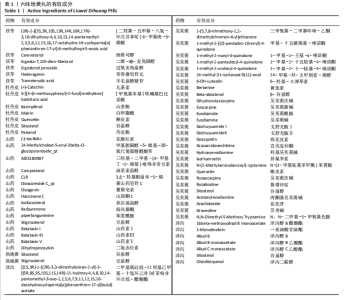
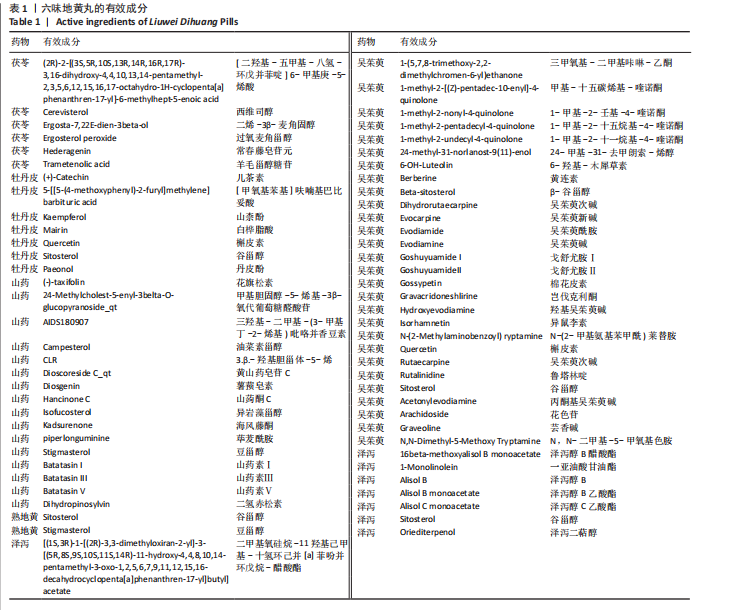
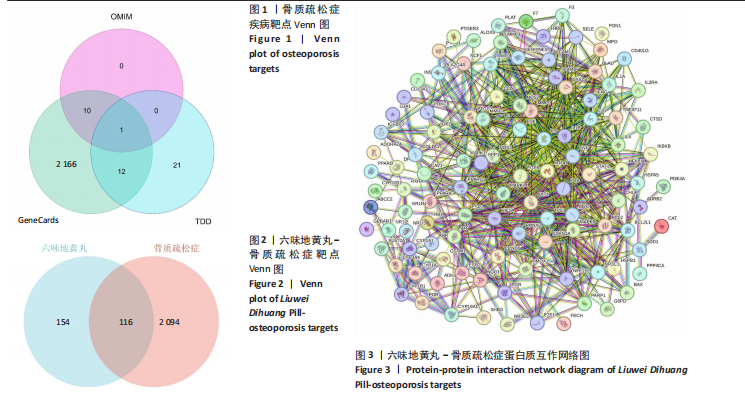
2.1 网络药理学分析结果 2.1.1 六味地黄丸的活性成分及靶点 根据TCMSP、ETCM数据库检索、去重,获取六味地黄丸各中药有效成分及作用靶点如下:熟地黄有效成分2个,作用靶点30个;山药有效成分16个,作用靶点125个;吴茱萸有效成分28个,作用靶点460个;泽泻有效成分8个,作用靶点66个;茯苓有效成分6个,作用靶点24个;牡丹皮有效成分7个,作用靶点213个。六味地黄丸的有效成分及对应ID见表1。 2.1.2 疾病靶点汇总 确定主题词后进行疾病靶点的检索,从GeneCards数据库获得2 189个靶点,OMIM数据库获得11个靶点,TTD数据库获得34个靶点,Disgenet、PharmGkb数据库未能检索到靶点。对各数据库所获取靶点取并集后共得到2 210个疾病靶点(图1)。"
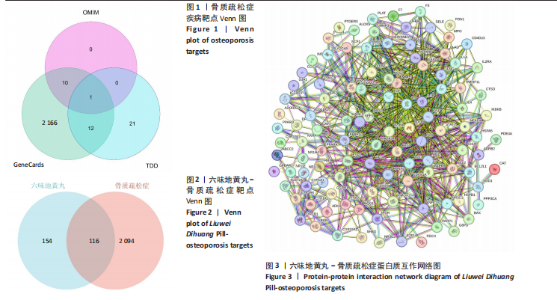
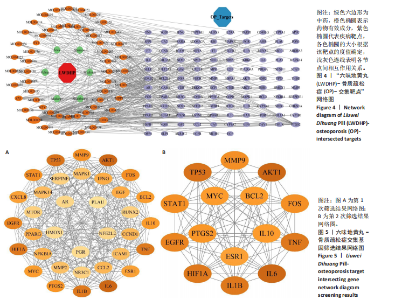
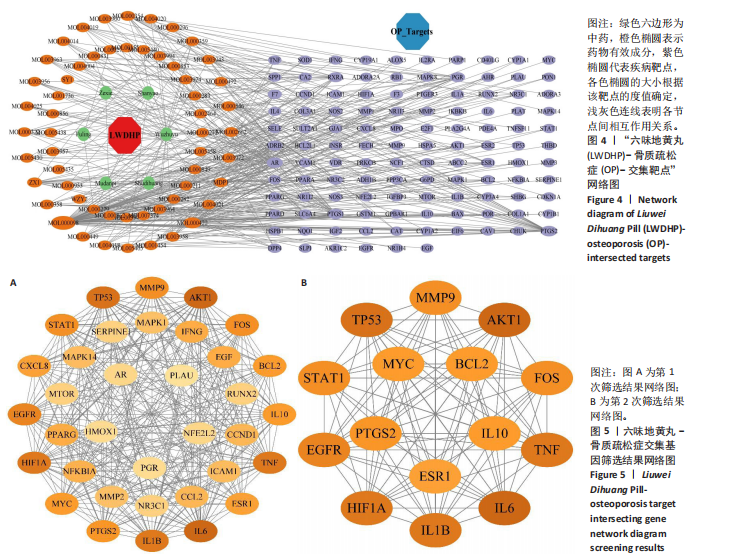
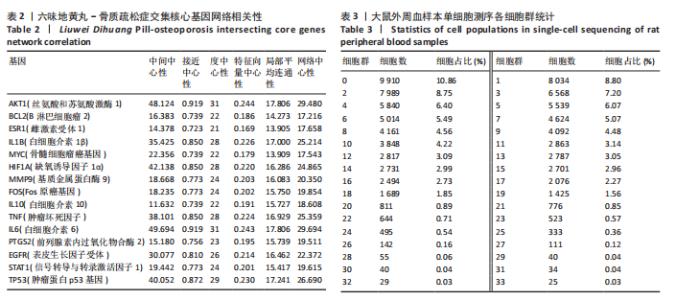
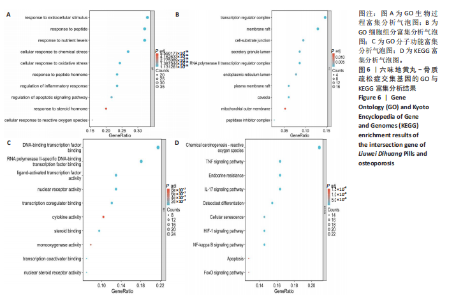
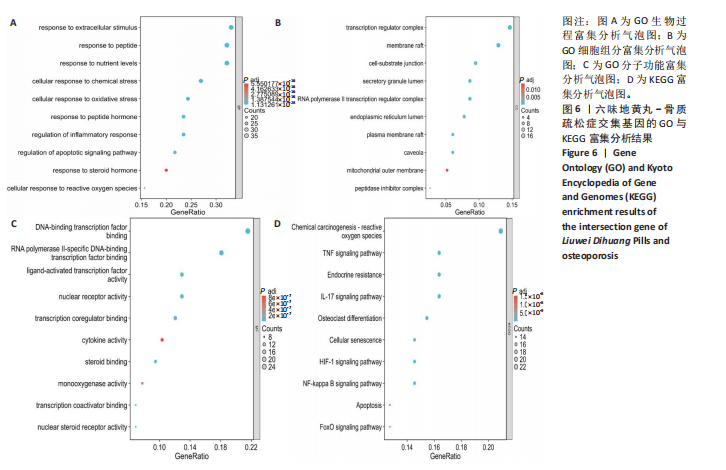
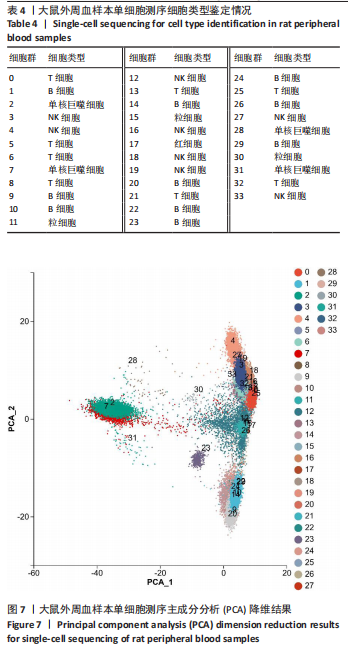
2.1.3 “药物-疾病-靶点”网络图构建与蛋白质互作网络分析 使用Venn包获得交集靶点116个(图2),将其通过STRING数据库进行蛋白质互作网络分析,构建蛋白质互作网络图(图3),并导出靶点互作文件。将数据导入Cytoscape构建“药物-疾病-靶点”网络图(图4),不同颜色和形状的节点有不同信息,绿色六边形为中药,橙色椭圆表示药物有效成分,紫色椭圆代表疾病靶点,各色椭圆的大小根据该靶点的度值确定,浅灰色连线表明各节点间相互作用关系。使用Cytoscape的CytoNCA插件计算靶点网络相关性指标中间中心性、接近中心性、度中心性、特征向量中心性、局部平均连通性、网络中心性以鉴定核心基因。通过计算上述指标,取其中位数进行2轮筛选后确定15个核心基因(表2,图5)。 2.1.4 交集靶点的GO与KEGG富集分析 使用ClusterProfiler包对交集基因进行GO和KEGG富集分析。GO富集分析获得生物过程数据2 329条,细胞组分数据48条,分子功能数据134条,KEGG富集到174条相关通路(P < 0.1)。基于P值、Count数等信息筛选富集信息,使用R软件中的ggplot2包对富集分析结果进行可视化,各富集分析结果见图6。GO_生物过程分析表明,交集靶点与细胞对营养水平、氧化应激、激素、凋亡、炎症反应等生物过程关系密切;GO_细胞组分分析表明,交集靶点与线粒体、内质网、RNA聚合酶、肽酶抑制剂等细胞成分有关;GO_分子功能分析表明,交集靶点与核受体、转录因子、类固醇受体、细胞因子等功能相关。KEGG富集分析显示,交集基因主要富集到激素、炎症、氧化应激、破骨细胞分化、细胞衰老与凋亡等多条相关通路。 2.2 动物实验结果 2.2.1 实验动物数量分析 9只大鼠全部进入结果分析。 2.2.2 各组大鼠骨密度情况 末次给药结束后,假手术组、模型组、六味地黄丸组大鼠骨密度分别为0.279,0.247,0.268 g/cm2,3组间整体比较差异有显著性意义(F=14.217,P=0.005),假手术组、六味地黄丸组大鼠骨密度高于模型组(P < 0.05),说明六味地黄丸可改善绝经后骨质疏松症大鼠的骨密度。 2.2.3 单细胞测序数据的降维聚类 基于单细胞测序数据高维度且复杂的特性,使用Seurat包中的LogNormalize标准化方法进"
"
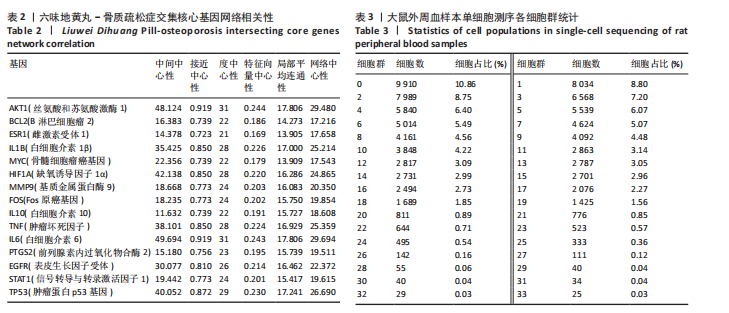
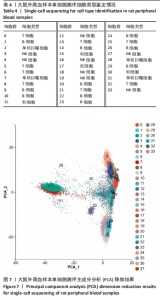
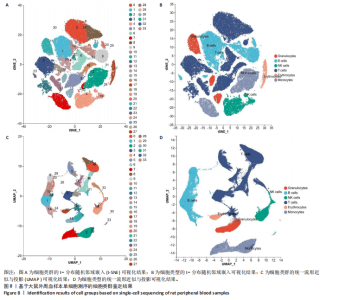
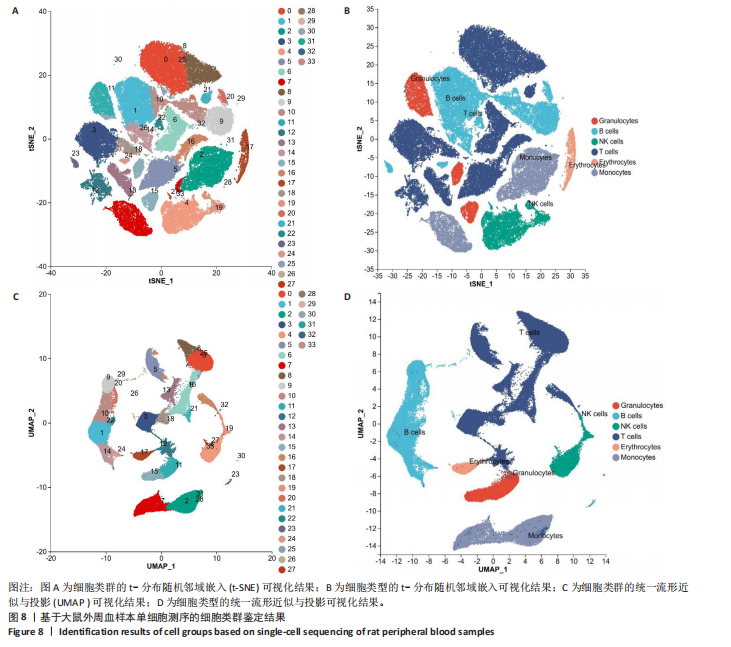
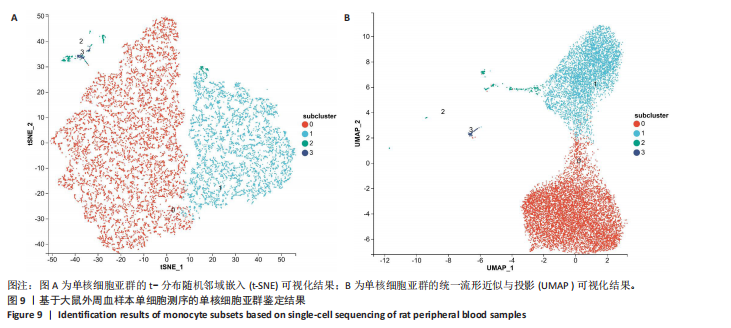
行主成分分析,将细胞初步降维成34个群(图7)。在去除批次效应后使用t-分布邻域嵌入算法(t-SNE) 和统一流形逼近与投影(UMAP) 将34群细胞进行聚类分析[20-21],各细胞群的细胞数与占比见表3。 2.2.4 细胞类群鉴定与亚群细分 基于Seurat包计算每群细胞的差异高表达基因,进一步筛选marker。过SingleR包对细胞类型进行初步注释,结合CellMarker数据库及文献报道等方式对注释结果进行细胞类型调整,确定各细胞类群(表4)。共鉴定出10群B细胞、8群T细胞、8群NK细胞、4群单核巨噬细胞、3群粒细胞、1群红细胞。基于细胞类型的tSNE、UMAP图见图8。 鉴于单核巨噬细胞与破骨细胞前体细胞的关系较为密切,此次研究对2,7,28,31共4群单核巨噬细胞进行进一步的亚群细分,t-分布随机邻域嵌入、统一流形近似与投影降维聚类结果如图9所示,各细胞亚群的差异基因气泡图如图10所示。根据降维聚类及基因表达情况,可以近似地将单核巨噬细胞看成CD16(FCGR3A)阳性和阴性两大亚群。"
"
"
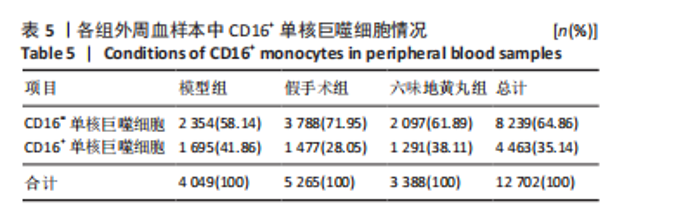
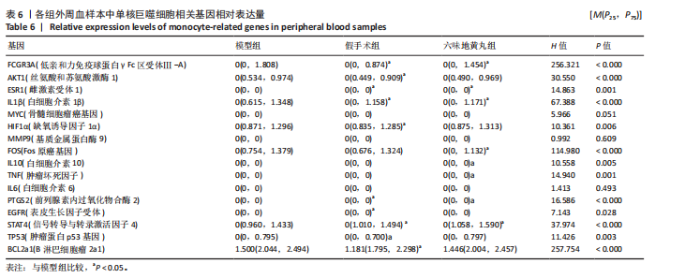
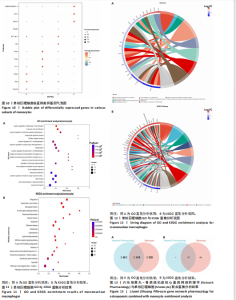
2.2.5 单核巨噬细胞富集分析 为进一步分析单核巨噬细胞的功能情况,对单核巨噬细胞群进行了GO、KEGG富集分析(图11)。GO富集分析结果表明,单核巨噬细胞群主要富集到细胞凋亡相关功能(淋巴细胞凋亡过程、外源性凋亡信号通路的正调控和活性氧代谢过程的正调控)、淋巴细胞分化功能(α-β T细胞活化、分化的正调控、T细胞分化的正调控)等功能,此外与免疫系统功能也关系密切。KEGG富集分析表明,与单核巨噬细胞群关系密切的有凋亡与免疫相关功能,值得注意的是,单核巨噬细胞群与破骨细胞分化也有密切联系(Rich number=43,Rich Factor=0.506,P < 0.000 1)。针对富集分析结果,进一步使用富集弦图的方式观察每个富集功能对应到哪些基因与这些基因的上调、下调情况(图12)。KEGG富集弦图表明,CD16表达上调、Fos基因表达下调等与破骨细胞分化关系密切。 2.3 网络药理学-单细胞测序联合分析结果 2.3.1 单核巨噬细胞的核心基因表达量分析 此次测序鉴定为单核巨噬细胞的细胞总数为12 702个,CD16+ 细胞总计4 463个,CD16+ 细胞占单核巨噬细胞比例为35.14%(表5)。为进一步探索六味地黄丸治疗绝经后骨质疏松症的机制,基于网络药理学分析所获得的核心基因,提取了此次测序单核巨噬细胞的相关基因表达量进行进一步分析(表6)。结果表明,核心基因中仅有MYC、MMP9、IL6组间比较差异无显著性意义,其余基因的表达均发生了明显变化。在组间有差异的核心基因中,ESR1、IL10、TNF、PTGS2、EGFR等核心基因的本底表达较低,而BCL2本底表达高且组间变化明显。作为单核巨噬细胞亚群Marker的CD16表达在模型组最高,在六味地黄丸组、假手术组中下降。 2.3.2 核心基因与单核巨噬细胞的联合富集分析 见图13。"
"
"

"
"
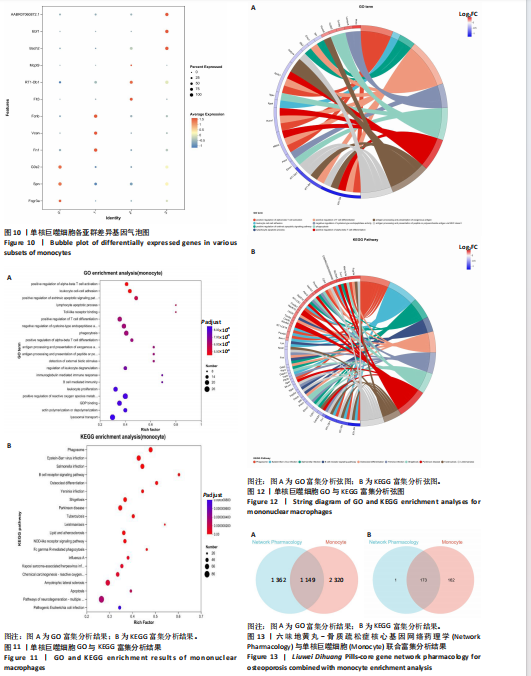

基于网络药理学和单核巨噬细胞的富集分析,对以上两部分的GO、KEGG富集分析结果取交集,两部分GO分析交集条目共1 149条,KEGG分析交集条目173条(图13)。基于网络药理学和单细胞测序的联合富集分析,六味地黄丸治疗绝经后骨质疏松症的机制主要在破骨细胞的分化、细胞凋亡、细胞衰老、多种激素、细胞因子相关通路等方面。"

| [1] 中华医学会骨质疏松和骨矿盐疾病分会.原发性骨质疏松症诊疗指南(2022)[J].中华骨质疏松和骨矿盐疾病杂志,2022,15(6):573-561. [2] WALKER MD, SHANE E. Postmenopausal Osteoporosis. N Engl J Med. 2023; 389(21):1979-1991. [3] 世界卫生组织.2019全球健康评估报告[Z].2020. [4] 中华医学会骨质疏松和骨矿盐疾病分会.中国骨质疏松症流行病学调查及“健康骨骼”专项行动结果发布[J].中华骨质疏松和骨矿盐疾病杂志,2019, 12(4):317-318. [5] WANG L, YU W, YIN X, et al. Prevalence of Osteoporosis and Fracture in China: The China Osteoporosis Prevalence Study. JAMA Netw Open. 2021;4(8):e2121106. [6] RUGGIERO C, BARONI M, XENOS D, et al. Dementia, osteoporosis and fragility fractures: Intricate epidemiological relationships, plausible biological connections, and twisted clinical practices. Ageing Res Rev. 2024;93:102130. [7] LONG ZY, WU JM, XIANG W, et al. Research on the Mechanism of Liuwei Dihuang Decoction for Osteoporosis Based on Systematic Biological Strategies. Evid Based Complement Alternat Med. 2022;2022:7017610. [8] LU Z, HUANG M, LIN H, et al. Network pharmacology and molecular docking approach to elucidate the mechanisms of Liuwei Dihuang pill in diabetic osteoporosis. J Orthop Surg Res. 2022;17(1):314. [9] WANG L, CHEN B, XIE D, et al. Bioinformatics and network pharmacology discover the molecular mechanism of Liuwei Dihuang pills in treating cerebral palsy. Medicine (Baltimore). 2024;103(43):e40166. [10] ZHANG Y, MA H, NAN T, et al. Comparative Efficacy of Oral Chinese Patent Medicine for Chronic Prostatitis/Chronic Pelvic Pain Syndrome With Sexual Dysfunction: A Bayesian Network Meta-Analysis of Randomized Controlled Trials. Front Pharmacol. 2021;12:649470. [11] 匡浩铭,杨张琪,彭志飞,等.六味地黄丸治疗绝经后骨质疏松症疗效和安全性的Meta分析[J].中医正骨,2022,34(8):31-35,58. [12] 陈娟,谢丽华,李生强,等.JAK/STAT通路介导的六味地黄丸对绝经后骨质疏松症肾阴虚证的免疫调节作用[J].中华中医药杂志,2017,32(4):1747-1750. [13] 谢丽华,郭澜,陈赛楠,等.基于ERK/mTOR信号通路探讨六味地黄丸对氧化应激状态下成骨细胞自噬的影响[J].中国骨质疏松杂志,2023,29(1):1-5. [14] 郭澜,李莉,葛继荣,等.六味地黄丸含药血清通过诱导自噬对氧化应激状态下成骨细胞增殖的影响[J].中国骨质疏松杂志,2023,29(1):11-16. [15] FISCHER V, HAFFNER-LUNTZER M. Interaction between bone and immune cells: Implications for postmenopausal osteoporosis. Semin Cell Dev Biol. 2022;123:14-21. [16] 阮红良,佘冬梅,孙绍裘.六味地黄丸减轻绝经后骨质疏松症及疲劳的作用机制:基于抑制表观调控分子BRD4通路[J].南方医科大学学报,2023, 43(12):1998-2005. [17] YEE JL, HUANG CY, YU YC, et al. Potential Mechanisms of Guizhi Fuling Wan in Treating Endometriosis: An Analysis Based on TCMSP and DisGeNET Databases. J Ethnopharmacol. 2024;329:118190. [18] ZHANG Y, LI X, SHI Y, et al. ETCM v2.0: An update with comprehensive resource and rich annotations for traditional Chinese medicine. Acta Pharm Sin B. 2023; 13(6):2559-2571. [19] 黄小彬,葛继荣,李生强,等.不同滋阴补肾法干预去势大鼠破骨通路的机制[J].中国组织工程研究,2025,29(6):1214-1219. [20] WANG Y, CHEN L, JO J, et al. Joint t-SNE for Comparable Projections of Multiple High-Dimensional Datasets. IEEE Trans Vis Comput Graph. 2022;28(1):623-632. [21] DO VH, CANZAR S. A generalization of t-SNE and UMAP to single-cell multimodal omics. Genome Biol. 2021;22(1):130. [22] BAE S, KIM K, KANG K, et al. RANKL-responsive epigenetic mechanism reprograms macrophages into bone-resorbing osteoclasts. Cell Mol Immunol. 2023;20(1):94-109. [23] ZIEGLER-HEITBROCK L, ANCUTA P, CROWE S, et al. Nomenclature of monocytes and dendritic cells in blood. Blood. 2010;116(16):e74-e80. [24] MAGRI Z, JETTON D, MUENDLEIN HI, et al. CD14 is a decision-maker between Fas-mediated death and inflammation. Cell Rep. 2024;43(9):114685. [25] SHARYGIN D, KONIARIS LG, WELLS C, et al. Role of CD14 in human disease. Immunology. 2023;169(3):260-270. [26] RUDER AV, WETZELS SMW, TEMMERMAN L, et al. Monocyte heterogeneity in cardiovascular disease. Cardiovasc Res. 2023;119(11):2033-2045. [27] RUIZ VY, CALDERON TM, LEON-RIVERA R, et al. Single-cell analysis of CD14+CD16+ monocytes identifies a subpopulation with an enhanced migratory and inflammatory phenotype. Front Immunol. 2025;16:1475480. [28] SUN C, RAHMAN MSU, ENKHJARGAL B, et al. Osteopontin modulates microglial activation states and attenuates inflammatory responses after subarachnoid hemorrhage in rats. Exp Neurol. 2024;371:114585. [29] BASHORE AC, XUE C, KIM E, et al. Monocyte Single-Cell Multimodal Profiling in Cardiovascular Disease Risk States. Circ Res. 2024;135(6):685-700. [30] TAHIR S, STEFFENS S. Nonclassical monocytes in cardiovascular physiology and disease. Am J Physiol Cell Physiol. 2021;320(5):C761-C770. [31] PREUß SL, OEHRL S, ZHANG H, et al. Immune complex-induced haptokinesis in human non-classical monocytes. Front Immunol. 2023;14:1078241. [32] ZAWADA AM, ROGACEV KS, ROTTER B, et al. SuperSAGE evidence for CD14++CD16+ monocytes as a third monocyte subset. Blood. 2011;118(12):e50-61. [33] ZIEGLER-HEITBROCK L, HOFER TP. Toward a refined definition of monocyte subsets. Front Immunol. 2013;4:23. [34] ZHAO C, TAN YC, WONG WC, et al. The CD14(+/low) CD16(+) monocyte subset is more susceptible to spontaneous and oxidant-induced apoptosis than the CD14(+) CD16(-) subset. Cell Death Dis. 2010;1(11):e95. [35] SHI C, PAMER EG. Monocyte recruitment during infection and inflammation. Nat Rev Immunol. 2011;11(11):762-774. [36] CROS J, CAGNARD N, WOOLLARD K, et al. Human CD14dim monocytes patrol and sense nucleic acids and viruses via TLR7 and TLR8 receptors. Immunity. 2010;33(3):375-386. [37] CZABOTAR PE, GARCIA-SAEZ AJ. Mechanisms of BCL-2 family proteins in mitochondrial apoptosis. Nat Rev Mol Cell Biol. 2023;24(10):732-748. [38] VOGLER M, BRAUN Y, SMITH VM, et al. The BCL2 family: from apoptosis mechanisms to new advances in targeted therapy. Signal Transduct Target Ther. 2025;10(1):91. |
| [1] | Chen Yulin, He Yingying, Hu Kai, Chen Zhifan, Nie Sha Meng Yanhui, Li Runzhen, Zhang Xiaoduo , Li Yuxi, Tang Yaoping. Effect and mechanism of exosome-like vesicles derived from Trichosanthes kirilowii Maxim. in preventing and treating atherosclerosis [J]. Chinese Journal of Tissue Engineering Research, 2026, 30(7): 1768-1781. |
| [2] | Zhou Sirui, Xu Yukun, Zhao Kewei. Ideas and methods of anti-melanogenesis of Angelica dahurica extracellular vesicles [J]. Chinese Journal of Tissue Engineering Research, 2026, 30(7): 1747-1754. |
| [3] | Peng Zhiwei, Chen Lei, Tong Lei. Luteolin promotes wound healing in diabetic mice: roles and mechanisms [J]. Chinese Journal of Tissue Engineering Research, 2026, 30(6): 1398-1406. |
| [4] | Yang Zhijie, Zhao Rui, Yang Haolin, Li Xiaoyun, Li Yangbo, Huang Jiachun, Lin Yanping, Wan Lei, HuangHongxing. Postmenopausal osteoporosis: predictive values of muscle mass, grip strength, and appendicular skeletal muscle index [J]. Chinese Journal of Tissue Engineering Research, 2026, 30(5): 1073-1080. |
| [5] | Chen Yixian, Chen Chen, Lu Liheng, Tang Jinpeng, Yu Xiaowei. Triptolide in the treatment of osteoarthritis: network pharmacology analysis and animal model validation [J]. Chinese Journal of Tissue Engineering Research, 2026, 30(4): 805-815. |
| [6] | Wang Houyuan, Xiao Jiacong, Shao Shoujia, He Paian, Yang Nan, Jiang Ziwei. Aucubin promotes osteogenic differentiation of mouse cranial pre-osteoblasts MC3T3-E1 [J]. Chinese Journal of Tissue Engineering Research, 2026, 30(36): 9381-9392. |
| [7] | Lin Kun, He Xianshun, Zhang Junjiao, Han Mingli, He Mincong, Wei Qiushi. Mechanism underlying Qu Shi Jie Du Formula for treating hyperuricemia in mice: an analysis integrating UHPLC-QE-MS with network pharmacology [J]. Chinese Journal of Tissue Engineering Research, 2026, 30(36): 9621-9631. |
| [8] | Wang Yuhe, Xie Tianyu, Ma Shijia, Wang Yujiao, Li Mengting, Xie Daojun. Regulatory effects of Yuping Shen’an Granules on neuronal autophagy in a mouse model of insomnia [J]. Chinese Journal of Tissue Engineering Research, 2026, 30(35): 9217-9230. |
| [9] | Zhao Canbin, Zeng Ping, Shi Weiqi, Liu Jinfu, Ding Qiang, Guo Liang, Wang Weiwei, Tao Hongcheng, Guo Yafeng, Qin Ying. Mechanism by which luteolin regulates macrophage polarization in the treatment of knee osteoarthritis [J]. Chinese Journal of Tissue Engineering Research, 2026, 30(34): 8868-8877. |
| [10] | Jing Kun, Wang Yulu, Liang Hao, Huo Yuhang, Cong Longxu, . Mechanisms by which mangiferin alleviates pain in osteoarthritis: integration of microarray data analysis, network pharmacology, and experimental validation in a rat model [J]. Chinese Journal of Tissue Engineering Research, 2026, 30(34): 8953- 8961. |
| [11] | Yuan Jingjing, Zhang Xiaomin, Du Pengyang, Wang Weifeng. Mazdutide improves cognitive function in APP/PS1/Tau triple transgenic mice [J]. Chinese Journal of Tissue Engineering Research, 2026, 30(34): 8962-8969. |
| [12] | Lu Chuan, Yang Jiale, Li Youliang, Li Chao. Anethole promotes osteogenic differentiation of human bone marrow mesenchymal stem cells [J]. Chinese Journal of Tissue Engineering Research, 2026, 30(31): 8041-8046. |
| [13] | Qi Yuxin, Dang Yifan, Dai Liming, Zhang Xiaoling. Function and molecular mechanism of physcion in regulating bone homeostasis [J]. Chinese Journal of Tissue Engineering Research, 2026, 30(28): 7237-7244. |
| [14] | Deng Qian, Peng Zining, Meng Fanyu, Huang Yuanbo, Liu Nian, Yan Weitian, Li Zhaofu, Peng Jiangyun. Molecular mechanisms of Toddalia asiatica against rheumatoid arthritis: bioinformatics and molecular dynamics simulation [J]. Chinese Journal of Tissue Engineering Research, 2026, 30(28): 7267-7279. |
| [15] | He Yanyan, Ge Jirong, Li Shengqiang, Chen Xuan, Huang Jingwen, Huang Xiaobin, Xue Lipeng. Transcriptomic analysis of expression and function of differential genes in traditional Chinese medicine syndromes of postmenopausal osteoporosis [J]. Chinese Journal of Tissue Engineering Research, 2026, 30(25): 6446-6454. |
| Viewed | ||||||
|
Full text |
|
|||||
|
Abstract |
|
|||||