Chinese Journal of Tissue Engineering Research ›› 2026, Vol. 30 ›› Issue (35): 9159-9164.doi: 10.12307/2026.415
Previous Articles Next Articles
An association between preoperative dental anxiety and the time of mandibular third molar extraction
Li Lei1, Bai Xiaolong1, Li Jiaye2, Wang Weili1
- 1Department of Stomatology, Aerospace Center Hospital, Beijing 100049, China; 2Department of Endodontics, Tianjin Medical University School and Hospital of Stomatology & Tianjin Key Laboratory of Oral Soft and Hard Tissues Restoration and Regeneration, Tianjin 300070, China
-
Received:2025-09-26Revised:2026-02-13Online:2026-12-18Published:2026-04-27 -
Contact:Wang Weili, PhD, Chief physician, Department of Stomatology, Aerospace Center Hospital, Beijing 100049, China -
About author:Li Lei, MS, Associate chief physician, Department of Stomatology, Aerospace Center Hospital, Beijing 100049, China -
Supported by:Health Development Research and Education Program of Haidian District, Beijing, No. HP2024-12-507003 (to LL)

CLC Number:
Cite this article
Li Lei, Bai Xiaolong, Li Jiaye, Wang Weili. An association between preoperative dental anxiety and the time of mandibular third molar extraction[J]. Chinese Journal of Tissue Engineering Research, 2026, 30(35): 9159-9164.
share this article
Add to citation manager EndNote|Reference Manager|ProCite|BibTeX|RefWorks
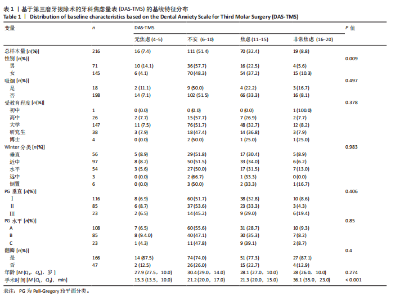
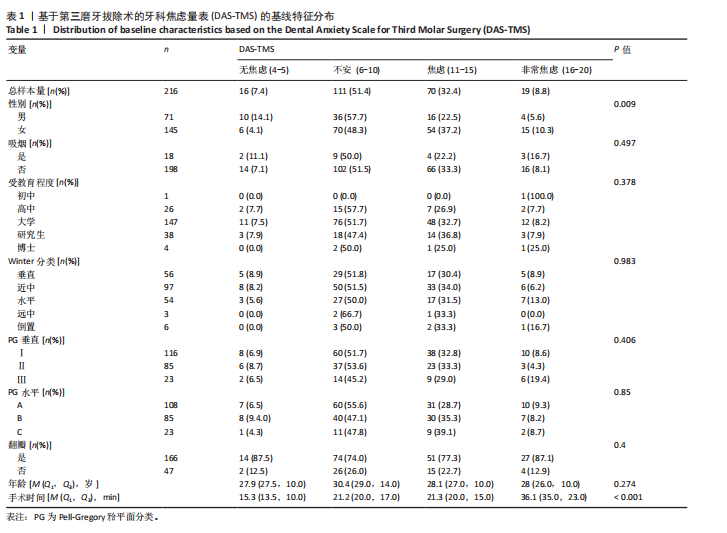
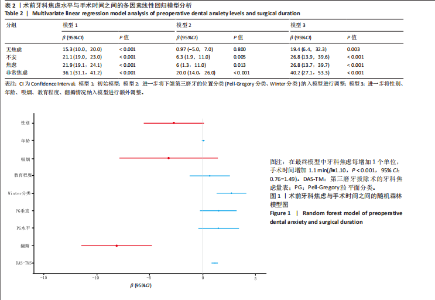
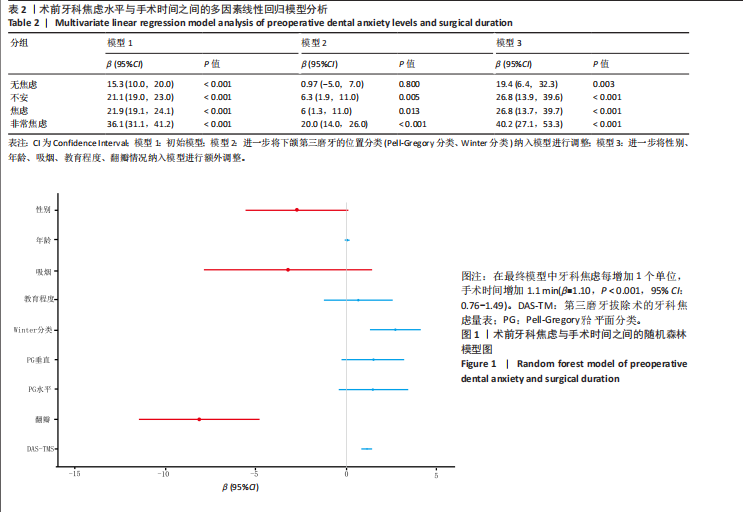
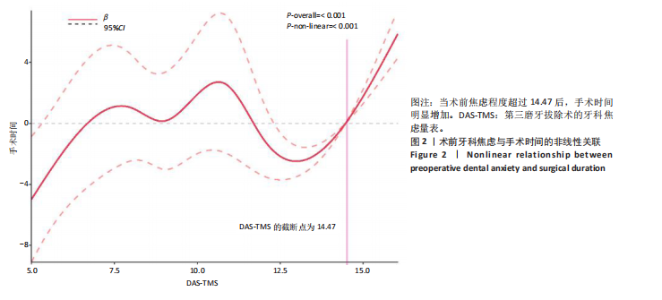
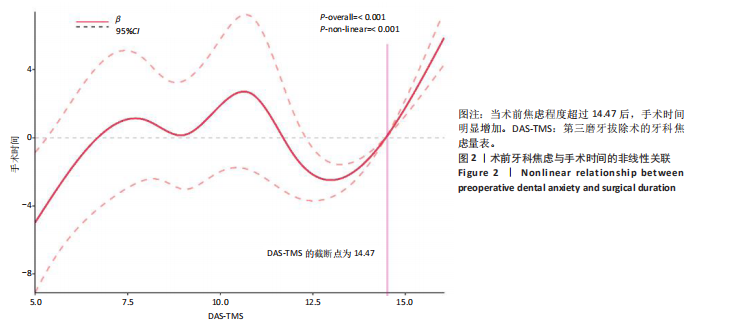
2.1 参与者数量分析 研究纳入216例患者,平均年龄(29±9)岁,男性71例、女性145例,全部参与焦虑量表评估及拔除第三磨牙。 2.2 牙科焦虑评估 平均牙科焦虑评分为10.4±3.5。男性平均得分9.4±3.3,女性平均得分10.8±3.4。 2.3 各个变量基于DAS-TMS的基线特征分布 各类DAS-TMS评分中,基于性别的DAS-TMS分布差异有显著性意义(P=0.009 < 0.05)。年龄、吸烟、受教育程度、Winter分类、Pell-Gregory水平、Pell-Gregory 垂直分类和翻瓣在DAS-TMS的不同类别中无明显差异(所有均P > 0.05),见表1。 2.4 术前牙科焦虑水平与手术时间之间的多因素线性回归模型分析 多变量调整前较高的DAS-TMS水平与较长的手术时间有关。调整其他混杂因素后各类DAS-TMS的水平与手术时间仍存在明显关联,调整后的结果并没有明显改变估计的关联,见表2。在最终模型中牙科焦虑每增加1个单位,手术时间增加1.1 min (β=1.10,P < 0.001,95% CI:0.76-1.49),见图1。 2.5 术前牙科焦虑与手术时间的非线性关联 限制性立方样条函数显示术前牙科焦虑与手术时间具有明显的非线性关系(P=0.013),见图2。阈值效应分析显示DAS-TMS值为14.47,即当术前焦虑程度超过14.47后,手术时间明显增加。"
"
"
| [1] BAILEY E, KASHBOUR W, SHAH N, et al. Surgical techniques for the removal of mandibular wisdom teeth. Cochrane Database Syst Rev. 2020;7(7):CD004345. [2] CORAH NL. Development of a dental anxiety scale. J Dent Res. 1969;48(4):596. [3] NL C, EN G, SJ I. Assessment of a dental anxiety scale. J Am Dent Assoc. 1978; 97(5):816-819. [4] EARL P. Patients’ anxieties with third molar surgery. Br J Oral Maxillofac Surg. 1994;32(5):293-297. [5] SIRIN Y, HUMPHRIS G, SENCAN S, et al. What is the most fearful intervention in ambulatory oral surgery? Analysis of an outpatient clinic. Int J Oral Maxillofac Surg. 2012;41(10):1284-1290. [6] SILVEIRA ER, CADEMARTORI MG, SCHUCH HS, et al. Estimated prevalence of dental fear in adults: A systematic review and meta-analysis. J Dent. 2021; 108:103632. [7] NG SK, LEUNG WK. A community study on the relationship of dental anxiety with oral health status and oral health-related quality of life. Community Dent Oral Epidemiol. 2008;36(4):347-356. [8] QIAO F, ZHANG M, ZHANG T, et al. Dental anxiety is related to postoperative symptoms in third molar surgery. Front Psychiatry. 2022;13:956566. [9] GORDON D, HEIMBERG RG, TELLEZ M, et al. A critical review of approaches to the treatment of dental anxiety in adults. J Anxiety Disord. 2013;27(4):365-378. [10] 陈海艳,王芳云,罗武香,等. 成人拔牙患者牙科焦虑症相关因素分析[J]. 安徽医学,2024,45(1):65-68. [11] HUMPHRIS GM, MORRISON T, LINDSAY SJ. The modified dental anxiety scale: Validation and united kingdom norms. Community Dent Health. 1995;12(3):143-150. [12] 朱承章,万宏坤. 超前镇痛对阻生牙微创拔牙术后镇痛效果及mdas评分的影响[J].中国口腔颌面外科杂志,2024,22(1):49-52. [13] KLEINKNECHT RA, KLEPAC RK, ALEXANDER LD. Origins and characteristics of fear of dentistry. J Am Dent Assoc (1939). 1973;86(4):842-848. [14] SPIELBERGER CD, GONZALEZ-REIGOSA F, MARTINEZ-URRUTIA A, et al. The state-trait anxiety inventory. Int J Psychol. 1971;5:145-158. [15] LIN CS, LEE CY, WU SY, et al. Translation and validation of modified dental anxiety scale based on adult taiwan population. BMC Oral Health. 2021;21(1):647. [16] XU JL, XIA R. Influence factors of dental anxiety in patients with impacted third molar extractions and its correlation with postoperative pain: a prospective study. Med Oral Patol Oral Cir Bucal. 2020;25(6):e714-e719. [17] POTTER CM, KINNER DG, TELLEZ M, et al. Clinical implications of panic symptoms in dental phobia. J Anxiety Disord. 2014;28(7):724-730. [18] 刘玲侠,曹敏,赵雯,等. 牙科焦虑对牙周膜龈美学手术后疼痛的影响[J]. 实用口腔医学杂志,2021,37(4):540-544. [19] LAGO-MÉNDEZ L, DINIZ-FREITAS M, SENRA-RIVERA C, et al. Postoperative recovery after removal of a lower third molar: role of trait and dental anxiety. Oral Surg Oral Med Oral Pathol Oral Radiol Endod. 2009;108(6):855-860. [20] RAFETTO LK. Managing impacted third molars. Oral Maxillofac Surg Clin N Am. 2015;27(3):363-371. [21] DE JONGH A, VAN WIJK AJ, LINDEBOOM JA. Psychological impact of third molar surgery: a 1-month prospective study. J Oral Maxillofac Surg. 2011;69(1):59-65. [22] International ethical guidelines for health-related research involving humans.TARTU ÜLIKOOL digiarhiiv ADA.2016. [23] WMA declaration of helsinki - ethical principles for medical research involving human participants-WMA -the world medical association[EB/OL]. https://www.wma.net/policies-post/wma-declaration-of-helsinki/. [24] 张志愿. 口腔颌面外科学[M]. 8版. 北京:人民卫生出版社, 2020. [25] QIAO F, HUANG X, LI B, et al. A Validated Model to Predict Postoperative Symptom Severity After Mandibular Third Molar Removal. J Oral Maxillofac Surg. 2020;78(6):893-901. [26] LIU F, YOU F, YANG L, et al. Nonlinear relationship between oxidative balance score and hyperuricemia: Analyses of NHANES 2007-2018. Nutr J. 2024;23(1):48. [27] ALENEZI AA, ALDOKHAYEL HS. The impact of dental fear on the dental attendance behaviors: a retrospective study. J Family Med Prim Care. 2022;11(10):6444-6450. [28] SCHEMEL-SUAREZ M, EGIDO-MORENO S, MARTÍNEZ-LIZAN I, et al. Evaluation of anxiety in a group of adult patients attending a dental surgery unit. BMC Oral Health. 2025;25(1):355. [29] PARVEEN S, KHAN NA, WASEEM HF, et al. Frequency of anxiety in pre-operative surgical patients in the tertiary care hospitals, karachi. J Health Rehabil Res. 2024; 4(1):1587-1596. [30] GAY-ESCODA C, SÁNCHEZ-TORRES A, BORRÁS-FERRERES J, et al. Third molar surgical difficulty scales: systematic review and preoperative assessment form. Med Oral Patol Oral Cir Bucal. 2022;27(1):e68-e76. [31] RIZQIAWAN A, LESMAYA YD, RASYIDA AZ, et al. Postoperative complications of impacted mandibular third molar extraction related to patient’s age and surgical difficulty level: a cross-sectional retrospective study. Int J Dent. 2022;2022: 7239339. [32] WU W, CHEN S, CHEN P, et al. Identification of root canal morphology in fused-rooted mandibular second molars from X-ray images based on deep learning. J Endod. 2024;50(9):1289-1297.e1. [33] MATERNI A, PASQUALE C, SIGNORE A, et al. Comparison between the flapless surgical approach and a novel single incision access in terms of recovery time and comfort after extraction of impacted inferior third molars: A randomised, blinded, split-mouth controlled clinical trial. J Clin Med. 2023;12(5):1995. [34] EDIN S, ELMEDIN B. Assessment of preoperative and postoperative anxiety in adults during extraction of impacted third permanent molars. Balk J Dent Med. 2023;27(3):192-198. [35] WANG TF, WU YT, TSENG CF, et al. Associations between dental anxiety and postoperative pain following extraction of horizontally impacted wisdom teeth: A prospective observational study. Medicine (Baltimore). 2017;96(47):e8665. [36] DERECI O, SARUHAN N, TEKIN G. The comparison of dental anxiety between patients treated with impacted third molar surgery and conventional dental extraction. Biomed Res Int. 2021;2021:7492852. [37] KHAN SDAA, ALQANNASS NM, ALWADEI MM, et al. Assessment of the relationship between dental anxiety and oral health-related quality of life. J Pharm Bioallied Sci. 2021;13(Suppl 1):S359-S362. [38] VUJOVIC D, ALSEN M, VASAN V, et al. Anxiety and depression as potential predictors for shorter time to undergo initial surgical treatment for papillary thyroid cancer. Cancers (Basel). 2024;16(3):545. [39] TURER OU, OZCAN M, ALKAYA B, et al. The effect of mindfulness meditation on dental anxiety during implant surgery: A randomized controlled clinical trial.Sci Rep. 2023;13(1):21686. [40] EDIN S, ELMEDIN B. Characteristics of preoperative and postoperative anxiety in adults undergoing surgical extraction of impacted third molars. Balk J Dent Med. 2023;27(2):92-97. [41] QIAO F, HE B, ZHANG J, et al. Establishment and validation of a predictive nomogram for extended operation time following mandibular third molar removal. Clin Oral Investig. 2021;25(4):1915-1923. [42] LE SH, TONAMI K, UMEMORI S, et al. Relationship between preoperative dental anxiety and short-term inflammatory response following oral surgery. Aust Dent J. 2021;66(1):13-19. [43] AZNAR-ARASA L, FIGUEIREDO R, VALMASEDA-CASTELLÓN E, et al. Patient anxiety and surgical difficulty in impacted lower third molar extractions: a prospective cohort study. Int J Oral Maxillofac Surg. 2014;43(9):1131-1136. [44] TIWARI S, KULKARNI P, AGRAWAL N, et al. Dental anxiety scales used in pediatric dentistry: A systematic review and meta-analysis. J Contemp Dent Pract. 2021; 22(11):1338-1345. [45] YUAN S, ZHENG Y, SUN Z, et al. Does fear of infection affect people’s dental attendance during COVID-19? A Chinese example to examine the association between COVID anxiety and dental anxiety. Front Oral Health. 2023;4:1236387. [46] DUARTE-RODRIGUES L, MIRANDA EFP, SOUZA TO, et al. Third molar removal and its impact on quality of life: Systematic review and meta-analysis. Qual Life Res: Int J Qual Life Asp Treat Care Rehabil. 2018;27(10):2477-2489. [47] SÁNCHEZ-JORGE MI, CORTÉS-BRETÓN-BRINKMANN J, ACEVEDO-OCAÑA R, et al. Perceived surgical difficulty of mandibular third molar extraction. A comparative cross-sectional study of dentists with postgraduate qualification in oral surgery and maxillofacial surgeons in a spanish subpopulation. Med Oral Patol Oral Cir Bucal. 2024;29(2):e263-e272. [48] GIL-ABANDO G, MEDINA P, SIGNORINI C, et al. Assessment of clinical parameters of dental anxiety during noninvasive treatments in dentistry. Int J Environ Res Public Health. 2022;19(17):11141. [49] YAMASHITA K, KIBE T, OHNO S, et al. The effects of music listening during extraction of the impacted mandibular third molar on the autonomic nervous system and psychological state. J Oral Maxillofac Surg. 2019;77(6):1153.e1-1153.e8. [50] MONTEIRO JLGC, DA SILVA BARBIRATO D, MORAES SLD, et al. Does listening to music reduce anxiety and pain in third molar surgery?-a systematic review. Clin Oral Investig. 2022;26(10):6079-6086. [51] SORRIBES DE RAMÓN LA, FERRÁNDEZ MARTÍNEZ AF, GARCÍA CARRICONDO AR, et al. Effect of virtual reality and music therapy on anxiety and perioperative pain in surgical extraction of impacted third molars. J Am Dent Assoc. 2023;154(3): 206-214. |
| [1] | Wang Shiyu, Huang Yangyang, Liu Hao, Xu Jiabin, Wang Penglai, Yang Li. Efficiency of anterior tooth intrusion in deep overbite cases with clear aligners: analysis via the indirect model superimposition method [J]. Chinese Journal of Tissue Engineering Research, 2026, 30(25): 6489-6495. |
| [2] | Li Pengli, Yang Yanmei, Hu Yawen, Liu Hongqi, Wang Manyi, Yan Jianfei, Gu Bin. Effect of zoledronic acid on jaw bone marrow mesenchymal stem cells in mice with bisphosphonate-related osteonecrosis of the jaw [J]. Chinese Journal of Tissue Engineering Research, 2026, 30(13): 3217-3225. |
| [3] | He Longcai, Song Wenxue, Ming Jiang, Chen Guangtang, Wang Junhao, Liao Yidong, Cui Junshuan, Xu Kaya. An experimental method for simultaneous extraction and culture of primary cortical neurons and microglial cells from SD rats [J]. Chinese Journal of Tissue Engineering Research, 2025, 29(7): 1395-1400. |
| [4] | Hu Siyuan, Chen Jianquan. Extraction and characterization of three types of primary cells from rat intervertebral disc and their matrix expression in monolayer and micromass culture [J]. Chinese Journal of Tissue Engineering Research, 2025, 29(12): 2528-2535. |
| [5] | Huang Haozhe, Zheng Min, Li Na, Sun Libo, Lan Yuyan, Liu Min. Effects of naringin on healing of tooth extraction wound in osteoporotic rats [J]. Chinese Journal of Tissue Engineering Research, 2023, 27(32): 5144-5149. |
| [6] | Chen Lin, Xu Xiaomei, Zhang Li, Xu Pengfei, Zheng Qian. Finite element study on the effect of canine distal movement on anterior tooth intrusion by clear aligners [J]. Chinese Journal of Tissue Engineering Research, 2022, 26(35): 5669-5675. |
| [7] | Wang Wenli, Zhang Zihan, Li Yourui. Application of the socket-shield technique in the implant restoration [J]. Chinese Journal of Tissue Engineering Research, 2022, 26(27): 4406-4410. |
| [8] | Li Shidan, Xing Wei, Xie Xiaoyu, Li Youbin, Wang Shaochuan, Fei Jun. A new method for extracting human bone marrow mesenchymal stem cells and the comparison with traditional methods [J]. Chinese Journal of Tissue Engineering Research, 2022, 26(24): 3814-3820. |
| [9] | Li Jing, Qiao Wei, Ren Xiaoqi, Shi Hao, Yang Ting, Ma Shaoying, Su Chengzhong, Li Baoxing, Zhao Yaping. Calcined bovine bone combined with acellular dermal matrix for maintaining the alveolar ridge in dog [J]. Chinese Journal of Tissue Engineering Research, 2022, 26(22): 3445-3449. |
| [10] | Li Lichun, Li Xiaofeng, Li Jianping. Potential new target effects between exosomes derived from mesenchymal stem cells and various hematological tumors [J]. Chinese Journal of Tissue Engineering Research, 2022, 26(13): 2099-2105. |
| [11] | Zhao Yiming, Wang Jie, Zhang Gaowei, Sun Jianjun, Yang Peng. Recognition of human lower limb movement intention based on surface electromyography of lower limb corresponding to five gaits [J]. Chinese Journal of Tissue Engineering Research, 2022, 26(12): 1805-1811. |
| [12] | Zhu Bikang, Luo Shanchao, Luo Shixing. Progress and main application of fish skin collagen in tissue engineering [J]. Chinese Journal of Tissue Engineering Research, 2021, 25(28): 4561-4566. |
| [13] | Wulan•Saitahemaiti, Ailijiang•Asila, Nuerhanati•Shayilanbieke, Nuerman•Yixijian, Asihati•Nuermaimaiti, Fang Rui. Xinjiang Sambucus sibirica Nakai bark extract promotes fracture healing [J]. Chinese Journal of Tissue Engineering Research, 2020, 24(20): 3122-3129. |
| [14] | Luo Xujiang, Xian Hai, Peng Liqing, Shen Shi, Zhang Bin, Gao Chao, Wang Zhenyong, Sui Xiang, Huang Jingxiang, Han Gang, Liu Shuyun, Guo Quanyi, Lu Xiaobo. Extraction of porcine cancellous bone by supercritical carbon dioxide [J]. Chinese Journal of Tissue Engineering Research, 2020, 24(10): 1508-1514. |
| [15] | Zhuang Yan-qin, Chen Hui-min, Wu Qi-yue, Wang Ze-hua, Wu Ming-yue. Implantation of beta-tricalcium phosphate combined with osteoblast-specific peptides for alveolar bone preservation in extraction sockets [J]. Chinese Journal of Tissue Engineering Research, 2018, 22(10): 1517-1522. |
| Viewed | ||||||
|
Full text |
|
|||||
|
Abstract |
|
|||||