Chinese Journal of Tissue Engineering Research ›› 2026, Vol. 30 ›› Issue (34): 9067-9074.doi: 10.12307/2026.859
Previous Articles Next Articles
Different doses of aquatic exercise for improving muscle strength in older adults: a meta-analysis
Wang Yifei¹, Zhao Jing², Gao Mingchen¹, Wu Xiaobin¹
- ¹School of Physical Education, Chengdu Sport University, Chengdu 610000, Sichuan Province, China; ²Department of Physical Education, Lanzhou University, Lanzhou 730000, Gansu Province, China
-
Received:2025-12-01Revised:2026-02-11Online:2026-12-08Published:2026-04-15 -
Contact:Wu Xiaobin, PhD, Professor, School of Physical Education, Chengdu Sport University, Chengdu 610000, Sichuan Province, China -
About author:Wang Yifei, MS, School of Physical Education, Chengdu Sport University, Chengdu 610000, Sichuan Province, China

CLC Number:
Cite this article
Wang Yifei, Zhao Jing, Gao Mingchen, Wu Xiaobin. Different doses of aquatic exercise for improving muscle strength in older adults: a meta-analysis[J]. Chinese Journal of Tissue Engineering Research, 2026, 30(34): 9067-9074.
share this article
Add to citation manager EndNote|Reference Manager|ProCite|BibTeX|RefWorks
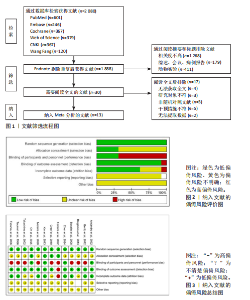
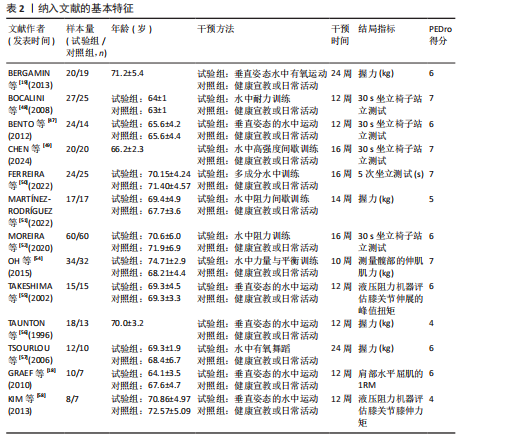
2.1 文献基本情况 初步检索获得2 080篇文献,去除重复文献后剩余1 888篇,阅读标题和摘要后获得文献30篇,最后阅读全文纳入13篇文献,共涉及531名参与者,其中试验组287名、对照组244名。文献筛选流程见图1。纳入研究的样本量范围为15–120名,中位数为38;平均年龄介于60–75岁,中位数为 69.3岁;出版年份跨度为1996–2024年,中位数为2014年;对于水中运动的变量,报告周期的中位数为12周(范围:10–24周),频率为每周3次(范围:两三次),单次运动时间为60 min (范围:45–70 min)。纳入文献的基本特征见表2。 2.2 风险评估结果 纳入研究的整体质量为中等,PEDro得分为3-7分,10项研究的得分为6分或以上。由2名研究人员使用Cochrane偏倚风险评估工具独立进行评估,如有分歧则交第3名研究人员复核并裁定。得出的偏倚风险结果,如图2,3所示。13篇文献报告了随机序列产生的具体方法,这些方法包括随机数字表法和基于计算机的随机序列法;9篇文章未说明是否采用盲法[18-19,47-48,50,54-57];1 篇文章因COVID-19肺炎导致样本缺失[19];所有文献"
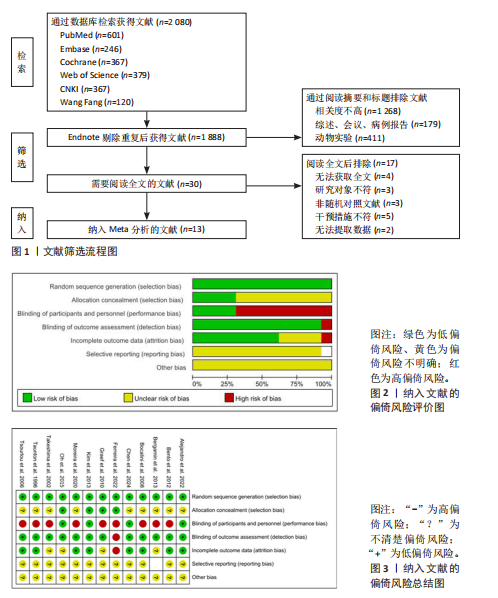
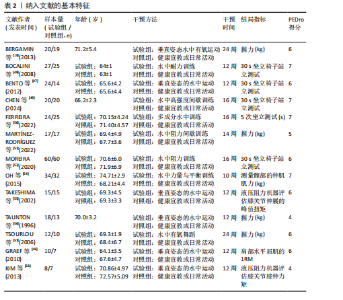
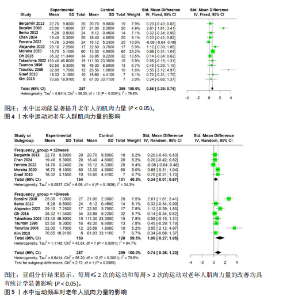
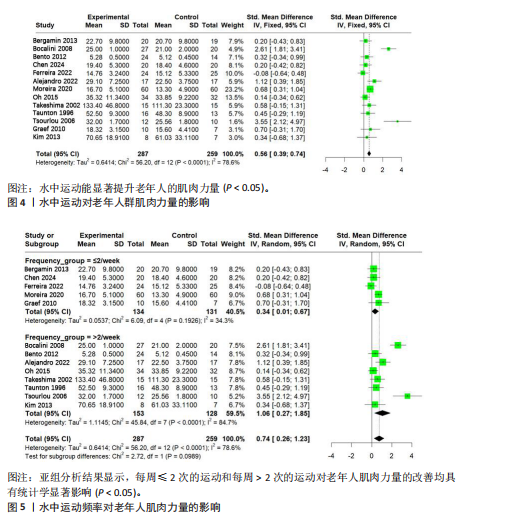
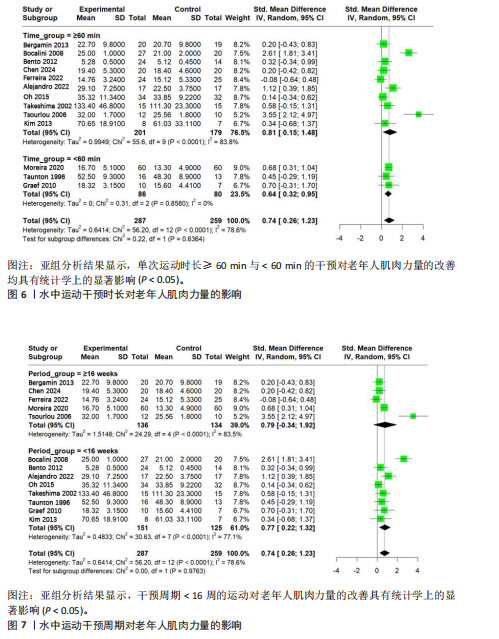
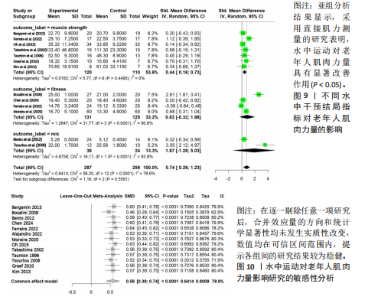
均未出现选择性报告的情况。此外,由于运动干预的特殊性,施盲难度较大,这可能对纳入文献的方法学质量产生了一定影响。 2.3 Meta分析结果 2.3.1 水中运动对老年人肌肉力量的影响 对13项研究的数据进行了合并分析,以评估水中运动对老年人肌肉力量的总体效果。首先,异质性检验结果显示,各独立研究的效应量之间存在显著的高度异质性(P < 0.000 1,I2= 78.6%)。因此,采用随机效应模型进行数据合并。 森林图分析结果表明,与对照组相比,水中运动能显著提升老年人的肌肉力量。合并后的SMD=0.56,95%CI:0.39-0.74(P < 0.000 1)。这一结果表明,水中运动对改善老年人肌肉力量具有统计学上显著的、中等强度的正向效应(图4)。为探究高度异质性的来源,根据运动方案的关键变量进行了亚组分析。 2.3.2 不同水中运动频率对老年人肌肉力量的影响 共计13篇文献被纳入水中运动频率对老年人群影响的 Meta分析中,其中5篇文献每周训练频率≤2次[18-19,49-50,52],8篇文献每周训练频率> 2次[19,48,51,54-58]。每周进行超过2次干预的亚组,其效应量 (SMD=1.06,95%CI:0.27-1.85) 远大于每周≤2次的亚组 (SMD=0.34,95%CI:0.01-0.67)。组间差异检验未达到统计学显著水平(P > 0.05),因此不能表明高频与低频组在效应上存在显著差异。不过,从点估计来看,高频组效应量明显较大,提示更高频率的干预可能带来更优的效果(图5)。 2.3.3 不同水中运动干预时长对老年人肌肉力量的影响 共计13篇文献被纳入水中运动时长对老年人群影响的 Meta分析中,其中10篇文献的单次训练时间≥60 min[19,47-51,54-55,57-58],3篇文献的单次训练时间< 60 min[18,52,56]。以60 min为界进行了亚组分析。结果显示,单次运动时长≥60 min对老年人肌肉力量影响较大 (SMD=0.81,95%CI:0.15-1.48),每次运动< 60 min的组获得中等效应量 (SMD=0.64,95%CI:0.32-0.95)。两组的效应量无统计学差异 (P=0.64),更长的运动时长并未显示出与较短时长在效应上存在统计学上的显著差异(P > 0.05)(图6)。 2.3.4 不同水中运动干预周期对老年人肌肉力量的影响 共计13篇文献被纳入水中运动周期对老年人群影响的Meta分析中,其中5篇文献的训练周期≥16周[19,49-50,52,57],8篇文献的训练周期< 16周[18,47-48,51,54-56,58]。结果显示,干预时长≥16周的亚组(SMD=0.79,95%CI:-0.34-1.92)与< 16周的亚组(SMD=0.77,95%CI:0.22-1.32)均获得了较大的点估计效应量,但两组的效应量几乎没有差别。组间差异检验结果证实了这一点(P=0.98),表明在此次研究纳入的范围内,干预周期的长短不是异质性的来源。然而,而干预周期≥16 周组运动的置信区间较宽且包含零,提示统计学证据不足;同时该组仅包含5项研究,样本量有限,效应估计的不确定性较大。因此,对于长期干预效果的解释应保持谨慎(图7)。 2.3.5 不同水中运动干预强度对老年人肌肉力量的影响 共计10篇文献报告了单次水中运动"
"
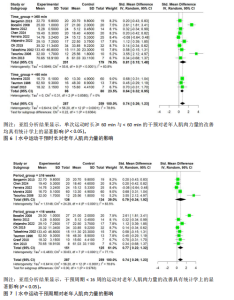
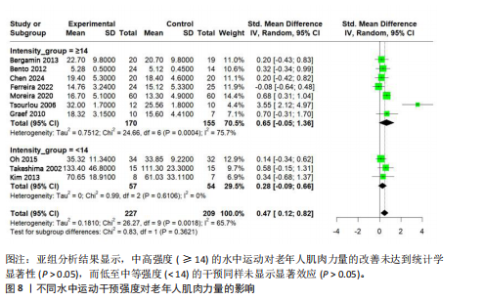
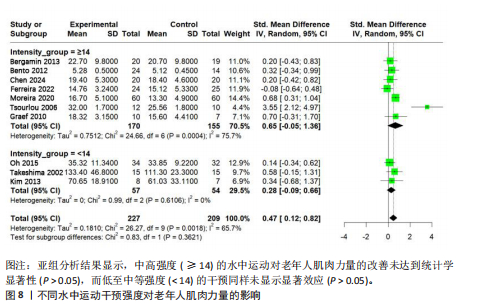
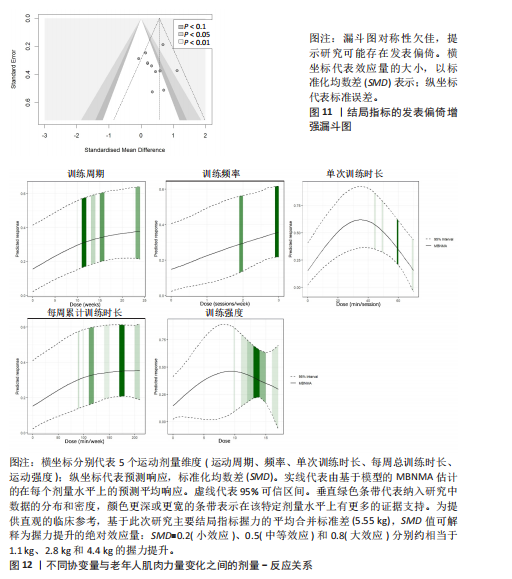
的强度,其中7篇文献的强度处于较重及以上(RPE≥14)[18-19,47,49-50,52,57],3篇文献处于低强度(RPE < 14)[54-55,58]。结果显示,强度为较重及以上(RPE≥14)的干预组获得了较大的效应点估计值(SMD=0.65,95%CI:-0.05-1.36)。与此同时,低至中等强度(RPE < 14) 的干预组仅产生了较小的效应(SMD=0.28,95%CI:-0.09-0.66)。组间差异检验结果(P=0.36)未达到统计学显著水平,表明分析中没有足够的证据确认不同强度水平对该结局指标的效应存在真实差异。尽管高强度组的点估计略高,但证据不足以确认强度水平对效应量存在真实差异(图8)。 2.3.6 不同水中运动干预结局指标对老年人肌肉力量的影响 13篇文献报告了不同的结局指标,其中7篇文献报告了使用仪器测试的特定肌群力量[18-19,50,54-56,58],4篇文章报告了模拟日常活动所评估的力量[48-50,52],2篇文章同时采用了肌力和功能性力量进行评估[46,56]。结果显示,在直接肌力组中,水中运动对肌肉力量有显著的积极影响(SMD=0.44,95%CI:0.16-0.73),且该亚组内部异质性极小。在功能性体能组中,合并效应量不具有统计学显著性(SMD=0.83,95%CI:-0.32-1.98),且组内存在极高的异质性(I2=90.6%)。混合组也呈现出类似的高异质性(I2=93.8%)。三组间效应差异无统计学显著性(P > 0.05)(图9)。 2.4 敏感性分析 为了检验此次Meta分析结果的稳健性,进行了逐一剔除法(Leave-one-out)的敏感性分析(图10)。结果显示,在依次排除任意一项研究后,合并后的SMD范围为0.46-0.64,且均保持统计学显著(P < 0.05)。这一结果表明,此Meta分析的总体结论并非由某一项特定的研究主导,具有良好的稳健性。 2.5 发表偏倚分析 采用漏斗图目测法和Egger’s线性回归检验评估可能存在的发表偏倚(图11)。结果显示各研究左右分布稍有不对称,提示文章存在一定的发表偏倚,这可能与纳入的部分研究质量较低、样本量较小有关。尽管传统的Egger’s检验未能提供存在偏倚的统计学证据(P=0.127 4),但因漏斗图的不对称性,采用更稳健的Vevea & Hedges权重函数选择模型进行进一步检验,其结果证实,研究纳入的文献中存在显著的发表偏倚(似然比检验, P=0.008 8)。这可能与纳入的部分研究质量较低、样本量较小有关。 2.6 剂量-反应关系 为了探究水中运动不同剂量维度与干预效果之间的关系,对5个关键剂量变量(运动频率、每周总时长、单次时长、运动周期和强度)进行了剂量-反应分析。基于DIC值和模型灵活性,最终选择限制性立方样条来统一分析并可视化所有剂量维度的非线性关系,根据最佳拟合和生物学合理性的模型,在剂量的第10、第50和第90百分位处放置了3个样条[59]。节点分裂分析显示,所有剂量维度的网络均表现出良好的一致性(P > 0.05)。此外,所有报告的剂量-反应模型均通过了收敛性诊断(R-hat < 1.05)。各剂量维度的剂量-反应曲线如图12所示。 结果显示,不同剂量维度下,老年人水中力量训练的剂量–反应关系呈现两种非线性趋"
"
势:周期、频率和周总时长随剂量增加持续上升且趋于平台;而单次时长和训练强度则呈倒U型剂量–反应关系。反映出老年人对不同训练剂量的响应特征存在明显差异。 随着训练周期增长,预测SMD持续上升,在12周时出现最低显著效应(SMD=0.55;95%CI:0.28–0.62),并在24周达到最高值(SMD=0.65;95%CI:0.40–0.66)。训练频率与肌力改善同样呈近线性正相关,2次/周即可达到显著增益(SMD=0.56;95%CI:0.22–0.58),3次/周时效应进一步略增(SMD=0.62;95%CI:0.24–0.62)。每周累计训练时长则在100周总时长即达到显著效果(SMD=0.58;95%CI:0.34–0.60),并在200周总时长时可见最大增益(SMD=0.62;95%CI:0.38–0.62),但边际提升有限。 相比之下,单次训练时长与训练强度均呈现倒U型关系。单次时长的效应峰值发生在40 min(SMD=0.62;95%CI:0.32–0.82),最佳区间建议为30–45 min。训练强度的效应则在Borg 10–12强度区间达到最大值(SMD=0.45;95%CI:0.18–0.46),最小显著强度阈值为12(SMD=0.30;95%CI:0.05–0.35),表明中等偏上强度为最佳实践。"
"
| [1] DE LIMA EP, TANAKA M, LAMAS CB, et al. Vascular impairment, muscle atrophy, and cognitive decline: Critical age-related conditions. Biomedicines. 2024;12(9):2096. [2] WENG SE, HUANG YW, TSENG YC, et al. The evolving landscape of sarcopenia in Asia: a systematic review and meta-analysis following the 2019 Asian working group for sarcopenia (AWGS) diagnostic criteria. Arch Gerontol Geriatr. 2025; 128:105596. [3] SÁNCHEZ-SÁNCHEZ JL, HE L, MORALES JS, et al. Association of physical behaviours with sarcopenia in older adults: a systematic review and meta-analysis of observational studies. Lancet Healthy Longev. 2024;5(2):e108-e119. [4] SAYER AA, CRUZ-JENTOFT A. Sarcopenia definition, diagnosis and treatment: consensus is growing. Age Ageing. 2022;51(10):afac220. [5] IZQUIERDO M, DE SOUTO BARRETO P, ARAI H, et al. Global consensus on optimal exercise recommendations for enhancing healthy longevity in older adults (ICFSR). J Nutr Health Aging. 2025; 29(1):100401. [6] 朱为模,李校堃,付小兵,等.温泉结合运动疗法在疾病治疗和康复中的应用:中国专家共识(2024)[J].体育科研,2024,45(6):1-22. [7] SUN P, YANG J, LI N, et al. Effects of aquatic exercise compared with Land-based exercise on the body composition and function of older adults with sarcopenia: Protocol for a randomised controlled Trial. BMJ Open. 2025;15(1):e085474. [8] FAÍL LB, MARINHO DA, MARQUES EA, et al. Benefits of aquatic exercise in adults with and without chronic disease-a systematic review with meta‐analysis. Scand J Med Sci Sports. 2022; 32(3):465-486. [9] KUCIA K, KOTEJA A, RYDZIK Ł, et al. The Impact of a 12-Week Aqua Fitness Program on the Physical Fitness of Women over 60 Years of Age. Sports. 2024;12(4):105. [10] ALIKHAJEH Y, AFROUNDEH R, MOTEVALLI M, et al. The Effect of a Three‐Month Aquatic Training Program on Physical Functioning in Elderly Men: A Randomized Controlled Trial. Int J Clin Pract. 2025;2025(1). doi: 10.1155/ijcp/9157147 [11] DUNLAP E, ALHALIMI T, MCLAURIN N, et al. Hypotensive Effects of Aquatic Exercise Training in Older Adults. Am J Hypertens. 2023;36(11):588-592. [12] TANG Z, WANG Y, LIU J, et al. Effects of aquatic exercise on mood and anxiety symptoms: A systematic review and meta-analysis. Front Psychiatry. 2022;13:1051551. [13] MOREIRA L, FRONZA FC, DOS SANTOS RN, et al. High-intensity aquatic exercises (HydrOS) improve physical function and reduce falls among postmenopausal women. Menopause. 2013;20(10):1012-1019. [14] CABO CA, HERNÁNDEZ-BELTRÁN V, FERNANDES O, et al. Effectiveness of different physical activity programs in improving older adults’ physical capacities: a randomized controlled trial. Front Physiol. 2025;16:1540776. [15] 类美容,张红伟,刘静,等.水中运动对高血压患者干预效果的Meta分析[J].中国护理管理, 2022,22(4):583-590. [16] REICHERT T, COSTA RR, BARROSO BM, et al. Aquatic training in upright position as an alternative to improve blood pressure in adults and elderly: a systematic review and meta-analysis. Sports Med. 2018;48(7):1727-1737. [17] PINTO SS, ALBERTON CL, CADORE EL, et al. Water-based concurrent training improves peak oxygen uptake, rate of force development, jump height, and neuromuscular economy in young women. J Strength Cond Res. 2015;29(7):1846-1854. [18] GRAEF FI, PINTO RS, ALBERTON CL, et al. The effects of resistance training performed in water on muscle strength in the elderly. J Strength Cond Res. 2010;24(11):3150-3156. [19] BERGAMIN M, ERMOLAO A, TOLOMIO S, et al. Water-versus land-based exercise in elderly subjects: effects on physical performance and body composition. Clin Interv Aging. 2013;8:1109-1117. [20] BUITRAGO-RESTREPO CM, PATIÑO-VILLADA FA, ARANGO-PATERNINA CM. Effects of Aquatic Exercise on Physical Performance in Older Adults: A Systematic Review and Meta-Analysis. J Aging Phys Act. 2024;32(5):651-667. [21] PRADO AKG, REICHERT T, CONCEIÇÃO MO, et al. Effects of aquatic exercise on muscle strength in young and elderly adults: a systematic review and meta-analysis of randomized trials. J Strength Cond Res. 2022;36(5):1468-1483. [22] PRADO C, ROSA C, FARIAS DL, et al. Effects of aquatic strength training on muscle strength and functional performance in postmenopausal women. Exp Gerontol. 2016;79:1-6. [23] World Health Organization. World report on ageing and health. World Health Organization. 2015. [24] STUDENSKI S, PERERA S, PATEL K, et al. Gait speed and survival in older adults. JAMA. 2011;305(1): 50-58. [25] GRGIC J, GAROFOLINI A, ORAZEM J, et al. Effects of resistance training on muscle size and strength in very elderly adults: a systematic review and meta-analysis of randomized controlled trials. Sports Med. 2020;50(11):1983-1999. [26] PAGE MJ, MCKENZIE JE, BOSSUYT PM, et al. The PRISMA 2020 statement: an updated guideline for reporting systematic reviews. BMJ. 2021;372:n71. [27] HUTTON B, SALANTI G, CALDWELL DM, et al. The PRISMA extension statement for reporting of systematic reviews incorporating network meta-analyses of health care interventions: checklist and explanations. Ann Intern Med. 2015;162(11): 777-784. [28] MAWDSLEY D, BENNETTS M, DIAS S, et al. Model‐based network meta‐analysis: a framework for evidence synthesis of clinical trial data. CPT Pharmacometrics Syst Pharmacol. 2016;5(8): 393-401. [29] TER VEER E, VAN OIJEN MGH, VAN LAARHOVEN HWM. The use of (network) meta-analysis in clinical oncology. Front Oncol. 2019;9:822. [30] WHEELER DC, HICKSON DA, WALLER LA. Assessing local model adequacy in Bayesian hierarchical models using the partitioned deviance information criterion.Comput Stat Data Anal. 2010;54(6): 1657-1671. [31] VAN VALKENHOEF G, DIAS S, ADES AE, et al. Automated generation of node‐splitting models for assessment of inconsistency in network meta‐analysis. Res Synth Methods. 2016;7(1):80-93. [32] EVANS NJ. Assessing the practical differences between model selection methods in inferences about choice response time tasks. Psychon Bull Rev. 2019;26(4):1070-1098. [33] COHEN J. Statistical power analysis for the behavioral sciences. Routledge. 2013. [34] WALLER B, OGONOWSKA-SŁODOWNIK A, VITOR M, et al. The effect of aquatic exercise on physical functioning in the older adult: a systematic review with meta-analysis. Age Ageing. 2016;45(5):593-601. [35] JAMES E, NICHOLS S, GOODALL S, et al. The influence of resistance training on neuromuscular function in middle-aged and older adults: A systematic review and meta-analysis of randomised controlled trials. Exp Gerontol. 2021; 149:111320. [36] FRANKLIN BA, EIJSVOGELS TMH, PANDEY A, et al. Physical activity, cardiorespiratory fitness, and cardiovascular health: A clinical practice statement of the American Society for Preventive Cardiology Part I: Bioenergetics, contemporary physical activity recommendations, benefits, risks, extreme exercise regimens, potential Maladaptations. Am J Prev Cardiol. 2022;12:100424. [37] BERGAMIN M, ZANUSO S, ALVAR BA, et al. Is water-based exercise training sufficient to improve physical fitness in the elderly? A systematic review of the evidence. Eur Rev Aging Phys Act. 2012; 9(2):129-141. [38] COELHO-JÚNIOR HJ, PICCA A, CALVANI R, et al. Prescription of resistance training for sarcopenic older adults: Does it require specific Attention?. Ageing Res Rev. 2022;81:101720. [39] WANG Z, QI K, ZHANG P. Effect of physical activity interventions on physical and mental health of the elderly: A systematic review and meta-Analysis. Aging Clin Exp Res. Aging Clin Exp Res. 2025;37(1):169. [40] DENG Y, TANG Z, YANG Z, et al. Comparing the effects of aquatic-based exercise and land-based exercise on balance in older adults: a systematic review and meta-analysis. Eur Rev Aging Phys Act. 2024;21(1):13. [41] JUESAS A, BABILONI-LOPEZ C, GENE-MORALES J, et al. Impact of a Novel Aquatic-Based Strength Program on Body Composition, Strength, and Quality of Life in Older Women: a 16-Week Randomized Controlled Trial. J Sci Sport Ex. 2025. doi:10.1007/s42978-025-00330-2 [42] BORDE R, HORTOBÁGYI T, GRANACHER U. Dose-Response Relationships of Resistance Training in Healthy Old Adults: A Systematic Review and Meta-Analysis. Sports Med. 2015;45(12):1693-1720. [43] YEHYA M, BOULGHOBRA D, GRILLET PE, et al. Natural Extracts Mitigate the Deleterious Effects of Prolonged Intense Physical Exercise on the Cardiovascular and Muscular Systems. Antioxidants. 2023;12(7):1474. [44] ZARZISSI S, ZGHAL F, BOUCHIBA M, et al. Delayed neuromuscular fatigue recovery unveils reduced fatigue tolerance in elderly following maximal intermittent Exercise. Eur J Appl Physiol. 2024; 124(10):2941-2949. [45] CUGUSI L, MANCA A, BASSAREO PP, et al. Supervised aquatic-based exercise for men with coronary artery disease: a meta-analysis of randomised controlled trials. Eur J Prev Cardiol. 2020;27(19):2387-2392. [46] CHAIMANI A, HIGGINS JPT, MAVRIDIS D, et al. Graphical tools for network meta-analysis in STATA. PloS one. 2013;8(10):e76654. [47] BENTO PCB, PEREIRA G, UGRINOWITSCH C, et al. The effects of a water-based exercise program on strength and functionality of older adults. J Aging Phys Act. 2012;20(4):469-470. [48] BOCALINI DS, SERRA AJ, MURAD N, et al. Water‐versus land‐based exercise effects on physical fitness in older women. Geriatr Gerontol Int. 2008;8(4):265-271. [49] CHEN Y, LAN Y, ZHAO AH, et al. High-intensity interval swimming improves cardiovascular endurance, while aquatic resistance training enhances muscular strength in older adults. Sci Rep. 2024;14(1):25241. [50] FERREIRA DL, CHRISTOFOLETTI G, CAMPOS DM, et al. Effects of aquatic physical exercise on motor risk factors for falls in older people during the COVID-19 pandemic: a randomized controlled trial. J Manipulative Physiol Ther. 2022;45(5): 378-388. [51] MARTÍNEZ-RODRÍGUEZ A, CUESTAS-CALERO BJ, GARCÍA DE FRUTOS JM, et al. Effect of aquatic resistance interval training and dietary education program on physical and psychological health in older women: Randomized controlled trial. Front Nutr. 2022;9:980788. [52] MOREIRA NB, DA SILVA LP, RODACKI ALF. Aquatic exercise improves functional capacity, perceptual aspects, and quality of life in older adults with musculoskeletal disorders and risk of falling: A randomized controlled trial. Exp Gerontol. 2020; 142:111135. [53] ARNEY BE, GLOVER R, FUSCO A, et al. Comparison of rating of perceived exertion scales during incremental and interval exercise. Kinesiology. 2019;51(2):150-157. [54] OH SJ, LIM JM, KIM Y, et al. Comparison of the effects of water-and land-based exercises on the physical function and quality of life in community-dwelling elderly people with history of falling: a single-blind, randomized controlled trial. Arch Gerontol Geriatr. 2015;60(2):288-293. [55] TAKESHIMA N, ROGERS ME, WATANABE E, et al. Water-based exercise improves health-related aspects of fitness in older women. Med Sci Sports Exerc. 2002;34(3):544-551. [56] TAUNTON JE, RHODES EC, WOLSKI LA, et al. Effect of land-based and water-based fitness programs on the cardiovascular fitness, strength and flexibility of women aged 65-75 years. Gerontology. 1996;42(4):204-210. [57] TSOURLOU T, BENIK A, DIPLA K, et al. The effects of a twenty-four--week aquatic training program on muscular strength performance in healthy elderly women. J Strength Cond Res. 2006;20(4): 811-818. [58] KIM SB, O’SULLIVAN DM.Effects of aqua aerobic therapy exercise for older adults on muscular strength, agility and balance to prevent falling during gait. J Phys Ther Sci. 2013;25(8):923-927. [59] PEDDER H, DIAS S, BENNETTS M, et al. Modelling time‐course relationships with multiple treatments: Model‐based network meta‐analysis for continuous summary outcomes. Res Synth Methods. 2019;10(2):267-286. [60] 郝莹, 陈卓. 抗阻运动提升老年人下肢肌肉力量及功能状态的网状Meta分析[J].中国循证医学杂志,2024,24(2):175-182. |
| [1] | Zhang Zihua. Simulation and force characterization of the lower limbs in elderly people from sitting to standing [J]. Chinese Journal of Tissue Engineering Research, 2026, 30(6): 1407-1416. |
| [2] | Chen Qiang, Wu Wenjuan, Jiang Shuhua, Huang Da. Physical exercise improves physical function in burn patients: a systematic review and meta-analysis [J]. Chinese Journal of Tissue Engineering Research, 2026, 30(5): 1269-1281. |
| [3] | Zhou Jian, Zhang Tao, Zhou Weili, Zhao Xingcheng, Wang Jun, Shen Jie, Qian Li, Lu Ming. Effects of resistance training on quadriceps mass and knee joint function in patients with osteoporosis and sarcopenia [J]. Chinese Journal of Tissue Engineering Research, 2026, 30(5): 1081-1088. |
| [4] | Jiang Yang, Peng Hao, Song Yanping, Yao Na, Song Yueyu, Yin Xingxiao, Li Yanqi, Chen Qigang. Isometric exercise reduces resting blood pressure: a meta-analysis of moderating factors and dose effects [J]. Chinese Journal of Tissue Engineering Research, 2026, 30(4): 975-986. |
| [5] | Li Hanyue, Li Yini, Xiang Linmei, Li Sen. Effects of resistance exercise therapy on pain and function in patients with cervical spondylotic radiculopathy: a meta-analysis [J]. Chinese Journal of Tissue Engineering Research, 2026, 30(4): 987-996. |
| [6] | Sun Jiahe, Shi Jipeng, Zhu Tianrui, Quan Helong, Xu Hongqi. Effect of exercise intervention in elderly individuals with sarcopenia and its comorbidities: a meta-analysis [J]. Chinese Journal of Tissue Engineering Research, 2026, 30(4): 997-1007. |
| [7] | Chen Simin, Song Rui, Peng Xing, Wang Jie, Jing Zhaohang, Parhati Nasr, Abdunabi Wupu, He Qi, Yang Lei. Correlation between skeletal muscle mass and Chinese healthy eating index in older adults [J]. Chinese Journal of Tissue Engineering Research, 2026, 30(34): 9075-9080. |
| [8] | Li Wenhao, Yang Xi, Du Xinran, Bai Shi, Li Zhongshan. Effect of magnetic field mitochondrial regulation technology combined with low-load blood flow restriction on the strength of lower limb muscle groups [J]. Chinese Journal of Tissue Engineering Research, 2026, 30(29): 7555-7564. |
| [9] | Chen Ziang, Li Qinlong, Wu Xue, Zhou Yue. Meta-analysis of blood flow restriction training to improve knee function and muscle strength in patients after anterior cruciate ligament reconstruction [J]. Chinese Journal of Tissue Engineering Research, 2026, 30(29): 7680-7687. |
| [10] | Fan Mengmeng, Ding Jiali, Wan Yujie, Huang Hailiang. A systematic review and network meta-analysis of neuromodulation techniques for promoting upper limb motor function after stroke [J]. Chinese Journal of Tissue Engineering Research, 2026, 30(28): 7494-7504. |
| [11] | Li Guangmin, Wang Jiangna. Mechanical loading of the patellofemoral joint and its correlation with various body mass indices in older adults practicing Tai Chi exercises [J]. Chinese Journal of Tissue Engineering Research, 2026, 30(24): 6182-6188. |
| [12] | Hu Zhe, Sun Yuxiang, Han Xiao, Liu Yabin, Si Luyao, Li Zhouyu, Jia Yi. Stroboscopic visual interference combined with balance training improves the balance ability of older adults [J]. Chinese Journal of Tissue Engineering Research, 2026, 30(24): 6267-6274. |
| [13] | Xia Caigui, Li Wei, Su Yuying, Shi Yu, Yang Zhonghe. Effects of antioxidant pretreatment on skeletal muscle damage and oxidative stress following acute high-intensity exercise: a meta-analysis [J]. Chinese Journal of Tissue Engineering Research, 2026, 30(24): 6345-6353. |
| [14] | Fang Enhui, Guan Hui, Ma Lihong. Non-invasive brain stimulation for core symptoms in children with autism spectrum disorder: a network meta-analysis [J]. Chinese Journal of Tissue Engineering Research, 2026, 30(24): 6373-6381. |
| [15] | Li Yiguang, Guo Haonan, Ding Xiaotao, Yuan Mengyao, Jiang Lijin, Fan Xinfeng, Feng Yan. Visual analysis of research hotspots in the field of gut microbiota in the elderly at home and abroad [J]. Chinese Journal of Tissue Engineering Research, 2026, 30(23): 6071-6080. |
| Viewed | ||||||
|
Full text |
|
|||||
|
Abstract |
|
|||||