Chinese Journal of Tissue Engineering Research ›› 2026, Vol. 30 ›› Issue (29): 7572-7580.doi: 10.12307/2026.252
Previous Articles Next Articles
Biomechanical analysis during non-anticipated stop-jump cutting before and after exercise fatigue in functional ankle instability and healthy populations
Fu Guangliang1, Bao Chunyu1, 2, Meng Qinghua3, 4, 5, Wang Baochen1, Cao Jiaxing1, Sun Jiawei1
- 1Sports Training College, 2Social Sports College, 3Sports Health College, 4Sports Economics and Management College, Tianjin University of Sport, Tianjin 301617, China; 5Tianjin Sports Injury and Rehabilitation Virtual Simulation Experiment Teaching Center, Tianjin 301617, China
-
Received:2025-09-20Revised:2025-11-20Online:2026-10-18Published:2026-03-04 -
Contact:Bao Chunyu, PhD, Professor, Doctoral supervisor, Sports Training College and Social Sports College, Tianjin University of Sport, Tianjin 301617, China -
About author:Fu Guangliang, PhD candidate, Sports Training College, Tianjin University of Sport, Tianjin 301617, China -
Supported by:the National Natural Science Foundation of China, No. 11372223 (to MQH); General Administration of Sport of China Research Project, Nos. 24ZDKJCX11, 22KJCX077 (to BCY).

CLC Number:
Cite this article
Fu Guangliang, Bao Chunyu, Meng Qinghua, Wang Baochen, Cao Jiaxing, Sun Jiawei. Biomechanical analysis during non-anticipated stop-jump cutting before and after exercise fatigue in functional ankle instability and healthy populations[J]. Chinese Journal of Tissue Engineering Research, 2026, 30(29): 7572-7580.
share this article
Add to citation manager EndNote|Reference Manager|ProCite|BibTeX|RefWorks
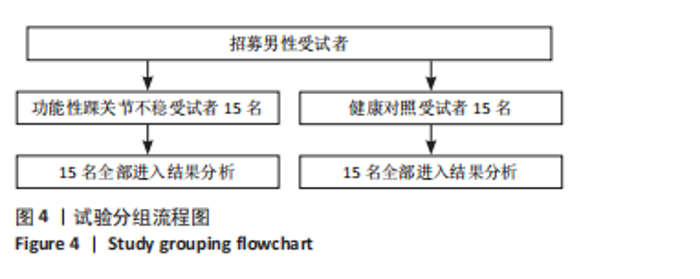
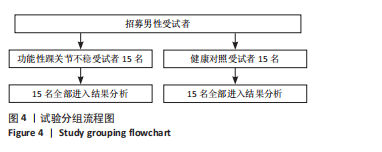
2.1 试验分组流程图 见图4。"
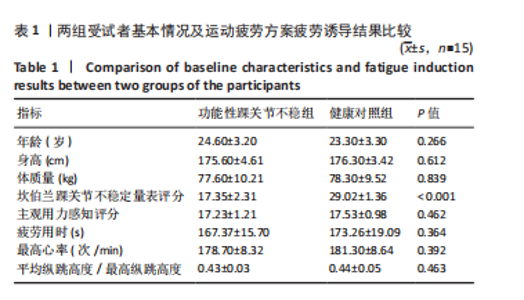
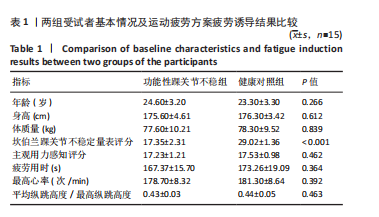
2.2 两组受试者基本情况及运动疲劳方案干预效果 测试期间未发生不良事件,30名受试者全部进入结果分析。 两组受试者的身高、年龄、体质量、最高心率、疲劳用时、平均纵跳高度/最高纵跳高度比值比较差异无显著性意义 (P > 0.05),CAIT评分比较差异有显著性意义(P < 0.001),具体情况见表1。"
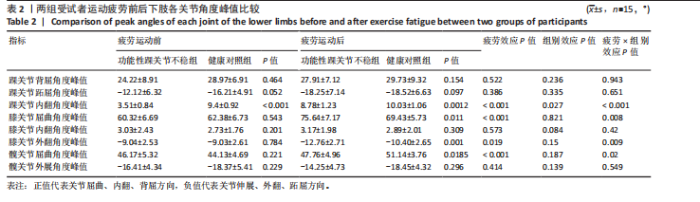
2.3 两组受试者侧切动作期间下肢关节运动学的特征差异 独立样本t检验结果显示,运动疲劳前,两组受试者踝关节内翻角度峰值比较差异有显著性意义(P < 0.001);运动疲劳后,两组受试者踝关节内翻角度峰值、髋关节屈曲角度峰值、膝关节外翻角度峰值与膝关节屈曲角度峰值比较差异有显著性意义(P < 0.05或P < 0.01)。 双因素重复测量方差分析显示,踝关节内翻角度峰值、膝关节屈曲角度峰值、膝关节外翻角度峰值及髋关节屈曲角度峰值均存在显著的疲劳主效应和组间交互效应(P < 0.05);踝关节背屈角度峰值、踝关节跖屈角度峰值、膝关节内翻角度峰值、髋关节外展角度峰值的疲劳主效应和组间交互效应均不显著(P > 0.05)。简单效应分析显示,与运动疲劳前相比,功能性踝关节不稳组疲劳后的踝关节内翻角度峰值增加(P < 0.001),两组运动疲劳后的膝关节屈曲角度峰值增加(P < 0.001),健康对照组运动疲劳后的髋关节屈曲角度峰值增加(P < 0.001),见表2。 统计参数映射分析显示,功能性踝关节不稳组运动疲劳后侧切运动4%-18%阶段的踝关节内外翻角度大于疲劳前(超过阈值:α=0.05,t*=3.23,t=4.59,P=0.013 5),两组运动疲劳后的踝关节跖背屈、内外旋角度与运动疲劳前比较差异无显著性"
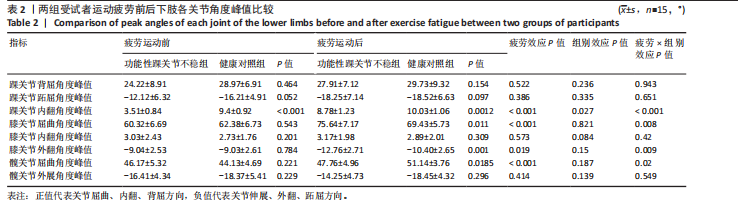
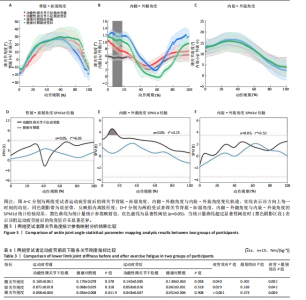
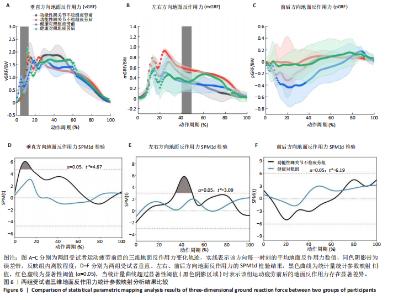
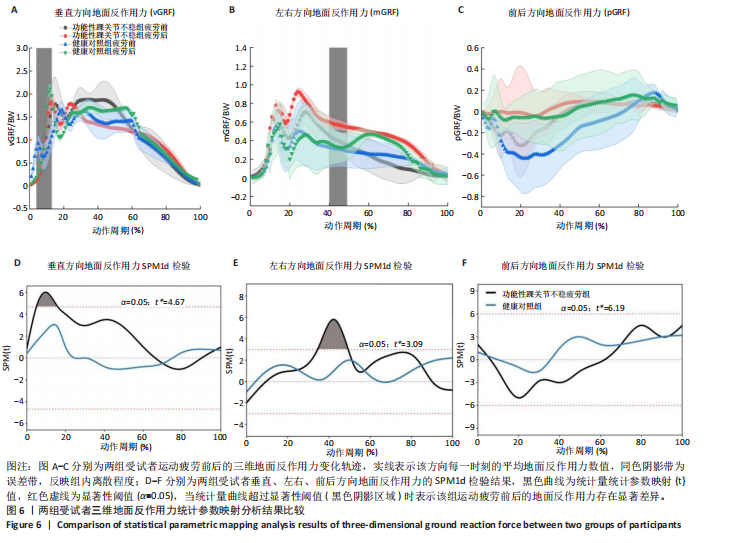
意义(未超过阈值:t < t*),健康对照组运动疲劳后的踝关节内外翻角度值与运动疲劳前比较差异无显著性意义(未超过阈值:t < t*),见图5。 2.4 两组受试者侧切动作期间下肢关节动力学差异特征差异 独立样本t检验结果显示,运动疲劳前,两组受试者踝关节刚度比较差异有显著性意义(P < 0.05),膝关节与髋关节刚度比较差异无显著性意义(P > 0.05);运动疲劳后,两组受试者髋关节、膝关节和踝关节刚度比较差异均无显著性意义(P > 0.05),见表3。 双因素重复测量方差分析显示,髋关节、膝关节和踝关节刚度均表现出显著的疲劳主效应与组别交互效应(P < 0.05)。简单效应分析显示,健康对照组运动疲劳后的髋关节刚度、踝关节刚度低于运动疲劳前(P < 0.05),功能性踝关节不稳组运动疲劳后的膝关节刚度、踝关节刚度低于运动疲劳前(P < 0.05),见表3。 统计参数映射分析显示,功能性踝关节不稳组运动疲劳后侧切运动5%-16%阶段的垂直方向地面反作用力大于运动疲劳前(超过阈值:α=0.05,t*=4.67,t=5.81,P=0.047),运动疲劳后侧切运动35%-49%阶段的左右方向地面反作用力大于运动疲劳前(超过阈值:α=0.05,t*=3.09,t=5.53,P=0.001 5),运动疲劳前后前后方向地面反作用力比较差异无显著性意义(未超过阈值:t < t*);健康对照组运动疲劳前后的垂直、左右与前后方向地面反作用力比较差异无显著性意义(未超过阈值:t < t*),见图6。"
"
| [1] FREEMAN MA. Instability of the foot after injuries to the lateral ligament of the ankle. J Bone Joint Surg Br. 1965;47(4):669-677. [2] 吴一晗,魏乔叶,庞宇,等.功能性踝关节不稳本体感觉特征的Meta分析[J].中国组织工程研究,2023,27(18):2943-2952. [3] LIU Y, DONG S, WANG Q, et al. Deficits in proprioception and strength may contribute to the impaired postural stability among individuals with functional ankle instability. Front Physiol. 2024;15:1342636. [4] 刘亚楠,田雪文,宋祺鹏,等.全身性疲劳对功能性踝关节不稳者平衡能力和跳跃落地时踝关节本体感觉的影响[J].中国康复医学杂志, 2023,38(12):1669-1676. [5] POWELL MR, POWDEN CJ, HOUSTON MN, et al. Plantar cutaneous sensitivity and balance in individuals with and without chronic ankle instability. Clin J Sport Med. 2014;24(6):490-496. [6] 鲁君兰,蔡斌,吴智刚,等.单侧踝关节不稳患者双下肢肌力、背屈角度和平衡的差异性分析[J].中国康复,2022,37(8):482-485. [7] CAO S, WANG C, ZHANG G, et al. In vivo kinematics of functional ankle instability patients during the stance phase of walking. Gait Posture. 2019;73:262-268. [8] KAWABATA S, OZONE K, MINEGISHI Y, et al. Chronic Ankle Joint Instability Induces Ankle Sensorimotor Dysfunction: A Controlled Laboratory Study. Am J Sports Med. 2024;52(3):739-749. [9] 刘灏,李宗涛,蔡言伟.功能性踝关节不稳患者单脚静立平衡能力与踝关节肌力和位置觉的关系 [J].中国康复理论与实践,2024,30(2):243-248. [10] 周文星,王琳.人体运动过程中侧切落地模式和角度对下肢运动生物力学的影响[J].中国组织工程研究,2021,25(32):5184-5190. [11] 梅齐昌,相亮亮,李建设,等.基于一维统计参数映射分析跑者跑步地面反作用力差异[J].医用生物力学,2021,36(5):684-691. [12] GAO Z, FEKETE G, BAKER JS, et al. Effects of running fatigue on lower extremity symmetry among amateur runners: From a biomechanical perspective. Front Physiol. 2022;13:899818. [13] SMEETS A, VANRENTERGHEM J, STAES F, et al. Are Anterior Cruciate Ligament-reconstructed Athletes More Vulnerable to Fatigue than Uninjured Athletes? Med Sci Sports Exerc. 2020;52(2):345-353. [14] YU P, LIANG M, FEKETE G, et al. Effect of running-induced fatigue on lower limb mechanics in novice runners. Technol Health Care. 2021;29(2):231-242. [15] ZHANG X, XIA R, DAI B, et al. Effects of Exercise-Induced Fatigue on Lower Extremity Joint Mechanics, Stiffness, and Energy Absorption during Landings. J Sports Sci Med. 2018;17(4): 640-649. [16] 王璐,于歌,尹航,等.功能性踝关节不稳疼痛与功能关系分析[J].中国康复医学杂志,2025,40(2): 237-242. [17] 张嘉源,马小远,周志鹏,等.非预期条件下前交叉韧带重建术后运动员侧切动作下肢运动生物力学特征[J].医用生物力学,2023,38(6):1127-1133. [18] BESIER TF, LLOYD DG, ACKLAND TR, et al. Anticipatory effects on knee joint loading during running and cutting maneuvers. Med Sci Sports Exerc. 2001;33(7):1176-1181. [19] 张希妮,傅维杰,夏锐,等.不同疲劳诱导方案对落地时下肢关节力学、刚度和能量吸收的影响[J]. 体育科学,2017,37(11):48-55. [20] 薛博士,杨晓巍,赵建斌,等.不同落地方向及运动疲劳对侧切动作中前交叉韧带损伤风险的影响 [J].首都体育学院学报,2023,35(6):653-662. [21] 张泽毅,刘卉,张美珍,等. FAI和Coper患者踝关节扭伤相关动作中的下肢运动生物力学特征[J]. 中国体育科技,2023,59(8):47-55. [22] GAO Z, ZHU Y, FANG Y, et al. Automated recognition of asymmetric gait and fatigue gait using ground reaction force data. Front Physiol. 2023;14: 1159668. [23] MORAIS JE, BARBOSA TM, GONJO T, et al. Using Statistical Parametric Mapping as a statistical method for more detailed insights in swimming: a systematic review. Front Physiol. 2023;14:1213151. [24] 张颖慧,丁昊阳,苏健蛟.运动性疲劳对横踢技术动作特征及其击打速度的影响研究[J].武汉体育学院学报,2020,54(6):87-94. [25] 周志鹏,曲峰,刘鹏,等.不同方向单腿跳跃落地及运动疲劳对非接触性前交叉韧带损伤风险的影响 [J].中国体育科技,2017,53(1):111-117. [26] 芦劼明,郑晓丹,刘悦,等.屈膝肌疲劳对单腿落地时下肢生物力学指标的影响[J].中国运动医学杂志,2022,41(2):101-108. [27] KIM H, SON SJ, SEELEY MK, et al. Altered movement strategies during jump landing/cutting in patients with chronic ankle instability. Scand J Med Sci Sports. 2019;29(8):1130-1140. [28] HUPPERETS MD, VERHAGEN EA, VAN MECHELEN W. Effect of sensorimotor training on morphological, neurophysiological and functional characteristics of the ankle: a critical review. Sports Med. 2009;39(7):591-605. [29] 付光亮,孟庆华,鲍春雨.功能性踝关节不稳者本体感觉力学差异及平衡训练干预效果[J].应用力学学报,2021,38(6):2426-2431. [30] YU P, CEN X, MEI Q, et al. Differences in intra-foot movement strategies during locomotive tasks among chronic ankle instability, copers and healthy individuals. J Biomech. 2024;162:111865. [31] 柳璇,李磊,李晨,等.踝关节扭伤史人群坐站转移中的姿势控制模式及肌肉协同特征分析[J].医用生物力学,2025,40(6):1563-1569. [32] PALMIERI-SMITH RM, HOPKINS JT, BROWN TN. Peroneal activation deficits in persons with functional ankle instability. Am J Sports Med. 2009;37(5): 982-988. [33] 徐小涵,陆怡,马文韬.非运动活跃人群单腿着陆时膝关节生物力学性别差异[J].医用生物力学,2021,36(S1):338. [34] 吴倩,魏梦力,曹偲佳,等.跑步疲劳进程中人体下肢着地冲击时的肌肉激活变化特征[J].中国康复理论与实践,2024,30(10):1215-1223. [35] LYU H, CAO X, WANG J. Comparative Effects of Fatiguing Exercise on Anticipatory and Compensatory Postural Adjustments between Trained and Untrained Individuals. Life (Basel). 2024;14(8):943. [36] YAN B, YAO S, ZHANG J, et al. Effects of asymmetric load bench press offset training on muscle activation levels and exercise-induced fatigue in collegiate bodybuilders. Front Physiol. 2025;16:1592477. [37] 姚军威,韦俏丽,马勇,等.基于Anybody的足球运动员大角度侧切下肢生物力学仿真分析[J].中国运动医学杂志,2022,41(1):9-16. [38] 刘延浩,董世玉,刘子寅,等.单侧慢性踝关节不稳对双侧姿势稳定性、本体感觉、足底触觉和肌肉力量的影响[J].中国组织工程研究, 2025,29(17):3572-3578. [39] 孔祥飞,王洪丹,连子瞻,等.连续疲劳干预对膝关节主被动生物力学特性的影响[J].医用生物力学,2024,39(3):457-462,468. [40] SHEEAN AJ, JIN Y, AMENDOLA A, et al. Successful Medial Meniscal Repair Reduces Knee Pain 10 Years After Anterior Cruciate Ligament Reconstruction: Exploring the Consequences of Subsequent Surgery With Causal Mediation Analysis in the MOON Cohort. Am J Sports Med. 2025;53(4):769-776. [41] DONELON TA, EDWARDS J, BROWN M, et al. Differences in Biomechanical Determinants of ACL Injury Risk in Change of Direction Tasks Between Males and Females: A Systematic Review and Meta-Analysis. Sports Med Open. 2024;10(1):29. [42] 关国平,孟强,牛文鑫,等.踝关节扭伤防护及其康复研究进展[J].医用生物力学,2016,31(1): 78-82. [43] 杨毅,彭玉鑫,郝增明,等.复杂人体运动冗余控制的肌肉协同理论研究进展与展望[J].体育科学,2020,40(12):63-72. [44] BROWN SR, BRUGHELLI M, HUME PA. Knee mechanics during planned and unplanned sidestepping: a systematic review and meta-analysis. Sports Med. 2014;44(11):1573-1588. [45] 赵建超.不同预期状态和变向角度对人体侧切动作下肢生物力学特征的影响[J].医用生物力学,2024,39(S1):470. [46] ROLLEY T, GILL SD, KEAST M, et al. Anticipatory effects on side-step cutting biomechanics in Women’s Australian Football League players. BMJ Open Sport Exerc Med. 2023;9(2):e001587. [47] 孙媛,刘陆帅,马运超.不同侧切角度和触地模式下膝关节内部应力的有限元分析[J].中国康复医学杂志,2024,39(10):1449-1455,1461. [48] BIRCH JV, KELLY LA, FARRIS DJ. The Effects of Surface Stiffness on Human Hopping Frequency Preference and the Underlying Neuromuscular Function of the Foot and Ankle. Scand J Med Sci Sports. 2025;35(5):e70067. [49] 高丕明,罗小兵,虞亚明,等.慢性踝关节不稳步态支撑期踝周神经肌肉控制特征研究[J].中国康复医学杂志,2025,40(4):555-560. |
| [1] | Yan Xiangning, Chen Lei, Chen Yonghuan, Wang Chao, Li Xiaosheng. Influence of different depths and loads on knee joint mechanics and peripheral muscle force characteristics during squatting [J]. Chinese Journal of Tissue Engineering Research, 2026, 30(9): 2236-2247. |
| [2] | Guo Zicheng, Meng Jingyuan, Zhang Jiechao, Ding Li, Tang Xiaoye, Tian Lichao, Wang Yilin, He Yong. Differences in scapular kinematics between healthy individuals and rotator cuff tear patients based on biplane X-ray [J]. Chinese Journal of Tissue Engineering Research, 2026, 30(3): 652-660. |
| [3] | Xiang Yang, Hu Jiangping, Liu Qi, Fu Beilun, Li Miao, Zhu Huan, Qian Youling, Wang Kangfeng. Single hyperbaric oxygen for exercise-induced fatigue: an evaluation using conventional monitoring indicators [J]. Chinese Journal of Tissue Engineering Research, 2026, 30(28): 7355-7363. |
| [4] | Gu Jiangpeng, Guo Wei, Chen Xujing, Liu Xiaomin, Liu Hongbo, Sun Peng, Ye Chaoqun, Feng Wei, Wang Fei. Feng’s spinal manipulation for cervical spondylosis: kinematic changes [J]. Chinese Journal of Tissue Engineering Research, 2026, 30(23): 6081-6091. |
| [5] | Li Xinke, Feng Ru, Rong Ke, Sun Xiaole, Zhou Zhipeng, Yang Chen. Effects of ankle taping on knee and ankle biomechanics of individuals with chronic ankle instability in the side-cutting and stop-jumping tasks [J]. Chinese Journal of Tissue Engineering Research, 2026, 30(10): 2422-2429. |
| [6] | Liu Mengling, Li Yongjie, Liu Hongju. Effect of increased stride length on knee kinematics and dynamics of asymmetric gait after anterior cruciate ligament reconstruction [J]. Chinese Journal of Tissue Engineering Research, 2025, 29(33): 7109-7115. |
| [7] | Gao Yuan, Xiong Zheyu, Zheng Wei, Chen Haonan, Chen Fangyuqing. Lower extremity biomechanical characterization during step-down test in patients with patellofemoral pain [J]. Chinese Journal of Tissue Engineering Research, 2025, 29(32): 6913-6919. |
| [8] | Guo Ping, Wang Juan. Bilateral lower limb biomechanical abnormalities in patients with unilateral chronic ankle instability [J]. Chinese Journal of Tissue Engineering Research, 2025, 29(32): 6920-6926. |
| [9] | Gou Yanyun, Hou Meijin, Jiang Zheng, Chen Shaoqing, Chen Xiang, Gao Yuzhan, Wang Xiangbin. Biomechanical characteristics of walking in patients with idiopathic scoliosis: cross-sectional analysis of three-dimensional motion capture [J]. Chinese Journal of Tissue Engineering Research, 2025, 29(3): 471-477. |
| [10] | Wang Zilong, Meng Xin, Zhang Zhiqi, Xie Yu, Meng Lingyue, Zhang Qiuxia, Kong Lingyu. Biomechanical characteristics of lower extremities during counter movement jump in male patients with functional ankle instability [J]. Chinese Journal of Tissue Engineering Research, 2025, 29(3): 478-485. |
| [11] | Dong Youqing, Wei Zixuan, Wu Haiou, Chen Ruixiong, Duan Peng, Chen Nan, Lin Xikai. Biomechanical characteristics of lower limbs in female patients with different types of patellofemoral pain syndrome [J]. Chinese Journal of Tissue Engineering Research, 2025, 29(21): 4458-4468. |
| [12] | Zhang Sizhuo, Liu Xiaoqian, Wang Guanglan. Effects of visual interference on biomechanical characteristics of lower limbs in athletes after anterior cruciate ligament reconstruction [J]. Chinese Journal of Tissue Engineering Research, 2025, 29(20): 4223-4229. |
| [13] | Jin Pengfei, Ren Jie. Biomechanical changes of the lower limbs in table tennis players with different foot contact patterns of table tennis forehand loop [J]. Chinese Journal of Tissue Engineering Research, 2025, 29(14): 2995-3001. |
| [14] | Wu Jing, Yao Yingce, Yang Xiaowei, Xue Boshi, Zhao Jianbin, Yang Chen, Luan Tianfeng, Zhou Zhipeng. Intervention of muscle strength training combined with neuromuscular electrical stimulation on lower limb function and biomechanical changes in patients with patellofemoral pain [J]. Chinese Journal of Tissue Engineering Research, 2024, 28(9): 1365-1371. |
| [15] | Dong Gengxin, Li Yiting, Hong Yinglu, Bao Dapeng. Effect of hydrogen-rich gas on proprioception and muscle endurance after high-intensity exercise [J]. Chinese Journal of Tissue Engineering Research, 2024, 28(34): 5413-5418. |
| Viewed | ||||||
|
Full text |
|
|||||
|
Abstract |
|
|||||