Chinese Journal of Tissue Engineering Research ›› 2026, Vol. 30 ›› Issue (28): 7485-7493.doi: 10.12307/2026.820
Previous Articles Next Articles
A network meta-analysis of effects of non-invasive neuromodulation techniques on language function in patients with aphasia after stroke
Li Sihui1, Wang Qin2, Cui Shenhong2, Cheng Xiaofei1, Feng Ziyun2, Wang Dehua1, Liang Chunting1, Leng Jun2
- 1Rehabilitation Medical College of Shandong University of Traditional Chinese Medicine, Jinan 250355, Shandong Province, China; 2Rehabilitation Hospital of Second Affiliated Hospital of Shandong University of Traditional Chinese Medicine, Jinan 250355, Shandong Province, China
-
Received:2025-09-10Revised:2025-12-08Online:2026-10-08Published:2026-02-27 -
Contact:Leng Jun, MD, Chief physician, Master’s supervisor, Rehabilitation Hospital of Second Affiliated Hospital of Shandong University of Traditional Chinese Medicine, Jinan 250355, Shandong Province, China -
About author:Li Sihui, MS candidate, Rehabilitation Medical College of Shandong University of Traditional Chinese Medicine, Jinan 250355, Shandong Province, China -
Supported by:2024 Shandong Provincial Key Research and Development Program (Major Scientific and Technological Innovation Project) Program, No. 2024CXGC010603 (to LJ); Shandong Provincial Traditional Chinese Medicine Science and Technology Project, No. M2023102 (to WQ)

CLC Number:
Cite this article
Li Sihui, Wang Qin, Cui Shenhong, Cheng Xiaofei, Feng Ziyun, Wang Dehua, Liang Chunting, Leng Jun. A network meta-analysis of effects of non-invasive neuromodulation techniques on language function in patients with aphasia after stroke[J]. Chinese Journal of Tissue Engineering Research, 2026, 30(28): 7485-7493.
share this article
Add to citation manager EndNote|Reference Manager|ProCite|BibTeX|RefWorks
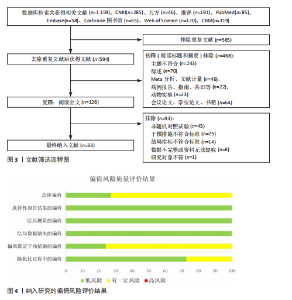
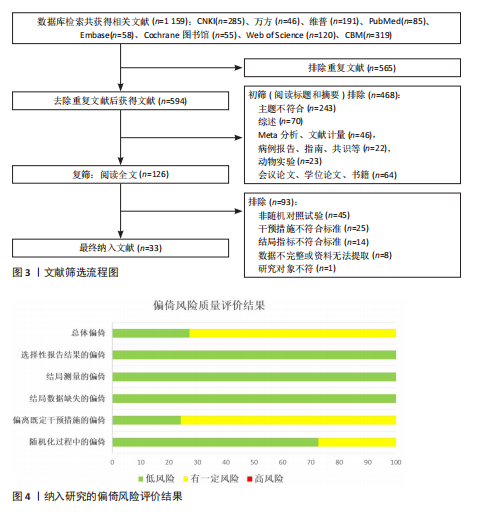
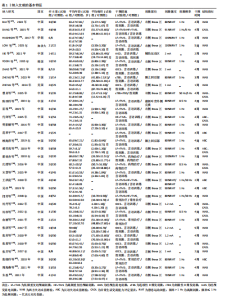
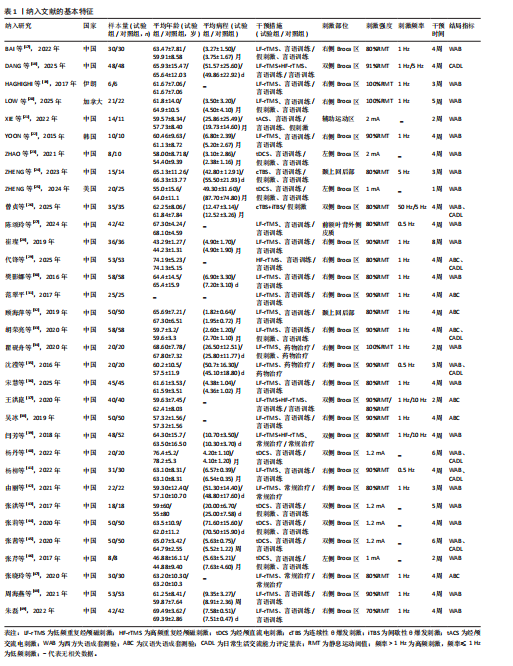
2.1 文献筛选结果 初步检索共获得1 159篇文献,利用EndNote X9软件剔除重复文献565篇,另外剔除468篇文献与研究主题不相关的文献,依据纳入和排除标准对剩余文献进行全文阅读,最终剔除了93篇不符合标准的文献,最终纳入33项研究[17-49]。文献筛选流程见图3。 2.2 纳入文献的基本特征 共纳入33篇研究,包括英文文献9篇[17-25]、中文文献24篇[26-49],涉及2 160例脑卒中后非流畅性失语患者,年龄多在50-70岁之间,病程为1-7年,干预周期为2-6周。33项研究中,有25项研究报告了WAB评分,7项研究报告了ABC评分,8项研究报告了CADL评分;涉及10种不同的非侵入性神经调控方式,包括低频重复经颅磁刺激右侧大脑半球Broca区、高频重复经颅磁刺激右侧Broca区、低频重复经颅磁刺激颞上回后部、低频重复经颅磁刺激右侧Broca区联合高频重复经颅磁刺激左侧Broca区、经颅直流电刺激双侧大脑Broca区、连续性θ爆发刺激左侧Broca区联合间歇性θ爆发刺激右侧Broca区、经颅直流电刺激左侧大脑Broca区、连续性θ爆发刺激颞上回后部、经颅交流电刺激大脑运动辅助区、低频重复经颅磁刺激前额叶背外侧皮质。纳入文献的基本特征见表1。 2.3 纳入文献的质量评价 在纳入的33篇研究中,24篇研究被评为有一定风险[26-49],偏倚风险占比约72.7%;9篇研究被评为低风险[17-25],偏倚风险占比约为27.3%;无高风险研究,见图4。24项研究提及随机化方案,包括随机数字表法、信封法等[17-27,31-32,35-37,41-46,48-49];8篇研究只提及随机[28,30,33-34,38-40,47],1篇研究按意愿分配[29];9篇研究执行分配隐藏并报告了盲法情况[17-25];所有研究不存在结局数据缺失及结果的选择性报告偏倚。"
"
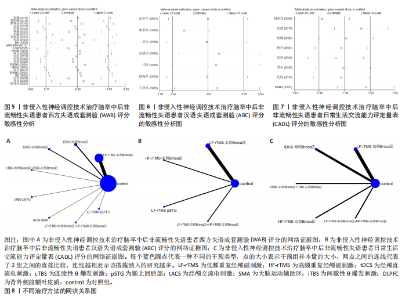
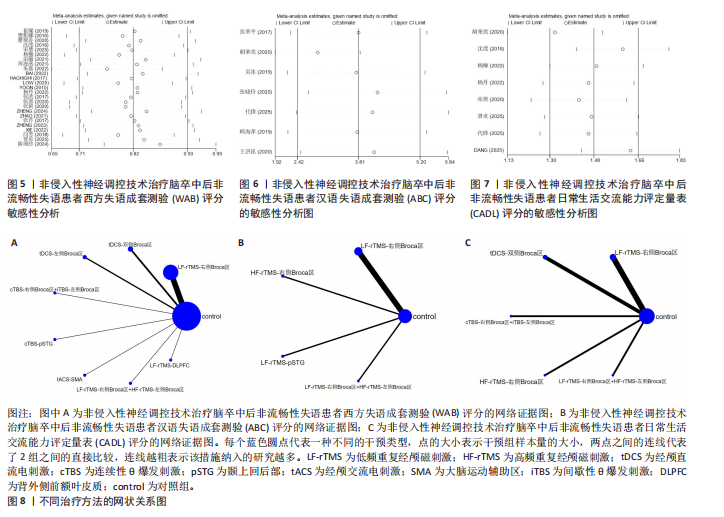
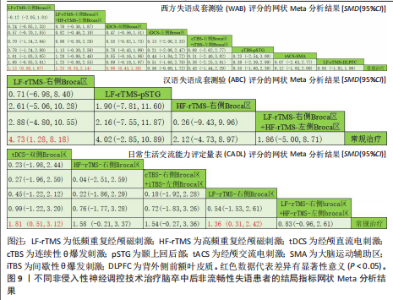
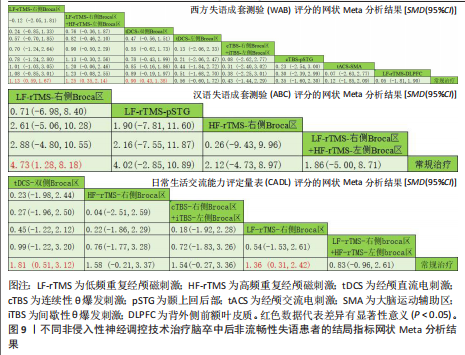
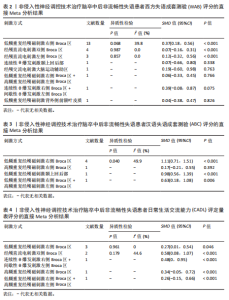
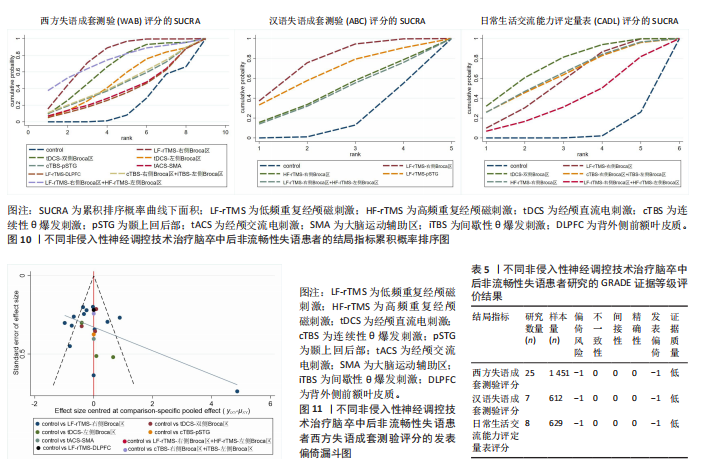
2.4 传统Meta分析结果 2.4.1 WAB评分的直接Meta分析结果 共纳入25项研究[17,19-28,30,34-36,39-46,48-49],研究间异质性较高(I2=66.8%,P=0.303),对研究进行敏感性分析,结果证实稳定性良好,见图5。参数选择刺激方式进行亚组分析来进一步明确高异质性的原因,结果表明研究间的异质性显著下降,据此推测刺激方式的差异可能是导致整体异质性较高的主要原因。研究结果显示,低频重复经颅磁刺激右侧Broca区、经颅直流电刺激双侧Broca区、经颅直流电刺激左侧Broca区对患者整体言语功能的改善程度明显优于对照组(P < 0.001),见表2。 2.4.2 ABC评分的直接Meta分析结果 共纳入7项研究[29,31-33,37-38,47],研究间异质性较高(I2=76.7%,P < 0.001),对研究进行敏感性分析,结果证实稳定性良好,见图6。参数选择刺激方式进行亚组分析来进一步明确高异质性的原因,结果表明研究间的异质性显著下降,据此推测刺激方式的差异可能是导致整体异质性较高的主要原因。研究结果显示,低频重复经颅磁刺激右侧Broca区、低频重复经颅磁刺激颞上回后部、低频重复经颅磁刺激右侧Broca区联合高频重复经颅磁刺激左侧Broca区对患者言语功能障碍的改善程度明显优于对照组(P < 0.05),见表3。 2.4.3 CADL评分的直接Meta分析结果 共纳入8项研究[18,26,29,33,35,40-41,45],研究间异质性较高(I2=84.6%,P < 0.001),对研究进行敏感性分析,结果证实稳定性良好,见图7。参数选择刺激方式进行亚组分析来进一步明确高异质性的原因,结果表明研究间的异质性显著下降,据此推测刺激方式的差异可能是导致整体异质性较高的主要原因。研究结果显示,低频重复经颅磁刺激右侧Broca区、经颅直流电刺激双侧Broca区、连续性θ爆发刺激右侧Broca区联合间歇性θ爆发刺激左侧Broca区、高频重复经颅磁刺激刺激右侧Broca区、低频重复经颅磁刺激右侧Broca区联合高频刺激左侧Broca区对患者日常生活交流能力的改善程度明显优于对照组(P < 0.05),见表4。 2.5 网状Meta分析结果 2.5.1 WAB评分 共纳入25项研究[17,19-28,30,34-36,39-46,48-49],包括8种非侵入性神经调控技术,由于网络证据图未形成闭环,故未进行不一致性检验,见图8。 网状Meta分析结果显示,低频重复经颅磁刺激右侧Broca区[SMD=1.13,95%CI(0.59,1.67),P < 0.05]、低频重复经颅磁刺激右侧Broca区+高频重复经颅磁刺激左侧Broca区[SMD=1.25,95%CI(0.35,2.14),P < 0.05]、经颅直流电刺激双侧Broca区[SMD=0.90,95%CI(0.43,1.38),P < 0.05] 3种干预措施在治疗效果上明显优于常规治疗;基于现有证据,其余5种干预方式对WAB评分的改善程度尚未能证实优于常规治疗(P > 0.05),此外,这8种不同的刺激方式对WAB评分的改善程度两两比较差异均无显著性意义(P > 0.05),见图9。 根据累积排序概率曲线下面积(surface under the cumulative ranking,SUCRA)值对不同干预措施的治疗效果进行排序,结果显示:低频重复经颅磁刺激右侧Broca区(77.2%)>低频重复经颅磁刺激右侧Broca区+高频重复经颅磁刺激左侧Broca区(68.8.%)>经颅直流电刺激双侧Broca区(65.5%)>经颅直流电刺激左侧Broca区(50.4.%)>连续性θ爆发刺激右侧Broca区+间歇性θ爆发刺激左侧Broca区(46.8%)>连续性θ爆发刺激颞上回后部(44.1%)>经颅交流电刺激大脑运动辅助区(36.4%)>低频重复经颅磁刺激背外侧前额叶皮质(32.9%)>常规治疗(24%),见图10。 2.5.2 ABC评分 共纳入7项研究[29,31-33,37-38,47],包括4种非侵入性神经调控技术,由于网络证据图未形成闭环,故无需进行不一致性检验,见图8。由于此次研究针对ABC评分仅纳入7篇研究,在SUCRA值的排序中可能存在一定的小样本效应。 网状Meta分析结果显示,低频重复经颅磁刺激右侧Broca区[SMD=4.73,95%CI(1.28,8.18),P < 0.05]对于ABC评分的改善程度明显优于常规治疗,基于现有证据,其余3种干预方式对于ABC评分的改善程度尚未能证实优于常规治疗(P > 0.05);此外,4种刺激方式对于WAB评分的改善程度两两比较差异均无显著性意义(P > 0.05),见图9。"
"
"
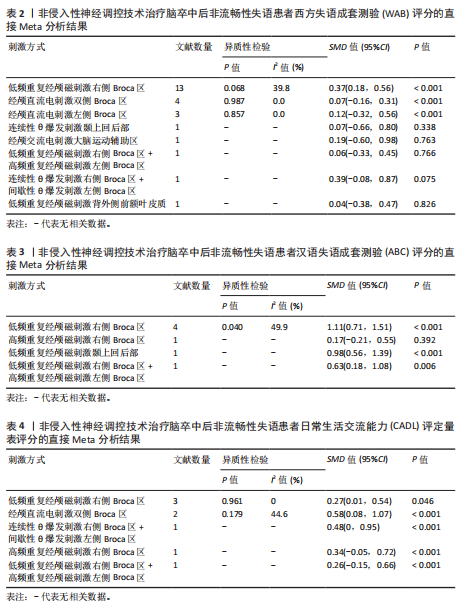
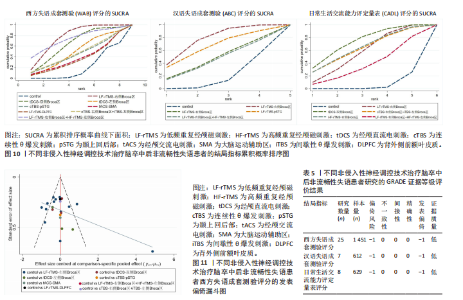
根据SUCRA值对不同干预措施的治疗效果进行排序,结果显示:低频重复经颅磁刺激右侧Broca区(76.8%)>低频重复经颅磁刺激颞上回后部(65.2%)>高频重复经颅磁刺激右侧Broca区(46.5%)>低频重复经颅磁刺激右侧Broca区+高频重复经颅磁刺激左侧Broca区(44.3%)>常规治疗(17.3%),见图10。由于该结局指标仅纳入7项研究,低频重复经颅磁刺激颞上回后部仅来自顾海萍等[32]的1项研究,试验组样本量为50例,低频重复经颅磁刺激右侧Broca区+高频重复经颅磁刺激左侧Broca区仅来自王洪崑[37]的1项研究,试验组样本量为40例,可能存在小样本效应,SUCRA值的排序结果需谨慎解释。 2.5.3 CADL评分 共纳入8项研究[18,26,29,33,35,40-41,45], 共5种非侵入性神经调控技术,由于网络证据图未形成闭环,故无需进行不一致性检验,见图8。 网状Meta分析结果显示,经颅直流电刺激双侧Broca区[SMD=1.81,95%CI(0.51,2.12),P < 0.05]、低频重复经颅磁刺激右侧Broca区[SMD=1.36,95%CI(0.31,2.42),P < 0.05] 2种干预对日常生活交流能力的改善程度明显优于常规治疗,基于现有证据,其余3种刺激方式对CADL评分的改善程度尚未能证实优于常规治疗(P > 0.05);此外,5种刺激方式对于CADL评分的改善程度两两比较差异均无显著性意义(P > 0.05),见图9。 根据SUCRA值对不同干预措施的治疗效果进行排序,结果显示:经颅直流电刺激双侧Broca区(73.5%)>高频重复经颅磁刺激右侧Broca区(63.8%)>连续性θ爆发刺激右侧Broca区+间歇性θ爆发刺激左侧Broca区(62.8%)>低频重复经颅磁刺激右侧Broca区(57%)>低频重复经颅磁刺激右侧Broca区+高频重复经颅磁刺激左侧Broca区(37.3%)>常规治疗(5.6%),见图10。由于该结局指标纳入的研究仅为8项,连续性θ爆发刺激右侧Broca区+间歇性θ爆发刺激左侧Broca区仅来自曾贞等[26]的1项研究,试验组样本量为35例,低频重复经颅磁刺激右侧Broca区+高频重复经颅磁刺激左侧Broca区仅来自代锋等[29]的1项研究,试验组样本量为48例,可能存在小样本效应,SUCRA值的排序结果需谨慎解释。 2.6 发表偏倚 此次研究仅对纳入研究≥10篇的WAB评分结局指标绘制漏斗图,并进行Egger检验评估研究的偏倚风险,结果显示散点在漏斗图中呈非对称性分布,散点集中在漏斗图上方,而底部散点数量少且分布散乱,个别散点偏离漏斗图的预设范围,进一步进行Egger检验,WAB评分P=0.047 7,提示存在一定的发表偏倚风险及小样本效应,见图11。 2.7 GRADE证据分级结果 由于多项研究在随机化方面对于盲法、分配隐藏情况描述不清,研究可能存在一定的发表偏倚,因此对偏倚风险此项进行降级;研究的3项结局指标在进行直接Meta分析时异质性较高,根据不同干预方式进行亚组分析和敏感性分析,结果显示异质性检验I2≤50%且敏感性分析结果较稳健,故不一致性不予降级;所纳入研究的结局指标与评估目的相关性较强且不存在最小临床差异的相关问题,故间接性和精确性不予降级;研究绘制了3项结局指标的漏斗图显示散点分布不均,有少量散落在漏斗图底部和范围之外,并且对WAB评分进行Egger检验(P=0.047 7),提示存在一定的发表偏倚,故对发表偏倚项进行降级。具体结果见表5。"
| [1] ASHAIE SA, ENGEL S, CHERNEY LR. Timing of transcranial direct current stimulation (tDCS) combined with speech and language therapy (SLT) for aphasia: study protocol for a randomized controlled trial. Trials. 2022;23(1):668. [2] 钟红丽,王江波,蔡琛,等.低频重复经颅磁刺激联合旋律语调疗法治疗脑卒中恢复期非流畅性失语的临床疗效[J].中国康复,2023,38(1):4-8. [3] BIOU E, CASSOUDESALLE H, COGNÉ M, et al. Transcranial direct current stimulation in post-stroke aphasia rehabilitation: A systematic review. Ann Phys Rehabil Med. 2019;62(2): 104-121. [4] BERTHIER ML, EDELKRAUT L, LÓPEZ-GONZÁLEZ FJ, et al. Donepezil alone and combined with intensive language-action therapy on depression and apathy in chronic post-stroke aphasia: A feasibility study. Brain Lang. 2023;236:105205. [5] ZHANG J, WEI R, CHEN Z, et al. Piracetam for aphasia in post-stroke patients: a systematic review and meta-analysis of randomized controlled trials. CNS Drugs. 2016;30:575-587. [6] 冷晓轩,赵玉欣,刘西花.不同神经调控刺激方式改善帕金森病患者非运动症状的网状Meta分析[J]. 中国组织工程研究,2026,30(5):1282-1293. [7] 张家铭,田艳萍,张月,等.经颅磁刺激治疗脑卒中的Citespace知识图谱可视化分析[J].中国组织工程研究,2021,25(35):5610-5618. [8] 张银,杨晓芸,陶芳芳,等.重复经颅磁刺激联合音乐疗法对轻中度阿尔茨海默病患者前瞻性记忆及精神行为症状的影响[J].浙江中西医结合杂志,2025,35(3):243-245,252. [9] 赵玉欣,张德旗,毕鸿雁.非侵入性脑刺激不同刺激方式对帕金森病患者认知功能影响的网状Meta分析[J].中国组织工程研究,2025,29(24): 5212-5223. [10] 周爱军,胡晓文,寇森.特发性震颤诊断与治疗的研究进展[J].中国实用神经疾病杂志,2025, 28(2): 261-264. [11] KESIKBURUN S. Non-invasive brain stimulation in rehabilitation.Turk J Phys Med Rehab. 2022; 68(1):1-8. [12] LIN BF, YEH SC, KAO YJ, et al. Functional remodeling associated with language recovery after repetitive transcranial magnetic stimulation in chronic aphasic stroke. Front Neurol. 2022;13: 809843. [13] 姜雪佳,赵虹飞,张文霞,等.低频重复经颅磁刺激治疗卒中后失语的系统评价及Meta分析[J].山东第一医科大学(山东省医学科学院)学报,2024,45(4):204-211. [14] 中华医学会神经病学分会,中华医学会神经病学分会脑血管病学组.中国急性缺血性脑卒中诊治指南2018[J].中华神经科杂志,2018,9(9):9. [15] 刘津池,刘畅,华成舸.随机对照试验偏倚风险评价工具RoB2(2019修订版)解读[J].中国循证医学杂志,2021,21(6):737-744. [16] CASHIN AG, MCAULEY JH. Clinimetrics: physiotherapy evidence database (PEDro) scale.J Physiother. 2020;66(1):59. [17] BAI GT, JIANG L, HUAN S, et al. Study on Low-Frequency Repetitive Transcranial Magnetic Stimulation Improves Speech Function and Mechanism in Patients With Non-fluent Aphasia After Stroke. Front Aging Neurosci. 2022;14: 883542. [18] DANG H, CHEN J, LI J, et al. Effects of speech rehabilitation training combined with repetitive transcranial magnetic stimulation on patients with post-stroke aphasia. Clin Neurol Neurosur. 2025;252:108833. [19] HAGHIGHI M, MAZDEH M, RANJBAR N, et al. Further Evidence of the Positive Influence of Repetitive Transcranial Magnetic Stimulation on Speech and Language in Patients with Aphasia after Stroke: Results from a Double-Blind Intervention with Sham Condition. Neuropsychobiology. 2017;75(4):185-192. [20] LOW TA, LINDLAND K, KIRTON A, et al. Transcranial Magnetic Stimulation Combined With Multimodality Aphasia Therapy for Chronic Poststroke Aphasia: a Randomized Clinical Trial. Neurology. 2025;104(6):e213424. [21] XIE X, HU P, TIAN Y, et al. Transcranial alternating current stimulation enhances speech comprehension in chronic post-stroke aphasia patients: A single-blind sham-controlled study. Brain Stimul. 2022;15(6):1538-1540. [22] YOON TH, HAN SJ, YOON TS, et al. Therapeutic effect of repetitive magnetic stimulation combined with speech and language therapy in post-stroke non-fluent aphasia. Neurorehabilitation. 2015;36(1):107-114. [23] ZHAO Q, WANG J, LI Z, et al. Effect of anodic transcranial direct current stimulation combined with speech language therapy on nonfluent poststroke aphasia. Neuromodulation. 2021;24(5): 923-929. [24] ZHENG K, XU X, JI Y, et al. Continuous theta burst stimulation-induced suppression of the right fronto-thalamic-cerebellar circuit accompanies improvement in language performance in poststroke aphasia: A resting-state fMRI study. Front Aging Neurosci. 2023;14:1079023. [25] ZHENG ZS, XING-LONG WANG K, MILLAN H, et al. Transcranial direct stimulation over left inferior frontal gyrus improves language production and comprehension in post-stroke aphasia: A double-blind randomized controlled study. Brain Lang. 2024;257:105459. [26] 曾贞,王凯,张琴,等.间歇性Theta节律刺激对脑卒中失语症患者语言功能、认知功能及日常生活交流能力的影响[J].中华保健医学杂志, 2025,27(1):99-102. [27] 陈颂玲,胡荣亮,邓筱燕.重复经颅磁刺激在脑卒中后非流畅性失语患者中的应用研究[J].反射疗法与康复医学,2024,5(7):43-45. [28] 崔璨.经颅磁刺激联合言语康复治疗对脑卒中后非流畅性失语症的疗效及QOL评分的分析[J].浙江临床医学,2019,21(4):515-516,519. [29] 代锋,崔可俊.高频重复经颅磁刺激疗法结合语言训练对脑卒中运动型失语患者功能恢复的影响[J].现代医学与健康研究电子杂志,2025, 9(4):45-48. [30] 樊影娜,赵佳.低频rTMS对急性脑梗死后运动性失语的疗效观察[J].中国康复,2016,31(1):28-30. [31] 范翠平.重复经颅磁刺激联合语言训练治疗脑卒中失语症的疗效观察[J].护理研究,2017, 31(14):1783-1784. [32] 顾海萍,王昊懿.低频重复经颅磁刺激联合言语训练对缺血性脑卒中患者语言功能重建的作用[J].神经损伤与功能重建,2019,14(10):525-526. [33] 胡荣亮,陈颂玲,任雪芹,等.重复经颅磁刺激对卒中后broca失语语言功能恢复的影响[J].吉林医学,2020,41(7):1702-1703. [34] 瞿砚舟,钟根龙,吕锦,等.低频重复经颅磁刺激治疗亚急性期卒中后非流利性失语疗效观察[J].中国现代医生,2020,58(17):112-115. [35] 沈滢,殷稚飞,周秋敏,等.低频重复经颅磁刺激治疗脑卒中后非流畅性失语的疗效观察[J].中华物理医学与康复杂志,2016,38(3):170-174. [36] 宋慧,刘秀磊.重复经颅磁刺激联合Schuell法语言训练治疗对脑梗死后失语症患者语言功能的影响 [J].反射疗法与康复医学,2025,6(5):43-46. [37] 王洪崑.重复经颅磁刺激对脑梗后失语患者的治疗效果[J].中国医药指南,2020,18(31):62-63. [38] 吴冰.重复经颅磁刺激对脑卒中后失语患者语言恢复的影响[J].黑龙江科学,2019,10(12):58-59. [39] 闫芳,臧卫周,张杰文,等.双侧rTMS治疗脑梗死后失语症的临床研究[J].中国实用神经疾病杂志, 2018,21(2):129-132. [40] 杨丹,杜飞,徐帆,等.经颅直流电刺激联合言语训练对脑梗死后失语症的治疗效果分析[J].中国现代药物应用,2022,16(13):188-190. [41] 杨柳,孙龚卫.经颅磁刺激联合常规言语康复治疗脑卒中后非流畅性失语症的疗效观察[J].当代医学,2022,28(23):180-183. [42] 由丽,朱慧敏,田丽,等.低频重复经颅磁刺激对首次脑卒中后言语失用的疗效观察[J].临床神经病学杂志,2021,34(3):204-206. [43] 张洪,刘静,杨未风,等.经颅直流电刺激联合常规言语康复治疗脑卒中后非流畅性失语症的疗效观察 [J].康复学报,2017,27(3):39-42,46. [44] 张莉,沈莉.经颅直流电刺激联合记忆强化训练治疗缺血性脑卒中后失语症患者的临床效果[J].实用心脑肺血管病杂志,2020,28(1):112-115. [45] 张茜,代欣,贺媛,等.经颅直流电刺激联合言语训练对脑梗死后失语症的治疗效果[J].蚌埠医学院学报,2020,45(5):601-605. [46] 张芹,江钟立,方欣,等.词联导航训练法联合经颅直流电刺激改善失语症言语流畅度及命名能力的临床观察[J].中国康复医学杂志,2017, 32(8):879-884. [47] 张晓玲,何伟亮,赵雪平,等.重复经颅磁刺激治疗脑梗死患者失语的疗效研究[J].脑与神经疾病杂志,2020,28(6):331-333. [48] 周海燕,袁磊,闻瑛,等.低频重复经颅磁刺激联合言语训练对脑卒中失语的康复效果[J].神经损伤与功能重建,2021,16(10):614-616. [49] 朱磊.经颅磁刺激联合语言康复对急性脑梗死后运动性失语患者神经功能及语言功能的影响[J].反射疗法与康复医学,2022,3(20):73-76. [50] HAN C, TANG J, TANG B, et al. The effectiveness and safety of noninvasive brain stimulation technology combined with speech training on aphasia after stroke: A systematic review and meta-analysis. Medicine. 2024;103(2):e36880. [51] NORISE C, HAMILTON RH. Non-invasive brain stimulation in the treatment of post-stroke and neurodegenerative aphasia: parallels, differences, and lessons learned. Front Hum Neurosci. 2017; 10:675. [52] ZOU T, LI L, HUANG X, et al. Dynamic causal modeling analysis reveals the modulation of motor cortex and integration in superior temporal gyrus during multisensory speech perception. Cogn Neurodyn. 2024;18(3):931-946. [53] 徐如月,尹丽丽.针刺为主治疗脑卒中后失语临床研究进展[J].实用中医药杂志,2020,36(10): 1363-1365. [54] ARDILA A. Supplementary motor area aphasia revisited. J Neurolinguistics. 2020;54:100888. [55] HERTRICH I, DIETRICH S, BLUM C, et al. The Role of the Dorsolateral Prefrontal Cortex for Speech and Language Processing. Front Hum Neurosci. 2021;15:645209. [56] PANUCCIO F, ROSSI G, DI NUZZO A, et al. Quality of Assessment Tools for Aphasia: A Systematic Review. Brain Sci. 2025;15(3):271. [57] FONG MW, VAN PATTEN R, FUCETOLA RP. The factor structure of the Boston diagnostic aphasia examination. J Int Neuropsychol Soc. 2019;25(7):772-776. [58] BYEON H, KOH HW. The relationship between communication activities of daily living and quality of life among the elderly suffering from stroke. J Physiother. 2016;28(5):1450-1453. [59] ELSNER B, KUGLER J, MEHRHOLZ J. Transcranial direct current stimulation (tDCS) for improving aphasia after stroke: a systematic review with network meta-analysis of randomized controlled trials. J NeuroEng Rehabil. 2020;17:1-11. [60] RODGER J, MO C, WILKS T, et al. Transcranial pulsed magnetic field stimulation facilitates reorganization of abnormal neural circuits and corrects behavioral deficits without disrupting normal connectivity. Faseb J. 2012;26(4):1593-1606. [61] NAESER MA, MARTIN PI, TREGLIA E, et al. Research with rTMS in the treatment of aphasia. Restor Neurol Neurosci. 2010;28(4):511-529. [62] 段国平,张旭,汪洁,等.经颅直流电刺激在神经系统疾病康复中的应用现状[J].中国康复医学杂志,2019,34(9):1106-1111. [63] CICHON N, WLODARCZYK L, SALUK-BIJAK J, et al. Novel advances to post-stroke aphasia pharmacology and rehabilitation. J Clin Med. 2021;10(17):3778. [64] OMAE E, SHIMA A, TANAKA K, et al. Case report: An N-of-1 study using amplitude modulated transcranial alternating current stimulation between Broca’s area and the right homotopic area to improve post-stroke aphasia with increased inter-regional synchrony. Front Hum Neurosci. 2024;18:1297683. |
| [1] | Cao Xinyan, Yu Zifu, Leng Xiaoxuan, Gao Shiai, Chen Jinhui, Liu Xihua. Effect of repetitive transcranial magnetic stimulation and transcranial direct current stimulation on motor function and gait in children with cerebral palsy: a network meta-analysis [J]. Chinese Journal of Tissue Engineering Research, 2026, 30(6): 1539-1548. |
| [2] | Zheng Yin, Wu Zhenhua, Zhang Cheng, Ruan Kexin, Gang Xiaolin, Ji Hong. Safety and efficacy of immunoadsorption therapy for rheumatoid arthritis: a network meta-analysis and systematic review [J]. Chinese Journal of Tissue Engineering Research, 2026, 30(5): 1260-1268. |
| [3] | Wang Xueting, Yang Wei, Wang Pengqin. Post-stroke rehabilitation robotics: current research status and hot topics in and outside China [J]. Chinese Journal of Tissue Engineering Research, 2026, 30(28): 7404-7409. |
| [4] | Fan Mengmeng, Ding Jiali, Wan Yujie, Huang Hailiang. A systematic review and network meta-analysis of neuromodulation techniques for promoting upper limb motor function after stroke [J]. Chinese Journal of Tissue Engineering Research, 2026, 30(28): 7494-7504. |
| [5] | Fang Enhui, Guan Hui, Ma Lihong. Non-invasive brain stimulation for core symptoms in children with autism spectrum disorder: a network meta-analysis [J]. Chinese Journal of Tissue Engineering Research, 2026, 30(24): 6373-6381. |
| [6] | Cao Xinyan, Leng Xiaoxuan, Gao Shiai, Chen Jinhui, Liu Xihua. Analysis of influencing factors and risk prediction model for spasticity severity in stroke patients with hemiplegia [J]. Chinese Journal of Tissue Engineering Research, 2026, 30(23): 6092-6098. |
| [7] | Wang Lejun, Chi Wenxin, Song Xiaoqian, Li Qian, Qiao Minjie, Tao Haifeng. Performance of unstable barbell bench press and changes in electromyographic activity after transcranial direct current stimulation [J]. Chinese Journal of Tissue Engineering Research, 2026, 30(23): 6099-6109. |
| [8] | Leng Xiaoxuan, Yu Zifu, Cao Xinyan, Gao Shiai, Chen Jinhui, Liu Xihua. Balance function and its influencing factors in patients with post-stroke hemiplegia [J]. Chinese Journal of Tissue Engineering Research, 2026, 30(18): 4611-4617. |
| [9] | Chen Jinhui, Yu Zifu, Gao Shiai, Cao Xinyan, Leng Xiaoxuan, Liu Xihua. Effects of central and peripheral rehabilitation therapies on upper extremity function and activities of daily living in stroke patients: a network meta-analysis [J]. Chinese Journal of Tissue Engineering Research, 2026, 30(17): 4457-4471. |
| [10] | Xu Feng, Gu Dongyang, Zhu Zihao, Li Qiujie, Wan Xianglin. Relationship between spatio-temporal gait characteristics and fall risk in stroke patients [J]. Chinese Journal of Tissue Engineering Research, 2026, 30(16): 4038-4044. |
| [11] | Gao Zan, Liu Yixuan, Zhang Lichen, Hou Bing, Tang Yalei, Li Shumei, Che Pengcheng, Dou Na. Network meta-analysis of robot-assisted gait training interventions on lower limb motor function in stroke patients [J]. Chinese Journal of Tissue Engineering Research, 2026, 30(16): 4219-4228. |
| [12] | Hou Bing, Zhao Hongfei, Che Pengcheng, Wang Ziyi, Gao Zan, Chen Linyu, Wang Jinzhi, Dou Na. Analysis of upper limb motor function and brain function immediately and 3 weeks after transcranial direct current stimulation [J]. Chinese Journal of Tissue Engineering Research, 2026, 30(12): 3066-3074. |
| [13] | Cheng Le, Zhu Caifeng, Zhou Bingyuan, Gao Dahong, Cui Xiaoya, Li Jing, Wang Xuewei, Yang Gaoshang, Chen Xiyang. Mechanisms of stroke therapy targeting inflammatory cytokines: a big data analysis based on the IEU Open GWAS [J]. Chinese Journal of Tissue Engineering Research, 2026, 30(12): 3198-3216. |
| [14] | Gao Shiai, Yu Zifu, Chen Jinhui, Cao Xinyan, Leng Xiaoxuan, Liu Xihua. Efficacy of non-invasive neuromodulation techniques on autism spectrum disorder: a network meta-analysis [J]. Chinese Journal of Tissue Engineering Research, 2026, 30(10): 2550-2559. |
| [15] | Wang He, Yu Shaohong, . Meta-analysis of transcranial direct current stimulation in improving lower limb motor dysfunction in stroke patients [J]. Chinese Journal of Tissue Engineering Research, 2025, 29(30): 6556-6565. |
| Viewed | ||||||
|
Full text |
|
|||||
|
Abstract |
|
|||||