Chinese Journal of Tissue Engineering Research ›› 2026, Vol. 30 ›› Issue (17): 4390-4399.doi: 10.12307/2026.214
Previous Articles Next Articles
Control strategies during gait termination in older adults under cognitive-motor dual-task conditions
Liang Tianqi, Zhang Xiaoquan
- College of Sports Science, Shenyang Normal University, Shenyang 110034, Liaoning Province, China
-
Received:2025-08-18Accepted:2025-09-11Online:2026-06-18Published:2025-12-01 -
Contact:Zhang Xiaoquan, PhD, Professor, College of Sports Science, Shenyang Normal University, Shenyang 110034, Liaoning Province, China -
About author:Liang Tianqi, MS candidate, College of Sports Science, Shenyang Normal University, Shenyang 110034, Liaoning Province, China -
Supported by:National Social Science Foundation Project, No.24BTY038 (to ZXQ)

CLC Number:
Cite this article
Liang Tianqi, Zhang Xiaoquan. Control strategies during gait termination in older adults under cognitive-motor dual-task conditions [J]. Chinese Journal of Tissue Engineering Research, 2026, 30(17): 4390-4399.
share this article
Add to citation manager EndNote|Reference Manager|ProCite|BibTeX|RefWorks
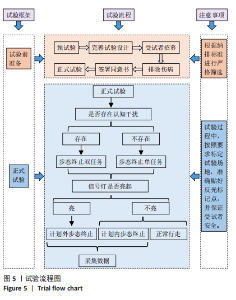
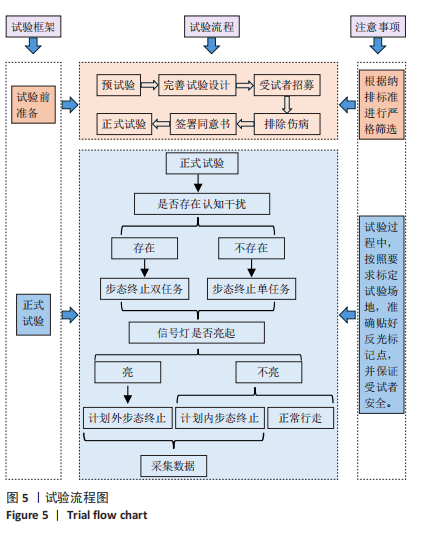
2.1 参与者数量分析 10名受试者均顺利完成试验,未发生不良事件,全部进入结果分析。 2.2 试验流程 见图5。"
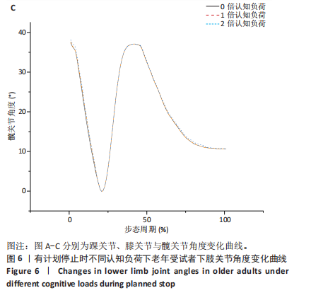
2.3 受试者下肢关节角度变化 该部分将比较单任务(0倍认知负荷,只进行步态终止)与1倍认知负荷和2倍认知负荷的下肢关节角度变化。由于步态终止下肢3个关节主要表现为矢状面内的屈曲和伸展,并且步态终止中起主要作用的为制动腿,因此,研究只对比制动腿的关节角度变化。为了将不同受试者之间进行比较,研究将所有受试者的步态周期数据进行了标准化处理,将步态周期归一化到0%-100%之间[1]。有计划停止和急停动作阶段划分为第一双支撑相、左脚单支撑相、第二双支撑相、摆动相、第三双支撑相及停止阶段。 2.3.1 有计划停止时受试者下肢关节角度变化 见图6。"
"
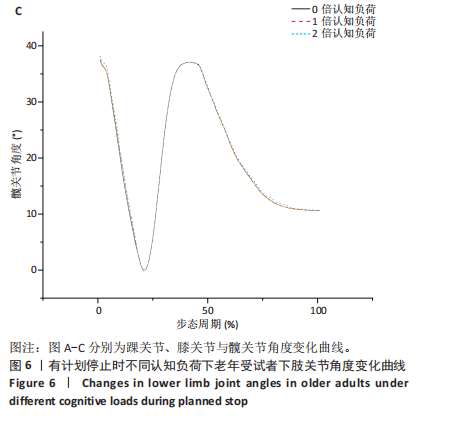
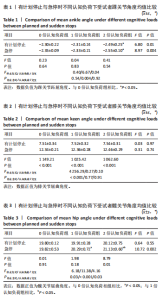
下肢踝、膝和髋关节在整个步态周期中的角度变化趋势较为一致,踝关节角度在停止阶段发生轻微变化,具体变现为:在第二双支撑相之前,0倍认知负荷、1倍认知负荷和2倍认知负荷下受试者踝关节角度变化趋势基本一致;在第二双支撑相达到跖屈极值后,在步态终止后期的并拢阶段踝关节开始逐渐背屈并停止,此时3种认知负荷下受试者的踝关节角度稍有波动,波动幅度主要表现为0倍认知负荷> 1倍认知负荷> 2倍认知负荷,并且与0倍认知负荷组相比,2倍认知负荷组踝关节跖屈角度显著增大(P < 0.05),见表1-3。"
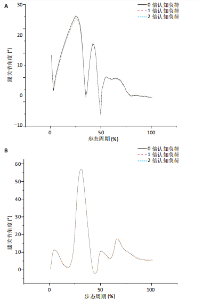
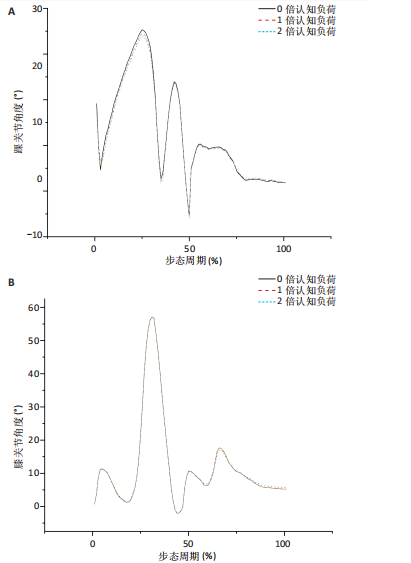
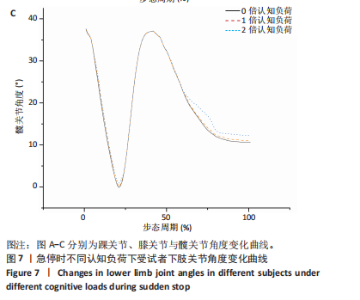
2.3.2 急停时受试者下肢关节角度变化 见图7。"
"
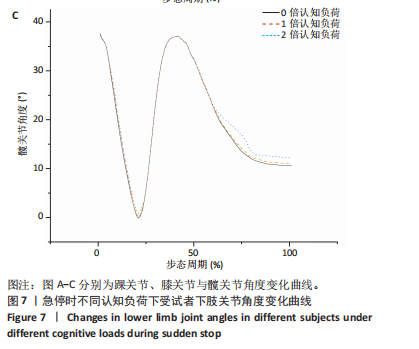
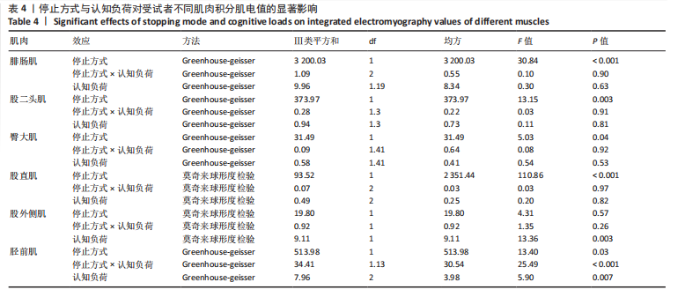
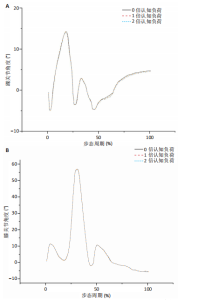
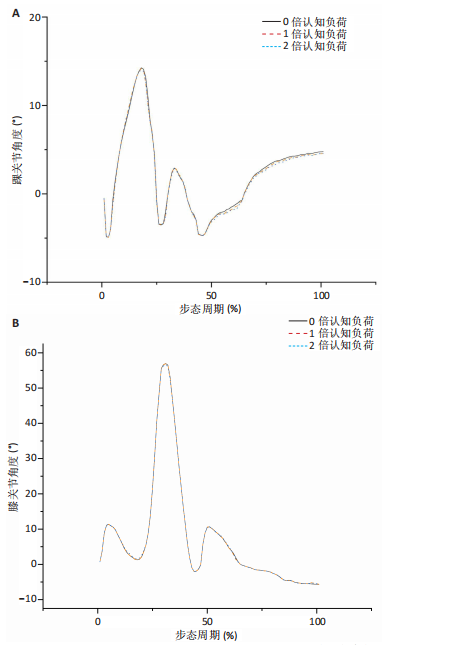
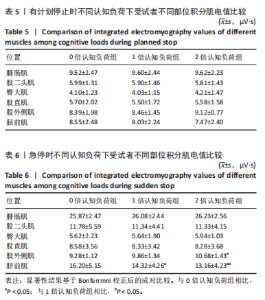
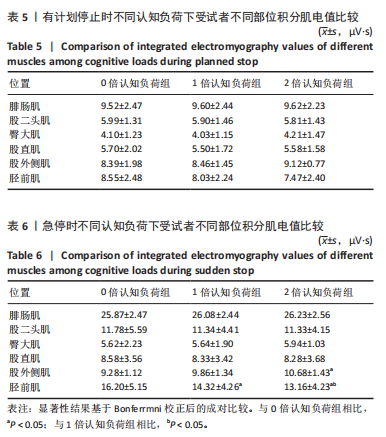
由图7A和表1可以看出,踝关节在步态周期的25%左右出现明显波动。在第一双支撑相的初期,0认知负荷、1倍认知负荷和2倍认知负荷下受试者的踝关节角度达到第一跖屈极值,主要表现为0倍认知负荷> 1倍认知负荷> 2倍认知负荷。由此踝关节角度开始逐渐上升,由跖屈逐渐变为背屈,3种认知负荷下受试者踝关节角度上升变化趋势基本一致。在左脚单支撑相达到背屈峰值,并且3种认知负荷下受试者的踝关节角度均值产生了明显差异,主要表现为0倍认知负荷> 1倍认知负荷> 2倍认知负荷。2倍认知负荷组踝关节跖屈角度明显大于0倍认知负荷组(P < 0.05)。 由图7B和表2可以看出,3种认知负荷下受试者的膝关节角度变化趋于一致。在第二双支撑相摆动相达到峰值57°,随后膝关节角度迅速下降转变为伸展状态进入摆动相。在步态周期的急停阶段,3种认知负荷下受试者的膝关节角度变化出现轻微波动,波动幅度表现为0倍认知负荷> 1倍认知负荷> 2倍认知负荷。受试者膝关节平均角度随着认知负荷的增加而增大,但是并未达到显著水平。 由图7C和表3可以看出,在步态周期的急停阶段,3种认知负荷下受试者的髋关节角度变化趋势有明显波动,髋关节角度由屈曲状态变为伸展状态,髋关节波动幅度表现为0倍认知负荷> 1倍认知负荷> 2倍认知负荷。随着认知负荷的增加,受试者的髋关节角度增大。1,2倍认知负荷组髋关节角度大于0倍认知负荷组(P < 0.05)。 双因素(认知负荷×停止方式)重复测量方差分析显示,认知负荷对踝关节角度的主效应显著(P < 0.05),双因素交互作用不显著;停止方式对膝关节角度的主效应显著(P < 0.001),双因素交互作用不显著;停止方式对髋关节角度的主效应显著(P < 0.05),认知负荷主对髋关节角度的效应显著(P < 0.001),双因素交互作用显著(P < 0.05)。 由于髋关节角度存在交互效应,进一步进行简单效应分析。停止方式的简单效应检验结果显示:0倍认知负荷下,停止方式的简单效应不显著(F=0.01,P=0.91);1倍认知负荷下,停止方式的简单效应不显著(F=1.98,P=0.18);2倍认知负荷下,停止方式的简单效应显著(F=8.79,P=0.01),表明在2倍认知负荷下有计划停止和急停两种停止方式之间髋关节角度的存在显著差异。认知负荷的简单效应检验结果显示,有计划停止时,认知负荷的主效应不显著(F=0.64,P=0.55);急停时,认知负荷的主效应显著(F=10.72,P=0.002)。 2.4 受试者下肢积分肌电变化 采用双因素(认知负荷×停止方式)重复测量方差分析对下肢制动腿6块肌肉的积分肌电进行分析,见表4。结果显示,对于腓肠肌、股二头肌、臀大肌、股直肌和胫前肌,停止方式的主效应显著(P < 0.05);对于股外侧肌和胫前肌,认知负荷的主效应显著(P < 0.05);对于胫前肌,存在显著的交互作用(P < 0.001)。由于上述主效应和交互效应作用均为整体方差分析结果,故无需进行Bonferroni校正,仅在后续配对比较中采用校正。 有计划停止时,随着认知负荷的增加,受试者下肢6块肌肉的积分肌电值并无显著变化。进一步的成对比较结果显示,仅股外侧肌和胫前肌的积分肌电值在某些认知负荷条件下呈现出显著差异(P < 0.05),因此,为了降低假阳性风险,对股外侧肌和胫前肌的积分肌电值采用Bonferroni校正,校正后的显著性阈值设定为α=0.05/3≈0.0167,结果显示:急停时,2倍认知负荷组股外侧肌积分肌电值大于0倍认知负荷组(P < 0.016 7),不同认知负荷组胫前肌肌积分肌电值比较差异有显著性意义(P < 0.016 7),见表5,6。"
"
| [1] 王新亭,吴永红,王鸥,等.老年人手提重物时不同停止方式对步态稳定性的影响[J].医用生物力学,2021,36(2):297-303. [2] 莫仕围,徐冬青,李静先.步态终止对身体姿势稳定性影响研究[J].中国运动医学杂志,2011,30(1):94-99. [3] SPARROW WA, TIROSH O. Gait termination: a review of experimental methods and the effects of ageing and gait pathologies. J Gait Posture. 2005;22(4):362-371. [4] JIAN Y, WINTER DA, ISHAC MG, et al. Trajectory of the body COG and COP during initiation and termination of gait. J Gait Posture. 1993;1(1):9-22. [5] KOO DK, KWON JW. Biomechanical Analysis of Unplanned Gait Termination According to a Stop-Signal Task Performance: A Preliminary Study. Brain Sci. 2023;13(2):304. [6] ZHANG X, WANG Q, LI Q, et al. Comparative effects of arithmetic, speech, and motor dual-task walking on gait in stroke survivors: a cross-sectional study. Front Hum Neurosci. 2025;19:1587153. [7] BECH SR, KJELDGAARD-MAN L, SIRBAUGH MC, et al. Attentional Capacity during Dual-task Balance Performance Deteriorates with Age before the Sixties. Exp Aging Res. 2022;48(1):86-98. [8] HALL CD, ECHT KV, WOLF SL, et al. Cognitive and motor mechanisms underlying older adults’ ability to divide attention while walking. Phys Ther. 2011;91(7):1039-1050. [9] KLINE PW, SHAIKH FD, TENNANT JE, et al. Global Cognition, Gender, and Level of Education Predict Dual-Task Gait Speed Variability Metrics in Older Adults. Gerontology. 2024;70(7):724-731. [10] 刘鑫玥,邢新阳,霍洪峰.不同认知负荷行走时人体动态稳定性的差异[J].中国组织工程研究,2023,27(9):1335-1339. [11] OMANA H, MADOU E, MONTERO-ODASSO M, et al. The effect of dual-task testing on the balance and gait of people with lower limb amputations: A systematic review. PM R. 2023;15(1):94-128. [12] JOHNSON RS, SCOTT KH, LYNALL RC. A proposal for complex gait evaluation using dual-task gait termination time. J Sport Rehabil. 2020;30(4):525-530. [13] AZADIAN E, TORBATI HRT, KAKHKI ARS, et al. The effect of dual task and executive training on pattern of gait in older adults with balance impairment: A Randomized controlled trial. Arch Gerontol Geriatr. 2016; 62:83-89. [14] SCHAEFER S, JAGENOW D, VERREL J, et al. The influence of cognitive load and walking speed on gait regularity in children and young adults. J Gait Posture. 2015;41(1):258-262. [15] 庄薇. 经颅交流电刺激对工作记忆及上肢双任务动作控制的影响研究[D].上海:上海体育学院,2021. [16] MENANT JC, STEELE JR, MENZ HB, et al. Rapid gait termination: effects of age, walking surfaces and footwear characteristics. J Gait Posture. 2009; 30(1):65-70. [17] ALJAWAEE M, WILLIAMS JM, JONES MD. Informing wobble-board training and assessment through an investigation of the effect of biological-sex, anthropometrics, footwear and dual-tasking in young adults. J Back Musculoskelet Rehabil. 2024;37(2):305-315. [18] HOMMEL B. Dual-task performance: Theoretical analysis and an event-coding account. J Cogn. 2020;3(1):29. [19] OH C, LAPOINTE LL. Changes in cognitive load and effects on parameters of gait. Cogent Psychology. 2017;4(1):1372872. [20] BEAUCHET O, DUBOST V, HERRMANN FR, et al. Stride-to-stride variability while backward counting among healthy young adults. J Neuroeng Rehabil. 2005;2(1):1-8. [21] MONTERO-ODASSO M, MUIR SW, SPEECHLEY M. Dual-task complexity affects gait in people with mild cognitive impairment: the interplay between gait variability, dual tasking, and risk of falls. Arch Phys Med Rehabil. 2012; 93(2):293-299. [22] SILSUPADOL P, SHUMWAY-COOK A, LUGADE V, et al. Effects of single- and dual-task conditions on executive function in walking. Arch Phys Med Rehabil. 2009;90(2):293-299. [23] OWEN AM, MCMILLAN KM, LAIRD AR, et al. N‐back working memory paradigm: A meta‐analysis of normative functional neuroimaging studies. Hum Brain Mapp. 2005;25(1):46-59. [24] WOLLESEN B, WANSTRATH M, VAN SCHOOTEN KS, et al. A taxonomy of cognitive tasks to evaluate cognitive-motor interference on spatiotemoporal gait parameters in older people: a systematic review and meta-analysis. Eur Rev Aging Phys Act. 2019;16(1):1-27. [25] 张肃.基于表面肌电技术对人体上肢肌肉疲劳过程中中枢共驱动的研究[J].中国运动医学杂志,2017,36(4):290-295. [26] TUENA C, MANCUSO V, BENZI I MA, et al. Executive functions are associated with fall risk but not balance in chronic cerebrovascular disease. J Clin Med. 2020;9(11):3405. [27] YUN SH, JANG TS, KWON JW. Cortical Activity and Spatiotemporal Parameters during Gait Termination and Walking: A Preliminary Study. Behav Brain Res. 2024; 456:114701. [28] NAGEL IE, PREUSCHHOF C, LI SC, et al. Load modulation of BOLD response and connectivity predicts working memory performance in younger and older adults. J Cogn Neurosci. 2011;23(8):2030-2045. [29] ROSS D, WAGSHUL ME, IZZETOGLU M, et al. Prefrontal cortex activation during dual-task walking in older adults is moderated by thickness of several cortical regions. Geroscience. 2021;(4):1959-1974. [30] RIDGE ST, HENLEY J, MANAL K, et al. Kinematic and kinetic analysis of planned and unplanned gait termination in children. J Gait Posture. 2013; 37(2):178-182. [31] CEN X, LU Z, BAKER JS, et al. A comparative biomechanical analysis during planned and unplanned gait termination in individuals with different arch Stiffnesses. Appl Sci. 2021;11(4):1871. [32] TIROSH O, SPARROW WA. Gait termination in young and older adults: effects of stopping stimulus probability and stimulus delay. J Gait Posture. 2004;19(3):243-251. [33] SHEN X, CEN X, SONG Y. Investigating Temporal Kinematic Differences Caused by Unexpected Stimulation during Gait Termination through the Waveform‐Level Variance Equality Test. Biomed Res Int. 2022;2022(1):4043426. [34] ZHOU H, CEN X, SONG Y, et al. Lower-limb biomechanical characteristics associated with unplanned gait termination under different walking speeds. J Vis Exp. 2020;(162):e61558. [35] HASE K, STEIN RB. Analysis of rapid stopping during human walking. J Neurophysiol. 1998;80(1):255-261. |
| [1] | Zhang Xianxu, Ma Zhong, Liu Xin, Huang Lei, Shen Wenxiang, Luo Zhiqiang . Lumbar fusion combined with unilateral fixation for lumbar degenerative diseases: biomechanics, technical evolution, and clinical applications [J]. Chinese Journal of Tissue Engineering Research, 2026, 30(9): 2334-2342. |
| [2] | Zeng Xuan, Weng Rui, Ye Shicheng, Tang Jiadong, Mo Ling, Li Wenchao. Two lumbar rotary manipulation techniques in treating lumbar disc herniation: a finite element analysis of biomechanical differences [J]. Chinese Journal of Tissue Engineering Research, 2026, 30(9): 2153-2161. |
| [3] | Wu Hongxu, Liu Xuanyu, Wang Taoyu, Wang Shiyao, Cheng Jingyi, Zhang Mingwen, Zhang Yinxia, Liu Zhihua, Wang Xiaojie. Finite element simulation of scoliosis with muscle unit introduction: verification of correction effect under bidirectional load [J]. Chinese Journal of Tissue Engineering Research, 2026, 30(9): 2172-2181. |
| [4] | Liu Jiafu, Ren Ruxia, Liao Zhouwei, Zhou Xiali, Wu Yihong, Zhang Shaoqun. Three-dimensional finite element analysis of cervical spine biomechanical characteristics in a rat model of cervical vertigo [J]. Chinese Journal of Tissue Engineering Research, 2026, 30(9): 2182-2190. |
| [5] | Zhou Daobin, Wang Kehao, Xie Yang, Ning Rende. Biomechanical characteristics of volar locking plate only versus combined dorsal mini-plate fixation of distal radius fractures with dorsal ulnar fragment [J]. Chinese Journal of Tissue Engineering Research, 2026, 30(9): 2255-2261. |
| [6] | Zheng Wangyang, Fei Ji, Yang Di, Zhao Lang, Wang Lingli, Liu Peng, Li Haiyang. Finite element analysis of the force changes of the supraspinatus tendon and glenohumeral joint during the abduction and flexion of the humerus [J]. Chinese Journal of Tissue Engineering Research, 2026, 30(9): 2199-2207. |
| [7] | Cai Qirui, Dai Xiaowei, Zheng Xiaobin, Jian Sili, Lu Shaoping, Liu Texi, Liu Guoke, Lin Yuanfang. Mechanical effects of Long’s traction orthopedic method on cervical functional units: quantitative analysis of biomechanical model of head and neck [J]. Chinese Journal of Tissue Engineering Research, 2026, 30(9): 2208-2216. |
| [8] | Rao Jingcheng, Li Yuwan, Zheng Hongbing, Xu Zhi, Zhu Aixiang, Shi Ce, Wang Bing, Yang Chun, Kong Xiangru, Zhu Dawei. Biomechanical differences between the new proximal femoral stable intramedullary nail and traditional intramedullary nail#br# [J]. Chinese Journal of Tissue Engineering Research, 2026, 30(9): 2217-2225. |
| [9] | Chen Long, Wang Xiaozhen, Xi Jintao, Lu Qilin. Biomechanical performance of short-segment screw fixation combined with expandable polyetheretherketone vertebral body replacement in osteoporotic vertebrae [J]. Chinese Journal of Tissue Engineering Research, 2026, 30(9): 2226-2235. |
| [10] | Yan Xiangning, Chen Lei, Chen Yonghuan, Wang Chao, Li Xiaosheng. Influence of different depths and loads on knee joint mechanics and peripheral muscle force characteristics during squatting [J]. Chinese Journal of Tissue Engineering Research, 2026, 30(9): 2236-2247. |
| [11] | Zhang Nan, Meng Qinghua, Bao Chunyu. Characteristics and clinical application of ankle joint finite element models [J]. Chinese Journal of Tissue Engineering Research, 2026, 30(9): 2343-2349. |
| [12] | Zhang Zihua. Simulation and force characterization of the lower limbs in elderly people from sitting to standing [J]. Chinese Journal of Tissue Engineering Research, 2026, 30(6): 1407-1416. |
| [13] | Zhong Caihong, Xiao Xiaoge, Li Ming, Lin Jianhong, Hong Jing. Biomechanical mechanism of sports-related patellar tendinitis [J]. Chinese Journal of Tissue Engineering Research, 2026, 30(6): 1417-1423. |
| [14] | Yu Xinlin, Chen Huiyu, Wang Yingying, Guo Weizhong, Feng Bin Lin Chengshou, Lin Wang. Finite element analysis of internal fixation with new retrograde intramedullary nail on lateral femur condyle for distal type A2 femur fractures [J]. Chinese Journal of Tissue Engineering Research, 2026, 30(3): 546-552. |
| [15] | Zhao Jingang, Liu Liping, Chen Jianwei, . Finite element analysis comparing lumbar fusion and artificial intervertebral disc replacement [J]. Chinese Journal of Tissue Engineering Research, 2026, 30(3): 553-560. |
| Viewed | ||||||
|
Full text |
|
|||||
|
Abstract |
|
|||||