Chinese Journal of Tissue Engineering Research ›› 2026, Vol. 30 ›› Issue (36): 9621-9631.doi: 10.12307/2026.900
Previous Articles Next Articles
Mechanism underlying Qu Shi Jie Du Formula for treating hyperuricemia in mice: an analysis integrating UHPLC-QE-MS with network pharmacology
Lin Kun1, He Xianshun1, Zhang Junjiao1, Han Mingli1, He Mincong2, 3, Wei Qiushi2, 3
- 1Third Clinical School of Medicine, Guangzhou University of Chinese Medicine, Guangzhou 510006, Guangdong Province, China; 2Joint Center, the Third Affiliated Hospital of Guangzhou University of Chinese Medicine, Guangzhou 510378, Guangdong Province, China; 3Guangdong Institute of Chinese Medicine and Orthopedics, Guangzhou 510378, Guangdong Province, China
-
Received:2025-09-29Revised:2026-03-06Online:2026-12-28Published:2026-05-26 -
Contact:Wei Qiushi, Chief physician, PhD, Doctoral supervisor, Postdoctoral co-supervisor, Joint Center, the Third Affiliated Hospital of Guangzhou University of Chinese Medicine, Guangzhou 510378, Guangdong Province, China; Guangdong Institute of Chinese Medicine and Orthopedics, Guangzhou 510378, Guangdong Province, China -
About author:Lin Kun, MS, Third Clinical School of Medicine, Guangzhou University of Chinese Medicine, Guangzhou 510006, Guangdong Province, China -
Supported by:National Natural Science Foundation of China (General Program), No. 82274544 (to WQS); Guangdong Provincial Natural Science Foundation (General Program), No. 2023A1515010551 (to WQS)

CLC Number:
Cite this article
Lin Kun, He Xianshun, Zhang Junjiao, Han Mingli, He Mincong, Wei Qiushi. Mechanism underlying Qu Shi Jie Du Formula for treating hyperuricemia in mice: an analysis integrating UHPLC-QE-MS with network pharmacology[J]. Chinese Journal of Tissue Engineering Research, 2026, 30(36): 9621-9631.
share this article
Add to citation manager EndNote|Reference Manager|ProCite|BibTeX|RefWorks
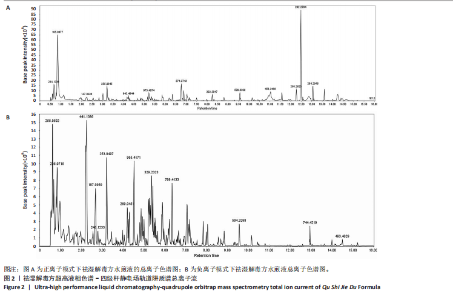
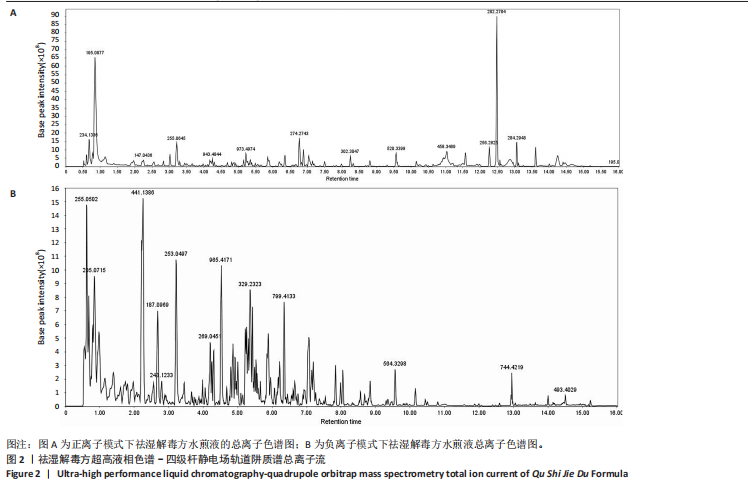
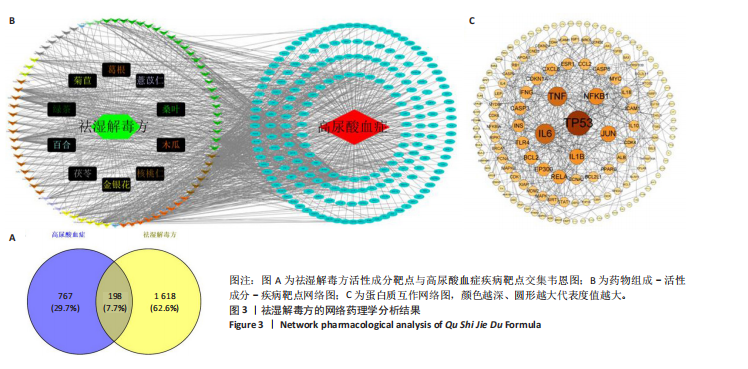
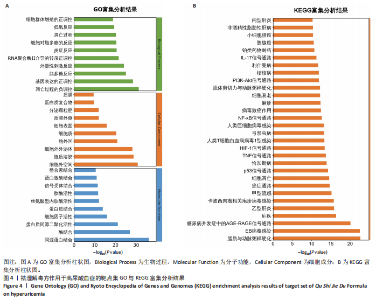
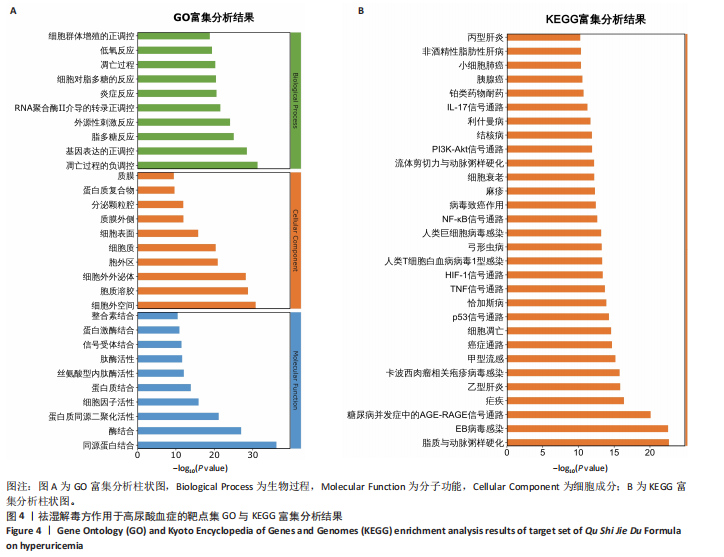
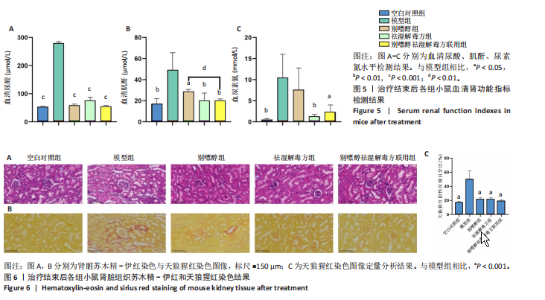
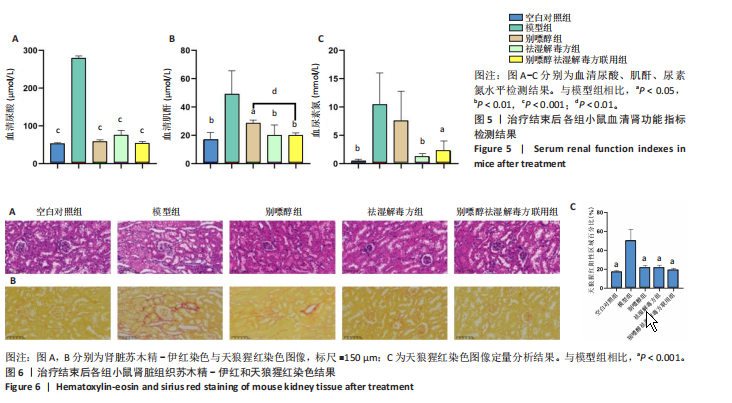
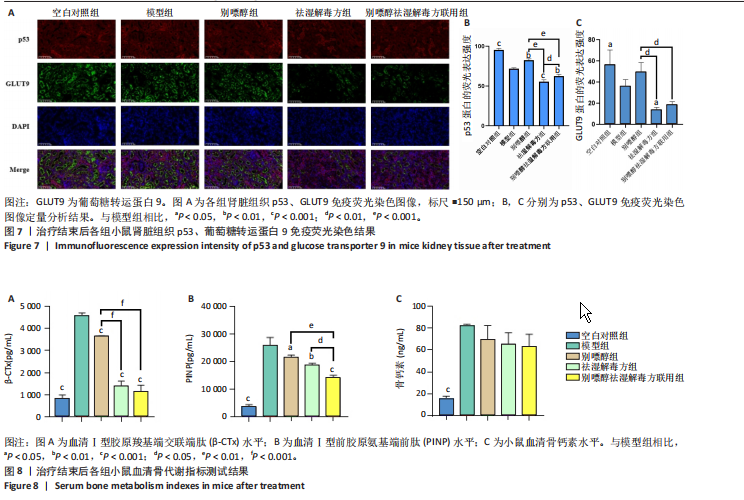
2.1 基于UHPLC-QE-MS技术对祛湿解毒方的化学成分表征结果 采用UHPLC-QE-MS技术对中药复方进行了正、负离子全扫描,获得正、负离子模式下的总离子色谱图,见图2。根据质核比、保留时间及峰面积,结合化合物质谱图,与数据库信息对比,最终鉴定得到75个化学成分,正离子模式下获得50种化学成分,负离子模式下获得25种化学成分;其中,化学成分分类中Flavonoids(黄酮类)有18种,Phenylpropanoids(苯丙素类)有17种,Organic acids and derivatives(有机酸及其衍生物)有13种,Phenols(酚类)有8种,Aromaticity(芳香族化合物)有7种,Alkaloid(生物碱)有4种,Terpenoids(萜类)有3种,Aliphatic acyl(脂肪酰类)有2种,Quinones(醌类)有2种,其他类型各1种。 2.2 祛湿解毒方对高尿酸血症的作用网络构建与分析结果 2.2.1 “活性成分-靶点”筛查 对75种化学成分在TCMSP数据库和Herb数据库查询得出主要的化学成分靶点,去除重复项后共得到1 816个成分靶点。经过4个疾病数据库搜集去重后,得到高尿酸血症疾病靶点965个,化学成分靶点和疾病靶点的交集198个,韦恩图绘制结果见图3A。 2.2.2 “活性成分-靶点”网络建立 将198个靶点与疾病、药物、有效分子构建网络,网络图绘制结果见图3B,该网络共有286个节点、1 183条边,相连节点越多度值越大,在整个网络中的调控作用越大,活性成分按照度值从大到小依次为Curcumin(姜黄素)(度值82)、Quercetin(槲皮素)(度值67)、Citric acid(柠檬酸)(53)、Apigenin(芹菜素)(度值47)、Isoflavone base+3O(染料木素)(度值43),Genistein(金雀异黄素)(度值43),推测它们为祛湿解毒方的核心成分。 2.2.3 蛋白质互作网络建立 将198个调控靶点上传至String数据库,绘制蛋白质互作网络图见图3C,并根据度值筛选关键靶点,其中TP53(度值37)、白细胞介素6(度值28)、肿瘤坏死因子(度值27)、JUN(度值21)、白细胞介素1B(度值20),为度值排名前10中的作用靶点,推测为祛湿解毒方治疗高尿酸血症的潜在核心靶点。 2.2.4 生物信息学分析 将核心靶点导入DAVID数据库进行GO和KEGG富集分析,以P < 0.01为条件,共筛选到605个条目,其中生物过程条目372个,主要涉及对外来刺激的反应、炎症反应、凋亡过程、缺氧反应、正调控细胞群增殖等;细胞组成条目45个,主要涉及细胞外空间、胞质、细胞外外泌体、细胞外区域、细胞质等;分子功能条目67个,主要涉及相同蛋白结合、酶绑定、蛋白同二聚化活性、细胞因子活动、蛋白质绑定等。KEGG通路富集分析得到121条通路,主要涉及高糖基化终产物-晚期糖基化终产物受体信号通路、缺氧诱导因子1信号通路、白细胞介素17信号通路等,其中与高尿酸血症疾病相关的通路有丝裂原活化蛋白激酶、核因子kB、磷脂酰肌醇-3-激酶/蛋白激酶B信号通路等[11],与祛湿解毒方治疗高尿酸血症的潜在靶点的相关性明显。GO和KEGG富集分析的前30条通路,见图4。 2.3 动物实验验证结果 2.3.1 实验动物数量分析 40只小鼠全部进入结果分析。 2.3.2 各组小鼠肾功能指标比较 与空白对照组相比,模型组、别嘌醇组、祛湿解毒方组、别嘌醇祛湿解毒方联用组血清尿酸水平升高(P < 0.001),说明高尿酸血症造模成功;与模型组相比,祛湿解毒方组、别嘌醇祛湿解毒方联用组血清尿酸、肌酐、尿素氮水平下降(P < 0.05,P < 0.01,P < 0.001),别嘌醇组血清尿酸、肌酐水平下降(P < 0.05,P < 0.001);别嘌醇祛湿解毒方联用组血清肌酐水平低于别嘌醇组(P < 0.01),见图5。以上结果说明祛湿解毒方能降低肾功能指标,对高尿酸血症小鼠的肾功能具有保护作用。 2.3.3 各组小鼠肾脏组织病理观察结果 如图6所示,与空白对照组相比,模型组小鼠肾脏苏木精-伊红染色可见间质肾小球结构不规则、肾小管与肾间质细胞排列紊乱,并且肾小球、小管细胞出现空泡样变,对应的天狼猩红染色示大量阳性表达,提示有大量胶原纤维沉积;与模型组对比,别嘌醇组、祛湿解毒方组、别嘌醇祛湿解毒方联用组小鼠肾脏苏木精-伊红染色显示肾小球形态较规则、肾小管与肾间质细胞排列较整齐,天狼星红阳性表达区较少。 2.3.4 各组小鼠肾脏组织上皮p53、葡萄糖转运蛋白9免疫荧光染色结果 根据蛋白质互作网络对祛湿解毒方对高尿酸血症潜在调控靶点的分析结果,发现TP53可能是祛湿解毒方治疗高尿酸血症的潜在核心靶点,其对应蛋白p53是一个重要的肿瘤抑制蛋白,而蛋白葡萄糖转运蛋白9是p53的一个直接靶基因。如图7所示,与空白对照组相比,模型组p53和葡萄糖转运蛋白9表达下降(P < 0.001,P < 0.05);与模型组相比,别嘌醇组p53"

"
表达升高(P < 0.01),祛湿解毒方组和别嘌醇祛湿解毒方联用组p53表达下降(P < 0.01,P < 0.001),祛湿解毒方组葡萄糖转运蛋白9表达下降;与别嘌醇组相比,祛湿解毒方组和别嘌醇祛湿解毒方联用组p53、葡萄糖转运蛋白9表达下降(P < 0.05);别嘌醇祛湿解毒方联用组p53表达高于祛湿解毒方组(P < 0.01)。 2.3.5 各组小鼠血清骨代谢指标比较 如图8所示,与空白对照"
"
"
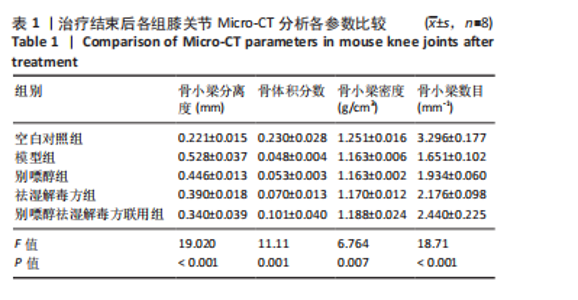
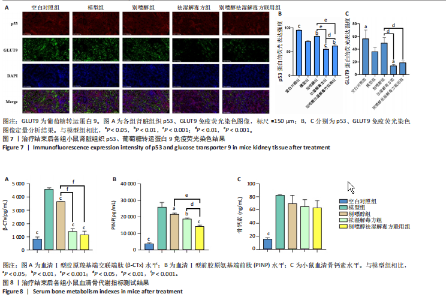
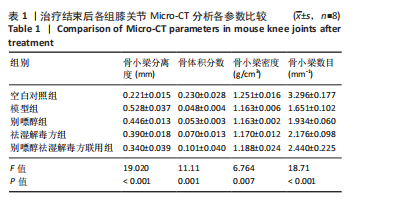
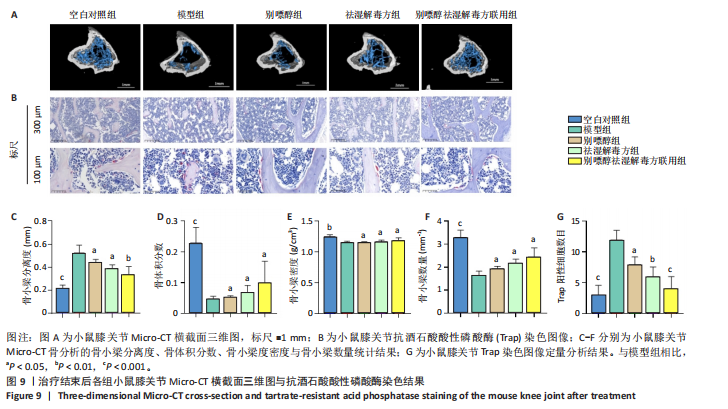
组比较,模型组血清Ⅰ型胶原羧基端交联端肽、Ⅰ型前胶原氨基端前肽、骨钙素水平升高(P < 0.001);与模型组比较,别嘌醇组、祛湿解毒方组和别嘌醇祛湿解毒方联用组血清Ⅰ型胶原羧基端交联端肽、Ⅰ型前胶原氨基端前肽水平降低(P < 0.05,P < 0.01,P < 0.001);祛湿解毒方组和别嘌醇祛湿解毒方联用组Ⅰ型胶原羧基端交联端肽水平低于别嘌醇组(P < 0.001),别嘌醇祛湿解毒方联用组血清Ⅰ型前胶原氨基端前肽水平低于别嘌醇组、祛湿解毒方组(P < 0.05,P < 0.01)。 2.3.6 各组小鼠膝关节Micro-CT骨分析与抗酒石酸酸性磷酸酶染色结果 图9A Micro-CT三维重建图像显示,与空白对照组相比,模型组骨小梁数量明显减少;与模型组相比,别嘌醇组、祛湿解毒方组和别嘌醇祛湿解毒方联用组骨小梁数量较多,祛湿解毒方组与别嘌醇祛湿解毒方联用组显著增多,其中别嘌醇祛湿解毒方联用组骨小梁数量最接近空白对照组。 如图9C-F与表1所示,与空白对照组比较,模型组小鼠的骨小梁分离度升高(P < 0.001),骨体积分数、骨小梁密度、骨小梁数量降低(P < 0.01,P < 0.001);与模型组比较,别嘌醇组、祛湿解毒方组和别嘌醇祛湿解毒方联用组小鼠的骨小梁分离度降低(P < 0.05,P < 0.01),骨体积分数、骨小梁密度、骨小梁数量升高(P < 0.05)。 图9B抗酒石酸酸性磷酸酶染色图像及图9G定量分析显示,模型组抗酒石酸酸性染色阳性表达细胞多于空白对照组(P <"
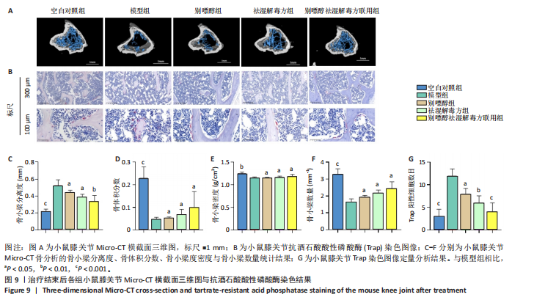
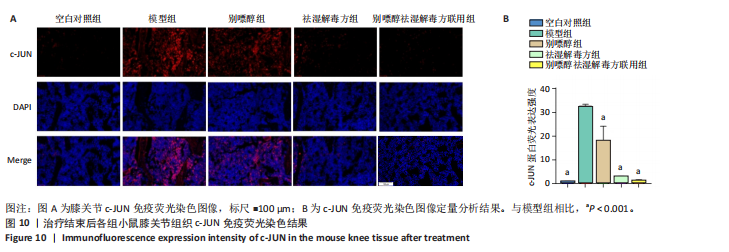
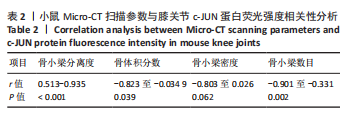
0.001),别嘌醇组、祛湿解毒方组和别嘌醇祛湿解毒方联用组抗酒石酸酸性染色阳性表达细胞少于模型组(P < 0.05,P < 0.01, P < 0.001)。 2.3.7 各组小鼠膝关节c-JUN免疫荧光染色结果 如图10所示,模型组c-JUN表达高于空白对照组(P < 0.001),别嘌醇组、祛湿解毒方组与别嘌醇祛湿解毒方联用组c-JUN表达低于模型组(P < 0.001)。 2.3.8 各组小鼠膝关节Micro-CT各参数与c-JUN蛋白荧光强度相关性分析结果 如表2所示,小鼠膝关节骨小梁分离度与c-JUN蛋白荧光强度呈显著正相关(r > 0,P < 0.05),骨体积分数、骨小梁数目与c-JUN蛋白荧光强度呈显著负相关(r < 0,P < 0.05)。"

"

"
| [1] CRAWLEY WT, JUNGELS CG, STENMARK KR, et al. U-shaped association of uric acid to overall-cause mortality and its impact on clinical management of hyperuricemia. Redox Biol. 2022;51:102271. [2] 王菱,彭艾.中国高尿酸血症及痛风诊疗指南(2019)解读[J].西部医学, 2021,33(9):1254-1257. [3] 何宪顺,田佳庆,何晓铭,等.基于“蓄毒致毒”探讨痛风性关节炎的态靶治毒思路[J].环球中医药,2023,16(10):2006-2010. [4] 郭明阳. 中医“热毒蚀骨”病机浅析[C]//全国第十届中西医结合风湿病学术会议论文集. 2012:336-337. [5] 吕顺一,徐进.尿酸对骨代谢作用机制中西医探究[J].辽宁中医药大学学报, 2023,25(3):84-88. [6] 孙凯,朱立国,魏戌,等.基于UPLC-Q-TOF-MS/MS结合网络药理学的壮腰通络方延缓腰椎间盘退行性病变的化学成分及作用机制研究[J].中国全科医学,2021,24(35):4437-4446. [7] 刘丽,闫秋莹,范晓萱,等.基于LC-MS结合网络药理学探讨参白解毒方抗结直肠腺瘤癌变成分及作用机制[J].南京中医药大学学报,2024,40(8):771-784. [8] 肖倩倩,王晓红,刘晓利,等.基于UHPLC-QE-MS分析结合网络药理学探讨小叶黄杨生物碱治疗阿尔茨海默病的作用机制[J].中国现代应用药学, 2022,39(23):3045-3054. [9] 《中药药理研究方法学》出版[J].中药新药与临床药理,1993(4):8. [10] 赵伟,孙国志.不同种实验动物间用药量换算[J].畜牧兽医科技信息, 2010(5):52-53. [11] SUN X, YANG L, SUN H, et al. TCM and related active compounds in the treatment of gout: the regulation of signaling pathway and urate transporter. Front Pharmacol. 2023;14:1275974. [12] ZHANG T, WANG Y, GU Y, et al. Relationship between seaweeds consumption and hyperuricaemia in general adults: a Population-based study from the Tianjin Chronic Low-grade Systemic Inflammation and Health (TCLSIH) cohort study. Br J Nutr. 2022;127(3):369-376. [13] XU R, LIAN D, XIE Y, et al. Relationship between serum uric acid levels and osteoporosis. Endocr Connect. 2023;12(11):e230040. [14] YANG K, LI J, TAO L. Purine metabolism in the development of osteoporosis. Biomed Pharmacother. 2022;155:113784. [15] 周航,何才剑,房谋昊,等.内毒入骨论骨痿[J].中国中医药科技,2021,28(3): 401-402. [16] 莫嘉敏,颜晓东.尿酸与骨代谢及骨质疏松相关机制研究进展[J].中国临床新医学,2021,14(11):1072-1075. [17] YANG HY, LIU ML, LUO P, et al. Network pharmacology provides a systematic approach to understanding the treatment of ischemic heart diseases with traditional Chinese medicine. Phytomedicine. 2022;104:154268. [18] FENG W, ZHONG XQ, ZHENG XX, et al. Study on the effect and mechanism of quercetin in treating gout arthritis. Int Immunopharmacol. 2022;111:109112. [19] NUTMAKUL T. A review on benefits of quercetin in hyperuricemia and gouty arthritis. Saudi Pharm J. 2022;30(7):918-926. [20] LI N, CHEN S, DENG W, et al. Kaempferol Attenuates Gouty Arthritis by Regulating the Balance of Th17/Treg Cells and Secretion of IL-17. Inflammation. 2023;46(5):1901-1916. [21] CHEN B, LI H, OU G, et al. Curcumin attenuates MSU crystal-induced inflammation by inhibiting the degradation of IkappaBalpha and blocking mitochondrial damage. Arthritis Res Ther. 2019;21(1):193. [22] WU H, WANG Y, HUANG J, et al. Rutin ameliorates gout via reducing XOD activity, inhibiting ROS production and NLRP3 inflammasome activation in quail. Biomed Pharmacother. 2023;158:114175. [23] OLIVIERO F, SCANU A, ZAMUDIO-CUEVAS Y, et al. Anti-inflammatory effects of polyphenols in arthritis. J Sci Food Agric. 2018;98(5):1653-1659. [24] SALEHI B, VENDITTI A, SHARIFI-RAD M, et al. The Therapeutic Potential of Apigenin. Int J Mol Sci. 2019;20(6):1305. [25] YUAN Q, XIE F, HUANG W, et al. The review of alpha-linolenic acid: Sources, metabolism, and pharmacology. Phytother Res. 2022;36(1):164-188. [26] SINGH M, VERMA M, PANDEY S, et al. Anticancer Potential of Quercetin, Epigallocatechin Gallate, Kaempferol, Apigenin, and Curcumin against Several Human Carcinomas. Endocr Metab Immune Disord Drug Targets. 2024. doi: 10.2174/0118715303320523240910072723 [27] 姚芳芳,张锐,傅瑞娟,等.槲皮素和芹菜素对高尿酸血症大鼠血尿酸及抗氧化能力的影响[J].食品科学,2011,32(5):287-290. [28] ZHAO J, LV C, WU Q, et al. Computational systems pharmacology reveals an antiplatelet and neuroprotective mechanism of Deng-Zhan-Xi-Xin injection in the treatment of ischemic stroke. Pharmacol Res. 2019;147:104365. [29] LIU Y, SU Z, TAVANA O, et al. Understanding the complexity of p53 in a new era of tumor suppression. Cancer Cell. 2024;42(6):946-967. [30] ITAHANA Y, HAN R, BARBIER S, et al. The uric acid transporter SLC2A9 is a direct target gene of the tumor suppressor p53 contributing to antioxidant defense. Oncogene. 2015;34(14):1799-1810. [31] SO A, THORENS B. Uric acid transport and disease. J Clin Invest. 2010;120(6): 1791-1799. [32] YANAI H, ADACHI H, HAKOSHIMA M, et al. Molecular Biological and Clinical Understanding of the Pathophysiology and Treatments of Hyperuricemia and Its Association with Metabolic Syndrome, Cardiovascular Diseases and Chronic Kidney Disease. Int J Mol Sci. 2021;22(17):9221. [33] 黄清华,严采馨,林翠婷,等.降尿酸药物对高尿酸血症合并多系统并发症的影响研究进展[J]. 中国医院药学杂志,2022,42(9):957-960. [34] KAWAMATA A, IZU Y, YOKOYAMA H, et al. JunD suppresses bone formation and contributes to low bone mass induced by estrogen depletion. J Cell Biochem. 2008;103(4):1037-1045. [35] JING W, FENG L, PENG K, et al. Formononetin attenuates osteoclast differentiation and calcium loss by mediating transcription factor AP‐1 in type I diabetic mice. J Biochem Mol Toxicol. 2022;36(6):e23042. [36] 韩龙飞,林天烨,何敏聪,等.胫骨平台下低密度区骨量及体积对下肢力线影响的有限元分析[J]. 中国修复重建外科杂志,2024,38(6):734-741. [37] 詹芝玮,韦雨柔,林天烨,等.膝骨关节炎内翻畸形与胫骨平台下低密度影面积的关联[J].中华关节外科杂志(电子版),2023,17(2):209-215. [38] XU F, XU J, XIONG X, et al. Salidroside inhibits MAPK, NF-kappaB, and STAT3 pathways in psoriasis-associated oxidative stress via SIRT1 activation. Redox Rep. 2019;24(1):70-74. [39] LIU Y, HAN Y, LIU Y, et al. Xanthoceras sorbifolium leaves alleviate hyperuricemic nephropathy by inhibiting the PI3K/AKT signaling pathway to regulate uric acid transport. J Ethnopharmacol. 2024;327:117946. [40] TAN EM, LI L, INDRAN IR, et al. TRAF6 Mediates Suppression of Osteoclastogenesis and Prevention of Ovariectomy-Induced Bone Loss by a Novel Prenylflavonoid[. J Bone Miner Res. 2017;32(4):846-860. [41] SUN SC. The non-canonical NF-kappaB pathway in immunity and inflammation. Nat Rev Immunol. 2017;17(9):545-558. |
| [1] | Chen Yulin, He Yingying, Hu Kai, Chen Zhifan, Nie Sha Meng Yanhui, Li Runzhen, Zhang Xiaoduo , Li Yuxi, Tang Yaoping. Effect and mechanism of exosome-like vesicles derived from Trichosanthes kirilowii Maxim. in preventing and treating atherosclerosis [J]. Chinese Journal of Tissue Engineering Research, 2026, 30(7): 1768-1781. |
| [2] | Zhou Sirui, Xu Yukun, Zhao Kewei. Ideas and methods of anti-melanogenesis of Angelica dahurica extracellular vesicles [J]. Chinese Journal of Tissue Engineering Research, 2026, 30(7): 1747-1754. |
| [3] | Peng Zhiwei, Chen Lei, Tong Lei. Luteolin promotes wound healing in diabetic mice: roles and mechanisms [J]. Chinese Journal of Tissue Engineering Research, 2026, 30(6): 1398-1406. |
| [4] | Chen Yixian, Chen Chen, Lu Liheng, Tang Jinpeng, Yu Xiaowei. Triptolide in the treatment of osteoarthritis: network pharmacology analysis and animal model validation [J]. Chinese Journal of Tissue Engineering Research, 2026, 30(4): 805-815. |
| [5] | Wang Houyuan, Xiao Jiacong, Shao Shoujia, He Paian, Yang Nan, Jiang Ziwei. Aucubin promotes osteogenic differentiation of mouse cranial pre-osteoblasts MC3T3-E1 [J]. Chinese Journal of Tissue Engineering Research, 2026, 30(36): 9381-9392. |
| [6] | Xu Pengchao, Xie Lihua, Huang Jingwen, Chen Juan, Chen Xuan, Li Shengqiang, Ge Jirong. Mechanisms of Liuwei Dihuang Pills in a rat model of postmenopausal osteoporosis [J]. Chinese Journal of Tissue Engineering Research, 2026, 30(36): 9402-9412. |
| [7] | Wang Yuhe, Xie Tianyu, Ma Shijia, Wang Yujiao, Li Mengting, Xie Daojun. Regulatory effects of Yuping Shen’an Granules on neuronal autophagy in a mouse model of insomnia [J]. Chinese Journal of Tissue Engineering Research, 2026, 30(35): 9217-9230. |
| [8] | Zhao Canbin, Zeng Ping, Shi Weiqi, Liu Jinfu, Ding Qiang, Guo Liang, Wang Weiwei, Tao Hongcheng, Guo Yafeng, Qin Ying. Mechanism by which luteolin regulates macrophage polarization in the treatment of knee osteoarthritis [J]. Chinese Journal of Tissue Engineering Research, 2026, 30(34): 8868-8877. |
| [9] | Jing Kun, Wang Yulu, Liang Hao, Huo Yuhang, Cong Longxu, . Mechanisms by which mangiferin alleviates pain in osteoarthritis: integration of microarray data analysis, network pharmacology, and experimental validation in a rat model [J]. Chinese Journal of Tissue Engineering Research, 2026, 30(34): 8953- 8961. |
| [10] | Yuan Jingjing, Zhang Xiaomin, Du Pengyang, Wang Weifeng. Mazdutide improves cognitive function in APP/PS1/Tau triple transgenic mice [J]. Chinese Journal of Tissue Engineering Research, 2026, 30(34): 8962-8969. |
| [11] | Lu Chuan, Yang Jiale, Li Youliang, Li Chao. Anethole promotes osteogenic differentiation of human bone marrow mesenchymal stem cells [J]. Chinese Journal of Tissue Engineering Research, 2026, 30(31): 8041-8046. |
| [12] | Qi Yuxin, Dang Yifan, Dai Liming, Zhang Xiaoling. Function and molecular mechanism of physcion in regulating bone homeostasis [J]. Chinese Journal of Tissue Engineering Research, 2026, 30(28): 7237-7244. |
| [13] | Deng Qian, Peng Zining, Meng Fanyu, Huang Yuanbo, Liu Nian, Yan Weitian, Li Zhaofu, Peng Jiangyun. Molecular mechanisms of Toddalia asiatica against rheumatoid arthritis: bioinformatics and molecular dynamics simulation [J]. Chinese Journal of Tissue Engineering Research, 2026, 30(28): 7267-7279. |
| [14] | Chen Chaoqi, Liu Fei, Song Chao, Shen Baoxin, Huang Wutao, Chen Feng, Yang Lei. Yanggan Roujin Decoction delays intervertebral disc degeneration: network pharmacological analysis and experimental validation in rat models [J]. Chinese Journal of Tissue Engineering Research, 2026, 30(25): 6533-6543. |
| [15] | He Wenyang, Chen Weijian, Ran Qingzhi, Huang Yidie, Lin Xiaodong, Xu Xuemeng, Guo Meirong, Liu Wengang. Action mechanisms of Bushen Qiangjin capsule in regulating inflammatory signaling pathways and improving knee osteoarthritis [J]. Chinese Journal of Tissue Engineering Research, 2026, 30(25): 6632-6642. |
| Viewed | ||||||
|
Full text |
|
|||||
|
Abstract |
|
|||||