Chinese Journal of Tissue Engineering Research ›› 2026, Vol. 30 ›› Issue (28): 7355-7363.doi: 10.12307/2026.807
Previous Articles Next Articles
Single hyperbaric oxygen for exercise-induced fatigue: an evaluation using conventional monitoring indicators
Xiang Yang1, Hu Jiangping2, Liu Qi1, Fu Beilun1, Li Miao1, Zhu Huan1, Qian Youling1, Wang Kangfeng2
- 1School of Sports, Hubei Minzu University, Enshi Tujia and Miao Autonomous Prefecture 445000, Hubei Province, China; 2School of Sports, Guangxi Minzu Normal University, Chongzuo 532200, Guangxi Zhuang Autonomous Region, China
-
Received:2025-09-25Revised:2025-12-05Online:2026-10-08Published:2026-02-12 -
Contact:Zhu Huan, PhD, Associate professor, School of Sports, Hubei Minzu University, Enshi Tujia and Miao Autonomous Prefecture 445000, Hubei Province, China -
About author:Xiang Yang, MS candidate, School of Sports, Hubei Minzu University, Enshi Tujia and Miao Autonomous Prefecture 445000, Hubei Province, China -
Supported by:2025 Doctoral Research Start-up Fund of Hubei Minzu University, No. BS25052 (to QYL); 2023 Hubei Provincial Department of Education Key Science and Technology Research Project, No. D20231903 (to ZH); 2024 University-Level Scientific Research Innovation Team Project of Guangxi Minzu Normal University, No. KYTD202404 (to HJP)

CLC Number:
Cite this article
Xiang Yang, Hu Jiangping, Liu Qi, Fu Beilun, Li Miao, Zhu Huan, Qian Youling, Wang Kangfeng. Single hyperbaric oxygen for exercise-induced fatigue: an evaluation using conventional monitoring indicators[J]. Chinese Journal of Tissue Engineering Research, 2026, 30(28): 7355-7363.
share this article
Add to citation manager EndNote|Reference Manager|ProCite|BibTeX|RefWorks
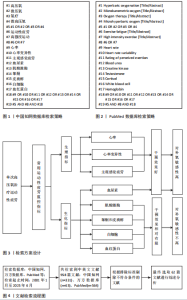
2.1 目前运动训练监控运动性疲劳常用的生理生化指标 当前,运动训练中心率、心率变异性相关指标、主观感觉疲劳等指标是监控运动性疲劳的常用生理指标,尤其是心率变异性相关指标在运动训练中有着广泛的应用[14-17]。对"
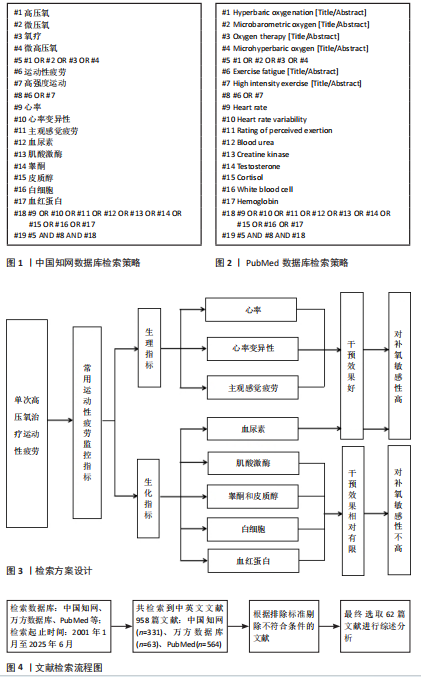
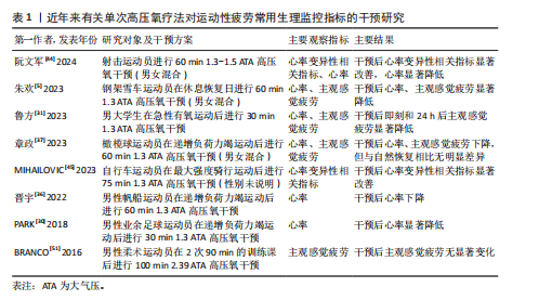
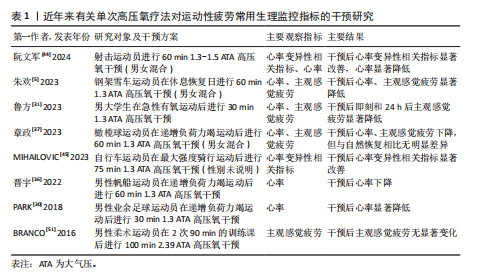
于血液生化监控指标,血尿素、肌酸激酶、睾酮、皮质醇、白细胞、血红蛋白等是常用指标,也是重点监控指标[18-19]。如在备战近2届冬奥会期间,血尿素、肌酸激酶、血红蛋白、睾酮、皮质醇、白细胞等是多支国家队监控运动员身体机能和疲劳状态的主要指标,能较好反映出运动员身体机能状态[6,20-22]。虽然免疫球蛋白与炎症指标、氧化应激与抗氧化等生化指标也能用于运动性疲劳监控,但由于测试过程繁琐,一般无法在运动队自主完成测试,因此不能满足运动训练需求。该类指标一般在特殊训练环境或者特殊阶段进行监测,用于辅助运动员身体机能状态的诊断和监控。另外,近年来也有研究提出将唾液、汗液等无创指标应用于运动员疲劳监控[23-24],但这些指标的准确性和科学性不足,尚不能作为监控运动员的有效指标。在运动训练实践中,“测试简单、测试耗时短、准确性高以及运动员依从性好”是对监控指标的基本要求,心率、心率变异性相关指标、主观感觉疲劳及血尿素、肌酸激酶、血红蛋白、睾酮、皮质醇、白细胞等监控指标符合这些特点,因此成为监控运动性疲劳的常用指标,这些指标从不同角度反映运动员的疲劳状态和特点,在国内运动训练领域有着广泛应用。 2.2 单次高压氧疗法对运动性疲劳常用生理监控指标的干预效果 目前,运动训练中使用的高压氧疗法主要有医用高压氧疗法和微高压氧疗法2种模式,其中医用高压氧的压力≥2 ATA,而微高压氧是近年来针对运动训练的实际需求而产生的一种新型高压氧疗法,压力主要介于1.3-1.5 ATA之间,并以1.3 ATA为主。 2.2.1 单次高压氧疗法对心率的干预效果 (1)单次医用高压氧疗法对心率的干预效果:心率是监控运动性疲劳的常用指标,具有简单、无创等优点,在运动训练领域有着广泛的应用。当机体处于疲劳状态,交感神经持续兴奋会诱导基础心率加快。有研究指出,当运动员清晨基础心率连续多天升高5-10次(较平时正常心率),说明机体有疲劳发生[5]。单次医用高压氧干预能促进高强度运动后心率的心率恢复,降低心率。毕学翠等[11]的研究指出,60 min 2.5 ATA高压氧干预能提高大学生3次30 s最大功率骑行后心率的恢复速度,有效降低心率。徐敏[25]得出相同结论,60 min高压氧干预能促进高强度运动后体育专业大学生心率、血乳酸、血氧饱和度的恢复,其效果优于传统的自然恢复手段,但血红蛋白、血清睾酮、血清皮质醇、血清睾酮/血清皮质醇等生化指标无明显变化,其原因可能与心率对高氧的敏感性较高有关,而生化指标的敏感性相对较弱,所以未能在干预后观察到显著变化。另外,即使吸入常压高浓度氧也能促进高强度后心率恢复。邢文娟等[26]研究发现,40 min常压高浓度氧(氧浓度> 90%,4 L/min)干预能促进大学生力竭运动后心率的恢复。以上研究均揭示,运动性疲劳状态下心率对氧气有着较高的敏感性,高压氧能加速心率的恢复,这对于改善心脏功能有着重要作用。 (2)单次微高压氧疗法对心率的干预效果:当压力减小到1.3 ATA时,单次高压氧干预也能促进运动疲劳状态下心率恢复。1.3 ATA高压氧疗法指在人置于1.3 ATA的环境下吸入高浓度的氧气,其舱内氧浓度一般不超过39%[27-29]。PARK等[30]以足球运动员为干预对象,得出30 min 1.3 ATA高压氧疗法能促进次最大强度运动后心率恢复,消除外周疲劳。另外,鲁方等[31]研究发现30 min 1.3 ATA高压氧恢复还能显著促进急性有氧运动后心率的恢复,但与常压高浓度氧(60%)和常压常氧相比无显著差异。由于在鲁方的研究中,受试者进行的是有氧运动,运动后机体疲劳程度较轻,运动后心率上升幅度有限,即使进行30 min常规恢复心率也能恢复到正常水平,所以高压氧干预组未表现出更佳的干预效果。 TAKEMURA[32]将干预时间延长到45 min,发现1.3 ATA高压氧干预能轻度降低受试者心率,并提高外周血氧饱和度;进一步将干预时间延长到60 min,发现1.3 ATA高压氧干预能显著降低大强度运动后心率、疲劳-惰性、紧张-焦虑和总情绪障碍状态分值,改善高强度运动引起的早期情绪受损状态[33]。提示1.3 ATA高压氧对心率的干预效果可能具有时间-剂量效应关系,干预时间延长(45→60 min),干预效果越好。但有研究指出,当干预时间超过30 min,1.3 ATA高压氧疗法并不能进一步促进心率恢复。李清正[34]探讨了不同时间的1.3 ATA高压氧疗法对疲劳状态下运动员心率的干预效果,20 min以上的1.3 ATA高压氧干预能有效促进举重运动员训练后心率的恢复,且在30 min时心率的恢复速度最快,但随着干预时间延长心率不再进一步下降。相比于其他指标,运动后心率恢复速度较快,即使常规的自然恢复也能在短时间使心率恢复正常,高压氧能加快心率恢复速度,且30 min内使心率恢复正常水平。但在TAKEMURA[32-33]的研究中,随着干预时间的延长高压氧体现出更好的干预效果,这可能与受试者疲劳程度有关。当运动训练造成运动员疲劳程度或神经功能障碍较深时,需要高剂量的高压氧干预,此时随着干预时间的延长,干预效果更明显。以上研究提示,运动性疲劳状态下1.3 ATA高压氧疗法对心率的干预效果与疲劳程度有关,当疲劳程度不深时仅需20-30 min的时间剂量,但当疲劳程度较深时需要进一步延长干预时间。 此外,60 min 1.3 ATA高压氧干预还能显著降低非急性疲劳状态下射箭运动员静息心率[35]。作者的相关研究也得出相似结论,非训练休息日非急性疲劳状态下60 min 1.3 ATA高压氧干预能降低国内钢架雪车运动员心率,且第2天清晨两组运动员心率持续下降,说明高压氧的干预效应在第2天清晨仍可能持续存在[5]。 另外,急性疲劳状态下的相关研究也得出相同结论。晋宇[36]以帆船运动员为干预对象,发现60 min 1.3 ATA高压氧恢复干预能促进运动员力竭运动后(多级负荷测试)心率的恢复,而常规恢复组经过相同时间的自然恢复后心率仍高于运动前,表明运动员仍处于疲劳状态。该研究提示,当运动造成机体疲劳程度较深时,即使将自然恢复时间延长到60 min仍不能有效消除疲劳,需通过高压氧等恢复措施予以强化干预。虽然上述研究中的研究对象和运动员疲劳状态(急性疲劳和非急性疲劳)不同,但单次高压氧干预均显示出良好的干预效果,这进一步说明了高压氧在促进心率恢复中的积极作用。 但有研究得出不一致的结论。章政[37]以橄榄球运动员为研究对象,发现与自然恢复相比,60 min 1.3 ATA高压氧恢复干预不能显著加快力竭运动后(功率自行车递增负荷运动)心率的恢复。作者认为,导致不同学者研究结果的差异可能与运动员训练前心率水平和干预时机等因素有关。当干预时机为运动后即刻时,运动员心率较高,此时高压氧能显著降低心率。但当高压氧干预前非运动后即刻时(高压氧干预前运动员已经经过一定时间的自然恢复),运动员的心率已得到一定程度恢复,此时心率的基数偏低,高压氧虽能进一步降低心率,但不能显示出统计学差异。提示由于运动后心率的恢复速率较快,为了明确高压氧的干预效果,应在运动后即刻进行高压氧干预,否则干预效果难以有效体现。 高压氧干预影响心率变化的机制与刺激主动脉和颈动脉体内的化学感受器反射性引起迷走神经兴奋、直接作用于迷走神经、刺激主动脉弓和颈动脉窦的压力感受器反射性引起迷走神经兴奋以及降低窦房结细胞的自律性等有关。正常情况下,心脏的跳动受交感神经和副交感神经(迷走神经)的调控,高压氧干预会减弱交感神经功能和提高副交感神经功能,使心脏跳动活动减弱,降低心率。此外,高压氧干预后心率下降可能还与甲状腺激素水平的变化有关。大强度运动会促进甲状腺激素等释放,提高机体的能量代谢水平,保证运动中的产能,这也是运动后心率升高的重要原因。有研究指出,高压氧干预能增强脑细胞过氧化能力,抑制甲状腺激素过度释放,降低基础能量代谢水平[38]。能量代谢水平与心率存在密切关系,一定范围内能量代谢水平越高心率越高;反之,心率降低。因此,高压氧干预后运动员心率降低与能量代谢水平的变化也有密切相关。但需要指出的是,该研究的干预对象是甲亢患者,研究结果是否适用于疲劳状态的运动员群体尚需深入研究。 2.2.2 单次高压氧疗法对心率变异性相关指标的干预效果 心率变异性相关指标是监控运动员训练适应情况和疲劳状态的无创指标,是反映运动员机体发生疲劳损伤和神经系统功能的早期信号,常用于中枢神经疲劳和心脏功能的诊断[16-17]。用于监控运动性疲劳常用的心率变异性指标主要有全部心搏RR间隔的标准差,反映心率变异性的总体水平;连续正常RR间期之差的均方根值反映副交感神经的调节能力;总功率反映心率变异性总功率;低频功率反映交感神经的调节能力;高频功率反映迷走神经的调节能力[39]。当机体处于疲劳状态时,交感神经持续兴奋,副交感神经和迷走神经活性被抑制,对自主神经系统的调节下降,会诱导自主神经系统失衡,进而导致低频功率升高,全部心搏RR间隔的标准差、连续正常RR间期之差的均方根、心率变异性总功率、高频功率降低。通过对相关文献梳理,目前尚未发现有关医用高压氧疗法对心率变异性相关指标干预效果的研究报道,相关研究主要观察微高压氧对心率变异性相关指标的影响。 单次1.3 ATA高压氧干预能调节中枢神经系统功能,改善心率变异性相关指标。李清正[34]的研究指出,持续30 min 1.3 ATA高压氧恢复干预能显著降低精英举重运动员交感神经活跃度,提高副交感神经活跃度,该研究主要使用无线版的OmegaWave竞技状态综合诊断系统监测运动员心率变异性和神经系统功能的变化。OmegaWave可以反馈自主神经系统与中枢神经系统状态,是监控运动员训练适应情况和疲劳状态的无创指标,能够在早期发现运动员机体疲劳状态[40]。但李清正[34]的研究仅观察了干预后运动员心率变异性和神经系统整体功能的变化,未通过进一步测量心率变异性相关指标深度分析心率变异性的变化特点,这是研究设计上存在的缺陷不足。谢元攀[41]将干预时间延长到60 min,得出60 min 1.3 ATA高压氧疗法能降低女子拳击运动员低频功率水平,升高心搏RR间隔的标准差、连续正常RR间期之差的均方根以及心率变异性总功率水平,提升睡眠质量及促进疲劳消除,这与马海林等[42]的研究结果一致。马海林等[42]的研究指出,高压氧干预可以有效调节机体自主神经系统功能,降低睡眠转换次数和觉醒次数,提高睡眠效率,改善睡眠状况与抑郁焦虑症状。睡眠是监控运动员疲劳的重要指标,当运动员处于疲劳状态时,可能会使睡眠质量明显下降,而睡眠质量下降有可能进一步加重运动性疲劳的程度从而形成恶性循环,因此改善睡眠质量对促进疲劳消除以及提升训练质量有着重要作用。心率变异性相关指标与睡眠之间有密切的关系。有研究指出,总睡眠时间、睡眠中最低血氧饱和度等睡眠质量监测指标与全部心搏RR间隔的标准差、连续正常RR间期之差的均方根、低频功率、高频功率等心率变异性相关指标均呈正相关[43]。提示为了更加精准地评估高压氧对运动员心率变异性相关指标的干预效果,建议在心率变异性相关指标的基础上进一步监测运动员的睡眠质量,进而综合评估干预效果。 另外,阮文军[44]以中枢疲劳的射击运动员为研究对象,也得出60 min(1.3-1.5) ATA高压氧干预能显著提高运动员全部心搏RR间隔的标准差、连续正常RR间期之差的均方根、高频功率水平,增强自主神经系统调节能力和增强副交感神经系统活性。该研究中高压氧疗法的压力介于1.3-1.5 ATA,高于上述学者所使用的1.3 ATA。但随着氧压的增大,微高压氧疗法对神经系统功能的干预效果是否具有正向的“压力-剂量效应”关系尚不明确,缺乏相关研究证据。因此,后续研究可在微高压氧的范围内,探讨微高压氧对神经系统功能的压力-剂量效应。朱欢[5]的相关研究也得出,非训练日60 min 1.3 ATA高压氧干预能显著改善钢架雪车运动员心率变异性,表现为中枢神经系统功能得分和综合准备状态得分均明显升高,心脏功能得分出现升高趋势,表明60 min1.3 ATA高压氧干预能促进运动员中枢神经系统和心脏功能的恢复。但该研究仅通过运动员中枢神经系统功能得分和综合准备状态得分评价心率变异性的变化,未对心率变异性的具体指标进行测试,这是此次研究存在的不足之处。还有学者对1.3 ATA高压氧疗法与心率变异性相关指标的“时间剂量-效应”关系进行研究,得出20-60 min 1.3 ATA高压氧恢复干预均能改善射击射箭运动员交感神经和张力水平,并且具有正向的时间剂量-效应关系[35]。提示随着高压氧干预时间的延长(20→60 min),高压氧能对心率变异性相关指标产生更好的干预效果。但当干预时间超过60 min时这种关系是否仍然存在尚不明确。有研究指出,当干预时间延长到75 min,1.3 ATA高压氧也能提高大强度运动后的疲劳状态下连续正常RR间期之差的均方根水平,改善心脏副交感神经功能[45]。以普通健康受试者为干预对象的研究也得出类似结论,70 min 1.4 ATA高压氧干预通过增加氧气输送、红细胞中血红蛋白结合的氧气和血浆中溶解氧含量来调节副交感神经活动,增加外周组织毛细血管的血流量以及增加自然杀伤免疫细胞计数[46-47]。 目前,有关1.3 ATA高压氧疗法在运动训练中的应用时间以单次60 min为主,该时间剂量被证明能有效促进疲劳消除,但干预时间超过60 min的相关研究较少,其原因与高压氧疗法潜在的不良反应有关。由于运动员的疲劳状态属于生理性变化,其身体缺氧和功能障碍程度与临床患者之间有较大差异。当干预时间超过60 min时,是否会因氧中毒造成更大程度神经功能障碍尚不明确。但根据MIHAILOVIC等[45]的研究结果,75 min 1.3 ATA高压氧仍能有效提高机体连续正常RR间期之差的均方根水平,表明该时间剂量仍是安全干预剂量。提示对于中枢疲劳的运动员,1.3 ATA高压氧疗法可延长到75 min,以获得更好的干预效果。但目前有关大强度运动后常规医用高压氧对心率变异性相关指标的单次干预研究尚未发现,该疗法是否也能显著改善心率变异性相关指标尚不明确;同时医用高压氧对心率变异性相关指标的干预是否存在“压力剂量-效应”关系也缺乏研究证据。基于测试简单、无创及准确性高等优点,心率变异性相关指标已广泛用于运动性疲劳的监控和疲劳消除效果的评价,并显示出良好的应用前景。因此,为了进一步推进心率变异性相关指标在运动训练中的应用,后续应重点围绕高压氧对心率变异性相关指标的“时间剂量-效应、压力剂量-效应”关系等深入研究。 高压氧疗法改善心率变异性的机制主要与抑制氧化应激以及影响相关神经递质的释放有关。由于缺氧,高强度运动会提高机体氧化应激水平,并可能进一步诱发炎症反应,导致神经组织中脂质过氧化和蛋白质氧化,造成神经细胞损伤,降低神经系统的调控功能,导致心率变异性下降。有研究指出,尿液中8-羟基脱氧鸟苷(DNA氧化损伤的重要产物)与全部心搏RR间隔的标准差呈负向关联[48]。多项研究揭示,高压氧疗法能通过补氧抑制高强度运动后机体产生的氧化应激反应,避免氧化应激对细胞的损伤[2,4,37]。因此,高压氧疗法可能通过抑制氧化应激、炎症反应等提高对神经细胞的保护作用,并经过相应的路径调节心率变异性的变化。另外,调节神经递质γ-氨基丁酸的代谢可能也是高压氧影响心率变异性的重要机制。γ-氨基丁酸是一种抑制性神经递质,对自主神经系统进行调控,其功能下降会导致自主神经系统的平衡性下降,从而表现为心率变异性降低。高强度运动过程中,机体因缺氧导致γ-氨基丁酸氧化受阻,造成γ-氨基丁酸积累,引起突触后抑制,造成中枢神经功能障碍,诱发疲劳产生[49]。高压氧疗法通过补充高浓度氧,有效改善了细胞缺氧状态,促进γ-氨基丁酸氧化,解除突触后抑制,消除中枢神经疲劳,提高心率变异性。 2.2.3 单次高压氧疗法对主观感觉疲劳的干预效果 (1)单次医用高压氧疗法对主观感觉疲劳的干预效果:主观感觉疲劳是评价运动员疲劳发生的常用方式,能够反映出运动员自身感受到的疲劳程度,在疲劳评价中主观感觉疲劳和血尿素、肌酸激酶、睾酮、皮质醇等血液生化指标具有较好的相关性[16]。伴随着运动性疲劳的发生,机体主观感觉疲劳程度会加深,量表得分会增加。单次医用高压氧对主观感觉疲劳有较好的干预效果。毕学翠等[11]的研究表明,60 min 2.5 ATA高压氧恢复能促进体育专业女大学生3次30 s全力骑行的高强度间歇训练后身体疲劳的消除,降低主观感觉疲劳得分。此外,一项纳入8项研究(共157人,运动方式均为力竭性运动)的综述指出,单次高压氧干预(2.0-3.0 ATA,稳压45-89 min)能显著降低受试者主观感觉疲劳得分[1]。综合以上研究,认为60-120 min的医用高压氧干预能降低大强度运动后主观感觉疲劳得分,但其作用路径(如是否存在心理慰藉作用)需深入研究。 (2)单次微高压氧疗法对主观感觉疲劳的干预效果:单次1.3 ATA高压氧干预也能降低大强度运动后主观感觉疲劳水平。研究指出,急性有氧运动后30 min 1.3 ATA高压氧恢复能显著降低主观感觉疲劳水平[31]。另有研究得出,60 min 1.3 ATA高压氧疗法能降低大强度运动后疲劳-惰性、紧张-焦虑和总情绪障碍状态分值,促进主观疲劳感觉恢复[33]。此外,60 min1.3 ATA高压氧恢复干预也能显著降低力竭运动后(功率自行车递增负荷运动)橄榄球运动员主观感觉疲劳水平,减轻主观疲劳程度[37]。朱欢[5]的相关研究也得出,非训练日60 min1.3 ATA高压氧干预能显著降低国家钢架雪车运动员主观感觉疲劳,并在次日清晨进一步下降,表明单次60 min 1.3 ATA高压氧干预能减轻运动员主观疲劳程度。MIHAILOVIC等[45]将干预时间延长到75 min得出相似结论,该研究指出,75 min 1.3 ATA高压氧恢复能降低自行车运动员最大强度骑行后的主观感觉疲劳,并持续改善第2天的感知恢复。综上,对于1.3 ATA高压氧疗法,30-75 min的干预均能有效降低大强度运动后机体主观感觉疲劳水平,但干预效果是否存在时间-剂量关系尚不明确,建议后续研究深入探讨高压氧疗法对主观感觉疲劳干预效果,明确时间剂量范围。 但也有学者认为高压氧干预对大强度运动后主观感觉疲劳的干预无显著效果。WHITE等[50]的研究得出,大强度训练后高氧恢复对机体主观感觉疲劳无明显影响,仅有降低主观感觉疲劳的趋势。BRANCO等[51]得出类似的研究结论,120 min 2.39 ATA高压氧干预未能降低柔术运动员大强度训练后的主观感觉疲劳得分。另外,ZINNER等[52]研究得出高氧恢复干预均不能显著改善常氧和低氧环境下大强度运动后机体主观感觉疲劳水平。不同研究结果的差异与主观感觉疲劳测量结果准确性、机体疲劳程度等有关。针对这一问题,可使用课次主观疲劳感觉代替主观感觉疲劳。有研究指出使用课次主观疲劳感觉评价运动员运动后的主观疲劳感觉,课次主观疲劳感觉在主观感觉疲劳基础上结合了时间因素,因此其评价结果更加精准,建议固定运动后5-30 min内的某个时间采集运动员的主观疲劳度[53]。另外,不同疲劳量表可能也会对测量结果产生不同影响,建议采用同一量表对运动员进行测试。因此,为了精准评估高压氧疗法对主观感觉疲劳的干预效果,应严格控制测试条件和人员。 高压氧疗法降低主观疲劳感觉的作用机制可能与减轻身体生理疲劳、改善心理状态及心理慰藉作用等有关。在缺氧、机械牵拉、乳酸积累等因素作用下,肌肉在大强度运动后会产生明显的僵硬、酸痛感等,这些不适感觉会造成机体产生主观疲劳感觉;同时大脑因缺氧造成脑细胞氧化应激损伤,产生中枢疲劳,进一步加重主观疲劳感觉。高压氧干预后,机体缺氧刺激得到缓解,这些生理疲劳变化得到缓解,进而减轻主观疲劳感觉。另外,经过高压氧后运动员心理状态的变化也对降低主观疲劳感觉起到重要作用。马涛等[7]的研究指出,提高训练成就感、自信心、改善情绪与体力变化等是高压氧疗法降低国家平行大回转运动员主观疲劳感觉水平的重要原因。此外,高压氧疗法可能还具有潜在的心理慰藉作用,这也有助于减轻主观疲劳感觉。 近年来有关单次高压氧疗法对运动性疲劳常用生理监控指标的干预研究总结见表1。 综上所述,单次高压氧疗法对心率、心率变异性相关指标、主观感觉疲劳等运动性疲劳生理监控指标有着较好的干预效果,表明运动性疲劳状态下机体生理监控指标对氧气的敏感性更高。"
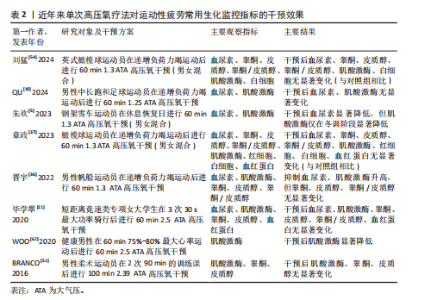
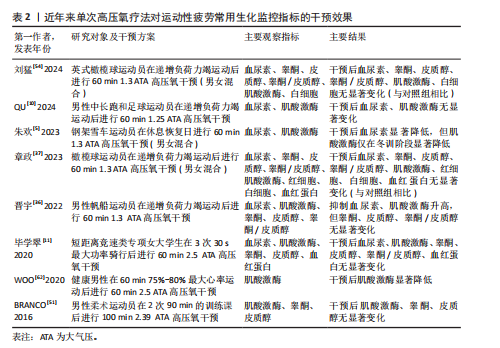
2.3 单次高压氧疗法对运动性疲劳常用生化监控指标的干预效果 2.3.1 单次高压氧疗法对血尿素和肌酸激酶的干预效果 (1)单次医用高压氧疗法对血尿素和肌酸激酶的干预效果:血尿素和肌酸激酶是监控运动性疲劳常用的血液指标,其中血尿素是监控运动量的敏感指标,肌酸激酶是监控运动强度和骨骼肌损伤的敏感指标,两者结合能较好地评价机体对运动负荷反应和适应情况。当机体处于运动性疲劳状态下,蛋白质分解加强导致血尿素含量升高,同时由于骨骼肌细胞膜通透性增加,肌酸激酶由细胞进入血液,导致血液中肌酸激酶活性升高。单次剂量的高压氧干预能加快血液中血尿素、肌酸激酶的清除能力,降低血尿素、肌酸激酶水平。徐敏[25]的研究得出,45 min 2.5 ATA高压氧休息能显著提高大学生大强度运动后(3次30 s骑行)血液尿素、肌酸激酶的恢复速度,受试者运动后即刻和第2天清晨血尿素、肌酸激酶均低于自然恢复组。但左朝等[12]研究得出,60 min 2.5 ATA高压氧恢复对体育学院大学生大强度运动后次日清晨血尿素、肌酸激酶的恢复无显著影响,该研究认为高压氧恢复与传统恢复方式之间无明显区别。此外,还有研究发现60 min 2.2 ATA高压氧干预对男性足球运动员大强度运动后肌酸激酶等无显著影响[13]。不同研究结果间的差异可能与疲劳诱发方案、指标采集时间等因素有关。当运动方案不能造成运动员血尿素、肌酸激酶含量显著升高时,高压氧恢复不能显著降低二者水平。此外,在左朝等[12]的研究中,血尿素、肌酸激酶的测试时间为次日晨起,由于运动后血尿素、肌酸激酶的上升幅度较小,常规的恢复休息也能将二者水平在次日降低到正常值。由于自然恢复已经到血尿素、肌酸激酶水平恢复到正常值,即便对受试者施加高压氧干预,血尿素、肌酸激酶也不能进一步下降。 (2)单次微高压氧疗法对血尿素和肌酸激酶的干预效果:单次1.3 ATA高压氧疗法也能促进运动性疲劳状态下血液血尿素、肌酸激酶的清除。研究指出,60 min 1.3 ATA高压氧恢复干预能加快帆船运动员力竭运动后(多级负荷测试)血尿素、肌酸激酶的清除能力,降低血尿素和肌酸激酶水平[36]。QU等[10]得出相似结论,60 min 1.25 ATA高压氧干预能促进男性中长跑和足球运动员在递增负荷力竭运动后血尿素、肌酸激酶的恢复。但该研究也指出,单次高压氧的干预效果不如重复多次(6次)的干预效果。另外,60 min 1.3 ATA高压氧恢复干预还能降低橄榄球运动员力竭运动后(功率自行车递增负荷运动)血液中的血尿素、肌酸激酶含量,但高压氧联合虾青素的干预效果更好[37]。另一学者的研究得出相同结论,该研究以英式橄榄球运动为研究对象,发现60 min 1.3 ATA高压氧恢复干预和高压氧联合虾青素干预均能促进力竭运动后血液中血尿素、肌酸激酶等指标的恢复,且相比单纯的高压氧干预,联合干预具有更佳的运动疲劳消除效果[54]。作者认为,其原因可能是虾青素作为一种较强的天然抗氧化剂,能进一步加强大强度运动后自由基的清除能力,减轻骨骼肌的氧化应激损伤。以上研究提示,当运动训练造成运动员血尿素、肌酸激酶上升幅度较大时,单次高压氧疗法的干预效果不如重复多次干预模式和联合干预模式(抗氧化剂)。 此外,作者的相关研究也得出单次1.3 ATA高压氧恢复干预能促进运动员疲劳消除[5]。在国家钢架雪车运动员非训练休息日,60 min 1.3 ATA高压氧干预能降低运动员血尿素水平,并在第2天清晨持续下降,但干预后和第2天清晨干预组和对照组的血尿素均未有显著差异,说明单次60 min 1.3 ATA高压氧仅能在一定程度上促进血尿素清除,可能需要反复多次或者更高剂量的高压氧干预才有显著的干预效果[5]。但不同训练阶段(夏训和冬训)1.3 ATA高压氧疗法对运动员肌酸激酶干预效果存在差异,夏训阶段经过60 min 1.3 ATA高压氧干预后运动员肌酸激酶出现下降,但第2天清晨出现回升并高于干预前水平;冬训阶段干预后运动员肌酸激酶水平明显下降,且第2天清晨肌酸激酶水平持续下降,其原因可能与不同训练阶段运动员的训练负荷特点有关[5]。夏训阶段运动员训练强度较大(主要以专项体能训练为主),次日运动员开始出现肌肉延迟性酸痛,高压氧疗法不能完全抑制肌肉延迟性酸痛的发生,因此次日肌酸激酶开始回升;冬训阶段运动员训练强度相对较小(主要以赛道滑行训练为主),运动员未在第2天清晨出现肌肉延迟性酸痛,所以第2天清晨肌酸激酶水平持续下降,说明冬训阶段60 min 1.3 ATA高压氧疗法能有效促进运动员血液肌酸激酶的清除,加速骨骼肌细胞功能的恢复。提示,当运动员出现肌肉延迟性酸痛时,高压氧对血液中肌酸激酶的干预效果可能有限。NAVID等[55]的研究结论支持这一观点,高压氧对肌肉延迟性酸痛后的肌酸激酶值无显著影响。提示虽然单次高压氧疗法能抑制骨骼肌细胞产生肌酸激酶,但当运动负荷过大造成运动员产生严重的肌肉延迟酸痛时,高压氧的干预效果可能不显著,因此大强度运动后的疲劳状态下,高压氧干预对肌酸激酶的影响与运动强度和运动量、肌肉损伤程度、损伤类型等因素有关。 虽然以上均得出单次60 min 1.3 ATA高压氧能提高运动员血尿素和肌酸激酶的清除能力,但高压氧的应用时机上不同,这可能也是导致朱欢[5]与其他2位学者干预效果存在一定差异的关键原因。在章政[37]、晋宇[36]的研究中,高压氧干预后运动员血尿素和肌酸激酶显著下降,而在朱欢[5]的研究中虽然干预组运动员血尿素水平有所下降,但与对照组相比无显著差异,这可能与运动员的疲劳状态有关。在章政[37]、晋宇[36]的研究中,高压氧干预时机是大强度运动后的急性疲劳期,此时运动员缺氧程度较深,缺氧是导致运动性疲劳的关键原因,因此高压氧干预表现出显著的干预效应。但在朱欢[5]的研究中,高压氧的干预时机是周日上午非训练日,干预前运动员并未进行大强度运动训练,此时机体处于非急性疲劳状态,缺氧程度相对较浅,缺氧并不是导致运动员疲劳的关键原因,因此高压氧干预效果相对有限。针对不同学者的研究结果,建议在训练实践中分别制定急性疲劳期和非急性疲劳期高压氧疗法的单次干预方案,以全面清除运动员的疲劳状态,其中急性疲劳期干预方案主要用于及时消除运动后即刻的身体疲劳,避免造成疲劳积累;非急性疲劳期干预方案主要用于急性干预方案尚未清除的身体疲劳,从而彻底清除训练日造成的疲劳痕迹。 高压氧对运动性疲劳状态下血尿素的影响机制主要与抑制蛋白质功能、增强肾脏过滤能力等有关。血尿素的升高主要与体内蛋白质过度供能有关。伴随着蛋白质大量供能,蛋白质的分解产物(氮元素)大量产生,并在血液中积累,造成血尿素水平升高。高压氧干预能增强细胞的供氧能力,增强线粒体氧化代谢能力,提高糖和脂肪的供能能力,减少蛋白质供能比例。此外,高压氧干预还能通过促进血液循环增加尿的产量,减少肾小球对尿素氮的重吸收,提高尿素在尿液中的含量,减少尿素在血液中的堆积。由于高压氧对肌酸激酶的干预效果尚存在争议,因此高压氧的作用机制还需进一步研究证实。当细胞因缺氧导致细胞损伤(如氧化应激)使肌酸激酶外流到血液中,高压氧疗法能通过抑制氧化应激和提高抗氧化能力修复细胞膜的功能以及细胞膜的通透性抑制肌酸激酶外流。但对于其他原因(如机械牵拉)导致的细胞损伤时,高压氧对肌酸激酶的作用效果不明显。 2.3.2 单次高压氧疗法对睾酮和皮质醇的干预效果 (1)单次医用高压氧疗法对睾酮和皮质醇的干预效果:睾酮能促进运动员蛋白质的合成,提高肌肉功能,皮质醇的功能则相反。当机体处于运动性疲劳状态下,睾酮水平出现下降,皮质醇水平则升高,表明此时分解代谢加强,合成代谢减弱,因此运动训练中常用二者的比值监控运动员身体机能状态和运动性疲劳的发生[56]。研究揭示,高压氧干预不能有效促进大强度运动后血清睾酮、皮质醇的恢复。毕学翠等[11]的研究发现,60 min 2.5 ATA高压氧休息不能显著促进短时间大强度运动后(3 次30 s全力骑行)血清睾酮、皮质醇及睾酮/皮质醇的恢复。左朝等[12]得出相似结论,60 min2.5 ATA高压氧恢复对体育学院大学生大强度力竭运动后睾酮、 皮质醇均无显著影响。另外,BRANCO等[51]将干预时间延长到120 min,同样得出2.39 ATA高压氧干预对柔术运动员大强度训练(柔术专项训练)后睾酮、皮质醇水平均无显著影响。以上研究均提示,单次医用高压氧干预不能促进大强度运动后机体睾酮、皮质醇的恢复。 (2)单次微高压氧疗法对睾酮和皮质醇的干预效果:有关1.3 ATA高压氧疗法的干预研究也得出相似结论。晋宇[36]的研究得出,60 min 1.3 ATA高压氧恢复干预对帆船运动员力竭运动后(多级负荷测试)睾酮、皮质醇水平无明显影响。另外,60 min 1.3 ATA高压氧恢复干预也不能促进男性橄榄球运动员力竭运动后(功率自行车递增负荷运动)睾酮和睾酮/皮质醇、女性睾酮/皮质醇恢复,且干预组显著低于对照组[37]。以上研究同样提示,单次1.3 ATA高压氧疗法对睾酮、皮质醇的干预效果有限,不能有效促进大强度运动后机体睾酮、皮质醇的恢复。结合单次医用高压氧的干预结果,认为压力不是导致单次高压氧疗法对睾酮、皮质醇干预效果不明显的关键因素,干预的时间剂量可能才是关键因素,可能需要多次干预才能有显著效果。 人体中调控睾酮分泌最高级的中枢为下丘脑,由于干预剂量较少,单次高压氧疗法未能对下丘脑产生足够的刺激,所以未能促进睾酮分泌,需要更高的干预剂量可能才具有显著的干预效应。有研究表明,持续4周[5,37]、6周和8周1.3 ATA高压氧疗法能促进运动性疲劳状态下运动员睾酮生成[6-7],提示训练中当运动员睾酮含量明显下降,单次剂量高压氧干预效果难以体现,需采用周期性多次高压氧疗法进行恢复干预。另外,人体睾酮含量具有性别的差异,同等剂量的高压氧干预可能对不同性别运动员睾酮的干预效果具有差异,因此在高压氧干预中需考虑性别因素进行针对性评价。此外,皮质醇分泌受昼夜节律和血液采集时间等因素影响,因此在制定高压氧干预方案时需考虑时间因素,以精准评价高压氧的干预效果。 2.3.3 单次高压氧疗法对白细胞和血红蛋白的干预效果 (1)单次医用高压氧疗法对白细胞和血红蛋白的干预效果:机体免疫功能是监控运动员疲劳发生的重要指标,当机体处于疲劳状态时,远动员机体会出现运动性免疫抑制,其中白细胞是常用指标,并表现为数量下降。通过对相关文献梳理,目前尚未发现有关单次医用高压氧疗法对大强度运动后机体白细胞干预效果的研究。但在临床医学领域,多项研究限制医用高压氧能提高相关疾病患者免疫系统功能,提高白细胞的含量或改善相应细胞因子水平,消除炎症反应[57-59]。由此可见,医用高压氧疗法对白细胞及相关细胞因子水平具有潜在的干预效果,但运动性疲劳状态下这一结论是否成立尚需研究证据证实。建议后续研究围绕这一问题开展研究,为医用高压氧在运动训练中的应用提供新的研究证据支撑。 血红蛋白是评价机体营养状况、有氧能力和恢复的重要指标。当血红蛋白含量过低时,会直接影响体内物质代谢和能量代谢,并造成有氧能力下降,因此血红蛋白可从有氧能力角度监控运动性疲劳的发生[9]。高强度运动后造成的疲劳状态会促进红细胞溶血,使血红蛋白发生降解,导致血红蛋白浓度下降。目前,有关单次医用高压氧疗法对大强度运动后机体血红蛋白干预效果的研究较少,仅有少量研究成果报道。毕学翠等[11]的研究指出,60 min2.5 ATA高压氧休息不能显著促进短时间大强度运动后(3次30 s全力骑行)血液中血红蛋白恢复,且在次日清晨仍低于干预前值。其原因可能是高压氧解除了缺氧对肾脏的刺激。低氧诱导肾脏分泌促红细胞生成素,然后作用骨髓生成红细胞,是骨髓生成红细胞的重要来源之一,但高压氧疗法解除了大强度训练后低氧对细胞抑制状态,造成肾脏无法生成促红细胞生成素,因此无法促使骨髓生成红细胞。 (2)单次微高压氧疗法对白细胞和血红蛋白的干预效果:有关微高压氧疗法对白细胞的干预效果存在不同的研究结果。章政[37]的研究得出,60 min 1.3 ATA高压氧恢复干预对力竭运动后(功率自行车递增负荷运动)橄榄球运动员白细胞、C-反应蛋白无显著影响。一项以普通健康女性为受试者的同样研究得出,70 min 1.4 ATA高压氧干预对白细胞介素6、白细胞介素12和活性氧代谢物衍生物无明显影响[47]。此外,大强度比赛后吸氧干预(氧浓度≥99%,流量为2.0 L/min )对白细胞也无明显影响(干预后值仍低于干预前)[60]。但有研究指出,高压氧促进人体的免疫抗炎状态,调节免疫细胞及其分泌的免疫调控因子,提高免疫水平,改善免疫微环境,减少组织损伤并减缓感染发展[61]。不同研究结果的差异可能与高压氧的剂量有关。在章政[37]和NISA等[47]的研究中,使用的高压氧压力为1.3 ATA和1.4 ATA,由于高压氧干预剂量较小故未显示明显的干预效果。此外,由于大强度力竭运动对免疫功能抑制程度较深,所以低压力的高压氧干预不能有效促进白细胞恢复。另外,在杨衍滔等[60]的研究中采用的常压吸氧模式,虽然氧气浓度达到99%,但由于氧气的压力偏低,因此氧气进入血液后的溶解量、运输速度、穿透力等明显低于高压氧疗法,导致补氧质量较低,未能引起白细胞的显著变化。提示当大强度训练造成机体免疫机能下降时,可能需要高压力和长时间的高压氧疗法才能显著促进白细胞的恢复。此外,有关微高压氧疗法对大强度运动后机体血红蛋白的干预效果与医用高压氧疗法的干预效应相似。章政[37]的研究指出,60 min 1.3 ATA高压氧恢复干预对力竭运动后(功率自行车递增负荷运动)橄榄球运动员血红蛋白也无显著影响。可见单次微高压氧疗法也不能促进大强度运动后血液中血红蛋白的恢复。 近年来单次高压氧疗法对运动性疲劳常用生化监控指标的干预效果总结见表2。 综上所述,单次高压氧疗法对运动性疲劳状态下血尿素有着较好的干预效果,但对其他生化指标的干预效果相对有限或干预效果尚存在争议,这可能与疲劳类型、疲劳程度、高压氧的剂量不足及生化指标在体内代谢特点等因素有关。另外,不同研究中疲劳诱导方法的差异可能也是导致这一现象产生的重要因素。因此,单次高压氧疗法对运动性疲劳常用生化指标的干预效果还需要更多深入研究。当运动训练造成运动员血液生化监控指标显著变化时,单次高压氧疗法的干预效果可能不足,需要增大高压氧单次干预剂量或采取多次干预模式。"
| [1] 段雪梅,李淑璠,王芃.冷疗与高压氧疗法对运动员疲劳后身体机能恢复的影响[J].中国体育教练员,2023,31(1):64-67. [2] 朱欢,晋宇,田广,等.高压氧在运动科学领域中的应用研究进展[J].中国运动医学杂志, 2022, 41(7):567-575. [3] 瞿超艺,冯亦唯,徐旻霄,等.不同氧疗手段对机体运动能力的影响及相关机理研究进展[J].中国运动医学杂志,2021,40(5):393-401. [4] ZHU H, TIAN G, JIN Y, et al. Effects of a 4-week micro-hyperbaric oxygen intervention on oxidation-antioxidation system function. Rev Bras Med Esporte. 2023;29:1-5. [5] 朱欢.高压氧干预对国家钢架雪车运动员微循环功能的影响及运动性疲劳消除效果研究[D].上海:上海体育学院, 2023. [6] 马涛,高炳宏.高压氧干预对平行大回转运动员冬季高原训练后疲劳消除的效果[J].北京体育大学学报,2023,46(7):13-27. [7] 马涛,高炳宏,庄继涵.高压氧干预对国家单板滑雪平行大回转运动员湿热环境训练后机体疲劳消除效果的研究[C].第十三届全国体育科学大会论文摘要集(一).中国体育科学学会. 2023:45-47. [8] 赵杰修,房国梁,资薇,等.冬季项目的体能训练和训练监控关键技术的研究进展[J].北京体育大学学报,2022,45(1):25-34. [9] 向阳,朱欢,文凡,等.周期性多次高压氧疗法对高强度训练后运动性疲劳干预效果的研究进展及训练应用策略[J].生命科学,2025,37(2): 158-169. [10] QU C, XU M, LORENZO S, et al. Effects of mild hyperbaric oxygen therapy on timing sequence recovery of muscle fatigue in Chinese university male athletes. J Exerc Sci Fit. 2024;22(4): 305-315. [11] 毕学翠,詹建国.软体高压氧舱对高强度间歇运动后恢复效果应用研究[J].科学技术与工程, 2020,20(20):8079-8085. [12] 左朝,张雪萍,杨芳,等.高分子软体高压氧舱对运动后人体生理生化指标的影响[J].粘接, 2022,49(11):122-125. [13] GUSIC M, STANTIC T, LAZIC A, et al. Effects of hyperbaric oxygen therapy on recovery after a football match in young players: a double-blind randomized controlled trial. Front Physiol. 2024;15:1483142-1483151. [14] 向阳,朱欢,胡庆华,等.监控运动性疲劳常用血液生化指标的应用研究进展及研究展望[J].武术研究,2025,10(3):152-156. [15] 王子龙,张秋霞,卢梦雅,等.体脑混合疲劳对橄榄球运动员下肢爆发力、心率变异性的影响研究[J].中国体育科技,2025,61(2):3-13. [16] 秦晗蕾,朱欢,万利,等.常用无创性生理指标在运动性疲劳监控中的应用研究进展及研究展望[J].体育科技文献通报,2024,32(2):98-102+125. [17] 时雪莹,孔兆伟,聂金雷.心率变异性指标连续正常 RR 间期之差的均方根用于耐力训练监控研究进展[J].中国运动医学杂志,2022, 41(10):793-798. [18] 杨颖.运动员运动训练的生理生化监控探讨[J].冰雪体育创新研究,2022(2):149-151. [19] 马涛,高炳宏.通过心率变异性联合儿茶酚胺和常规生化指标监控优秀赛艇运动员身体机能状态[J].体育科学,2021,41(8):61-69+97. [20] 孙志宏,张蓓,张妍,等.不同专项训练对越野滑雪优秀男子运动员身体机能的影响:基于血液生化指标监控[J].宁波大学学报(理工版), 2022,35(3):115-120. [21] 耿瑞峥,吴昊.优秀钢架雪车运动员冬训期间生化指标变化规律及个性化特点分析[C]//中国体育科学学会.第十二届全国体育科学大会论文摘要汇编:墙报交流(运动生理生化分会).首都体育学院,2022:106-108. [22] 赵鉴,甄立军.高龄运动员冬季训练安排与生理生化指标监控的研究[J].冰雪运动,2020, 42(3):37-41. [23] 许毅枭,赵永才,高炳宏.唾液:应用于运动训练领域的潜力生物样本[J].上海体育学院学报,2022,46(10):84-94. [24] 钟达财,徐加泉,罗雪婷,等.运动性疲劳生化监测方法的研究进展[J].东华理工大学学报(社会科学版),2019,38(3):269-274. [25] 徐敏.软体高压氧舱对短距离竞速类专项大学生30秒最大功率骑行后恢复的研究[D].北京: 首都体育学院,2014. [26] 邢文娟,董玲,周嘉恒,等.常压高氧吸入改善代谢组学指标及心率变异性促进运动疲劳的消除[J].北京体育大学学报,2023,46(7):28-41. [27] 瞿超艺,黄鹏,耿雪,等.微压氧疗在运动医学领域中的应用研究进展[J].中国运动医学杂志, 2023,42(11):919-924. [28] 瞿超艺,黄鹏,冯亦唯,等.微压氧疗在疾病辅助治疗及预防中的相关研究进展[J].按摩与康复医学,2023,14(6):70-75. [29] 谢荭,韩扬,王敏,等.微高压氧治疗临床疗效初探[J].中华航海医学与高气压医学杂志, 2020,27(5):597-600. [30] PARK SH, PARK SJ, SHIN MS, et al. The effects of low-pressure hyperbaric oxygen treatment before and after maximal exercise on lactate concentration, heart rate recovery, and antioxidantcapacity.J Exerc Rehabil. 2018;14(6): 980-984. [31] 鲁方,张新,张宇阳.急性有氧运动后微高压氧暴露对心率、主观疲劳感觉和体内自由基代谢的影响[C]//中国体育科学学会.第十三届全国体育科学大会论文摘要集:墙报交流(运动医学分会)(一).2023:3. [32] TAKEMURA A. Exposure to a mild hyperbaric oxygen environment elevates blood pressure. J Phys Ther Sci. 2022;34(5):360-364. [33] TAKEMURA A, EDA N, SAITO T, et al. Mild hyperbaric oxygen for the early improvement of mood disturbance induced by high-intensity exercise.J Sports Med Phys Fitness. 2022;62(2): 250-257. [34] 李清正. 微压氧对精英举重运动员疲劳消除影响的初步研究[A].中国体育科学学会.第十一届全国体育科学大会论文摘要汇编[C].中国体育科学学会:中国体育科学学会,2019:2. [35] 张晓炳,冯本余,窦志勇,等.微压氧对山西省优秀射击射箭运动员疲劳消除影响的研究[J].体育师友,2022,45(3):27-30+39. [36] 晋宇.高压氧干预对上海帆船运动员微循环功能的影响[D].上海: 上海体育学院,2022. [37] 章政.高压氧联合虾青素对橄榄球运动员运动性疲劳消除的效果及潜在机制的研究[D]. 上海:上海体育学院,2023. [38] 尹璐,邵岩,赵满英,等.高压氧对弥漫性甲状腺肿伴甲状腺功能亢进病人甲状腺激素及心率的影响[J].中西医结合心脑血管病杂志, 2022,20(6):1088-1091. [39] 董徽徽,高炳宏.4周下肢间歇负压干预对优秀赛艇运动员心率变异性和儿茶酚胺的影响[J].上海体育学院学报,2020,44(4):78-83. [40] GISSELMAN AS, BAXTER GD, WRIGHT A, et al. Musculoskeletal overuse injuries and heart rate variability: Is there a link? Med Hypotheses. 2016; 87:1-7. [41] 谢元攀.吸氧干预对女子拳击运动员睡眠质量的影响[D].北京:首都体育学院, 2016. [42] 马海林,杨熙玥,苏瑞,等.高压氧干预对高海拔移居者睡眠质量、抑郁状况及HRV的调节效应[J].四川师范大学学报(自然科学版), 2024,47(5):569-575+566. [43] 钱霞玲,郑金龙,田伟.首发未用药抑郁障碍者睡眠质量与心率变异的相关分析[J].国际精神病学杂志,2025,52(1):117-120. [44] 阮文军.微压氧舱恢复对中枢疲劳射击运动员自主神经系统的影响[J].体育科技文献通报, 2024,32(7):41-45+58. [45] MIHAILOVIC T, BOUZIGON R, BOUILLOD A, et al. Post-exercise hyperbaric oxygenation improves recovery for subsequent performance. Res Q Exerc Sport. 2023;94(2):427-434. [46] NISA BU, HIRABAYASHI T, MAESHIGE N, et al. Beneficial effects of mild hyperbaric oxygen exposure on microcirculation in peripheral tissues in healthy subjects: a pilot study. J Sports Med Phys Fitness. 2022;62(12):1600-1604. [47] NISA BU, NAKANISHI R, TANAKA M, et al. Mild hyperbaric oxygen exposure enhances peripheral circulatory natural killer cells in healthy young women. Life (Basel). 2023;13(2):408-420. [48] 张梓骞.邻苯二甲酸酯暴露、尿氧化应激标志物与成人心率变异性的固定群组研究[D].武汉:华中科技大学,2024. [49] 顾坤.γ-氨基丁酸与运动疲劳的相关性研究[J].食品安全质量检测学报,2021,12(8):3153-3158. [50] WHITE J, DAWSON B, LANDERS G, et al. Effect of supplemental oxygen on post-exercise inflammatory response and oxidative stresss. Eur J Appl Physiol. 2013;113(4):1059-1067. [51] BRANCO BH, FUKUDA DH, ANDREATO LV, et al. The Effects of hyperbaric oxygen therapy on post-training recovery in Jiu-Jitsu athletes. PLoS One. 2016;11(3):e0150517-e0150527. [52] ZINNER C, HAUSER A, BORN DP, et al. Influence of hypoxic interval training and hyperoxic recovery on muscle activation and oxygenation in connection with double-poling exercise. PLoS One. 2015;10(10):e0140616-e0140627. [53] 顾正秋,黎涌明.课次主观疲劳度的信效度及方法学影响因素[J].成都体育学院学报,2024, 50(1):143-151. [54] 刘猛,莫仕围,章政.高压氧联合虾青素干预对英式橄榄球运动员急性运动性疲劳消除效果的研究[J].中国体育科技,2024,60(9):3-13. [55] NAVID M, MICHINARI H, LINDSEY R, et al. Hyperbaric oxygen therapy in sports musculoskeletal injuries. Med Sci Sports Exerc. 2020;52(6):1420-1426. [56] 朱欢.钢架雪车运动员运动性疲劳特征分析及高压氧恢复干预措施研究[J].体育科技文献通报,2022,30(10):14-16+110. [57] 谈松,胡小洪.高压氧治疗在牙槽神经损伤中的应用效果[C]//上海市护理学会.第六届上海国际护理大会论文汇编(下).中国人民武装警察部队重庆市总队医院,2024:133. [58] 牛会忠,王丽亚,董彦清,等.高压氧对急性坏死性筋膜炎患儿血清降钙素原、白细胞和高敏C反应蛋白的影响及其疗效[J].中国生化药物杂志,2015,35(10):32-34. [59] 崔阳.高压氧治疗对癫痫大鼠血清白细胞介素1β、白细胞介素2、白细胞介素8、肿瘤坏死因子α水平及海马神经元Bax及Bcl-2表达的影响[J].解剖学杂志,2021,44(3):204-208. [60] 杨衍滔,莫伟彬,谢伟,等.吸氧对运动员血液生化指标及免疫球蛋白的影响[J].现代预防医学,2016,43(15):2724-2728. [61] 王琨元,高玉玲,宫晓洋,等.高压氧与免疫微环境的研究进展[J].医学研究与战创伤救治, 2024,37(5):526-531. [62] WOO J, MIN JH, LEE YH, et al. Effects of hyperbaric oxygen therapy on inflammation, oxidativea-antioxidant balance, and muscle damage after acute exercise in normobaric, normoxic and hypobaric, hypoxic environments: a pilot study. Int J Environ Res Public Health. 2020;17(20):7377-7386. |
| [1] | Dong Gengxin, Li Yiting, Hong Yinglu, Bao Dapeng. Effect of hydrogen-rich gas on proprioception and muscle endurance after high-intensity exercise [J]. Chinese Journal of Tissue Engineering Research, 2024, 28(34): 5413-5418. |
| Viewed | ||||||
|
Full text |
|
|||||
|
Abstract |
|
|||||