Chinese Journal of Tissue Engineering Research ›› 2026, Vol. 30 ›› Issue (36): 9429-9436.doi: 10.12307/2026.907
Previous Articles Next Articles
Effects of icariin-containing serum active ingredients on inflammatory chondrocytes: a metabolomics analysis
Chen Weinan, Li Yusheng, Li Linzhen, Jiao Hongzhuo, Zhang Mingzhe, Wang Jianlong, Zhang Juntao
- First Teaching Hospital of Tianjin University of Traditional Chinese Medicine, National Clinical Research Center for Chinese Medicine, Tianjin 300380, China
-
Received:2025-10-29Revised:2026-03-12Online:2026-12-28Published:2026-05-21 -
Contact:Zhang Juntao, PhD, Chief physician, First Teaching Hospital of Tianjin University of Traditional Chinese Medicine, National Clinical Research Center for Chinese Medicine, Tianjin 300380, China -
About author:Chen Weinan, MS candidate, First Teaching Hospital of Tianjin University of Traditional Chinese Medicine, National Clinical Research Center for Chinese Medicine, Tianjin 300380, China -
Supported by:the National Natural Science Foundation of China (General Program), Nos. 82575103 and 82074470 (both to ZJT)

CLC Number:
Cite this article
Chen Weinan, Li Yusheng, Li Linzhen, Jiao Hongzhuo, Zhang Mingzhe, Wang Jianlong, Zhang Juntao. Effects of icariin-containing serum active ingredients on inflammatory chondrocytes: a metabolomics analysis[J]. Chinese Journal of Tissue Engineering Research, 2026, 30(36): 9429-9436.
share this article
Add to citation manager EndNote|Reference Manager|ProCite|BibTeX|RefWorks
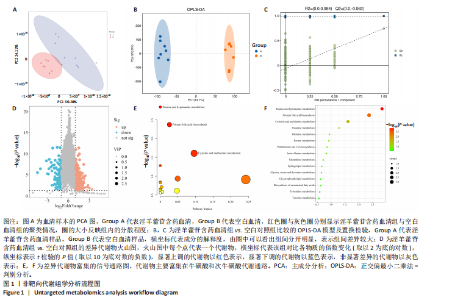
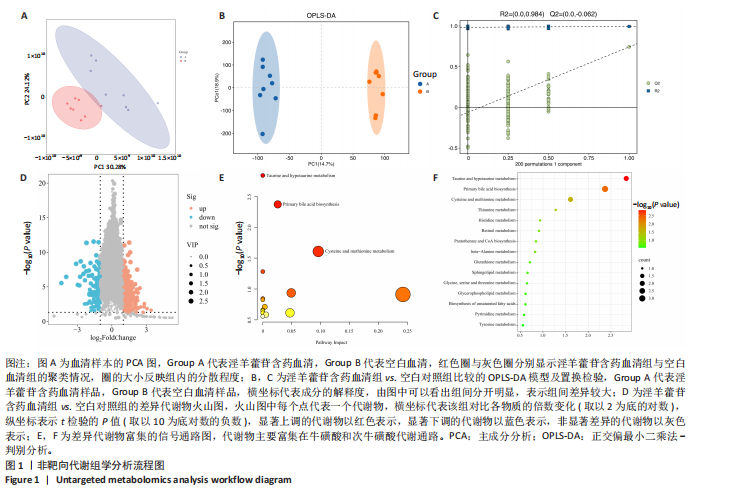
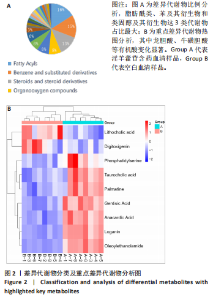
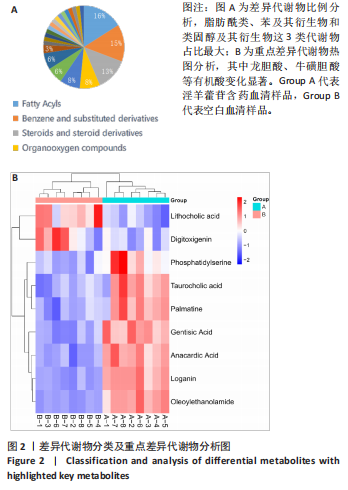
2.1 非靶向代谢组数据分析 主成分分析是通过正交变换,将一组可能相关的观测变量转换为线性不相关变量(即主成分)的统计方法[28-29]。该方法可揭示数据内在结构,从而更清晰地解释变量间关系。血清样本的主成分分析得分散点图如图1A所示。选用正交偏最小二乘法-判别分析(Orthogonalprojections to Latent Structures-Discriminant Analysis,OPLS-DA)的统计方法分析结果[30]。通过正交偏最小二乘法-判别分析,可过滤掉代谢物中与分类变量无关联的正交变量,之后分别对非正交变量和正交变量开展剖析,进而得到更可靠的代谢物组间差异和与淫羊藿苷含药血清相关程度的信息内容[30]。对数据进行UV格式化操作,针对第一主成分做正交偏最小二乘法-判别建模分析,开展200次置换检验,进一步检验模型有效性[30]。各个样本两两比较的正交偏最小二乘法-判别模型得分散点图和200次置换检验结果如图1B,C所示。 鉴于UHPLC-Q/Orbitrap MS代谢组数据的固有特性,采用多元变量统计方法对数据进行分析。以|log2FC| > 1,P < 0.05, VIP > 0.6为标准筛选差异代谢物,共筛选差异代谢物130个,将筛选差异代谢物的结果以火山图的形式进行可视化(图1D),其中脂肪酰类、苯及其衍生物和类固醇及其衍生物这3类代谢物得到了富集(图2A),进一步分析差异代谢物,发现龙胆酸、牛磺胆酸等有机酸变化显著(图2B)。 通过MetaboAnalyst网站进行通路富集分析,通过差异代谢物来筛选相关代谢通路,结果如图1E,F所示。结合淫羊藿苷等黄酮类物质在体内的代谢过程涉及龙胆酸等有机酚酸的转化,选取龙胆酸作为进一步研究的关键组分。 2.2 龙胆酸作用靶点分析 将龙胆酸与氨基树脂交联,然后与软骨细胞裂解液共孵育。通过Pulldown实验[26],根据差异条带分析龙胆酸可能的结合靶点(图3A)。质谱结果显示,龙胆酸与多"
"
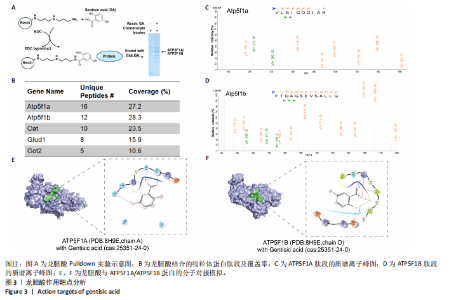
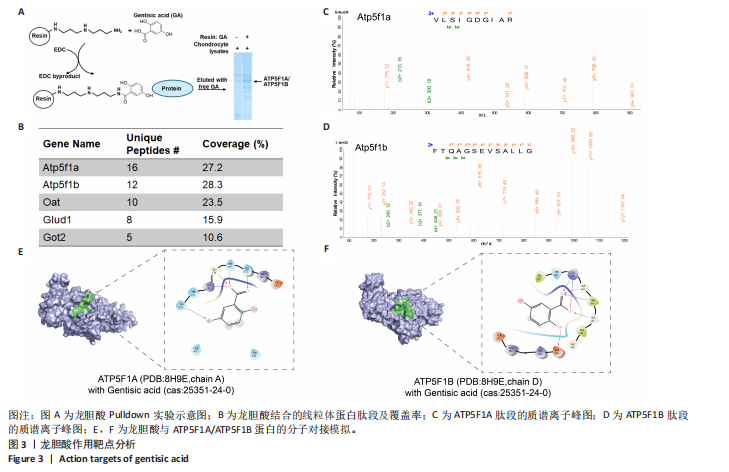
种线粒体蛋白结合(图3B)。质谱检测到多个和能量代谢相关的ATP合成酶ATP5F1A/ATP5F1B蛋白肽段,分别以图3C,D质谱峰图为例。 通过分子对接,发现龙胆酸和ATP5F1A、ATP5F1B的结合能为-27.82,-32.99 kJ/mol,具有较好的结合能力(图3E,F)。综合以上分子互作的靶点解析及初步的药效探讨,为深入研究龙胆酸在淫羊藿苷含药血清促软骨修复过程中的作用机制提供了关键切入点,提示龙胆酸可能通过与ATP5F1A/ATP5F1B 蛋白的相互作用,参与调节软骨细胞的能量代谢过程,进而发挥促软骨修复的作用。 2.3 软骨细胞鉴定结果 第2代小鼠软骨细胞贴壁生长,形态呈多边形或梭形,细胞核居中呈圆形,细胞间紧密连接,呈“铺路石状”排列,甲苯胺蓝染色后,软骨细胞呈现出紫蓝色,细胞质为蓝色,见图4。"
"
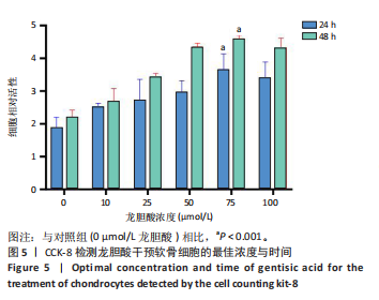
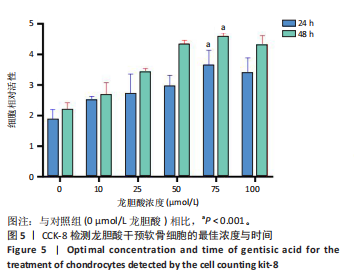
2.4 龙胆酸最佳浓度与干预时间 CCK-8检测结果显示,与对照组相比,当软骨细胞培养基中龙胆酸浓度达到75 μmol/L时,更能促进软骨细胞的增殖;与对照组比较,75 μmol/L龙胆酸干预24 h及48 h的细胞活性均具有统计学差异,都提高软骨细胞活力,其中48 h的细胞活性较24 h更明显。综上表明,当龙胆酸浓度为75 μmol/L且干预48 h时,能够对软骨细胞增殖有更好的促进作用,见图5。另一方面,课题组前期研究表明淫羊藿苷含药血清干预炎症软骨细胞24 h可有效调节能量代谢平衡,非靶向代谢组学提示龙胆酸为淫羊藿苷含药血清的关键代谢产物,并且在前期研究中,关于龙胆酸介导软骨细胞炎症相关分子机制研究中(仍在进行,未发表),发现24 h时75 μmol/L可有效改善软骨细胞炎症损伤修复,该研究结合上述前期研究,针对观察脂多糖诱导炎症软骨细胞模型能量代谢失衡干预效应的实验目的,后续相关实验继续选用了75 μmol/L龙胆酸干预24 h,确保前后研究的一致性。"
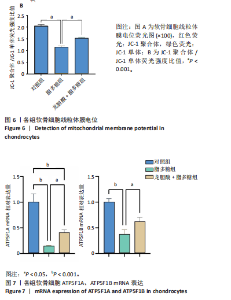
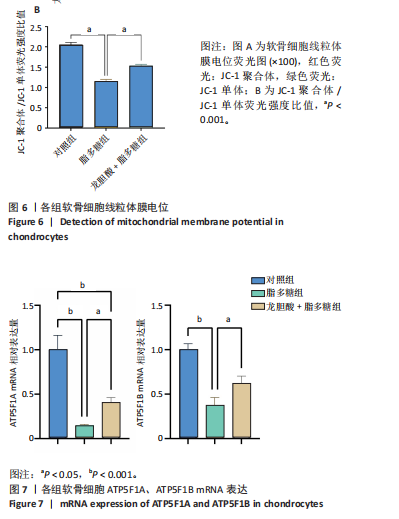
2.5 龙胆酸对炎性软骨细胞线粒体膜电位的影响 线粒体膜电位检测结果显示,与对照组相比,脂多糖组JC-1聚合体/JC-1单体荧光比值显著下降;与脂多糖组相比,龙胆酸+脂多糖组JC-1聚合体/JC-1单体荧光比值显著升高,这表明龙胆酸能显著抑制脂多糖诱导的软骨细胞线粒体膜电位去极化,见图6。 2.6 龙胆酸对炎性软骨细胞中ATP5F1A、ATP5F1B mRNA表达的影响 实时荧光定量PCR结果显示,与对照组相比,脂多糖组软骨细胞中ATP5F1A、ATP5F1B mRNA表达显著降低;与脂多糖组相比,龙胆酸+脂多糖组软骨细胞中ATP5F1A、ATP5F1B mRNA表达显著升高,说明龙胆酸能够显著增加脂多糖干预后软骨细胞的ATP5F1A、ATP5F1B表达量,见图7。"
| [1] DENG Z, CHEN X, LIN Z, et al. The Homeostasis of Cartilage Matrix Remodeling and the Regulation of Volume-Sensitive Ion Channel. Aging Dis. 2022;13(3):787-800. [2] TANG J, LIU T, WEN X, et al. Estrogen-related receptors: novel potential regulators of osteoarthritis pathogenesis. Mol Med. 2021;27(1):5. [3] PRIETO-ALHAMBRA D, JUDGE A, JAVAID MK, et al. Incidence and risk factors for clinically diagnosed knee, hip and hand osteoarthritis: influences of age, gender and osteoarthritis affecting other joints. Ann Rheum Dis. 2014;73(9):1659-1664. [4] GBD 2021 OSTEOARTHRITIS COLLABORATORS. Global, regional, and national burden of osteoarthritis, 1990-2020 and projections to 2050: a systematic analysis for the Global Burden of Disease Study 2021. Lancet Rheumatol. 2023; 5(9):e508-e522. [5] YAU MS, OKORO PC, HAUGEN IK, et al. Assessing the association of epigenetic age acceleration with osteoarthritis in the Multicenter Osteoarthritis Study (MOST). Osteoarthritis Cartilage. 2024;32(5):585-591. [6] ZENG C, WEI J, PERSSON MSM, et al. Relative efficacy and safety of topical non-steroidal anti-inflammatory drugs for osteoarthritis: a systematic review and network meta-analysis of randomised controlled trials and observational studies. Br J Sports Med. 2018;52(10):642-650. [7] SALAMONE FL, MOLONIA MS, MUSCARÀ C, et al. In Vitro Protective Effects of a Standardized Extract of Opuntia ficus-indica (L.) Mill. Cladodes and Olea europaea L. Leaves Against Indomethacin-Induced Intestinal Epithelial Cell Injury. Antioxidants (Basel). 2024;13(12):1507. [8] 张成龙,刘爱峰,张超,等.基于文献计量学的淫羊藿研究现状及热点分析[J].药物评价研究,2021,44(10):2242-2251. [9] BI Z, ZHANG W, YAN X. Anti-inflammatory and immunoregulatory effects of icariin and icaritin. Biomed Pharmacother. 2022;151:113180. [10] MI B, WANG J, LIU Y, et al. Icariin Activates Autophagy via Down-Regulation of the NF-κB Signaling-Mediated Apoptosis in Chondrocytes. Front Pharmacol. 2018;9:605. [11] CHEN Y, PAN X, ZHAO J, et al. Icariin alleviates osteoarthritis through PI3K/Akt/mTOR/ULK1 signaling pathway. Eur J Med Res. 2022;27(1):204. [12] CURTIS A, BESWICK A, JENKINS L, et al. Is there a role for autologous conditioned serum injections in osteoarthritis? A systematic review and meta-analysis of randomised controlled trials. Osteoarthritis Cartilage. 2024;32(10):1197-1206. [13] HAMAHASHI K, TOYODA E, ISHIHARA M, et al. Polydactyly-derived allogeneic chondrocyte cell-sheet transplantation with high tibial osteotomy as regenerative therapy for knee osteoarthritis. NPJ Regen Med. 2022;7(1):71. [14] BAI L, ZHANG X, HAN Z, et al. Injectable porous microspheres for articular cartilage regeneration through in situ stem cell recruitment and macrophage polarization. Acta Biomater. 2024;185:429-440. [15] BASELGA GARCÍA-ESCUDERO J, MIGUEL HERNÁNDEZ TRILLOS P. Treatment of Osteoarthritis of the Knee with a Combination of Autologous Conditioned Serum and Physiotherapy: A Two-Year Observational Study. PLoS One. 2015; 10(12):e0145551. [16] BUCHHEIT T, HUH Y, BREGLIO A, et al. Intrathecal administration of conditioned serum from different species resolves Chemotherapy-Induced neuropathic pain in mice via secretory exosomes. Brain Behav Immun. 2023;111:298-311. [17] ZHANG J, FAN F, ZHANG C, et al. Icariin-conditioned serum combined with chitosan attenuates cartilage injury in rabbit knees with osteochondral defect. J Orthop Surg Res. 2023;18(1):125. [18] ZHANG J, ZHANG D, WU C, et al. Icariin-conditioned serum engineered with hyaluronic acid promote repair of articular cartilage defects in rabbit knees. BMC Complement Altern Med. 2019;19(1):155. [19] 李林臻,焦泓焯,陈伟南,等.淫羊藿苷含药血清对脂多糖诱导人软骨细胞炎症损伤的影响[J].中国组织工程研究,2026,30(6):1368-1374. [20] LIU W, LI X, LI N, et al. UPLC-MS/MS method for Icariin and metabolites in whole blood of C57 mice: development, validation, and pharmacokinetics study. Front Pharmacol. 2023;14:1195525. [21] LV Y, XIE X, SHI H, et al. Differential serum metabolites in patients with pregnancy-associated venous thromboembolism analyzed using GC-MS/LC-MS untargeted metabolomics. Heliyon. 2024;10(20):e38788. [22] MÄKINEN ME, ZACHAROULI M, SÄRNLUND S, et al. Novel Data-Driven Mechanistic Modeling of Untargeted Metabolome Data Reveals Feed Component Effects in CHO Cell Bioprocess Using Column Generation-Based EFMs. Biotechnol J. 2025;20(7):e70008. [23] VILLEGAS-AGUILAR MDC, CÁDIZ GURREA ML, HERRANZ-LÓPEZ M, et al. An untargeted metabolomics approach applied to the study of the bioavailability and metabolism of three different bioactive plant extracts in human blood samples. Food Funct. 2024;15(18):9176-9190. [24] 赵子琪,庞湃,任越,等.2型糖尿病浊毒内蕴证患者血浆代谢组学特征分析[J].北京中医药大学学报,2025,48(1):34-42. [25] 赵亚茹,韩怡,朴婧羽,等.基于UPLC-MS技术探究糖脂代谢病的血清代谢谱特征[J].中国比较医学杂志,2023,33(5):24-35. [26] BONCHUK A, ZOLOTAREV N, BALAGUROV K, et al. Pulldown Assay Coupled with Co-Expression in Bacteria Cells as a Time-Efficient Tool for Testing Challenging Protein-Protein Interactions. J Vis Exp. 2022;(190). doi: 10.3791/64541. [27] 苏子珊,于利凯,田地,等.桂皮醛抑制RhoA/ROCK1/MLC通路改善膝骨关节炎小鼠滑膜巨噬细胞胞葬功能[J].中国药理学通报,2025,41(9):1636-1643. [28] PARK S, CEULEMANS E, VAN DEUN K. A critical assessment of sparse PCA (research): why (one should acknowledge that) weights are not loadings. Behav Res Methods. 2024;56(3):1413-1432. [29] THOMAS JC, SHIN K, XIE XJ. Principal Component Analysis in Dental Research. Int J Oral Maxillofac Implants. 2025;40(1):13-20. [30] 林珠灿,易开,许文,等.超高效液相色谱-四极杆飞行时间质谱法研究菊三七总生物碱致肝毒性的血清代谢组学[J].分析科学学报,2018,34(3):297-302. [31] RICHMOND SA, FUKUCHI RK, EZZAT A, et al. Are joint injury, sport activity, physical activity, obesity, or occupational activities predictors for osteoarthritis? A systematic review. J Orthop Sports Phys Ther. 2013;43(8):515-B19. [32] GUO X, XI L, YU M, et al. Regeneration of articular cartilage defects: Therapeutic strategies and perspectives. J Tissue Eng. 2023;14:20417314231164765. [33] BRODY LT. Knee osteoarthritis: Clinical connections to articular cartilage structure and function. Phys Ther Sport. 2015;16(4):301-316. [34] XU R, DU Y, LI X, et al. Differences between soluble and insoluble undenatured type II collagen in improving osteoarthritis in rats and their potential mechanisms. Food Funct. 2023;14(22):10240-10251. [35] MIYAZAKI T, ITO T, BASEGGIO CONRADO A, et al. Editorial for Special Issue on “Regulation and Effect of Taurine on Metabolism”. Metabolites. 2022;12(9):795. [36] MIYAZAKI T. Identification of a novel enzyme and the regulation of key enzymes in mammalian taurine synthesis. J Pharmacol Sci. 2024;154(1):9-17. [37] MARCINKIEWICZ J, KONTNY E. Taurine and inflammatory diseases. Amino Acids. 2014;46(1):7-20. [38] BIAN Y, WANG H, SUN S. Taurine alleviates endoplasmic reticulum stress in the chondrocytes from patients with osteoarthritis. Redox Rep. 2018;23(1):118-124. [39] HOU W, SHANG X, HAO X, et al. SHP2-mediated ROS activation induces chondrocyte paraptosis in osteoarthritis and is attenuated by low-intensity pulsed ultrasound. J Orthop Translat. 2025;52:233-248. [40] CHEN R, HAN S, LIU X, et al. Perturbations in amino acids and metabolic pathways in osteoarthritis patients determined by targeted metabolomics analysis. J Chromatogr B Analyt Technol Biomed Life Sci. 2018;1085:54-62. [41] PARK SY, KIM KY, GWAK DS, et al. L-Cysteine mitigates ROS-induced apoptosis and neurocognitive deficits by protecting against endoplasmic reticulum stress and mitochondrial dysfunction in mouse neuronal cells. Biomed Pharmacother. 2024;180:117538. [42] LIU X, JIANG S, JIANG T, et al. Bioenergetic-active exosomes for cartilage regeneration and homeostasis maintenance. Sci Adv. 2024;10(42):eadp7872. [43] DIVITA KM, KHATIK GL. Current Perspective of ATP Synthase Inhibitors in the Management of the Tuberculosis. Curr Top Med Chem. 2021;21(18):1623-1643. [44] JONCKHEERE AI, SMEITINK JA, RODENBURG RJ. Mitochondrial ATP synthase: architecture, function and pathology. J Inherit Metab Dis. 2012;35(2):211-225. [45] BOREIKAITE V, WICKY BIM, WATT IN, et al. Extrinsic conditions influence the self-association and structure of IF1, the regulatory protein of mitochondrial ATP synthase. Proc Natl Acad Sci U S A. 2019;116(21):10354-10359. [46] 张云,黄鹰.粟酒裂殖酵母Atp25蛋白定位和功能研究[J].南京师范大学学报(工程技术版),2021,21(4):80-86. [47] XU Y, TAN H, LIU K, et al. Targeted inhibition of ATP5B gene prevents bone erosion in collagen-induced arthritis by inhibiting osteoclastogenesis. Pharmacol Res. 2021;165:105458. [48] JANG S, LEE K, JU JH. Recent Updates of Diagnosis, Pathophysiology, and Treatment on Osteoarthritis of the Knee. Int J Mol Sci. 2021;22(5):2619. [49] 杨青,黄伟,刘清毅,等.高良姜素对膝关节炎大鼠软骨细胞自噬和凋亡的影响[J].中国药房,2025,36(3):312-317. [50] 罗江淼,如斯坦木,阿特尔,等.骨关节炎发病机制及治疗研究进展[J].陕西医学杂志,2024,53(7):1006-1009. [51] KANG J, JIE L, FU H, et al. Adipose Mesenchymal Stem Cells Derived Exosomes Ameliorates KOA Cartilage Damage and Inflammation by Activation of PINK1-Mediated Mitochondrial Autophagy. FASEB J. 2025;39(14):e70811. [52] YANG J, CHEN D, HE Q, et al. Arctiin alleviates knee osteoarthritis by suppressing chondrocyte oxidative stress induced by accumulated iron via AKT/NRF2/HO-1 signaling pathway. Sci Rep. 2024;14(1):31935. |
| [1] | Yu Cenqi, Liu Yang, Yu Jiangfeng, Kang Kang, Deng Yaoge, Xia Xiaowei, Zhang Yijian, Zhu Xuesong. Biomimetic Black Phosphorus Nanosystem Regulates Synovial Macrophage Polarization for Osteoarthritis Treatment [J]. Chinese Journal of Tissue Engineering Research, 2026, 30(在线): 1-13. |
| [2] | Fang Fengchao, Yang Wenwu, Wu Hongtao, Peng Peng, Liang Zhiye, Jiang Tao, Chen Weijian, Liu Wengang, Zhao Chuanxi. Association between mitochondrial dynamics imbalance and cartilage degeneration in osteoarthritis [J]. Chinese Journal of Tissue Engineering Research, 2026, 30(在线): 1-8. |
| [3] | Chen Qiuhan, Yang Long, Yuan Daizhu, Wu Zhanyu, Zou Zihao, Ye Chuan. Peri-knee osteotomy for treatment of knee osteoarthritis: optimization of treatment strategies [J]. Chinese Journal of Tissue Engineering Research, 2026, 30(9): 2303-2312. |
| [4] | Zhang Zizheng, Luo Wang, Liu Changlu. Application value of finite element analysis on unicompartmental knee arthroplasty for medial knee compartmental osteoarthritis [J]. Chinese Journal of Tissue Engineering Research, 2026, 30(9): 2313-2322. |
| [5] | Zhang Nan, Meng Qinghua, Bao Chunyu. Characteristics and clinical application of ankle joint finite element models [J]. Chinese Journal of Tissue Engineering Research, 2026, 30(9): 2343-2349. |
| [6] | Li Qingbin, Lin Jianhui, Huang Wenjie, Wang Mingshuang, Du Jiankai, Lao Yongqiang. Bone cement filling after enlarged curettage of giant cell tumor around the knee joint: a comparison of subchondral bone grafting and non-grafting [J]. Chinese Journal of Tissue Engineering Research, 2026, 30(8): 1896-1902. |
| [7] | Chen Yulin, He Yingying, Hu Kai, Chen Zhifan, Nie Sha Meng Yanhui, Li Runzhen, Zhang Xiaoduo , Li Yuxi, Tang Yaoping. Effect and mechanism of exosome-like vesicles derived from Trichosanthes kirilowii Maxim. in preventing and treating atherosclerosis [J]. Chinese Journal of Tissue Engineering Research, 2026, 30(7): 1768-1781. |
| [8] | Li Linzhen, Jiao Hongzhuo, Chen Weinan, Zhang Mingzhe, Wang Jianlong, Zhang Juntao. Effect of icariin-containing serum on lipopolysaccharide-induced inflammatory damage in human chondrocytes [J]. Chinese Journal of Tissue Engineering Research, 2026, 30(6): 1368-1374. |
| [9] | Chen Ju, Zheng Jinchang, Liang Zhen, Huang Chengshuo, Lin Hao, Zeng Li. Effect and mechanism of beta-caryophyllene in mice with osteoarthritis [J]. Chinese Journal of Tissue Engineering Research, 2026, 30(6): 1341-1347. |
| [10] | Lyu Guoqing, Aizimaitijiang·Rouzi, Xiong Daohai. Irisin inhibits ferroptosis in human articular chondrocytes: roles and mechanisms [J]. Chinese Journal of Tissue Engineering Research, 2026, 30(6): 1359-1367. |
| [11] | Peng Zhiwei, Chen Lei, Tong Lei. Luteolin promotes wound healing in diabetic mice: roles and mechanisms [J]. Chinese Journal of Tissue Engineering Research, 2026, 30(6): 1398-1406. |
| [12] | Li Hao, Tao Hongcheng, Zeng Ping, Liu Jinfu, Ding Qiang, Niu Chicheng, Huang Kai, Kang Hongyu. Mitogen-activated protein kinase signaling pathway regulates the development of osteoarthritis: guiding targeted therapy with traditional Chinese medicine [J]. Chinese Journal of Tissue Engineering Research, 2026, 30(6): 1476-1485. |
| [13] | Bu Yangyang, Ning Xinli, Zhao Chen. Intra-articular injections for the treatment of osteoarthritis of the temporomandibular joint: different drugs with multiple combined treatment options [J]. Chinese Journal of Tissue Engineering Research, 2026, 30(5): 1215-1224. |
| [14] | Zhang Qian, Huang Dongfeng. Weighted gene co-expression network analysis combined with machine learning to screen and validate biomarkers for osteoarthritis [J]. Chinese Journal of Tissue Engineering Research, 2026, 30(5): 1096-1105. |
| [15] | Chen Yixian, Chen Chen, Lu Liheng, Tang Jinpeng, Yu Xiaowei. Triptolide in the treatment of osteoarthritis: network pharmacology analysis and animal model validation [J]. Chinese Journal of Tissue Engineering Research, 2026, 30(4): 805-815. |
| Viewed | ||||||
|
Full text |
|
|||||
|
Abstract |
|
|||||