Chinese Journal of Tissue Engineering Research ›› 2026, Vol. 30 ›› Issue (26): 6701-6709.doi: 10.12307/2026.844
Three-dimensional printed isoniazid liposome photothermal composite scaffolds and their performance evaluation
Yang Guang, Yin Zhitao, Xu Yan
- College of Mechanical Engineering, Xinjiang University, Urumqi 830017, Xinjiang Uygur Autonomous Region, China
-
Accepted:2026-01-08Online:2026-09-18Published:2026-03-10 -
Contact:Xu Yan, MS, Professor, Doctoral supervisor, College of Mechanical Engineering, Xinjiang University, Urumqi 830017, Xinjiang Uygur Autonomous Region, China -
About author:Yang Guang, MS, College of Mechanical Engineering, Xinjiang University, Urumqi 830017, Xinjiang Uygur Autonomous Region, China -
Supported by:National Natural Science Foundation of China, No. 52365053 (to XY)

CLC Number:
Cite this article
Yang Guang, Yin Zhitao, Xu Yan. Three-dimensional printed isoniazid liposome photothermal composite scaffolds and their performance evaluation[J]. Chinese Journal of Tissue Engineering Research, 2026, 30(26): 6701-6709.
share this article
Add to citation manager EndNote|Reference Manager|ProCite|BibTeX|RefWorks
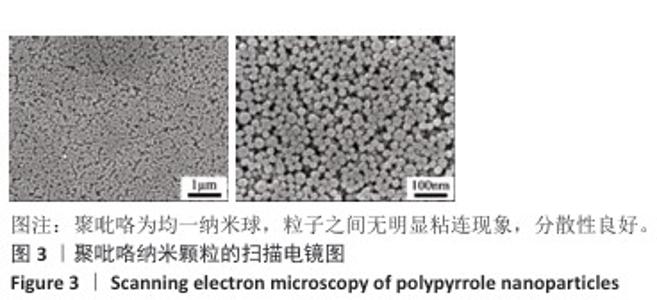
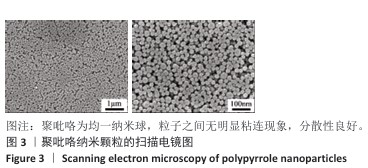
2.1 光热剂聚吡咯性能分析结果 2.1.1 光热剂聚吡咯的微观形貌观察 聚吡咯形貌的扫描电镜图如图3所示,形状为均一纳米球,粒子之间无明显粘连现象,分散性良好。"
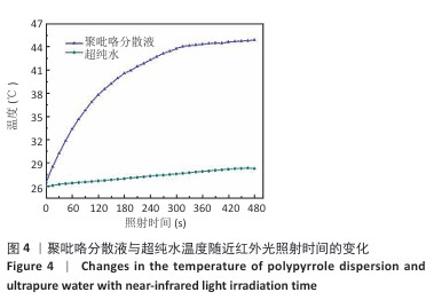
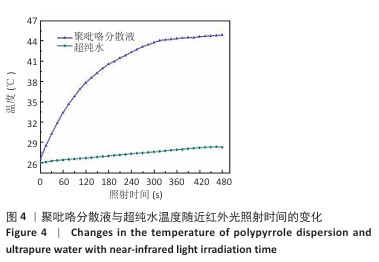
2.1.2 光热剂聚吡咯的光热性能及光稳定性分析 纳米光热剂的光热转换能力和光热稳定性是实现载药脂质体光热控释的重要影响因素。在相同的近红外光照射条件下(0.5 W/cm2、波长808 nm),20 μg/mL聚吡咯分散液与超纯水的升温曲线如图4所示,聚吡咯分散液在近红外光照射8 min后的升温幅度为18.32 ℃,升温速率较快且表现出一定的近红外光吸收性能,作为对照组的超纯水升温幅度为1.55 ℃,表明聚吡咯纳米颗粒具备良好的光热转换能力。"
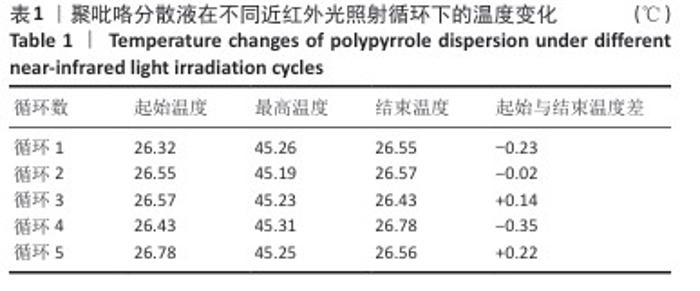
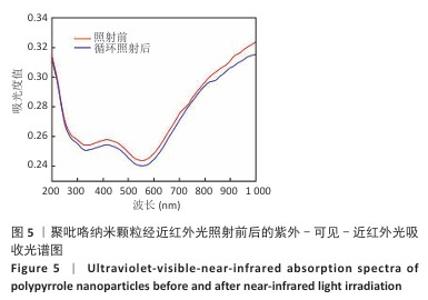
使用近红外激光器对聚吡咯分散液进行5个周期的循环照射,如表1所示,分散液温度在5个循环周期中未出现明显变化,其中第3循环中产生的温度变化最大,可能是由于循环照射期间环境温度的影响导致产生该偏差。 利用紫外光谱仪对照射前后的聚吡咯分散液进行紫外-可见-近红外光吸收光谱扫描,结果如图5所示,经激光照射后的聚吡咯纳米颗粒主要特征峰未发生明显偏移,在波长800-1 000 nm处仍保持对近红外光强而宽的吸收。上述结果表明聚吡咯纳米颗粒具备良好的光稳定性,经激光照射后无光漂白效应,能够作为光热剂用于光热支架的制备。"
"
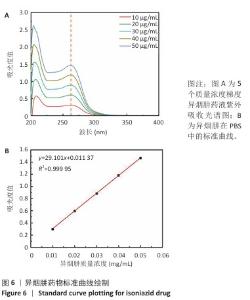
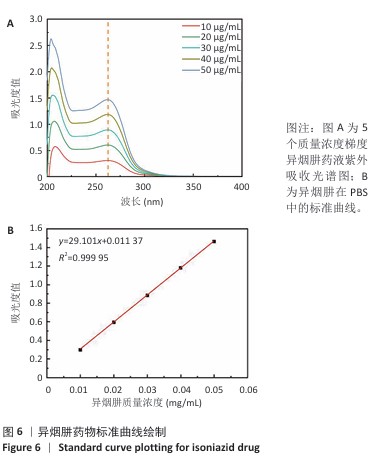
2.2 异烟肼标准曲线绘制 如图6A所示,为5个质量浓度异烟肼标准液在波长200-400 nm处的吸收光谱,取波长为262.5 nm处特征峰的吸收值,拟合出的标准曲线如图6B所示。"
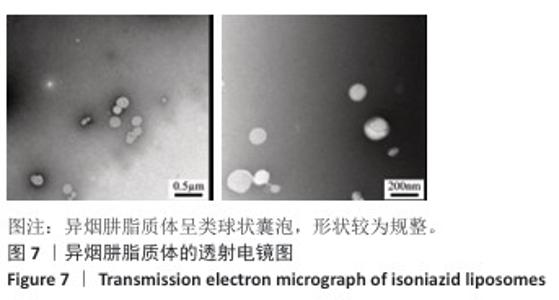
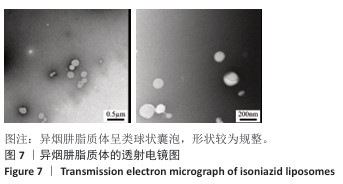
2.3 控释载体异烟肼脂质体性能分析结果 2.3.1 异烟肼脂质体的微观形貌观察 异烟肼脂质体形貌的透射电镜图如图7所示,形态为类球状囊泡,形状较为规整,符合脂质体的结构特征。 2.3.2 异烟肼脂质体的包封率、载药量、粒径和Zeta电位测试结果 异烟肼脂质体的包封率为(28.67±0.62)%、载药量为(3.54±0.19)%,平均粒径为(363.63±10.42) nm,平均Zeta电位为(-4.68±0.72) mV。"
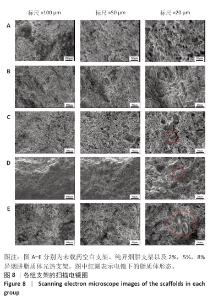
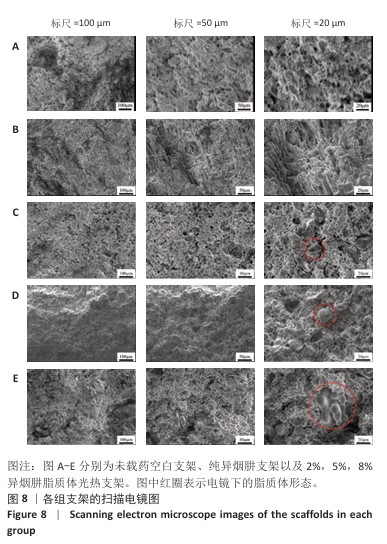
2.4 支架的微观形貌分析结果 4种支架的扫描电镜图如图8所示。异烟肼药物在支架中主要以片状分布,出现粘连团聚现象,造成这种现象的原因可能是异烟肼药物具有较好的亲水性,其通过聚乙烯醇凝胶与支架材料结合较为致密,故以团聚状包埋在复合支架中。相比于纯异烟肼支架,异烟肼脂质体光热支架内部产生较多孔隙,这些孔隙有利于人体内营养物质物质运输及支架中药物的释放。当异烟肼脂质体掺杂量较少时(3%和5%),异烟肼脂质体囊泡较为完整、无粘连并镶嵌在支架中;当异烟肼脂质体掺杂量到达8%时,支架中的异烟肼脂质体出现团聚现象,使脂质体与支架材料的结合性较差,周围产生大量空隙。"
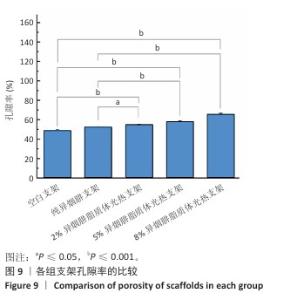
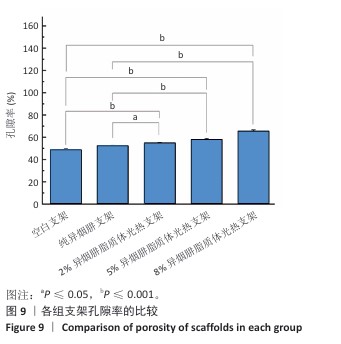
2.5 支架的孔隙率分析结果 孔隙率是评价组织工程骨支架力学性能和生物学性能的重要指标,适当的孔隙率能够促进骨细胞的增殖和骨组织的生长,同时为体液中的营养物质(如氨基酸、葡萄糖、氧气等)运输提供通道[29]。各组支架的孔隙率见图9。异烟肼脂质体光热支架的孔隙率显著优于纯异烟肼支架和非载药空白支架,这与扫描电镜观测结果相吻合,造成这种现象的原因可能是由于异烟肼脂质体冻干粉与浆料基材的变形系数不同,复合支架进行冷冻干燥处理时使脂质体与浆料基材结合不紧密,产生孔隙。随着异烟肼脂质体在浆料体系中掺杂量的增大,光热支架的孔隙率呈现增大趋势,这是可能是由于脂质体在支架中占据一定的体积,冷冻干燥时大量脂质体聚集使其附近空间结构发生改变,产生较大孔隙。"
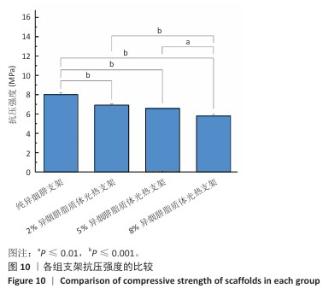
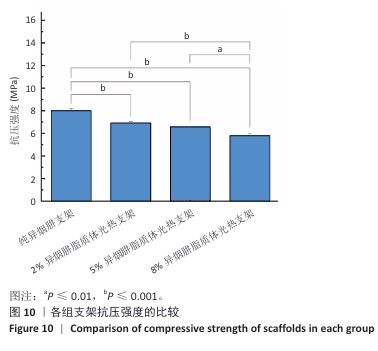
2.6 支架的力学性能分析结果 针对于骨组织工程支架,良好的力学性能能够为患者骨缺损部位提供足够的力学支撑作用,模拟正常人体的骨再生环境,促进骨组织的生长并加快骨缺损的修复进程[30]。纯异烟肼支架和2%,5%,8%异烟肼脂质体光热支架的弹性模量分别为(25.728±0.323),(22.254±0.198),(20.607±0.394),(17.118±0.259) MPa,可见随着异烟肼脂质体掺杂量的增大,支架的弹性模量降低,这是由于脂质体磷脂双分子层囊泡结构的弹性模量较小,远低于常用支架基材,其作为软质材料占据支架体积,直接降低整体承载截面,使支架的有效刚度下降;同时,打印浆料中脂质体与支架基材的结合力较弱,固化后形成弱界面,压缩实验时界面处首先产生微裂纹并向四周扩展,导致支架弹性模量降低。 各组支架的抗压强度见图10。异烟肼脂质体光热支架的抗压强度低于纯异烟肼支架,并且随着异烟肼脂质体掺杂量的增加,支架的抗压强度呈降低趋势,结合支架孔隙率测量结果,由于过多异烟肼脂质体的掺杂导致支架冷冻干燥后产生较多孔隙,孔隙的存在使得支架材料内部的连续性被破坏,较大应力在异烟肼脂质体附近的孔隙处集中,使支架更易发生变形破坏,导致支架承载能力下降。当异烟肼脂质体掺杂量为2%和5%时,支架的抗压强度变化较小,二者之间差值约为0.226 MPa;当异烟肼脂质体掺杂量为8%时,支架的抗压强度为(5.771±0.182) MPa,相比于2%,5%异烟肼脂质体光热支架组显著下降,考虑到动物体内组织回植实验所需的最低抗压强度为2.5 MPa[31],可知异烟肼脂质体光热支架的抗压强度可满足实际使用需求。 "
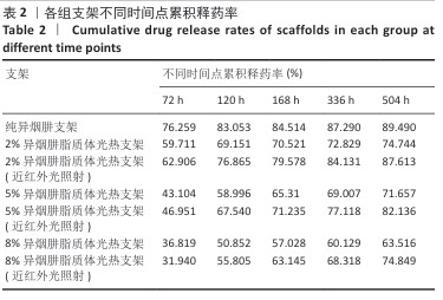
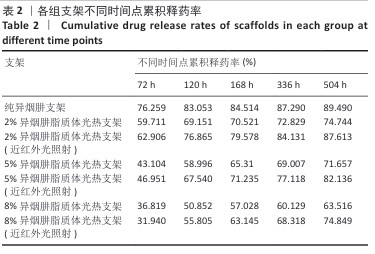
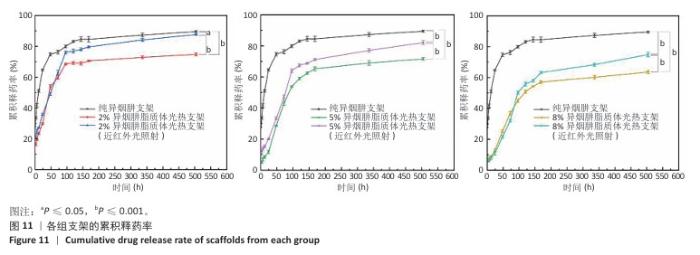
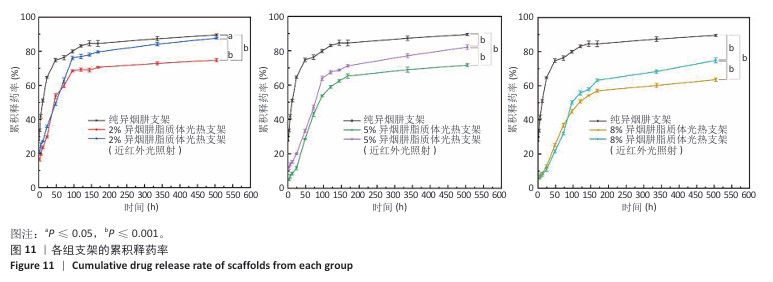
2.7 支架的释药性能分析结果 2.7.1 异烟肼脂质体光热支架药物缓释性能分析 结合图11和表2可以分析得出,纯异烟肼支架前期72 h累积释药率达到76.259%,相比异烟肼脂质体光热支架出现显著药物突释现象,这可能是由于实验药物异烟肼的水溶性较好且分子质量较小,通过直接包埋方式搭载到支架中时,支架内部孔隙中异烟肼药物浓度较高,与外部PBS形成浓度差而加速向外部扩散[32]。异烟肼脂质体的掺入可显著缓解支架的前期药物突释现象,异烟肼脂质体光热支架前72 h的累积释药率分别为59.711%,43.104%,36.819%,较纯异烟肼支架前72 h的累积释药率显著下降,并且随着异烟肼脂质体掺杂量的增多,光热支架药物缓释性能增强,造成这种现象的原因可能是:由于异烟肼脂质体的磷脂双分子层对药物具有包覆作用,亲水性药物异烟肼被包封在脂质体的内水相中,支架中异烟肼释放时需穿过脂质体磷脂双分子层这一物理屏障再二次扩散到模拟体液中,故随着异烟肼脂质体的掺杂量的增加,支架的这一缓释现象更为明显。 2.7.2 支架药物控释性能分析 结合图11和表2可以分析得出,相较于未经近红外光照射的同种支架,2%,5%,8%异烟肼脂质体光热支架经近红外光照射后在72-120 h的累积释药率分别增加4.519%,4.697%,9.832%,336-504 h的累积释药率分别增加1.567%,2.368%,3.144%,表现出较强的近红外光控释性能,这是由于掺杂的聚吡咯纳米颗粒具有较强的近红外吸收性能,当其吸收光能时内部的电子会被激发跃迁到更高能级,而处于激发态的电子返回基态时会以热能的形式释放能量,此过程将光能转化为热能[33],使支架温度升高,进而使脂质体磷脂双分子层通透性增强,导致脂膜孔隙增大,加快包封的异烟肼向模拟体液中扩散,同时,支架周围环境温度升高使分子热运动更为剧烈,有利于支架的降解和药物分子的释放。随着异烟肼脂质体掺杂量的增多,光热支架释药后期(336-504 h)的近红外光控释性能增强,结合药物缓解性能分析实验结果,这是由于异烟肼脂质体掺杂量较大时光热支架释药前期药物缓释较好,使得释药后期支架中留存的药量增多,能够更容易满足骨结核治疗后期对药物浓度的需求。 "
"
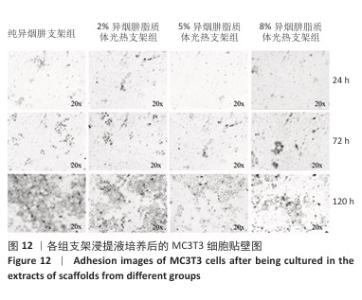
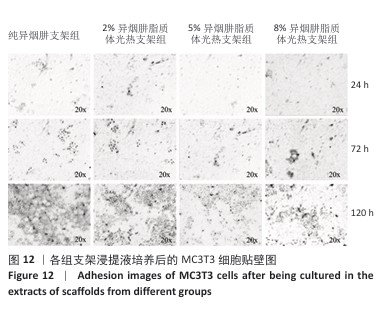
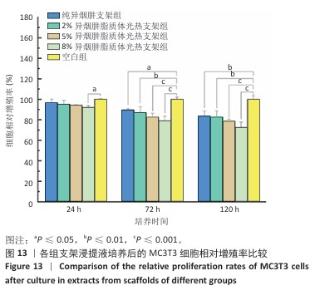
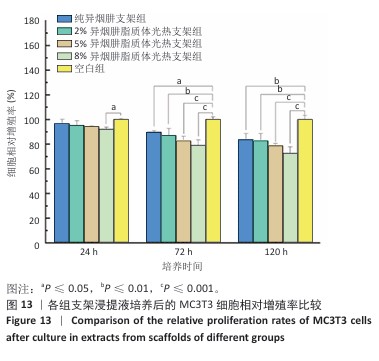
2.8 支架的细胞毒性实验分析结果 各组支架浸提液培养24,72,120 h的MC3T3细胞贴壁观察如图12所示,细胞相对增殖率计算结果如图13所示。随着培养时间的增长,4组支架浸提液培养的细胞相对增殖率降低,并且随着异烟肼脂质体掺杂量的增加,细胞相对增殖率呈降低趋势,培养120 h时,纯异烟肼支架组以及2%,5%,8%异烟肼脂质体光热支架组细胞相对增殖率分别为(83.42±5.22)%,(82.52±5.98)%,(78.57±1.94)%,(72.54±5.21)%,均显著低于与空白组。根据ISO10993-5-2009医疗器械生物学标准评价体外细胞毒性试验[34],实验样品的细胞相对增殖率大于70%可认为无毒,说明4组支架均无毒副作用,具有良好的生物安全性。 "
"
| [1] YIN JF, YAN GX, QIN LY, et al. Genomic investigation of bone tuberculosis highlighted the role of subclinical pulmonary tuberculosis in transmission. Tuberculosis (Edinb). 2024;148:102534. [2] RUAN T, NAVEED M, VIEN H. Case report: Tuberculosis recall on bone graft patient. N Am Spine Soc J. 2023;15:100241. [3] LEE JH, SHIN SJ, CHO SN, et al. Does the Effectiveness and Mechanical Strength of Kanamycin-Loaded Bone Cement in Musculoskeletal Tuberculosis Compare to Vancomycin-Loaded Bone Cement. J Arthroplasty. 2020;35(3):864-869. [4] LUO Y, CHEN H, CHEN H, et al. Recent Advances in Nanotechnology-Based Strategies for Bone Tuberculosis Management. Pharmaceuticals (Basel). 2024; 17(2):170. [5] GARG D, GOYAL V. Spinal tuberculosis treatment: An enduring bone of contention. Ann Indian Acad Neurol. 2020;23(4):441-448. [6] 袁虎成,丁永国,马雪花,等.载抗结核药吡嗪酰胺、卷曲霉素、莫西沙星及阿米卡星骨水泥的体外缓释性能[J].中国组织工程研究,2023,27(7):1017-1022. [7] QI JQ, YU TQ, HU BY, et al. Current Biomaterial-Based Bone Tissue Engineering and Translational Medicine. Int J Mol Sci. 2021;22(19):10233. [8] HUANG Y, ZHANG XF, GAO GF, et al. 3D bioprinting and the current applications in tissue engineering. Biotechnol J. 2017;12(8). doi:10.1002/biot.201600734. [9] BUDHARAJU H, SURESH S, SEKAR MP, et al. Ceramic materials for 3D printing of biomimetic bone scaffolds – Current state-of-the-art & future perspectives. Mater Design. 2023;231:112064. [10] ZHU M, LI K, ZHU Y, et al. 3D-printed hierarchical scaffold for localized isoniazid/rifampin drug delivery and osteoarticular tuberculosis therapy. Acta Biomater. 2015;16:145-155. [11] DENG M, WU S, NING M. 3D printing for controlled release Pharmaceuticals: Current trends and future directions. Int J Pharm. 2025;669:125089. [12] SHAO JL, MA JQ, LIN LL, et al. Three-Dimensional Printing of Drug-Loaded Scaffolds for Antibacterial and Analgesic Applications. Tissue Eng Part C Methods. 2019;25(4):222-231. [13] 林志东.淫羊藿苷/β-磷酸三钙骨支架3D打印工艺优化及在股骨头坏死模型中的研究[D].广州: 广州中医药大学,2022. [14] 李兴屿,周杰,李沙沙,等.缓释万古霉素三维支架修复兔感染性骨软骨缺损[J].中国组织工程研究,2024,28(22):3509-3516. [15] SHAIKH JAM, GOYAL K, AFZAL M, et al. Liposome-encapsulated therapies: Precision medicine for inflammatory lung disorders. Nano Trans Med. 2025;4: 100082. [16] 杜国辉,范维江,陈玉娟,等.超高效液相色谱串联质谱法测定乳制品中透明质酸[J].食品工业科技,2023,44(8):334-340. [17] 杨馨莹.盐酸青藤碱脂质体-透明质酸凝胶的制备,表征及对急性湿疹的初步药效学评价[D].合肥:安徽中医药大学,2023. [18] 颜红,宫思璠,于亮,等.脂质体作为药物载体的最新研究进展[J].药物生物技术,2023,30(3):325-330. [19] LEE Y, THOMPSON DH. Stimuli-responsive liposomes for drug delivery. Wiley interdisciplinary reviews. Wiley Interdiscip Rev Nanomed Nanobiotechnol. 2017;9(5):e1450. [20] CHENG Z, HUANG H, YIN M, et al. Applications of liposomes and lipid nanoparticles in cancer therapy: current advances and prospects. Exp Hematol Oncol. 2025;14(1):11. [21] YUAN Z, DAS S, LAZENBY RA, et al. Repetitive drug releases from light-activatable micron-sized liposomes. Colloids Surf A Physicochem Eng Asp. 2021;625:126778. [22] SUN R, CHEN H, WANG M, et al. Smart composite scaffold to synchronize magnetic hyperthermia and chemotherapy for efficient breast cancer therapy. Biomaterials. 2024;307: 122511. [23] CHEN XL, YU N, ZHANG LS, et al. Synthesis of polypyrrole nanoparticles for constructing full-polymer UV/NIR-shielding film. RSC Adv. 2015;5(117): 96888-96895. [24] DARYAN HS, JAVADPOUR J, KHAVANDI A. Synthesis and drug release study of ciprofloxacin loaded hierarchical hydroxyapatite mesoporous microspheres. Results Chem. 2025;14:102123-102123. [25] SHRIVASTAVA P, GAUTAM L, SHARMA R, et al. Dual antitubercular drug loaded liposomes for macrophage targeting: development, characterisation, ex vivo and in vivo assessment. J Microencapsul. 2021;38(2):108-123. [26] MARQUES SS, RAMOS II, FERNANDES RS, et al. Insights on Ultrafiltration-Based Separation for the Purification and Quantification of Methotrexate in Nanocarriers. Molecules. 2020;25(8):1879-1879. [27] 向晓雪,艾佳晨,赵科,等.利福平和异烟肼致小鼠肝损伤模型的特征研究[J].中国药理学通报,2019,35(4):586-590. [28] 李相成,索海瑞,王玲,等.基于3D打印羟基磷灰石支架的填充结构与力学性能研究[J].中国生物医学工程学报,2020,39(1):91-96. [29] 高泽,石志良,李锋,等.材料和孔隙率对可降解支架内骨形成的影响[J].医用生物力学,2021,36(4):582-588. [30] 鲍勇钢,吴彬.3D生物打印复合材料骨组织工程支架在骨缺损治疗中的应用[J].济宁医学院学报,2025,48(2):185-188. [31] 任泽宇,姜宏,石永芳.3D打印PLLA/HA复合组织工程骨支架及性能表征[J].燕山大学学报,2022,46(2):116-122. [32] JADIDI A, SALAHINEJAD E, SHARIFI E, et al. Drug-delivery Ca-Mg silicate scaffolds encapsulated in PLGA. Int J Pharm. 2020;589:119855. [33] 上海交通大学医学院附属第九人民医院.一种具有光热效应的聚吡咯纳米颗粒及其制备方法和应用: 201510017314.7[P].2016-08-10. [34] 马旭东,王健平.纳米羟基磷灰石根管充填材料的生物相容性及细胞毒性实验[J].中国组织工程研究与临床康复,2008,12(41):8051-8054. |
| [1] | Wang Qisa, Lu Yuzheng, Han Xiufeng, Zhao Wenling, Shi Haitao, Xu Zhe. Cytocompatibility of 3D printed methyl acrylated hyaluronic acid/decellularized skin hydrogel scaffolds [J]. Chinese Journal of Tissue Engineering Research, 2026, 30(8): 1912-1920. |
| [2] | Zhou Hongli, Wang Xiaolong, Guo Rui, Yao Xuanxuan, Guo Ru, Zhou Xiongtao, He Xiangyi. Fabrication and characterization of nanohydroxyapatite/sodium alginate/polycaprolactone/alendronate scaffold [J]. Chinese Journal of Tissue Engineering Research, 2026, 30(8): 1962-1970. |
| [3] | Chen Gang, Ge Caijun, Chen Jianpeng, Wang Yuanbin, Wang Qianliang. Mechanism of ferrostatin-1 hydrogel in treatment of lumbar disc herniation [J]. Chinese Journal of Tissue Engineering Research, 2026, 30(26): 6807-6813. |
| [4] | Wang Zitong, Wu Zijian, Yang Aofei, Mao Tian, Fang Nan, Wang Zhigang. Biomaterials regulate microenvironment imbalance for treating spinal cord injury [J]. Chinese Journal of Tissue Engineering Research, 2026, 30(20): 5321-5330. |
| [5] | Liu Shuting, Qiu Muen, Li Wei. Application and development trend of hydrogels in ophthalmic diseases [J]. Chinese Journal of Tissue Engineering Research, 2026, 30(20): 5349-5360. |
| [6] | Xiong Jiaying, Shen Jieyi, Lyu Jiahong. Characteristics and strategies of 3D-printed biomimetic bioceramic scaffolds for repairing jaw defects [J]. Chinese Journal of Tissue Engineering Research, 2026, 30(14): 3709-3716. |
| [7] | Yu Lei, Zhang Wei, Qin Yi, Ge Gaoran, Bai Jiaxiang, Geng Dechun. Repair of femoral condyle defects using mesoporous bioactive glass grafted with bone morphogenetic protein 2 osteogenic peptide inspired by mussel [J]. Chinese Journal of Tissue Engineering Research, 2025, 29(22): 4629-4638. |
| [8] | Wu Zhixin, Jiang Wenwen, Zhan Jianhui, Li Yangshurun, Ren Wenyan, Wang Yiyu. Hydrogels: role and problems in the repair of oral and maxillofacial defects [J]. Chinese Journal of Tissue Engineering Research, 2025, 29(10): 2178-2188. |
| [9] | Xin Pengfei, Sun Youqiang, Li Jie, Chen Jianfa, Deng Baogui, Xiang Xiaobing . Research progress of biomaterials for repair of rotator cuff tear [J]. Chinese Journal of Tissue Engineering Research, 2020, 24(28): 4459-4464. |
| Viewed | ||||||
|
Full text |
|
|||||
|
Abstract |
|
|||||