Chinese Journal of Tissue Engineering Research ›› 2026, Vol. 30 ›› Issue (29): 7688-7695.doi: 10.12307/2026.289
Previous Articles Next Articles
Optimal exercise prescription for chronic low back pain in adults: a network meta-analysis
Zhao Ke1, 2, Zhang Ping1, Xi Yongping2, Zeng Fanzhi2, Zhang Liru2
- 1Harbin Sport University, Harbin 150006, Heilongjiang Province, China; 2Zhangjiakou University, Zhangjiakou 075000, Hebei Province, China
-
Received:2025-10-15Revised:2025-12-04Online:2026-10-18Published:2026-03-06 -
Contact:Zhang Ping, PhD, Doctoral supervisor, Professor, Harbin Sport University, Harbin 150006, Heilongjiang Province, China -
About author:Zhao Ke, PhD candidate, Lecturer, Harbin Sport University, Harbin 150006, Heilongjiang Province, China; Zhangjiakou University, Zhangjiakou 075000, Hebei Province, China -
Supported by:Hebei Provincial Social Science Foundation Project, No. HB24TY013 (to ZLR)

CLC Number:
Cite this article
Zhao Ke, Zhang Ping, Xi Yongping, Zeng Fanzhi, Zhang Liru. Optimal exercise prescription for chronic low back pain in adults: a network meta-analysis[J]. Chinese Journal of Tissue Engineering Research, 2026, 30(29): 7688-7695.
share this article
Add to citation manager EndNote|Reference Manager|ProCite|BibTeX|RefWorks
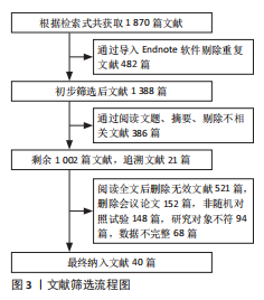
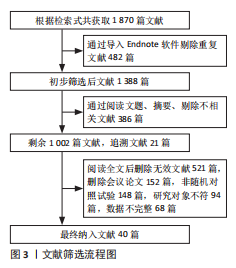
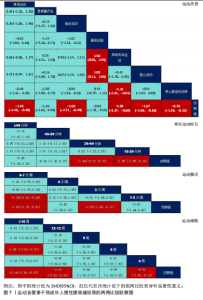
2.1 文献检索结果 共检索到1 870篇文献,经过查重后剔除482篇文献,对剩余1 388篇进行进一步筛选,最终纳入40篇文献,总共涵盖2 280名受试者。文献筛选过程见图3。"
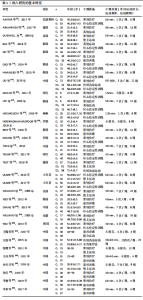
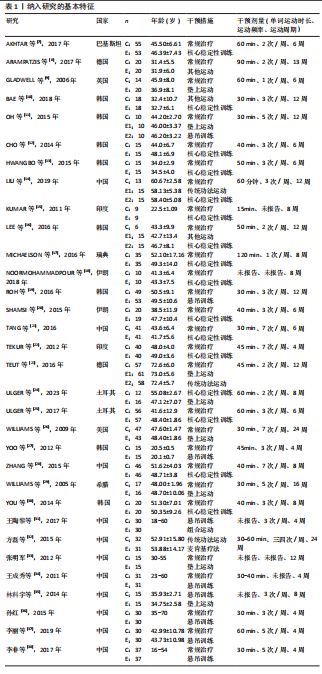
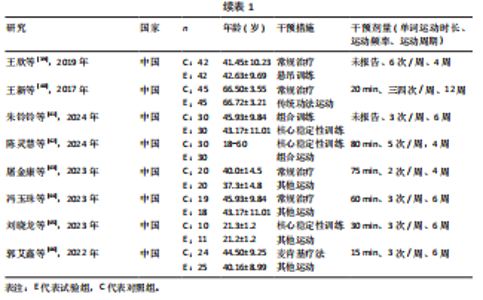
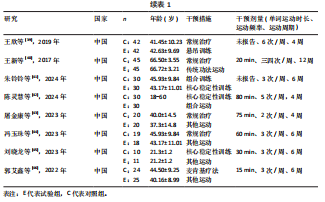
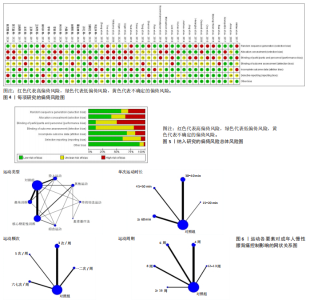
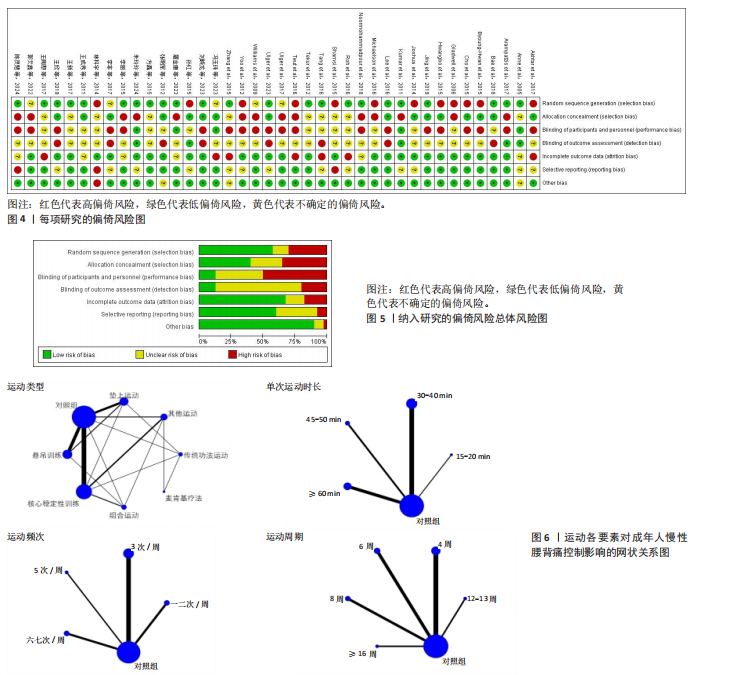
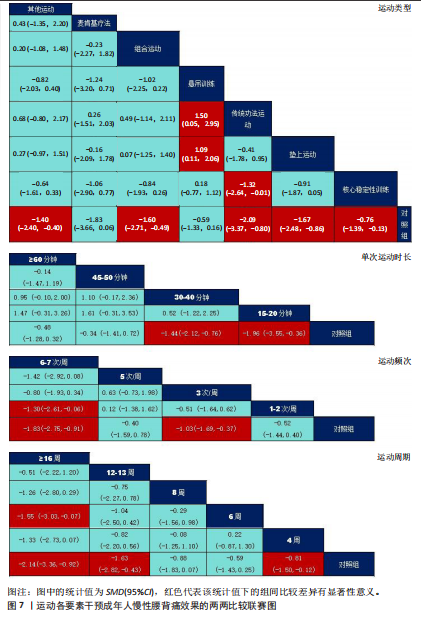
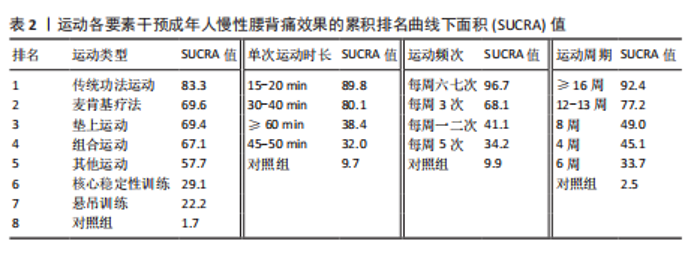
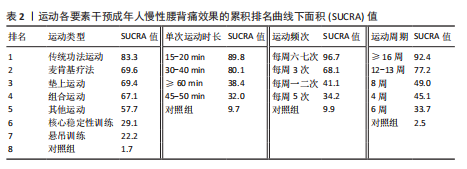
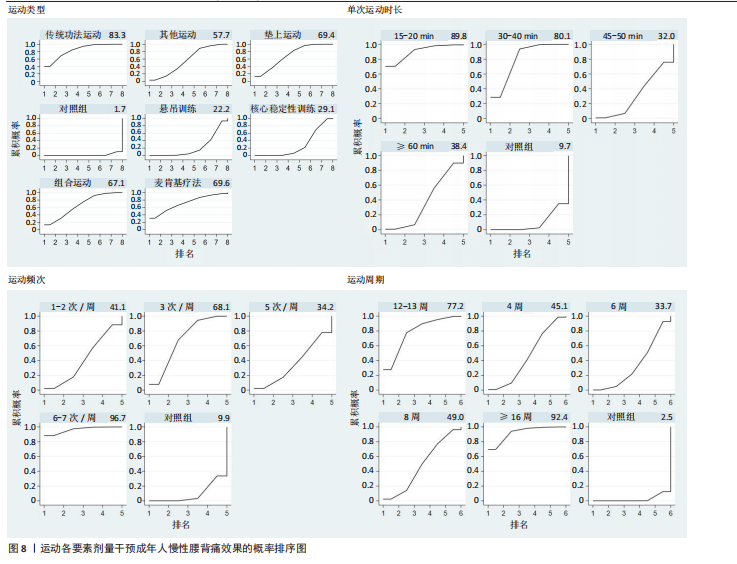
2.2 纳入文献的基本特征 在纳入的40篇文献中[7-46],试验组运动干预类型主要包括核心稳定性训练、垫上运动(瑜伽、普拉提)、传统功法运动(太极拳、八段锦、气功、五禽戏)、悬吊训练、组合运动(指每次运动干预中施加两种及以上干预动作的运动方式)、麦肯基疗法、其他运动(仰卧起坐、倒走、扰动训练),干预周期涵盖了4,6,8周以及12-13周和≥16周,干预频次包括每周一二次、每周3次、每周5次和每周六七次,运动时长为15-20 min、30-40 min;45-50 min和≥60 min。对照组的常规治疗包括药物治疗(如非类固醇抗炎药)、物理治疗(如热敷、电刺激)等非运动干预。纳入研究的基本特征请见表1。 2.3 纳入文献质量评价 采用RevMan 5.3软件和Cochrane偏倚风险评估工具作为标准,对纳入分析的文献质量进行了全面而严谨的评估,每项研究的Cochrane偏倚风险评估结果见图4,图5直观展示了偏倚风险的总体分布。如果研究采用随机化方法进行分配,则在选择偏倚评估中被划为低偏倚风险;未采用随机化或未报告随机化过程的研究,则被标为高偏倚风险。由于此次研究涉及多种运动干预,并且患者无法对治疗分配保持盲态,因此超过70%研究文献被判定为高偏倚风险。 2.4 网状Meta分析结果 2.4.1 网状关系图 网状关系(图6)结果显示,在运动类型中,对照组与核心稳定性训练、垫上运动、悬吊训练之间的连线较粗,核心稳定性训练与其他运动之间的连线也较粗,其余连线粗细中等;在运动时间方面,对照组与运动30-40 min和≥60 min的连线较粗;对于运动干预频次,对照组与每周运动3次的连线最粗;在运动干预周期上,对照组与运动4周和6周的连线较粗,线越粗代表纳入的相关研究数量越多。 2.4.2 不一致性检验 通过对全局的不一致性进行检验,检验显示P值为0.096,大于0.05,说明全局一致性良好。对于存在闭合环的结局指标使用节点拆分法进行局部不一致性检验,进行直接比较与间接比较结果的一致性比对,节点拆分法显示直接比较与间接比较具有一致性(P > 0.05),结果可靠性高,故采用一致性模型进行分析。 2.4.3 运动各要素间两两对比结果 见图7。 结果显示,核心稳定性训练、传统功法运动、组合运动、其他运动改善成年人慢性腰背痛的效果均显著优于对照组[SMD=-0.76,95%CI(-1.39,-0.13),P < 0.05)、垫上运动(SMD=-1.67,95%CI(-2.48,-0.86),P < 0.05;SMD=-2.09,95%CI(-3.37,-0.80),P < 0.05;SMD=-1.60,95%CI(-2.71,-0.49),P < 0.05;SMD=-1.40,95%CI(-2.40,-0.40),P < 0.05],悬吊训练改善成年人慢性腰背痛的效果显著弱于传统功法运动和垫上运动[SMD=1.50,95%CI(0.05,2.95),P < 0.05;SMD=1.09,95%CI(0.11,2.06),P < 0.05],传统功法运动改善成年人慢性腰背痛的效果显著优于核心稳定性训练[SMD=-1.32,95%CI(-2.64,-0.01),P < 0.05]。单次运动15-20 min、30-40 min改善成年人慢性腰背痛的效果显著优于对照组[SMD=-1.96,95%CI(-3.55,-0.36),P < 0.05;SMD=-1.44,95%CI(-2.12,-0.76),P < 0.05]。每周运动3次、六七次的干预效果均显著优于对照组[SMD=-1.03,9%CI(-1.69,-0.37),P < 0.05;SMD=-1.83,95%CI(-2.75,-0.91),P < 0.05],每周运动六七次的干预效果显著优于每周运动一二次[SMD=-1.30,95%CI(-2.61,-0.06),P < 0.05]。运动4周、12-13周和≥16周的干预效果均显著优于对照组[SMD=-0.81,95%CI(-1.50,-0.12),P < 0.05;SMD=-1.63,95%CI(-2.82,-0.43),P < 0.05;SMD=-2.14,95%CI(-3.36,-0.92),P < 0.05],运动≥16周的干预效果显著优于运动6周[SMD=-1.55,95%CI(-3.03,-0.07),P < 0.05]。 2.4.4 运动各要素最佳干预的概率排序 运动各要素剂量干预成年人慢性腰背痛效果的概率排序图,见图8。从表2可以看出,运动干预类型对成年人慢性腰痛干预影响效果的排序为:传统功法运动(SUCRA=83.3) > 麦肯基疗法(SUCRA=69.6) > 垫上运动(SUCRA=69.4) > 组合运动(SUCRA=67.1) > 其他运动(SUCRA=57.7) > "
核心稳定性训练 (SUCRA=29.1) > 悬吊训练(SUCRA=22.2);单次运动时长对成年人慢性腰痛改善影响效果的排序为:15-20 min(SUCRA=89.8) > 30-40 min (SUCRA=80.1) > ≥60 min (SUCRA=38.4) > 45-50 min (SUCRA=32);干预频次对成年人腰痛改善影响效果的排序为:每周运动六七次(SUCRA=96.7) > 每周运动3次(SUCRA=68.1)> 每周运动一二次(SUCRA=41.1) > 每周运动5次(SUCRA=34.2);运动周期对成年人腰痛改善影响效果的排序为:≥16周(SUCRA=92.4) > 12-13周(SUCRA=77.2) > 8周(SUCRA=49) > 4周(SUCRA=45.1) > 6周(SUCRA=33.7)。 2.4.5 敏感性分析 此次研究敏感性分析采用逐一剔除法进行。依次剔除纳入的每一篇文献后,合并效应量在-1.048至-0.678之间波动,该结果表明任何单一研究对整体结论的影响均较轻微,表明结果具有很好的稳健性。 2.4.6 文献发表偏倚检验 此次研究运用Egger法进行发表偏倚的检验,结果显示P=0.168,说明不存在显著的发表偏倚,但对结果的解释仍需谨慎对待。"
"
"
"
"
| [1] TAHERI N, BECKER L, FLEIG L, et al. Objective and subjective assessment of back shape and function in persons with and without low back pain. Sci Rep-UK. 2025;15(1):20105. [2] FERREIRA ML, DE LUCA K, HAILE LM, et al. Global, regional, and national burden of low back pain, 1990-2020, its attributable risk factors, and projections to 2050: a systematic analysis of the Global Burden of Disease Study 2021. Lancet Rheumatol. 2023; 5(6):E316-E329. [3] 顾蕊,王岩,陈伯华.中国非特异性腰背痛临床诊疗指南[J].中国脊柱脊髓杂志,2022, 32(3):258-268. [4] 王润生,黄承军,唐成.脊柱感染继发腰大肌脓肿的诊断及微创治疗研究进展[J].中国脊柱脊髓杂志,2024,34(2):206-210. [5] ZANG W, YAN J. Exercise interventions for nonspecific low back pain: a bibliometric analysis of global research from 2018 to 2023. J Front Med. 2024;(11):1390920. [6] HAYDEN JA, ELLIS J, OGILVIE R, et al. Some types of exercise are more effective than others in people with chronic low back pain: a network meta-analysis. J Physiother. 2021;67(4):252-262. [7] AKHTAR MW, KARIMI H, GILANI SA. Effectiveness of core stabilization exercises and routine exercise therapy in management of pain in chronic nonspecific low back pain: A randomized controlled clinical trial. Pak J Med Sci. 2017;33(4):1002-1006. [8] ARAMPATZIS A, SCHROLL A, CATALA MM, et al. A random-perturbation therapy in chronic non-specific low-back pain patients: a randomised controlled trial. Eu J Appl Physiol. 2017; 117(12):2547-2560. [9] GLADWELL V, HEAD S, HAGGAR M, et al. Does a program of Pilates improve chronic non-specific low back pain? J Sport Rehabil. 2006;15(4):338-350. [10] BAE CR, JIN Y, YOON BC, et al. Effects of assisted sit-up exercise compared to core stabilization exercise on patients with non-specific low back pain: A randomized controlled trial. J Back Musculoskele Rehabil. 2018;31(5):871-880. [11] OH BH, KIM HH, KIM CY, et al. Comparison of physical function according to the lumbar movement method of stabilizing a patient with chronic low back pain. J Phys Ther Sci. 2015;27(12): 3655-3658. [12] CHO HY, KIM EH, KIM J. Effects of the CORE Exercise Program on Pain and Active Range of Motion in Patients with Chronic Low Back Pain. J Sport Rehabil. 2014;26(8):1237-1240. [13] HWANGBO G, LEE CW, KIM SG, et al. The effects of trunk stability exercise and a combined exercise program on pain, flexibility, and static balance in chronic low back pain patients. J Phys Ther Sci. 2015;27(4):1153-1155. [14] LIU J, YEUNG A, XIAO T, et al. Chen-Style Tai Chi for Individuals (Aged 50 Years Old or Above) with Chronic Non-Specific Low Back Pain: A Randomized Controlled Trial. Int J Env Res Pub He. 2019;16(3):517-526. [15] KUMAR SP. Efficacy of segmental stabilization exercise for lumbar segmental instability in patients with mechanical low back pain: A randomized placebo controlled crossover study. N Am J Med Sci. 2011;3(10):456-461. [16] LEE JS, KANG SJ. The effects of strength exercise and walking on lumbar function, pain level, and body composition in chronic back pain patients. J Exerc Rehabil. 2016;12(5):463-470. [17] MICHAELSON P, HOLMBERG D, AASA B, et al. High load lifting exercise and low load motor control exercises as interventions for patients with mechanical low back pain: a randomized controlled trial with 24-month follow-up. J Rehabil Med. 2016;48(5):456-463. [18] NOORMOHAMMADPOUR P, KORDI M, MANSOURNIA MA, et al. The Role of a Multi-Step Core Stability Exercise Program in the Treatment of Nurses with Chronic Low Back Pain: A Single-Blinded Randomized Controlled Trial. Asian Spine J. 2018;12(3):490-502. [19] ROH HS, CHO WJ, RYU WJ, et al. The change of pain and lumbosacral sagittal alignment after sling exercise therapy for patients with chronic low back pain. J Phys Ther Sci. 2016; 28(10):2789-2792. [20] SHAMSI MB, SARRAFZADEH J, JAMSHIDI A. Comparing core stability and traditional trunk exercise on chronic low back pain patients using three functional lumbopelvic stability tests. Physiother Theor Pr. 2015;31(2):89-98. [21] TANG S, QIAN X, ZHANG Y, et al. Treating low back pain resulted from lumbar degenerative instability using Chinese Tuina combined with core stability exercises: A randomized controlled trial. Complement Ther Med. 2016; 25:45-50. [22] TEKUR P, NAGARATHNA R, CHAMETCHA S, et al. A comprehensive yoga programs improves pain, anxiety and depression in chronic low back pain patients more than exercise: An RCT. Complement Ther Med. 2012;20(3):107-118. [23] TEUT M, KNILLI J, DAUS D, et al. Qigong or Yoga Versus No Intervention in Older Adults With Chronic Low Back Pain-A Randomized Controlled Trial. J Pain. 2016;17(7):796-805. [24] ULGER O, OZ M, ASLIYUCE YO. The Effects of Yoga and Stabilization Exercises in Patients With Chronic Low Back Pain A Randomized Crossover Study. Holist Nurs Pract. 2023;37(4): E59-E68. [25] ULGER O, DEMIREL A, OZ M, et al. The effect of manual therapy and exercise in patients with chronic low back pain: Double blind randomized controlled trial. J Back Musculoskelet. 2017;30(6):1303-1309. [26] WILLIAMS K, ABILDSO C, STEINBERG L, et al. Evaluation of the Effectiveness and Efficacy of Iyengar Yoga Therapy on Chronic Low Back Pain. Spine (Phila Pa 1976). 2009; 34(19):2066-2076. [27] YOO YD, LEE YS. The Effect of Core Stabilization Exercises Using a Sling on Pain and Muscle Strength of Patients with Chronic Low Back Pain. J Phys Ther Sci. 2012;24(8):671-674. [28] ZHANG Y, TANG S, CHEN G, et al. Chinese massage combined with core stability exercises for nonspecific low back pain: A randomized controlled trial. Complement Ther Med. 2015; 23(1): 1-6. [29] WILLIAMS KA, PETRONIS J, SMITH D, et al. Effect of Iyengar yoga therapy for chronic low back pain. Pain. 2005;115(1-2):107-117. [30] YOU JH, KIM SY, OH DW, et al. The effect of a novel core stabilization technique on managing patients with chronic low back pain: a randomized, controlled, experimenter-blinded study. Clin Rehabil. 2014;28(5):460-469. [31] 王陶黎,唐一鸣,解骏,等.数字医疗康复技术在悬吊运动治疗(SET)慢性非特异性下背痛中的应用 [J].中国数字医学,2017,12(5): 88-90. [32] 方磊,严隽陶,曹彦俊,等.五禽戏对中老年慢性非特异性下背痛患者腰腹核心肌群力学性能及疼痛影响的临床研究[J].上海中医药杂志,2015,49(9):49-53. [33] 张明军.瑜伽运动对女性慢性下背痛康复效果的分析[J].体育成人教育学刊,2012,28(3): 61-62. [34] 王成秀,徐远红,杨凤翔,等.悬吊运动训练对非特异性下背痛患者远期疗效的临床研究[J].中国康复,2011,26(2):103-105. [35] 林科宇,许轶,王楚怀,等.悬吊式核心稳定训练对慢性非特异性下背痛的疗效[J].中国康复医学杂志,2014,29(10):923-928. [36] 孙红.悬吊运动疗法治疗非特异性下背痛的疗效观察[J].护士进修杂志,2015,30(19): 1806-1817. [37] 李丽,王芹,冯梓芸,等.悬吊循经弹拨技术治疗腰椎间盘突出症机制研究[J].康复学报,2019,29(3):13-16+21. [38] 李非,李丽,陈加新,等.悬吊运动疗法辅助治疗脊柱关节炎性腰背痛的临床观察[J].风湿病与关节炎,2017,6(7):34-37. [39] 王欣,田秀娟,王金玲,等.悬吊运动训练治疗慢性非特异性腰痛的效果[J].中国康复理论与实践, 2019,25(4):385-389. [40] 王新,朱群邦,方凡夫,等.健身气功八段锦辅助治疗老年男性慢性腰痛患者的临床观察[J].中华中医药杂志,2017,32(10): 4753-4755. [41] 朱铃铃,陈炎春,方亮,等.动态关节松动术联合核心稳定训练治疗非特异性下腰痛的疗效[J].实用医学杂志,2024,40(18): 2602-2606. [42] 陈灵慧,郑琦,李岩,等.在核心稳定训练基础上联合呼吸训练对慢性非特异性腰痛患者前馈控制的效果[J].中国康复理论与实践,2024,30(6):737-744. [43] 屠金康,李方方,吴晓琼,等.反重力跑台系统的倒走训练结合常规腰背核心训练治疗非特异性腰痛的效果研究[J].中国全科医学,2023,26(33):4203-4206. [44] 冯玉珠,董继革,陈雪丽,等.运动控制训练治疗慢性腰痛的临床疗效研究[J].中国康复医学杂志,2023,38(1):68-73. [45] 刘晓龙,何梦晓,尹贻锟,等.核心稳定康复训练系统对慢性非特异性腰痛干预效果研究[J].中国全科医学,2023,26(9): 1064-1074. [46] 郭艾鑫,顾新,马钊,等.两种腰痛家庭训练方案的临床疗效[J].中国康复医学杂志, 2022,37(1): 56-60,67. [47] YU Z, YIN Y, WANG J, et al. Efficacy of Pilates on Pain, Functional Disorders and Quality of Life in Patients with Chronic Low Back Pain: A Systematic Review and Meta-Analysis. Int J Env Res Pub Health. 2023;20(4):2850-2859. [48] MENG XG, YUE SW. Efficacy of aerobic exercise for treatment of chronic low back pain: a meta-analysis. Am J Phys Med Rehab. 2015;94(5):358-365. [49] LAMOTH CJ, MEIJER OG, DAFFERTSHOFER A, et al. Effects of chronic low back pain on trunk coordination and back muscle activity during walking: changes in motor control. Euro Spine J. 2006;15(1):23-40. [50] 张帅攀,朱清广,程艳彬,等.易筋经功法干预膝骨关节炎患者步态生物力学的随机对照试验[J]. 中华中医药杂志,2023,38(10): 5081-5086. [51] WAYNE PM, AHN A, CLARK J, et al. The Science of Tai Chi and Qigong as Whole Person Health-Part I: Rationale and State of the Science. J Integr Complement. 2025;31(6):499-520. [52] GOUVEIA D, CARDOSO A, CARVALHO C, et al. Approach to small animal neurorehabilitation by locomotor training: an update. Animals. 2022;12(24):3582-3599. [53] 刘振,蔡乾,耿涛,等.运动训练数智化转型:要义指向、现实羁绊与实践进路[J].中国体育科技,2025,61(4):77-83. [54] BABILONI-LOPEZ C, FRITZ N, RAMIREZ-CAMPILLO R, et al. Water-Based Exercise in Patients With Nonspecific Chronic Low-Back Pain: A Systematic Review With Meta-Analysis. J Strength Cond Res. 2024;38(1):206-219. [55] FERNÁNDEZ-RODRÍGUEZ R, ÁLVAREZ-BUENO C, CAVERO-REDONDO I, et al. Best exercise options for reducing pain and disability in adults with chronic low back pain: Pilates, strength, core-based, and mind-body. A network meta-analysis. J Orthop Sport Phys. 2022;52(8):505-521. [56] VACHON-PRESSEAU E, CENTENO M, REN W, et al. The emotional brain as a predictor and amplifier of chronic pain. J Dent Res. 2016; 95(6):605-612. [57] 刘辉,尹航,梅博威,等. 24式简化太极拳野马分鬃动作导致膝关节损伤的风险评估[J].中国康复理论与实践,2022,28(6):690-695. |
| [1] | Zhang Qingtong, Chen Leqin, Liu Chang, Chen Yuting, Guo Ruiwu. Neuromechanism of the endocannabinoid system in regulating exercise motivation [J]. Chinese Journal of Tissue Engineering Research, 2026, 30(在线): 1-11. |
| [2] | Liu Jinlong, Abuduwupuer·Haibier, Bai Zhen, Su Danyang, Miao Xin, Li Fei, Yang Xiaopeng. Efficacy of different nonsurgical treatments for adolescent idiopathic scoliosis: a systematic review and network meta-analysis [J]. Chinese Journal of Tissue Engineering Research, 2026, 30(9): 2370-2379. |
| [3] | Cao Yong, Teng Hongliang, Tai Pengfei, Li Junda, Zhu Tengqi, Li Zhaojin. Interactions between cytokines and satellite cells in muscle regeneration [J]. Chinese Journal of Tissue Engineering Research, 2026, 30(7): 1808-1817. |
| [4] | Pan Dong, Yang Jialing, Tian Wei, Wang Dongji, Zhu Zheng, Ma Wenchao, Liu Na, Fu Changxi. Resistance exercise activates skeletal muscle satellite cells in aged rats: role of adiponectin receptor 1 pathway [J]. Chinese Journal of Tissue Engineering Research, 2026, 30(7): 1736-1746. |
| [5] | Peng Zhiwei, Chen Lei, Tong Lei. Luteolin promotes wound healing in diabetic mice: roles and mechanisms [J]. Chinese Journal of Tissue Engineering Research, 2026, 30(6): 1398-1406. |
| [6] | Hou Chaowen, Li Zhaojin, Kong Jianda, Zhang Shuli. Main physiological changes in skeletal muscle aging and the multimechanism regulatory role of exercise [J]. Chinese Journal of Tissue Engineering Research, 2026, 30(6): 1464-1475. |
| [7] | Sun Yaotian, Xu Kai, Wang Peiyun. Potential mechanisms by which exercise regulates iron metabolism in immune inflammatory diseases [J]. Chinese Journal of Tissue Engineering Research, 2026, 30(6): 1486-1498. |
| [8] | Zhang Di, Zhao Jun, Ma Guangyue, Sun Hui, Jiang Rong. Mechanism of depression-like behavior in chronic social defeat stress mice based on high-throughput sequencing [J]. Chinese Journal of Tissue Engineering Research, 2026, 30(5): 1139-1146. |
| [9] | Liu Yu, Lei Senlin, Zhou Jintao, Liu Hui, Li Xianhui. Mechanisms by which aerobic and resistance exercises improve obesity-related cognitive impairment [J]. Chinese Journal of Tissue Engineering Research, 2026, 30(5): 1171-1183. |
| [10] | Wen Fan, Xiang Yang, Zhu Huan, Tuo Yanfang, Li Feng. Exercise improves microvascular function in patients with type 2 diabetes [J]. Chinese Journal of Tissue Engineering Research, 2026, 30(5): 1225-1235. |
| [11] | Zheng Yin, Wu Zhenhua, Zhang Cheng, Ruan Kexin, Gang Xiaolin, Ji Hong. Safety and efficacy of immunoadsorption therapy for rheumatoid arthritis: a network meta-analysis and systematic review [J]. Chinese Journal of Tissue Engineering Research, 2026, 30(5): 1260-1268. |
| [12] | Chen Qiang, Wu Wenjuan, Jiang Shuhua, Huang Da. Physical exercise improves physical function in burn patients: a systematic review and meta-analysis [J]. Chinese Journal of Tissue Engineering Research, 2026, 30(5): 1269-1281. |
| [13] | Leng Xiaoxuan, Zhao Yuxin, Liu Xihua. Effects of different neuromodulatory stimulation modalities on non-motor symptoms in Parkinson’s patients: a network meta-analysis [J]. Chinese Journal of Tissue Engineering Research, 2026, 30(5): 1282-1293. |
| [14] | Jiang Yang, Peng Hao, Song Yanping, Yao Na, Song Yueyu, Yin Xingxiao, Li Yanqi, Chen Qigang. Isometric exercise reduces resting blood pressure: a meta-analysis of moderating factors and dose effects [J]. Chinese Journal of Tissue Engineering Research, 2026, 30(4): 975-986. |
| [15] | Li Hanyue, Li Yini, Xiang Linmei, Li Sen. Effects of resistance exercise therapy on pain and function in patients with cervical spondylotic radiculopathy: a meta-analysis [J]. Chinese Journal of Tissue Engineering Research, 2026, 30(4): 987-996. |
| Viewed | ||||||
|
Full text |
|
|||||
|
Abstract |
|
|||||