Chinese Journal of Tissue Engineering Research ›› 2022, Vol. 26 ›› Issue (11): 1656-1661.doi: 10.12307/2022.347
Previous Articles Next Articles
Effects of different types of abdominal support on lumbar-back muscle surface electromyography signals in people with abdominal obesity
Shang Wandi1, Wang Xingze1, 2, Wei Xiaoyan1
- 1School of Sports Science, Shanghai University of Sport, Shanghai 200438, China; 2School of Physical Education, Huzhou University, Huzhou 313000, Zhejiang Province, China
-
Received:2020-12-23Revised:2020-12-25Accepted:2021-01-30Online:2022-04-18Published:2021-12-11 -
Contact:Wei Xiaoyan, Professor, School of Sports Science, Shanghai University of Sport, Shanghai 200438, China -
About author:Shang Wandi, Master candidate, School of Sports Science, Shanghai University of Sport, Shanghai 200438, China -
Supported by:the National Key Project, No. 2020YFC2007205 (to WXY)

CLC Number:
Cite this article
Shang Wandi, Wang Xingze, Wei Xiaoyan. Effects of different types of abdominal support on lumbar-back muscle surface electromyography signals in people with abdominal obesity[J]. Chinese Journal of Tissue Engineering Research, 2022, 26(11): 1656-1661.
share this article
Add to citation manager EndNote|Reference Manager|ProCite|BibTeX|RefWorks
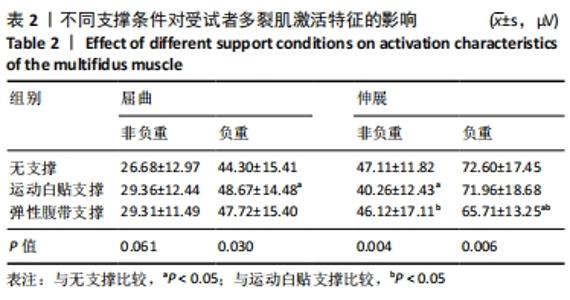
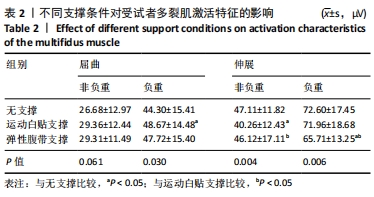
2.1 参与者数量分析 共纳入男性腹型肥胖受试者18名,受试者无脱落,将全部测试结果纳入分析。 2.2 受试者表面肌电信号数据 2.2.1 支撑条件对多裂肌均方根振幅值的影响 在屈曲阶段,非负重时,不同支撑条件对多裂肌均方根振幅值的影响无显著差异(P > 0.05);负重时,与无支撑相比,运动白贴支撑时的多裂肌均方根振幅值显著增加(P < 0.05),见表2。在伸展阶段,非负重时,与无支撑和弹性腹带支撑相比,运动白贴支撑时多裂肌均方根振幅值显著降低(P < 0.05);负重时,与无支撑和运动白贴支撑相比,弹性腹带支撑时多裂肌均方根振幅值显著降低(P < 0.05),见表2。 2.1 参与者数量分析 共纳入男性腹型肥胖受试者18名,受试者无脱落,将全部测试结果纳入分析。 2.2 受试者表面肌电信号数据 2.2.1 支撑条件对多裂肌均方根振幅值的影响 在屈曲阶段,非负重时,不同支撑条件对多裂肌均方根振幅值的影响无显著差异(P > 0.05);负重时,与无支撑相比,运动白贴支撑时的多裂肌均方根振幅值显著增加(P < 0.05),见表2。在伸展阶段,非负重时,与无支撑和弹性腹带支撑相比,运动白贴支撑时多裂肌均方根振幅值显著降低(P < 0.05);负重时,与无支撑和运动白贴支撑相比,弹性腹带支撑时多裂肌均方根振幅值显著降低(P < 0.05),见表2。"
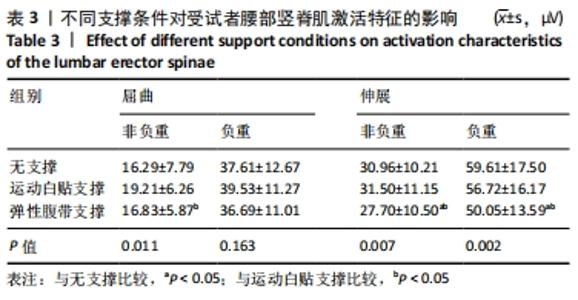
2.2.2 支撑条件对腰部竖脊肌均方根振幅值的影响 在屈曲阶段,非负重时,与运动白贴相比,弹性腹带支撑时腰部竖脊肌均方根振幅值显著降低(P < 0.05);负重时,不同支撑条件对腰部竖脊肌均方根振幅值的影响无显著差异(P > 0.05),见表3。"
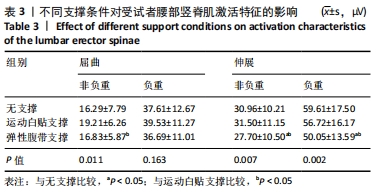
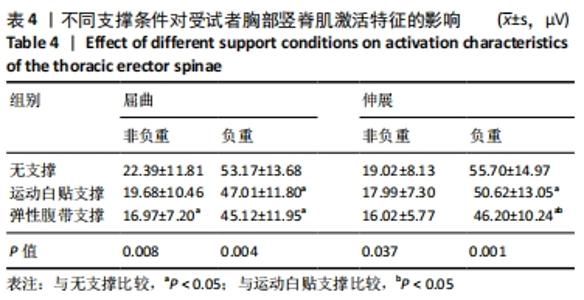
在伸展阶段,无论是负重还是非负重下,与无支撑和运动白贴支撑相比,弹性腹带支撑时腰部竖脊肌均方根振幅值显著降低(P < 0.05),见表3。 2.2.3 支撑条件对胸部竖脊肌均方根振幅值的影响 在屈曲阶段,非负重时,与无支撑条件相比,弹性腹带支撑时胸部竖脊肌均方根振幅值显著降低(P < 0.05);负重时,弹性腹带和运动白贴支撑时胸部竖脊肌均方根振幅值显著降低(P < 0.05),见表4。在伸展阶段,非负重时,不同支撑条件对胸部竖脊肌均方根振幅值的影响有显著差异(P < 0.05),运动白贴支撑与弹性腹带支撑时胸部竖脊肌均方根振幅值的影响有显著差异(P > 0.05);负重时,与无支撑相比,运动白贴和弹性腹带支撑时胸部竖脊肌均方根振幅值显著降低(P < 0.05),弹性腹带支撑时胸部竖脊肌均方根振幅值低于运动白贴支撑时(P < 0.05),见表4。"
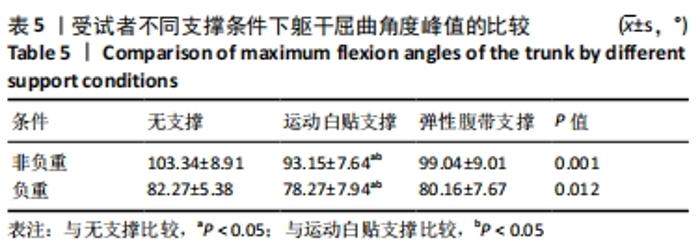
2.3 受试者躯干运动学数据 无论是负重还是非负重下,与无支撑条件相比,运动白贴支撑时躯干屈曲角度峰值显著减小(P < 0.05);与弹性腹带相比,运动白贴支撑时躯干屈曲角度峰值显著减小(P < 0.05),见表5。因此,不同类型支撑对躯干屈曲角度峰值的影响表现为无支撑>弹性腹带支撑>运动白贴支撑。"


2.4 不良事件及材料宿主反应 所有参与者试验过程中未发生任何不良事件。"

| [1] MELLOH M, ELFERING A, KäSER A, et al. What is the best time point to identify patients at risk of developing persistent low back pain? J Back Musculoskelet Rehabil. 2015;28(2):267-276. [2] ALONSO-GARCíA M, SARRíA-SANTAMERA A. The Economic and Social Burden of Low Back Pain in Spain: A National Assessment of the Economic and Social Impact of Low Back Pain in Spain. Spine (Phila Pa 1976). 2020;45(16):E1026-E1032. [3] CHOLEWICKI J, IVANCIC PC, RADEBOLD A. Can increased intra-abdominal pressure in humans be decoupled from trunk muscle co-contraction during steady state isometric exertions? Eur J Appl Physiol. 2002;87(2):127-133. [4] HOOGENDOORN WE, BONGERS PM, DE VET HC, et al. Flexion and rotation of the trunk and lifting at work are risk factors for low back pain: results of a prospective cohort study. Spine (Phila Pa 1976). 2000; 25(23):3087-3092. [5] 杨立杰,欧阳林,陈鼎伟,等.下腰疼痛的生物力学分析[J].中国组织工程研究,2020,24(33):5267-5271. [6] DAI H, ALSALHE T, CHALGHAF N, et al. The global burden of disease attributable to high body mass index in 195 countries and territories, 1990-2017: An analysis of the Global Burden of Disease Study. PLoS Med. 2020;17(7):e1003198. [7] YANG L, MU L, HUANG K, et al. Abdominal adipose tissue thickness measured using magnetic resonance imaging is associated with lumbar disc degeneration in a Chinese patient population. Oncotarget. 2016; 7(50):82055-82062. [8] HOWARTH SJ, CALLAGHAN JP. Compressive force magnitude and intervertebral joint flexion/extension angle influence shear failure force magnitude in the porcine cervical spine. J Biomech. 2012;45(3):484-490. [9] MYUNG E, NETO J, MURTA G, et al. ANAMT Technical Guideline (DT 05): prevention of occupational low back pain through back belts, lumbar support or braces. Rev Bras Med Trab. 2020;16(4):524-531. [10] AMMENDOLIA C, KERR MS, BOMBARDIER C. Back belt use for prevention of occupational low back pain: a systematic review. J Manipulative Physiol Ther. 2005;28(2):128-134. [11] CANADIAN TASK FORCE ON PREVENTIVE HEALTH CARE. Use of back belts to prevent occupational low-back pain. Recommendation statement from the Canadian Task Force on Preventive Health Care. Can Med Assoc J. 2003;169(3):213-214. [12] BOONKERD C, LIMROONGREUNGRAT W. Elastic therapeutic tape: do they have the same material properties? J Phys Ther Sci. 2016;28(4): 1303-1306. [13] MIYAMOTO K, IINUMA N, UEKI S, et al. Effects of abdominal belts on the cross-sectional shape of the trunk during intense contraction of the trunk muscles observed by computer tomography. Clin Biomech. 2008; 23(10):1220-1226. [14] JORGENSEN MJ, MARRAS WS. The effect of lumbar back support tension on trunk muscle activity. Clin Biomech. 2000;15(4):292-294. [15] FU W, LIU Y, ZHANG S, et al. Effects of local elastic compression on muscle strength, electromyographic, and mechanomyographic responses in the lower extremity. J Electromyogr Kinesiol. 2012;22(1): 44-50. [16] YEN SC, FOLMAR E, FRIEND KA, et al. Effects of kinesiotaping and athletic taping on ankle kinematics during walking in individuals with chronic ankle instability: A pilot study. Gait Posture. 2018;66(1): 118-123. [17] HUEBNER A, FAENGER B, SCHENK P, et al. Alteration of Surface EMG amplitude levels of five major trunk muscles by defined electrode location displacement. J Electromyogr Kinesiol. 2015;25(2):214-223. [18] ESCAMILLA R, LEWIS C, PECSON A, et al. Muscle Activation Among Supine, Prone, and Side Position Exercises With and Without a Swiss Ball. Sports Health. 2016;8(4):372-379. [19] PERCHTHALER D, HAUSER S, HEITKAMP HC, et al. Acute effects of whole-body vibration on trunk and neck muscle activity in consideration of different vibration loads. J Sports Sci Med. 2015;14(1): 155-162. [20] LUDVIG D, PREUSS R, LARIVIERE C. The effect of extensible and non-extensible lumbar belts on trunk muscle activity and lumbar stiffness in subjects with and without low-back pain. Clin Biomech. 2019;67(1): 45-51. [21] MOKHTARINIA H, GHAMARY J, MALEKI-GHAHFAROKHI A, et al. The new “Tehran Back Belt”: Design then testing during a simulated sitting task improved biomechanical spine muscle activity. Health Promot Perspect. 2019;9(2):115-122. [22] KINGMA I, FABER GS, SUWARGANDA EK, et al. Effect of a stiff lifting belt on spine compression during lifting. Spine (Phila Pa 1976). 2006; 31(22):E833-839. [23] LAVENDER S, SHAKEEL K, ANDERSSON G, et al. Effects of a lifting belt on spine moments and muscle recruitments after unexpected sudden loading. Spine (Phila Pa 1976). 2000;25(12):1569-1578. [24] HEALEY EL, BURDEN AM, MCEWAN I M, et al. The impact of increasing paraspinal muscle activity on stature recovery in asymptomatic people. Arch Phys Med Rehabil. 2008;89(4):749-753. [25] GRANATA KP, MARRAS WS, DAVIS KG. Biomechanical assessment of lifting dynamics, muscle activity and spinal loads while using three different styles of lifting belt. Clin Biomech. 1997;12(2):107-115. [26] YH L, SM K. Effect of belt pressure and breath held on trunk electromyography. Spine (Phila Pa 1976). 2002;27(3):282-290. [27] 陈岚岚,韩晓鸣,胡飞锋,等.不同方式躯干运动时腰部肌肉表面肌电信号特征研究[J].杭州师范大学学报(自然科学版),2019,18(5): 555-560. [28] MARRAS WS, JORGENSEN MJ, DAVIS KG. Effect of foot movement and an elastic lumbar back support on spinal loading during free-dynamic symmetric and asymmetric lifting exertions. Ergonomics. 2000;43(5): 653-668. [29] CHOLEWICKI J. The effects of lumbosacral orthoses on spine stability: what changes in EMG can be expected? J Orthop Res. 2004;22(5): 1150-1155. [30] KAWCHUK G, EDGECOMBE T, WONG A, et al. A non-randomized clinical trial to assess the impact of nonrigid, inelastic corsets on spine function in low back pain participants and asymptomatic controls. Spine (Phila Pa 1976). 2015;15(10):2222-2227. [31] SHAHVARPOUR A, PREUSS R, SULLIVAN MJL, et al. The effect of wearing a lumbar belt on biomechanical and psychological outcomes related to maximal flexion-extension motion and manual material handling. Appl Ergon. 2018;69(1):17-24. [32] LARIVIERE C, CARON JM, PREUSS R, et al. The effect of different lumbar belt designs on the lumbopelvic rhythm in healthy subjects. BMC Musculoskelet Disord. 2014;15(1):307. [33] GIORCELLI RJ, HUGHES RE, WASSELL JT, et al. The effect of wearing a back belt on spine kinematics during asymmetric lifting of large and small boxes. Spine (Phila Pa 1976). 2001;26(16):1794-1798. [34] BATALLER-CERVERO AV, RABAL-PELAY J, ROCHE-SERUENDO LE, et al. Effectiveness of lumbar supports in low back functionality and disability in assembly-line workers. Ind Health. 2019;57(5):588-595. [35] KATSUHIRA J, SASAKI H, ASAHARA S, et al. Comparison of low back joint moment using a dynamic 3D biomechanical model in different transferring tasks wearing low back belt. Gait Posture. 2008;28(2): 258-264. |
| [1] | Wang Shuai, Wang Liancheng, Zhang Shuhao, Li Fuli, Dong Jiaxing, Zhang Yajie. Correlation of the electromyography ratio of the paraspinal muscles on the convex and concave sides with Cobb angle, apical vertebra translation, and coronal balance distance in adolescent idiopathic scoliosis patients [J]. Chinese Journal of Tissue Engineering Research, 2022, 26(9): 1402-1406. |
| [2] | Ouyang Yiyi, Peng Jie, Wang Kun, Zhang Tingran, Luo Jiong. Changes in biomechanical characteristics of children’s lower limbs during visual deprivation and dual tasks [J]. Chinese Journal of Tissue Engineering Research, 2022, 26(12): 1834-1842. |
| [3] | Lü Zhen, Bai Jinzhu. A prospective study on the application of staged lumbar motion chain rehabilitation based on McKenzie’s technique after lumbar percutaneous transforaminal endoscopic discectomy [J]. Chinese Journal of Tissue Engineering Research, 2021, 25(9): 1398-1403. |
| [4] | Gao Yan, Zhao Licong, Zhao Hongzeng, Zhu Yuanyuan, Li Jie, Sang Deen. Alteration of low frequency fluctuation amplitude at brain-resting state in patients with chronic discogenic low back pain [J]. Chinese Journal of Tissue Engineering Research, 2021, 25(8): 1160-1165. |
| [5] | Zhang Peng, Zhang Junxia. Surface electromyography characteristics of lower limbs in heterogeneous gait environment [J]. Chinese Journal of Tissue Engineering Research, 2021, 25(36): 5814-5820. |
| [6] | Ji Zhongqiu, Li Jiahui, Zhao Panchao, Jiang Guiping. Biomechanical characteristics of children with different body weights during vertical jump [J]. Chinese Journal of Tissue Engineering Research, 2021, 25(33): 5281-5287. |
| [7] | Zhou Wenxing, Wang Lin . Effect of side cutting foot strike pattern and angle on the biomechanics of lower extremities [J]. Chinese Journal of Tissue Engineering Research, 2021, 25(32): 5184-5190. |
| [8] | Li Shanghua, Wang Haiyan. Biomechanics of lower extremities from straight forward to side-step cutting [J]. Chinese Journal of Tissue Engineering Research, 2020, 24(8): 1260-1266. |
| [9] | Young Lihjier, Ouyang Lin, Chen Dingwei, Lin Qi. A biomechanical analysis of low back pain [J]. Chinese Journal of Tissue Engineering Research, 2020, 24(33): 5267-5271. |
| [10] | Wen Wangqiang, Xu Haoxiang, Zhang Zepei, Miao Jun. Related factors and biomechanical characteristics of lumbar facet joint degeneration [J]. Chinese Journal of Tissue Engineering Research, 2020, 24(24): 3883-3889. |
| [11] | Xu Ping, Liang Leichao, Liang Zhenwen, Cai Ming, Chen Bo, Huang Ping, Zhang Linlin. Surface electromyogram features of the lower limb muscles in cerebral palsy children standing and walking on tiptoes [J]. Chinese Journal of Tissue Engineering Research, 2020, 24(23): 3673-3677. |
| [12] | Xie Rui, Zhu Liguo, Yu Jie, Li Kaiming, Zhuang Minghui, Chang Xiaojuan, Dai Wenkang. Interpretation of American Osteopathic Association Guidelines for osteopathic manipulative treatment of nonspecific low back pain [J]. Chinese Journal of Tissue Engineering Research, 2020, 24(21): 3401-3408. |
| [13] | Chen Xiaolan, Wang Lin, Liang Xiaotian, Li Yu1, Liu Haitao, Wang Bo, He Hui, Liu Chunyu. Gait characteristics of youth with chronic non-specific low back pain: spatio-temporal and kinetic parameters [J]. Chinese Journal of Tissue Engineering Research, 2019, 23(4): 556-561. |
| [14] | Chen Lingling, Yang Zekun, Sun Jianjun, Zhang Cun. Motion compatibility recognition of walk-aid robot based on multi-scale permutation entropy [J]. Chinese Journal of Tissue Engineering Research, 2019, 23(34): 5473-5478. |
| [15] | Yang Jinfeng, Ma Sanhui. Association between polymorphism of aggregate protein metabolic pathway gene and severity of lumbar disc herniation [J]. Chinese Journal of Tissue Engineering Research, 2019, 23(31): 4939-4944. |
| Viewed | ||||||
|
Full text |
|
|||||
|
Abstract |
|
|||||