Chinese Journal of Tissue Engineering Research ›› 2026, Vol. 30 ›› Issue (24): 6267-6274.doi: 10.12307/2026.411
Previous Articles Next Articles
Stroboscopic visual interference combined with balance training improves the balance ability of older adults
Hu Zhe, Sun Yuxiang, Han Xiao, Liu Yabin, Si Luyao, Li Zhouyu, Jia Yi
- School of Sport and Physical Education, North University of China, Taiyuan 030051, Shanxi Province, China
-
Received:2025-09-02Revised:2025-11-27Online:2026-08-28Published:2026-02-02 -
Contact:Jia Yi, MD, Professor, School of Sport and Physical Education, North University of China, Taiyuan 030051, Shanxi Province, China -
About author:Hu Zhe, School of Sport and Physical Education, North University of China, Taiyuan 030051, Shanxi Province, China -
Supported by:Graduate Student Science and Technology Project of North University of China, No. 20242048 (to HZ)

CLC Number:
Cite this article
Hu Zhe, Sun Yuxiang, Han Xiao, Liu Yabin, Si Luyao, Li Zhouyu, Jia Yi. Stroboscopic visual interference combined with balance training improves the balance ability of older adults[J]. Chinese Journal of Tissue Engineering Research, 2026, 30(24): 6267-6274.
share this article
Add to citation manager EndNote|Reference Manager|ProCite|BibTeX|RefWorks
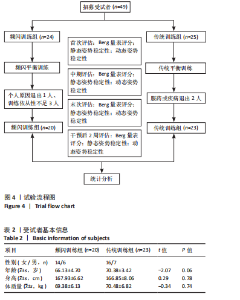
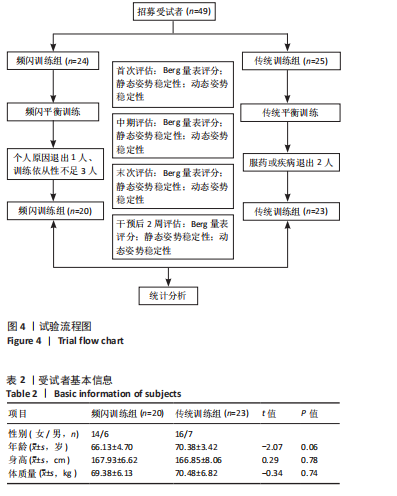
2.1 参与者数量分析 在干预过程中,频闪训练组有3人因训练依从性不足而退出,1人因个人原因无法完成试验而退出;传统训练组2人因服药或疾病而退出;除以上6人退出,其他受试者均完成此次试验,共训练24次。最终纳入统计计算和分析的样本量为43名,其中频闪训练组20例,传统训练组23例。 2.2 试验流程图 见图4。 2.3 受试者基本信息 干预前,两组受试者的性别、年龄、身高和体质量相比均无显著性差异(P > 0.05),见表2。 2.4 静态姿势稳定性的比较 双因素重复测量方差分析结果见表3,在平面闭目单足站立测试中,时间因素具有统计学意义(P < 0.001),组别因素(P=0.530)和组别×时间(P=0.780)交互效应均无统计学意义;在软榻闭目单足站立测试中,时间因素(P < 0.01)与组别因素(P=0.024)均有统计学意义,而组别×时间交互效应(P=0.063)没有统计学意义。训练8周后,两组受试者的静态姿势稳定性测试的两项成绩均较训练前明显改善(P < 0.05);至干预结束后的第2周,两组的静态稳定性保留了部分训练效果(P < 0.05)。在静态姿势稳定性的两项测试中,两组数据都呈持续增长趋势,且频闪训练组的增长速度快于传统训练组。"
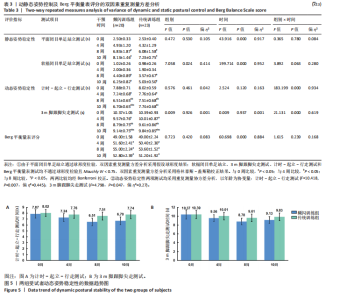
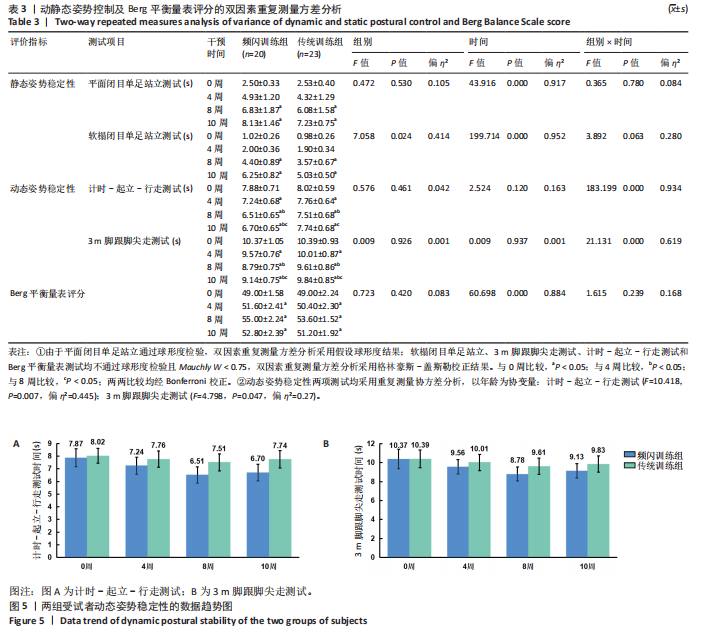
2.5 动态姿势稳定性的比较 双因素重复测量协方差分析,见表3,以年龄为协变量结果显示,计时-起立-行走和3 m脚跟脚尖走测试具有显著的组别×时间交互效应(P < 0.01),组别(计时-起立-行走和3 m脚跟脚尖走测试分别为P=0.461、P=0.926)和时间(两测试分别为P=0.120、P=0.937)因素无统计学意义。在动态姿势稳定性的两项测试中,两组数据均呈现下降后小幅回升的趋势,但频闪训练组始终呈现显著下降趋势,传统训练组保持相对稳定,见图5。 2.6 Berg平衡量表的比较 双因素重复测量方差分析结果见表3,Berg平衡量表评分的时间效应(P < 0.001)具有统计学意义;组别(P=0.420)、组别×时间(P=0.239)无统计学意义。与干预前相比,第4,8,10周后,两组受试者的Berg平衡量表评分均高于训练前(P < 0.05)。两组在试验期间呈上升趋势,试验结束后2周有小幅回落,但仍高于基线水平。 2.7 不良事件 正式试验的8周里,未见老年人因试验训练内容出现不适症状,无不良事件发生。"
| [1] 马越,王新.不同年龄中老年人群行走过程下肢姿势控制变化的生物力学特征[J].科学技术与工程,2024,24(30):12885-12893. [2] 路广龙.双任务训练对跌倒恐惧老年女性平衡能力、认知功能和跌倒风险的影响研究[D].上海:上海师范大学,2025. [3] 杨艺.球瑜伽对老年女性平衡能力影响的实验研究[D]. 西安:西安体育学院,2022. [4] ANGUS G, TOBIAS M. TRX suspension training: a new functional training approach for older adults - development, training control and feasibility. Int J Exerc Sci. 2015;8(3):224-233. [5] REZAEI S, ESLAMI R, TARTIBIAN B. The effects of TRX suspension training on sarcopenic biomarkers and functional abilities in elderlies with sarcopenia: a controlled clinical trial. BMC Sports Sci Med Rehabil. 2024; 16(1): 58. [6] 罗晶晶,杨丰洁,郑娟,等.不稳定支撑面核心稳定训练在老年胸腰椎压缩性骨折术后康复中的应用[J].河北医学,2023,29(4): 600-605. [7] 李静,裴辰淞,何心怡,等.不同训练方法对老年人平衡能力的影响[J].中国老年学杂志,2024,44(24):6127-6130. [8] KONG L, ZHANG Y, LIU Z, et al. Effects of stroboscopic disruption on static postural control in elderly individuals based on rambling and trembling analysis. Acta Bioeng Biomech. 2025. doi: 10.37190/abb/206094. [9] 林强,陈武德,郑煜欣,等.基于足底压力下睁闭眼对静态平衡功能的影响[J].康复学报,2021,31(1):17-23. [10] 肖春梅,王彤,姜桂萍.太极拳运动对老年平衡能力的影响[J].北京体育大学学报,2006,29(4):489-490+511. [11] 李翠查,徐蕊,宋淑华.渐进性抗阻运动对老年人体适能及跌倒风险的干预研究[J].中国老年保健医学,2022,20(5):41-45. [12] 高东旭,苑廷刚,刘嘉伟,等.频闪视觉训练应用研究进展[C]//中国体育科学学会.第十三届全国体育科学大会论文摘要集:专题报告(体能训练分会).上海体育大学;国家体育总局体育科学研究所;武汉体育学院,2023:321-323. [13] KIM KM, ESTUDILLO-MARTINEZ MD, CASTELLOTE-CABALLERO Y, et al. Short-term effects of balance training with stroboscopic vision for patients with chronic ankle instability: asingle-blinded randomized controlled trial. Int J Environ Res Public Health. 2021; 18(10):53-64. [14] SYMEONIDOU ER, FERRIS DP. Intermittent visual occlusions increase balance training effectiveness. Front Hum Neurosci. 2022; 16:748930. [15] 吴一晗,刘中强,魏乔叶,等.不同视觉条件平衡训练对慢性踝关节不稳患者本体感觉的影响[J].中国组织工程研究,2025,29(5): 1050-1057. [16] 张思卓,刘骁蒨,王广兰.视觉干扰对前交叉韧带重建后运动者下肢生物力学特征的影响[J].中国组织工程研究,2025,29(20): 4223-4229. [17] 孙像鸿.视觉干扰的平衡训练对慢性踝关节不稳患者的康复疗效研究[D].武汉:武汉体育学院,2023. [18] 李文静.频闪视觉干扰下平衡训练对功能性踝关节不稳患者本体感觉的影响[D].广州:广州体育学院,2024. [19] 吴婷.渐进性视觉遮蔽下功能性踝关节不稳者落地动作的生物力学特征研究[D].苏州:苏州大学,2023. [20] 蒋珊.频闪视觉训练对运动表现的提升及对注意网络功能的影响[D]. 北京:北京体育大学,2022. [21] 高东旭,苑廷刚,吴雪青,等.频闪训练对精英飞碟射击运动员运动视觉能力的影响[C]//中国体育科学学会.第十三届全国体育科学大会论文摘要集:专题报告(体能训练分会).国家体育总局体育科学研究所;上海体育大学;武汉体育学院,2023:119-121. [22] CHEN YC, CHOU YC, HWANG IS. Reliance on visual input for balance skill transfer in older adults: eeg connectome analysis using minimal spanning tree. Front Aging Neurosci. 2021;13:632553. [23] CHEN YC, HUANG CC, ZHAO CC, et al. Visual effect on brain connectome that scales feedforward and feedback processes of aged postural system during unstable stance. Front Aging Neurosci. 2021;13:679412. [24] TSAI YY, CHEN YC, ZHAO CG, et al. Adaptations of postural sway dynamics and cortical response to unstable stance with stroboscopic vision in older adults. Front Physiol. 2022;13:919184. [25] CHEN YC, TSAI YY, LIN YT, et al. Enhancing anticipation control of the posture system in the elderly wearing stroboscopic glasses. Neuroeng Rehabil. 2025;22(1):104. [26] BERG K. Measuring balance in the elderly: preliminary development of an instrument. Physiotherapy Canada. 1989;41. [27] LIMA CA, RICCI NA, NOGUEIRA EC, et al. The berg balance scale as a clinical screening tool to predict fall risk in older adults: a systematic review. Physiotherapy. 2018;104(4):383-394. [28] 杨颖,贾谊.小蹦床和BOSU球训练对人体平衡能力影响的比较研究[J].四川体育科学,2023,42(3):36-44. [29] FRANK SM, REAVIS EA, TSE PU, et al. Neural mechanisms of feature conjunction learning: enduring changes in occipital cortex after a week of training. Hum Brain Mapp. 2014;35(4):1201-1211. [30] RUBEGA M, FORMAGGIO E, DI MARCO R, et al. Cortical correlates in upright dynamic and static balance in the elderly. Sci Rep. 2021;11(1): 14132. [31] LIN CL, HSIEH YW, CHEN HY. Age-related differences in alpha and beta band activity in sensory association brain areas during challenging sensory tasks. Behav Brain Res. 2021;408:113279. [32] BUGNARIU N, FUNG J. Aging and selective sensorimotor strategies in the regulation of upright balance. Neuro Engineering Rehabil. 2007; 4(1):19. [33] FRANZ JR, FRANCIS CA, ALLEN MS, et al. Advanced age brings a greater reliance on visual feedback to maintain balance during walking. Hum Mov Sci. 2015;40:381-392. [34] MIAO Y, GE Y, WANG D, et al. Effects of visual disruption on static and dynamic postural control in people with and without chronic ankle instability. Front Bioeng Biotechnol. 2024;12:1499684. [35] SONG K, KANG TK, WIKSTROM EA, et al. Effects of reduced plantar cutaneous sensation on static postural control in individuals with and without chronic ankle instability. Sci Med Sport. 2017; 20(10):910-914. [36] ROERDINK M, HLAVACKOVA P, VUILLERME N. Center-of-pressure regularity as a marker for attentional investment in postural control: a comparison between sitting and standing postures. Hum Mov Sci. 2011;30(2):203-212. [37] RIZZATO A, BENAZZATO M, COGNOLATO M, et al. Different neuromuscular control mechanisms regulate static and dynamic balance: A center-of-pressure analysis in young adults. Hum Mov Sci. 2023;90:103120. [38] LEE H, HAN S, HOPKINS JT. Altered Visual Reliance Induced by Stroboscopic Glasses during Postural Control. Int J Environ Res Public Health. 2022;19(4):2076. [39] LEE H, HAN S, PAGE G, et al. Effects of balance training with stroboscopic glasses onpostural control in chronic ankle instability patients. Scand J Med Sci Sports. 2022;32(3):576-587. [40] 段林茹,郑洁皎,郑拥军,等.老年人与青年人姿势控制能力的差异[J].中国康复理论与实践,2025,31(7):846-852. [41] WOOLLACOTT MH, SHUMWAY-COOK A, NASHNER LM. Aging and posture control: changes in sensory organization and muscular coordination. Int J Aging Hum. 1986;23(2):97-114. [42] 戴雯,金晖,彼末一之.目标设置在不同肌肉强度的短期运动训练中对大脑运动皮层突触可塑性影响研究[J].中国体育科技, 2021,57(9):46-54. [43] KOSTER RAJ, ALIZADEHSARAVI L, MUIJRES W, et al. Balance training in older adults enhances feedback control after perturbations. PeerJ. 2024;12:e18588. [44] JIANG Q, KIM Y, CHOI M. Kinetic effects of 6 weeks’ pilates or balance training incollege soccer players with chronic ankle instability. Int J Environ Res Public Health. 2022;19(19):12903. [45] ASSLÄNDER L, HETTICH G, GOLLHOFER A, et al. Contribution of visual velocity and displacement cues to human balancing of support surface tilt. Exp. Brain Res. 2013;228(3):297-304. [46] KIM KM, KIM JS, OH J, et al. Stroboscopic vision as a dynamic sensory reweighting alternative to the sensory organization test. Sport Rehabil. 2020;30(1):166-172. [47] 周娟.基于太极拳云手、站桩和功法七式对预防老年人跌倒的实证研究[D]. 广州: 广州体育学院,2024. [48] BERG KO, MAKI BE, WILLIAMS JI, et al. Clinical and laboratorymeasures of postural balance in an elderly population. Arch Phys Med Rehabil. 1992;73(11):1073-1080. [49] 段亚飞,姬得文,傅涛,等.具有跌倒经历的老年女性身体功能特征[J].中国医学科学院学报,2025,47(2):182-190. [50] 刘贝雪,周璇,宋明阳,等.中国老年残疾预防政策特征与演进:基于1988-2024年政策文本分析[J].海军军医大学学报,2025, 46(3):392-399. [51] 燕声.要锻炼要服老要适老早治疗[N].保健时报,2025-06-12(001). |
| [1] | Zhang Zihua. Simulation and force characterization of the lower limbs in elderly people from sitting to standing [J]. Chinese Journal of Tissue Engineering Research, 2026, 30(6): 1407-1416. |
| [2] | Li Guangmin, Wang Jiangna. Mechanical loading of the patellofemoral joint and its correlation with various body mass indices in older adults practicing Tai Chi exercises [J]. Chinese Journal of Tissue Engineering Research, 2026, 30(24): 6182-6188. |
| [3] | Li Yiguang, Guo Haonan, Ding Xiaotao, Yuan Mengyao, Jiang Lijin, Fan Xinfeng, Feng Yan. Visual analysis of research hotspots in the field of gut microbiota in the elderly at home and abroad [J]. Chinese Journal of Tissue Engineering Research, 2026, 30(23): 6071-6080. |
| [4] | Liang Tianqi, Zhang Xiaoquan. Control strategies during gait termination in older adults under cognitive-motor dual-task conditions [J]. Chinese Journal of Tissue Engineering Research, 2026, 30(17): 4390-4399. |
| [5] | Xu Feng, Gu Dongyang, Zhu Zihao, Li Qiujie, Wan Xianglin. Relationship between spatio-temporal gait characteristics and fall risk in stroke patients [J]. Chinese Journal of Tissue Engineering Research, 2026, 30(16): 4038-4044. |
| [6] | Ren Pengbo, Li Tingwen, Cai Feng, Zhang Jian. Meta-analysis of lumbar bone mineral density, pain score and fall incidence in middle-aged and elderly osteoporosis patients undergoing whole-body vibration training [J]. Chinese Journal of Tissue Engineering Research, 2026, 30(10): 2569-2575. |
| [7] | Zhang Yuxin, Yu Cong, Zhang Cui, Ding Jianjun, Chen Yan. Differences in postural control ability between older adults with mild cognitive impairment and those with normal cognition under different single-task and dual-task conditions [J]. Chinese Journal of Tissue Engineering Research, 2025, 29(8): 1643-1649. |
| [8] |
Liang Xiaoxiao, Zheng Jiejiao, Duan Linru, Chen Xi, Zhang Tingyu.
Characterization of postural stability in elderly patients with idiopathic normal pressure hydrocephalus #br#
#br#
[J]. Chinese Journal of Tissue Engineering Research, 2025, 29(6): 1208-1213.
|
| [9] | Wu Yihan, Liu Zhongqiang, Wei Qiaoye, Liu Mingdong, Chen Keyi, Li Zhigang. Effect of balance training with different visual conditions on proprioception in patients with chronic ankle instability [J]. Chinese Journal of Tissue Engineering Research, 2025, 29(5): 1050-1057. |
| [10] | Li Huijun, Li Huangyan, Zhang Yeting. Physical activity and cognition in older adults: research hotspot and topic evolution [J]. Chinese Journal of Tissue Engineering Research, 2025, 29(5): 1073-1080. |
| [11] | Li Zhenggang, Shang Xuehong, Wu Zhang, Li Hong, Sun Chaojun, Chen Huadong, Sun Zhe, Yang Yi. Finite element analysis of three internal fixation modalities for treatment of Pauwels type III femoral neck fractures under different loading conditions [J]. Chinese Journal of Tissue Engineering Research, 2025, 29(3): 455-463. |
| [12] | Wang Jinfu, Yang Guan. Meta-analysis of wearable device interventions to promote physical activity in older adults [J]. Chinese Journal of Tissue Engineering Research, 2025, 29(28): 6146-6160. |
| [13] | Zhu Tianrui, Shi Jipeng, Sun Jiahe, Wang Luyi, Zhang Chen, Xu Hongqi, Quan Helong. Effectiveness of different exercise regimens to reduce fall risks in older adults: a Meta-analysis [J]. Chinese Journal of Tissue Engineering Research, 2025, 29(26): 5662-5672. |
| [14] | Zhao Yanan, Lu Donglei, Tan Sijie, . Exercise intervention for sarcopenic obesity in older adults [J]. Chinese Journal of Tissue Engineering Research, 2025, 29(17): 3657-3667. |
| [15] | Hong Jintao, Wang Jingjing, Li Yansong, Wang Chen, Mi Shouling. Sedentary behavior and lower-limb muscle strength in community-dwelling older adults: the mediating and moderating effects of fear of falling and age [J]. Chinese Journal of Tissue Engineering Research, 2025, 29(17): 3566-3571. |
| Viewed | ||||||
|
Full text |
|
|||||
|
Abstract |
|
|||||