Chinese Journal of Tissue Engineering Research ›› 2026, Vol. 30 ›› Issue (17): 4357-4365.doi: 10.12307/2026.114
Previous Articles Next Articles
Hind limb muscle atrophy in rats with spinal cord injury: effects of different rehabilitation therapy strategies
Fu Yingxue1, 2, Wang Xianbin1, 2, Chen Xingyu2, Wu Shuang1, 2
- 1Affiliated Hospital of Guizhou Medical University, Guiyang 550004, Guizhou Province, China; 2Guizhou Medical University, Guiyang 550004, Guizhou Province, China
-
Received:2025-02-25Accepted:2025-06-13Online:2026-06-18Published:2025-11-27 -
Contact:Wu Shuang, MD, Professor, Chief physician, Affiliated Hospital of Guizhou Medical University, Guiyang 550004, Guizhou Province, China; Guizhou Medical University, Guiyang 550004, Guizhou Province, China -
About author:Fu Yingxue, MS candidate, Affiliated Hospital of Guizhou Medical University, Guiyang 550004, Guizhou Province, China; Guizhou Medical University, Guiyang 550004, Guizhou Province, China -
Supported by:the National Natural Science Foundation of China (Regional Project), No. 82260452 (to WS); Guizhou Provincial Science and Technology Program Project, Nos. Qiankehejichu-zk[2022] Key 045 (to WS) and Qiankehejichu-zk[2022] General 438 (to WXB)

CLC Number:
Cite this article
Fu Yingxue, Wang Xianbin, Chen Xingyu, Wu Shuang. Hind limb muscle atrophy in rats with spinal cord injury: effects of different rehabilitation therapy strategies[J]. Chinese Journal of Tissue Engineering Research, 2026, 30(17): 4357-4365.
share this article
Add to citation manager EndNote|Reference Manager|ProCite|BibTeX|RefWorks
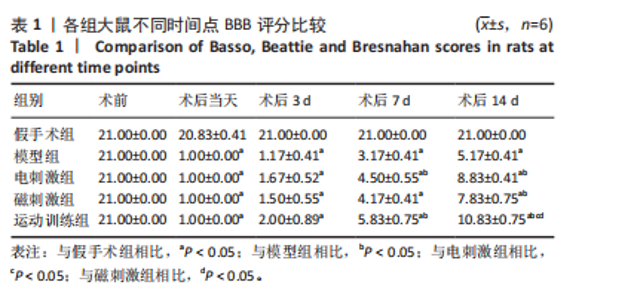
2.1 实验动物数量分析 实验选用SD大鼠30只,全部进入结果分析。 2.2 电刺激、磁刺激与运动训练不同程度改善脊髓损伤大鼠运动功能 2.2.1 BBB评分 术前各组大鼠BBB评分均为21分。术后第3天,模型组与其余各组大鼠之间BBB评分无明显差异(P > 0.05)。术后第7天,相较于模型组,电刺激组与运动训练组大鼠BBB评分明显增高(P < 0.05)。术后第14天,相较于模型组,电刺激组、磁刺激组、运动训练组大鼠BBB评分均明显增高(P < 0.05);且运动训练组明显高于电刺激组与磁刺激组(P < 0.05),见图1A,表1。"
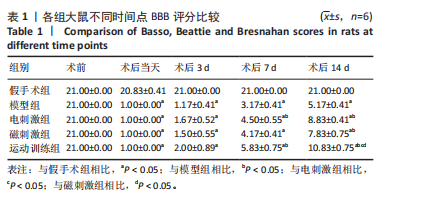
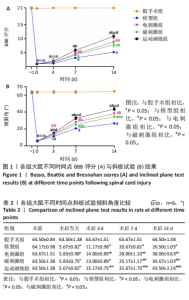
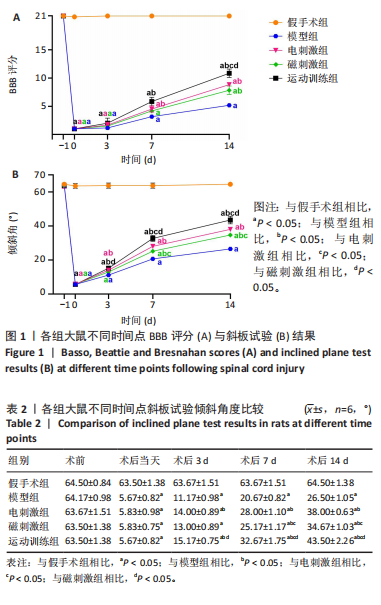
2.2.2 斜板试验 术前各组大鼠斜板试验倾斜角度无明显差异(P > 0.05)。术后第3天,电刺激组倾斜角度明显高于模型组,运动训练组倾斜角度明显高于模型组与磁刺激组(P < 0.05)。术后第7天与第14天,相较于模型组,电刺激组、磁刺激组、运动训练组倾斜角度均明显增加(P < 0.05);且运动训练组高于电刺激组与磁刺激组,电刺激组高于磁刺激组(P < 0.05),见图1B,表2。"
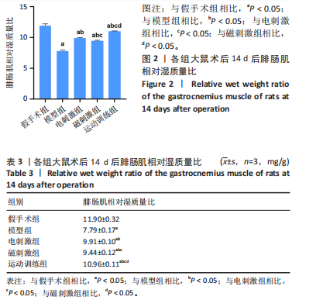
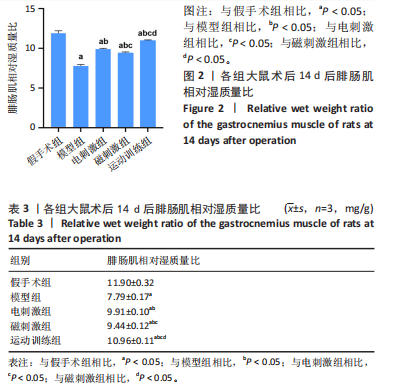
2.3 电刺激、磁刺激与运动训练不同程度改善脊髓损伤大鼠腓肠肌萎缩 2.3.1 腓肠肌湿质量 术后第14天,称量各组大鼠双侧腓肠肌湿质量,并用其体质量进行标准化。与假手术组相比,模型组腓肠肌相对湿质量比明显下降(P < 0.05);相较于模型组,电刺激组、磁刺激组、运动训练组腓肠肌相对湿质量比明显升高(P < 0.05);且电刺激组与运动训练组明显高于磁刺激组,运动训练组明显高于电刺激组(P < 0.05),见图2,表3。"
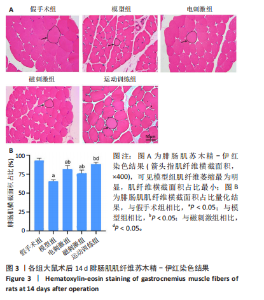
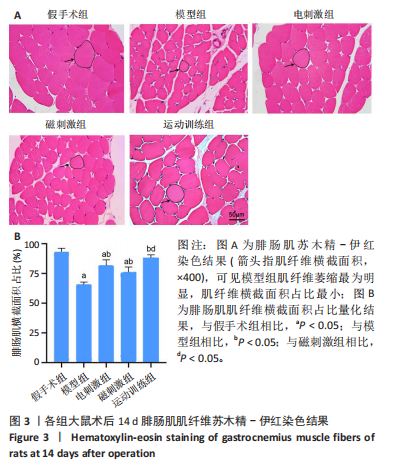
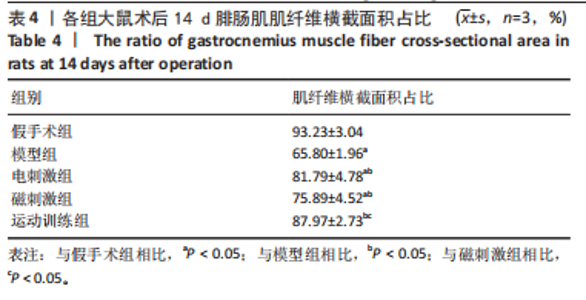
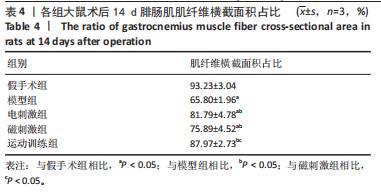
2.3.2 苏木精-伊红染色结果 术后第14天,与假手术组相比,模型组腓肠肌肌纤维横截面积明显减少 (P < 0.05);与模型组相比,电刺激组、磁刺激组与运动训练组腓肠肌肌纤维横截面积明显增加,且运动训练组明显高于磁刺激组(P < 0.05),见图3, 表4。"
"
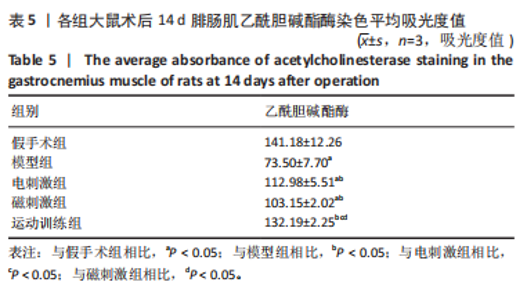
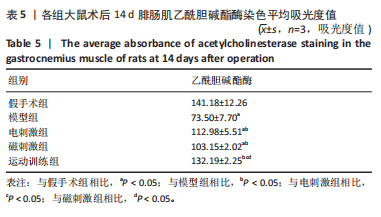
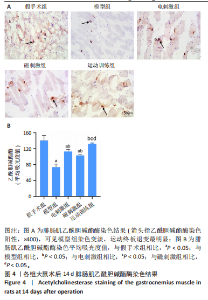
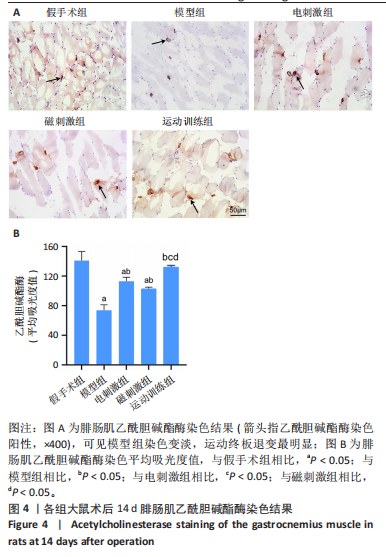
2.4 电刺激、磁刺激与运动训练不同程度提高腓肠肌神经肌肉接头处乙酰胆碱酯酶平均吸光度值 乙酰胆碱酯酶染色结果显示,术后第14天,与假手术组相比,模型组乙酰胆碱酯酶平均吸光度值明显减少(P < 0.05);相较于模型组,其余各组平均吸光度值明显增加(P < 0.05),且运动训练组明显高于电刺激组与磁刺激组(P < 0.05),见图4,表5。"
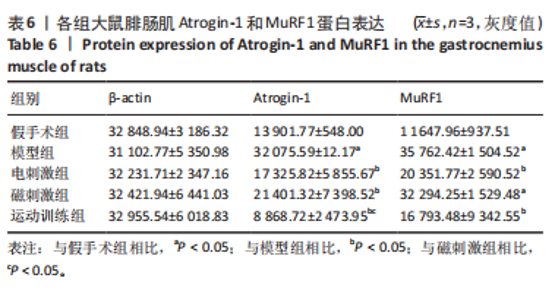
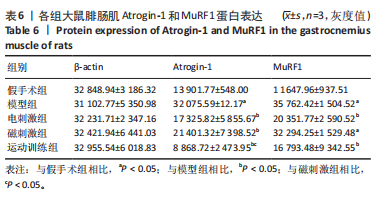
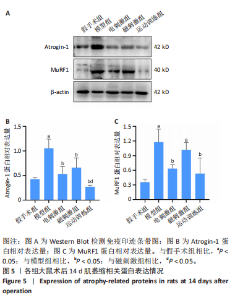
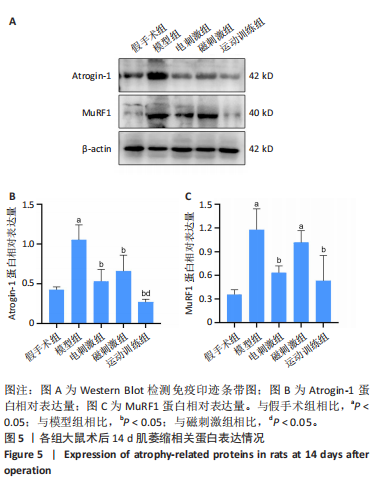
2.5 电刺激、磁刺激与运动训练不同程度降低腓肠肌肌萎缩相关蛋白表达 Western Blot检测结果见图5A。术后第14天,与假手术组相比,模型组Atrogin-1蛋白与MuRF1蛋白表达明显升高(P < 0.05);电刺激组、磁刺激组与运动训练组Atrogin-1蛋白表达量明显低于模型组(P < 0.05),且运动训练组明显低于磁刺激组(P < 0.05);电刺激组与运动训练组MuRF1蛋白表达量明显低于模型组(P < 0.05),见图5B,C,表6。"
"
"
| [1] FLACK JA, SHARMA KD, XIE JY. Delving into the recent advancements of spinal cord injury treatment: a review of recent progress. Neural Regen Res. 2022;17(2):283-291. [2] 张浩, 刘宇, 肖世宁,等. 中国创伤性脊髓损伤患者流行病学特征的Meta分析[J].中国脊柱脊髓杂志,2023,33(5):397-407. [3] LI J, CUI S, LI Y, et al. Sirtuin1 in Spinal Cord Injury: Regulatory Mechanisms, Microenvironment Remodeling and Therapeutic Potential. CNS Neurosci Ther. 2025;31(2):e70244. [4] XU X, TALIFU Z, ZHANG CJ, et al. Mechanism of skeletal muscle atrophy after spinal cord injury: A narrative review. Front Nutr. 2023;10: 1099143. [5] YIN L, LI N, JIA W, et al. Skeletal muscle atrophy: From mechanisms to treatments. Pharmacol Res. 2021;172: 105807. [6] ATKINS KD, BICKEL CS. Effects of functional electrical stimulation on muscle health after spinal cord injury. Curr Opin Pharmacol. 2021;60: 226-231. [7] BAZAREK SF, KRENN MJ, SHAH SB, et al. Novel Technologies to Address the Lower Motor Neuron Injury and Augment Reconstruction in Spinal Cord Injury. Cells. 2024;13(14):1231. [8] NEMETH C, BANIK NL, HAQUE A. Disruption of Neuromuscular Junction Following Spinal Cord Injury and Motor Neuron Diseases. Int J Mol Sci. 2024;25(6):3520. [9] O’BRIEN LC, GORGEY AS. Skeletal muscle mitochondrial health and spinal cord injury. World J Orthop. 2016;7(10):628-637. [10] BATTISTUZZO CR, CALLISTER RJ, CALLISTER R, et al. A systematic review of exercise training to promote locomotor recovery in animal models of spinal cord injury. J Neurotrauma. 2012;29(8):1600-1613. [11] ALHARBI A, LI J, WOMACK E, et al. The Effect of Lower Limb Combined Neuromuscular Electrical Stimulation on Skeletal Muscle Cross-Sectional Area and Inflammatory Signaling. Int J Mol Sci. 2024;25(20): 11095. [12] DO ESPíRITO SANTO CC, SECCO DD, MEIRELES A, et al. Locomotor Treadmill Training Promotes Soleus Trophism by Mammalian Target of Rapamycin Pathway in Paraplegic Rats. Neurochem Res. 2018;43(6): 1258-1268. [13] CHAKRABORTY A, SHARMA MC, VISHNUBHATLA S, et al.Electromagnetic field stimulation facilitates motor neuron excitability, myogenesis and muscle contractility in spinal cord transected rats. J Biosci. 2022:47:78. [14] DE SIRE A, MOGGIO L, MAROTTA N, et al. Impact of rehabilitation on volumetric muscle loss in subjects with traumatic spinal cord injury: A systematic review. NeuroRehabilitation. 2023;52(3):365-386. [15] DUFFELL LD, DONALDSON NN. A Comparison of FES and SCS for Neuroplastic Recovery After SCI: Historical Perspectives and Future Directions. Front Neurol. 2020;11:607. [16] DE FREITAS GR, SZPOGANICZ C, ILHA J. Does Neuromuscular Electrical Stimulation Therapy Increase Voluntary Muscle Strength After Spinal Cord Injury? A Systematic Review. Top Spinal Cord Inj Rehabil. 2018;24(1):6-17. [17] BOCHKEZANIAN V, NEWTON RU, TRAJANO GS, et al. Effects of Neuromuscular Electrical Stimulation in People with Spinal Cord Injury. Med Sci Sports Exerc. 2018;50(9):1733-1739. [18] XU X, DU H Y, TALIFU Z, et al. Glycine and N-Acetylcysteine (GlyNAC) Combined with Body Weight Support Treadmill Training Improved Spinal Cord and Skeletal Muscle Structure and Function in Rats with Spinal Cord Injury. Nutrients. 2023;15(21):4578. [19] WANG ZQ, RAN R, MA CW, et al. Lentivirus-mediated Knockdown of Ski Improves Neurological Function After Spinal Cord Injury in Rats. Neurochem Res. 2024;50(1):15. [20] LI J Z, FAN BY, SUN T, et al. Bioinformatics analysis of ferroptosis in spinal cord injury. Neural Regen Res. 2023;18(3):626-633. [21] LI M, MO J, WU D, et al. Treadmill training improves neural function recovery in rats with spinal cord injury via JAK2/STAT3 signaling pathway and attenuating apoptosis. Neuroreport. 2024;35(13):811-821. [22] JIANG YF, ZHANG D, ZHANG J, et al. A Randomized Controlled Trial of Repetitive Peripheral Magnetic Stimulation applied in Early Subacute Stroke: Effects on Severe Upper-limb Impairment. Clin Rehabil. 2022;36(5):693-702. [23] LI X, WU Q, XIE C, et al. Blocking of BDNF-TrkB signaling inhibits the promotion effect of neurological function recovery after treadmill training in rats with spinal cord injury. Spinal Cord. 2019;57(1):65-74. [24] SONG J, YANG M, XIA L, et al. Aptamer-Conjugated Exosomes Ameliorate Diabetes-Induced Muscle Atrophy by Enhancing SIRT1/FoxO1/3a-Mediated Mitochondrial Function. J Cachexia Sarcopenia Muscle. 2025;16(1):e13717. [25] YANG X, KONDO M, TOHDA C. Intramuscular inhibition of glycogen phosphorylase improves motor function in spinal cord injury. Biochem Biophys Res Commun. 2025;750:151395. [26] BODINE SC, BAEHR LM. Skeletal muscle atrophy and the E3 ubiquitin ligases MuRF1 and MAFbx/atrogin-1. Am J Physiol Endocrinol Metab. 2014;307(6):E469-84. [27] 李冰一. 手康复机器人联合神经肌肉电刺激对脑卒中患者上肢及手功能恢复的影响[D].大连:大连医科大学,2023. [28] MAFFIULETTI NA, DIRKS ML, STEVENS-LAPSLEY J, et al. Electrical stimulation for investigating and improving neuromuscular function in vivo: Historical perspective and major advances. J Biomech. 2023;152: 111582. [29] GUO Y, B EP, ATHERTON PJ, et al. Molecular and neural adaptations to neuromuscular electrical stimulation; Implications for ageing muscle. Mech Ageing Dev. 2021;193:111402. [30] DE FREITAS GR, SANTO C, DE MACHADO-PEREIRA N, et al. Early Cyclical Neuromuscular Electrical Stimulation Improves Strength and Trophism by Akt Pathway Signaling in Partially Paralyzed Biceps Muscle After Spinal Cord Injury in Rats. Phys Ther. 2018;98(3):172-181. [31] MACHADO-PEREIRA N, DO NASCIMENTO PS, DE FREITAS GR, et al. Electrical Stimulation Prevents Muscular Atrophy and the Decrease of Interleukin-6 in Paralyzed Muscles after Spinal Cord Injury in Rats.Rev Bras Ortop (Sao Paulo). 2024;59(4):e526-e531. [32] 朱光跃, 陈思韵, 霍聪聪, 等. 外周联合中枢双靶磁刺激促进脑卒中运动功能障碍康复专家共识[J]. 中国康复医学杂志,2023,38(7): 880-884. [33] PANATHOOP A, SAENGSUWAN J, VICHIANSIRI R. Effects of repetitive peripheral magnetic stimulation vs. conventional therapy in the management of carpal tunnel syndrome: a pilot randomized controlled trial. PeerJ. 2023;11:e15398. [34] YAN T, LIANG M, PENG J, et al. Cortical Mechanisms Underlying Effects of Repetitive Peripheral Magnetic Stimulation on Dynamic and Static Postural Control in Patients with Chronic Non-Specific Low Back Pain: A Double-Blind Randomized Clinical Trial. Pain Ther. 2024;13(4):953-970. [35] ZSCHORLICH V, YAMAGUCHI T, SCHNEIDER C. Editorial: The use of repetitive peripheral magnetic stimulation (rPMS) in neurological disorders and neurorehabilitation. Front Neurol. 2023;14: 1324882. [36] 宋雨修. 神经肌肉电刺激与重复外周磁刺激治疗脑卒中后上肢痉挛的疗效比较研究[D].沈阳:中国医科大学,2020. [37] CHEN ZJ, LI YA, XIA N, et al. Effects of repetitive peripheral magnetic stimulation for the upper limb after stroke: Meta-analysis of randomized controlled trials. Heliyon. 2023;9(5):e15767. [38] BI J, JING H, ZHOU C, et al. Regulation of skeletal myogenesis in C2C12 cells through modulation of Pax7, MyoD, and myogenin via different low-frequency electromagnetic field energies.Technol Health Care. 2022;30(S1):371-382. [39] GRAHAM ZA, LAVIN KM, O’BRYAN SM, et al. Mechanisms of exercise as a preventative measure to muscle wasting. Am J Physiol Cell Physiol. 2021;321(1):C40-C57. [40] HE N, YE H. Exercise and Muscle Atrophy. Adv Exp Med Biol. 2020;1228: 255-267. [41] KONG X, YAO T, ZHOU P, et al. Brown Adipose Tissue Controls Skeletal Muscle Function via the Secretion of Myostatin. Cell Metab. 2018; 28(4):631-43.e3. [42] ROSALES-ANTEQUERA C, VISCOR G, ARANEDA OF. Inflammation and Oxidative Stress as Common Mechanisms of Pulmonary, Autonomic and Musculoskeletal Dysfunction after Spinal Cord Injury. Biology (Basel). 2022;11(4):550. [43] WANG J, CHEN X, OSLAND J, et al. Deletion of Nrip1 Extends Female Mice Longevity, Increases Autophagy, and Delays Cell Senescence. J Gerontol A Biol Sci Med Sci. 2018;73(7):882-892. [44] MôNICO-NETO M, LEE KS, DA LUZ MHM, et al. Histopathological changes and oxidative damage in type I and type II muscle fibers in rats undergoing paradoxical sleep deprivation. Cell Signal. 2021;81:109939. [45] 李欣然, 李瑞青. 神经肌肉电刺激在脑卒中后运动障碍中的研究进展[J].中山大学学报(医学科学版),2024,45(2):180-189. [46] ALHARBI A, LI J, WOMACK E, et al. The Effect of Lower Limb Combined Neuromuscular Electrical Stimulation on Skeletal Muscle Signaling for Glucose Utilization, Myofiber Distribution, and Metabolic Function after Spinal Cord Injury. Int J Environ Res Public Health. 2023;20(20):6958. [47] VAN DOORSLAER DE TEN RYEN S, DELDICQUE L. The Regulation of the Metastatic Cascade by Physical Activity: A Narrative Review.Cancers (Basel). 2020;12(1):153. [48] P DRASITES K, SHAMS R, ZAMAN V, et al. Pathophysiology, Biomarkers, and Therapeutic Modalities Associated with Skeletal Muscle Loss Following Spinal Cord Injury. Brain Sci. 2020;10(12):933. [49] BATTISTUZZO CR, RANK MM, FLYNN JR, et al. Effects Of treadmill training on hindlimb muscles of spinal cord-injured mice. Muscle Nerve. 2017;55(2):232-242. [50] ZHANG X, LIU X, LI Q, et al. GsMTx-4 combined with exercise improves skeletal muscle structure and motor function in rats with spinal cord injury. PLoS One. 2025;20(1):e0317683. |
| [1] | Yin Yongcheng, Zhao Xiangrui, Yang Zhijie, Li Zheng, Li Fang, Ning Bin. Effect and mechanism of peroxiredoxin 1 in microglial inflammation after spinal cord injury [J]. Chinese Journal of Tissue Engineering Research, 2026, 30(5): 1106-1113. |
| [2] | Hu Tong, Li Xuan, Yuan Jing, Wang Wei. Different electromagnetic stimulation programs improve post-stroke dysphagia: a network Meta-analysis [J]. Chinese Journal of Tissue Engineering Research, 2025, 29(24): 5224-5236. |
| [3] | Zhang Shuyang, Du Xinyu, Zhao Donglin, Xing Zheng, Chu Xiaolei, Li Qi. Application of virtual reality technology in functional recovery of peripheral nerve injury [J]. Chinese Journal of Tissue Engineering Research, 2025, 29(21): 4593-4601. |
| [4] | Zhao Jing, Liu Xiaobo, Zhang Yue, Zhang Jiaming, Zhong Dongling, Li Juan, Jin Rongjiang. Visualization analysis of neuromuscular electrical stimulation therapy based on CiteSpace: therapeutic effects, hot spots, and developmental trends [J]. Chinese Journal of Tissue Engineering Research, 2022, 26(8): 1234-1241. |
| [5] | Lü Shuaiyao, Guan Haishan, Hao Chen, Ding Zhuangzhi. Cervical spondylotic amyotrophy: problems about classification, diagnosis, treatment, and prognosis [J]. Chinese Journal of Tissue Engineering Research, 2022, 26(11): 1788-1792. |
| [6] | Wang Ji, Yang Zhongya, Zhang Long, Li Wenbo, Zhou Yue. Effect of AMPK/PGC1 alpha on improving skeletal muscle atrophy in type 2 diabetic rats by aerobic exercise [J]. Chinese Journal of Tissue Engineering Research, 2020, 24(20): 3180-3185. |
| [7] | Yang Shao-an, Cai Jin-kui, Zhou Chu-song, Xiao Xiao-tao, Xiao Sha, Zou Xiao-ying. Muscle satellite cells transfected with acidic fibroblast growth factor gene in vitro [J]. Chinese Journal of Tissue Engineering Research, 2013, 17(15): 2761-2768. |
| Viewed | ||||||
|
Full text |
|
|||||
|
Abstract |
|
|||||