Chinese Journal of Tissue Engineering Research ›› 2026, Vol. 30 ›› Issue (32): 8487-8495.doi: 10.12307/2026.298

Previous Articles     Next Articles

Application strategies of DNA hydrogels for tissue repair

Fei Xiaoyuan1, 2, Xu Jiao1, Shi Hui1, 2   

  1. 1Affiliated Wujin Hospital of Jiangsu University, Changzhou 213017, Jiangsu Province, China; 2School of Medicine, Jiangsu University, Jiangsu Key Laboratory of Laboratory Medicine, Zhenjiang 212013, Jiangsu Province, China
  • Accepted:2025-12-19 Online:2026-11-18 Published:2026-04-28
  • Contact: Shi Hui, PhD, Associate professor, Affiliated Wujin Hospital of Jiangsu University, Changzhou 213017, Jiangsu Province, China; School of Medicine, Jiangsu University, Jiangsu Key Laboratory of Laboratory Medicine, Zhenjiang 212013, Jiangsu Province, China Xu Jiao, MS, Associate chief physician, Affiliated Wujin Hospital of Jiangsu University, Changzhou 213017, Jiangsu Province, China
  • About author:Fei Xiaoyuan, MS, Affiliated Wujin Hospital of Jiangsu University, Changzhou 213017, Jiangsu Province, China; School of Medicine, Jiangsu University, Jiangsu Key Laboratory of Laboratory Medicine, Zhenjiang 212013, Jiangsu Province, China
  • Supported by:
    National Natural Science Foundation of China, No. 82472573 (to SH); Jiangsu Provincial Youth Science and Technology Talent Support Program, No. JSJT-2023-WJ019 (to SH); Open Project of Jiangsu Provincial Key Laboratory of Laboratory Medicine (General Project), No. JSKLM-Y-2024-006 (to XJ); Major Project of Changzhou Municipal Health Commission, No. ZD202455 (to XJ)

Abstract: BACKGROUND: DNA hydrogels possess thermal resilience, thixotropy, enzyme responsiveness, and degradability. Further functionalization with chemical modifications, peptides, aptamers, and other elements can endow hydrogels with unique responsiveness, demonstrating their immense potential as smart materials.
OBJECTIVE: To summarize fabrication strategies, functional properties, and applications of DNA hydrogels.
METHODS: PubMed and CNKI databases were searched using "DNA hydrogel, tissue engineering, tissue regeneration" as English and Chinese search terms. Based on inclusion criteria, 76 relevant articles were selected for in-depth analysis.
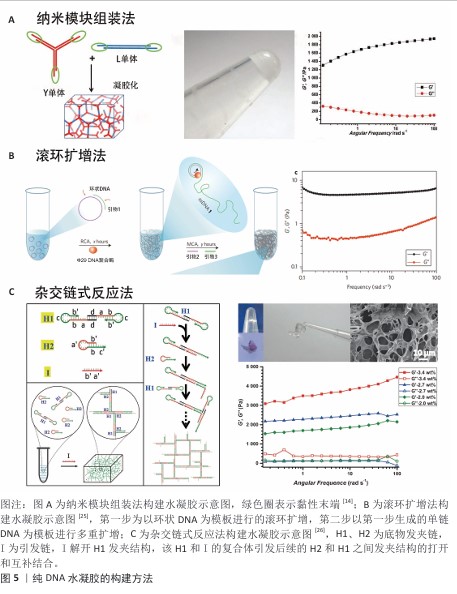
RESULTS AND CONCLUSION: Current research has established diverse preparation methods for DNA hydrogels, including: nanomodule assembly, rolling circle amplification, or hybridization chain reaction for pure DNA hydrogels; hybrid DNA hydrogels formed by grafting DNA onto polymers with crosslinking; interpenetrating networks combining polymers and DNA nanostructures; and physically crosslinked hydrogels through non-covalent interactions. Modularly self-assembled variants exhibit shear-thinning and self-healing properties, enabling injectable delivery for irregular wound repair and bone regeneration with precise filling capabilities. DNA hydrogels effectively load, protect, and deliver bioactive components while mimicking the extracellular matrix to facilitate 3D cell culture or serve as cell-laden carriers to the injury site, providing a delivery and application platform for stem cell therapies in bone repair and nerve regeneration. DNA hydrogels can also achieve integrated diagnosis and treatment, intelligently responding to the needs of different diseases. However, the clinical translation of DNA hydrogels still faces many challenges: immunoreactivity remains controversial; current laboratory synthesis of DNA hydrogels is small-scale and costly; and to further improve the application effects of DNA hydrogels, it is necessary to explore the integration of bioactive molecules into the hydrogels to enhance therapeutic efficacy.

Key words: DNA hydrogel, tissue repair, cell scaffolds, smart hydrogel, muti-functional hydrogel

CLC Number: