Chinese Journal of Tissue Engineering Research ›› 2026, Vol. 30 ›› Issue (33): 8703-8711.doi: 10.12307/2026.480
Previous Articles Next Articles
Relationship between diaphragmatic ultrasound parameters and core stability tests in young adults
Ma Tian1, Luo Yu2
- 1Ruijin-Hainan Hospital, Shanghai Jiao Tong University School of Medicine (Hainan Boao Research Hospital), Qionghai 571442, China; 2School of Rehabilitation, Gannan Medical University, Ganzhou 341000, Jiangxi Province, China
-
Received:2025-10-29Revised:2026-03-12Online:2026-11-28Published:2026-06-15 -
Contact:Luo Yu, PhD, Lecturer, Master’s supervisor, School of Rehabilitation, Gannan Medical University, Ganzhou 341000, Jiangxi Province, China -
About author:Ma Tian, Therapist n charge, Ruijin-Hainan Hospital, Shanghai Jiao Tong University School of Medicine (Hainan Boao Research Hospital), Qionghai 571442, China -
Supported by:Jiangxi Provincial Fund for Humanities and Social Sciences in Higher Education Institutions, No. TY24207 (to LY); Jiangxi Provincial Fund for Graduate Education Teaching Reform, No. JXYJG-2024-121 (to LY)

CLC Number:
Cite this article
Ma Tian, Luo Yu. Relationship between diaphragmatic ultrasound parameters and core stability tests in young adults[J]. Chinese Journal of Tissue Engineering Research, 2026, 30(33): 8703-8711.
share this article
Add to citation manager EndNote|Reference Manager|ProCite|BibTeX|RefWorks
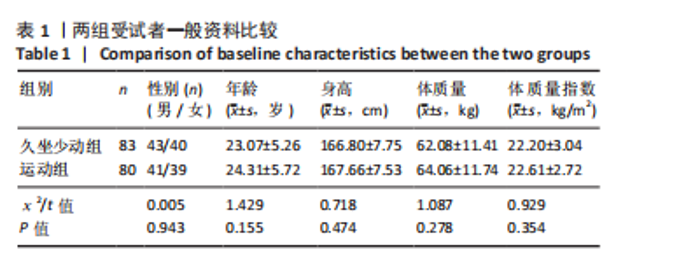
2.1 参与者数量分析 163名受试者全部进入结果分析。 2.2 两组受试者一般资料比较 两组受试者的性别分布比、年龄、身高、体质量和体质量指数之间并无显著性差异(表1)。"
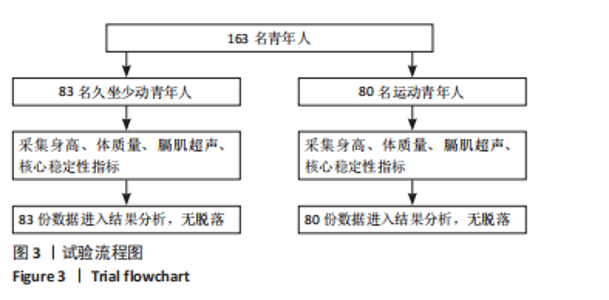
2.3 试验流程图 见图3。"
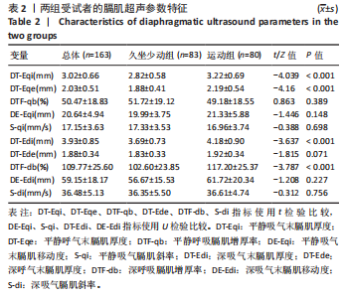
2.4 膈肌超声参数与核心稳定性特征 2.4.1 膈肌超声参数特征 两组受试者的膈肌超声参数结果显示(表2),与运动组相比,久坐少动组的膈肌结构功能水平较低。久坐少动组的平静吸气末膈肌厚度、平静呼气末膈肌厚度、深吸气末膈肌厚度、深呼吸膈肌增厚率均低于运动组,差异有显著性意义(P < 0.001)。"
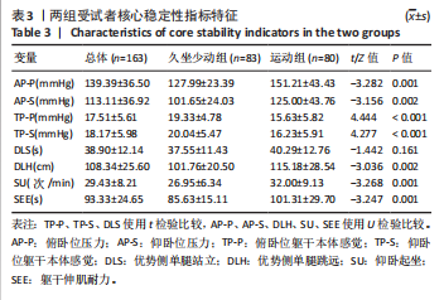
2.4.2 核心稳定性特征 两组受试者的核心稳定性结果显示(表3),与运动组相比,久坐少动组的核心稳定性明显衰退。久坐少动组俯卧位压力、仰卧位压力、优势侧单腿跳远、仰卧起坐、躯干伸肌耐力低于运动组,俯卧位躯干本体感觉、仰卧位躯干本体感觉高于运动组,差异有显著性意义(P < 0.01)。"
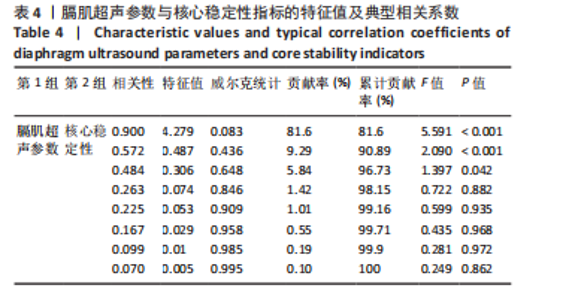
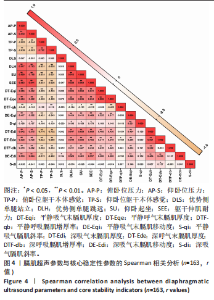
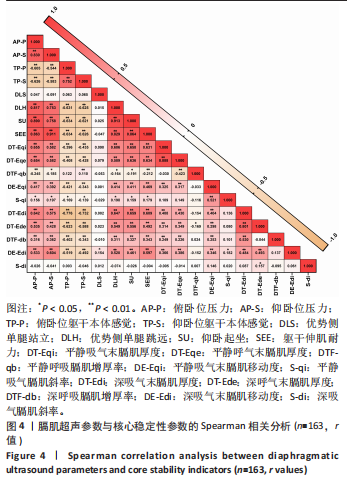
2.5 膈肌超声参数与核心稳定性的关系 2.5.1 各指标间的简单相关 青年人膈肌超声参数与核心稳定性之间的相关性结果显示(图4),在膈肌超声参数中,平静吸气末膈肌厚度、平静呼气末膈肌厚度、平静吸气末膈肌移动度、平静吸气膈肌斜率、深吸气末膈肌厚度、深呼气末膈肌厚度、深呼吸膈肌增厚率与除优势侧单腿站立外各指标的相关性检验均有显著性意义(P < 0.05),平静呼吸膈肌增厚率与除俯卧位躯干本体感觉和优势侧单腿站立外各指标的相关性检验均有显著性意义(P < 0.05),深吸气末膈肌移动度与核心稳定性各指标的相关性检验均有显著性意义(P < 0.05),深吸气膈肌斜率与核心稳定性各指标的相关性检验均无显著性意义(P > 0.05)。 2.5.2 各类指标间的典型相关 (1)典型相关系数及检验:由表4可知,典型相关分析中分别提取了8对典型相关变量,但根据相伴概率低于0.05的要求,"
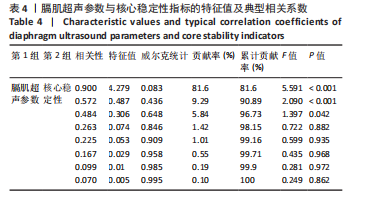
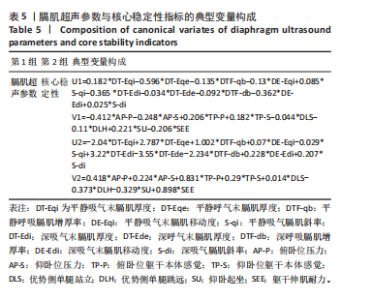
两组指标中的前3个典型相关系数均显著相关。前2个典型相关系数所包含的信息量能够充分反映原变量指标的主要信息。膈肌超声参数与核心稳定性的前2个典型相关系数分别为0.900与0.572,贡献率分别为81.60%与9.29%,两组指标之间前2个典型相关系数所含信息量大于90%。 (2)典型相关模型构成及分析:典型相关系数是原始变量在典型变量表达式中重要性的体现。原始变量间计量单位存在差异性,标准化处理后的典型系数被广泛采用。表4数据显示,前2个典型相关系数信息量占比超过90%。因此,两组指标间前2个典型相关系数对应的模型被列出(U1与V1、U2与V2的关系在表5中可见)。"
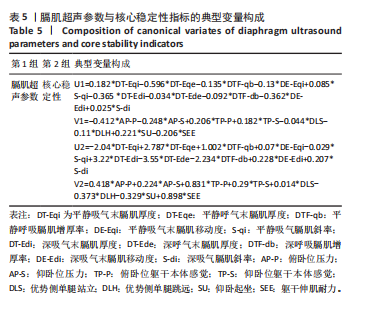
从膈肌超声参数与核心稳定性的第1典型相关模型中可以看出,在第1典型变量U1中,平静呼气末膈肌厚度和深吸气末膈肌厚度的系数较大,系数分别为-0.596和-0.365;在第1典型变量V1中俯卧位压力和仰卧位压力的系数较大,系数达到-0.412和-0.248。鉴于上述变量的符号相同(均为负号),因此,可以认为平静呼气和深吸气时的膈肌厚度与腹内压和腹部肌肉控制的相关性较高。"
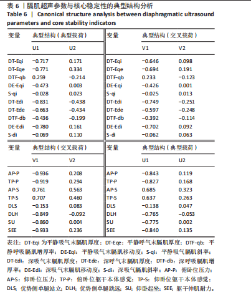
变量V2中,俯卧位躯干本体感觉和躯干伸肌耐力的系数较大,系数分别为0.831和0.898。因此,可以认为膈肌超声参数与核心稳定性的相关性主要是深呼吸膈肌厚度与躯干本体感觉及耐力的相关性所致。 (3)典型结构分析结果:在典型结构分析的框架下,可展示原始变量施加于典型变量的影响程度特征与方向。典型载荷是原始变量同该组典型变量之间的相关系数指标,其功能在于揭示典型变量与各组内单一变量的相关性强弱,典型载荷(表6)比典型权重(表5)更适合用于解释各原始变量与典型变量间的关系。呈现较大绝对值的典型载荷,表明原始变量与典型变量的相关性趋于增强。当考察某一典型变量同另一组原始变量的相关系数时,此类参数则被命名为交叉载荷。 从表6、图5中可以看出,第1组典型变量包含的信息量远多于第2组,因此分析时主要采用原始变量组合的第1组典型变量的典型载荷和交叉载荷。典型变量V1与核心稳定性中的俯卧位压力、俯卧位躯干本体感觉、仰卧位压力、仰卧位躯干本体感觉、优势侧单腿跳远、仰卧起坐、躯干伸肌耐力具有高度相关性,典型载荷分别为-0.936,-0.919,0.761,0.707,-0.849,-0.860,-0.933,这表明这些变量是反映核心稳定性的重要指标。同时,这7个核心稳定性变量与典型变量U1也表现出很高的相关性,其交叉载荷分别为-0.843,-0.827,0.685,0.637,-0.765,-0.775,-0.840,这说明核心稳定性的各主要变量能够反映膈肌结构功能水平。核心稳定性中的腹内压、躯干本体感觉、"
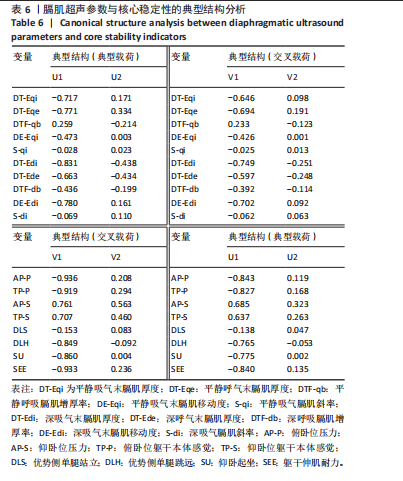
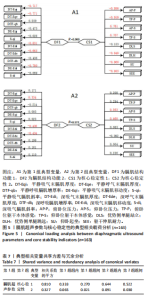
躯干控制力和耐力为膈肌结构功能提供了稳定性支持。 另一方面,典型变量U1与平静吸气末膈肌厚度、平静呼气末膈肌厚度、深吸气末膈肌厚度、深呼气末膈肌厚度、深吸气末膈肌移动度有很高的相关性,典型载荷分别为-0.717,-0.771,-0.831,-0.663,-0.780,说明这些变量是反映膈肌结构功能水平的重要指标。这些变量也和典型变量V1高度相关,其交叉载荷分别为-0.646,-0.694,-0.749,-0.597,-0.702,这说明膈肌可为核心稳定性提升提供一定的结构功能基础。宏观上讲,膈肌结构功能改善可创造良好的腹内压基础,带动更多核心肌肉不断地协同配合运动,有助于核心稳定性的进一步提升。 (4)典型冗余分析与解释能力:衡量模型解释能力存在2种主要方法。典型相关系数平方值为第1种方法,其反映的是共享方差部分。第2种方法则涉及冗余分析过程,涉及典型变量组内代表比例与冗余指数的分析。对该组变量方差的解释程度,通过组内代表比例得以体现。对另一组变量方差的解释程度,可用冗余指数这一指标,该指标亦被称作交叉解释比例。 如表7所示,膈肌超声参数与核心稳定性之间的第1组和第2组典型变量的组内、组间分别表示膈肌超声参数组的方差被其自身典型变量解释的比例,以及方差被对应的核心稳定性典型变量解释的比例。同样,核心稳定性组的方差也通过相应典型变量进行解释。从典型相关系数的平方可以看出,这两组典型变量都具有较强的解释能力,其中核心稳定性组的81.00%"
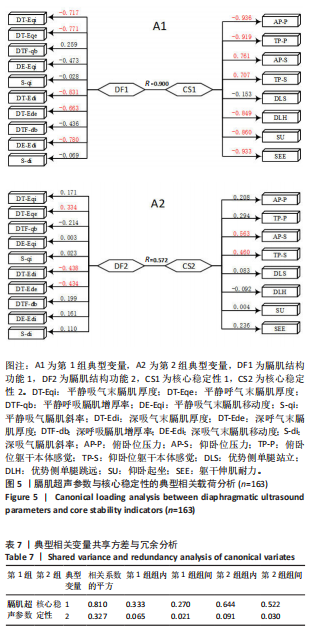

和32.70%信息能够被膈肌超声参数组的变量解释。特别是第1组典型变量,显示了膈肌超声参数与核心稳定性之间较高的相关性。具体来说,膈肌超声参数的方差被自身及对方的第1典型变量解释的比例分别为33.30%和27.00%,而核心稳定性组的方差被自身及对方第1典型变量解释的比例分别为64.40%和52.20%,这表明两者之间确实存在较高的相关性。 2.6 不良事件 全体受试者均顺利完成所有测试,未报告或发生任何与研究操作相关的不良事件或严重不良事件。"

| [1] PANJABI MM. The stabilizing system of the spine. Part II. Neutral zone and instability hypothesis. J Spinal Disord. 1992;5(4):390-397. [2] WALLDEN M. The diaphragm–more than an inspired design. J Bodyw Mov Ther. 2017;21(2):342-349. [3] YOON HS, CHA YJ, YOU JSH. The effects of dynamic core-postural chain stabilization on respiratory function, fatigue and activities of daily living in subacute stroke patients: A randomized control trial. NeuroRehabilitation. 2020;47(4):471-477. [4] 孔军峰,肖海彬,马天,等.青年人躯干压力生物反馈与膈肌功能参数的相关性[J].中国组织工程研究,2024,28(32):5196-5202. [5] 高雅楠,杨亚,韩晓伟,等.儿童青少年身体活动和久坐少动行为与体质健康关系的研究[J].北京体育大学学报,2024,47(3):22-39. [6] 田露,刘斌.身体活动与运动对代谢综合征的影响与作用[J].中国组织工程研究,2020,24(2):296-302. [7] AMIRI B, ZEMKOVÁ E. Trunk stability and breathing exercises superior to foam rolling for restoring postural stability after core muscle fatigue in sedentary employees. Sci Rep. 2025;15(1):13909. [8] KAPDULE P, POL T. Relationship between Core Stability and Physical Activity in Young Adults. Int J Health Sci Res Dev Disabil. 2019;126(3):112-119. [9] AMIRI B, ZEMKOVÁ E. Diaphragmatic breathing exercises in recovery from fatigue-induced changes in spinal mobility and postural stability: a study protocol. Front Physiol. 2023;14:1200018. [10] 陈梦,王白冰,王丹丹,等.超声评估膈肌功能的应用进展[J].临床超声医学杂志,2022,24(5):378-381. [11] ROCHA FR, BRÜGGEMANN AKV, FRANCISCO DDS, et al. Diaphragmatic mobility: relationship with lung function, respiratory muscle strength, dyspnea, and physical activity in daily life in patients with COPD. J Bras Pneumol. 2017;43(1):32-37. [12] PRINZBACH A, BULLOCK WM, KUMAR AH, et al. Diaphragmatic Ultrasound in Adults: Image Acquisition and Interpretation. J Vis Exp. 2025;(215):e67684. [13] 祝捷,尚博睿,周林,等.超重肥胖大学生24小时活动指南依从性及其心理健康问题研究[J].武汉体育学院学报,2024,58(3):73-80. [14] ÇETINKAYA İ, KURU ÇOLAK T, SAKA S, et al. Respiratory function and respiratory muscle strength in adolescent idiopathic scoliosis. Spine Deform. 2024;12(3):635-641. [15] WATSON K, EGERTON T, SHEERS N, et al. Respiratory muscle training in neuromuscular disease: a systematic review and meta-analysis. Eur Respir Rev. 2022;31(166):220065. [16] DAHMA EM, EL-LAWATY WM, SHAARAWY DE, et al. Ultrasonographic evaluation of diaphragmatic thickness and movement for assessment of diaphragmatic dysfunction in COPD patients. Egypt J Bronchol. 2024; 18(1):69-75. [17] MÖLLER K, SABORIO M, GOTTSCHALL H, et al. The Perception of the Diaphragm with Ultrasound: Always There Yet Overlooked? Life (Basel). 2025;15(2):239-245. [18] JAIN S, NAIR G, NUCHIN A, et al. Study of the diaphragm in chronic obstructive pulmonary disease using ultrasonography. Lung India. 2019; 36(4):299-303. [19] SONG SE, YUN SH. Diaphragmatic ultrasound assessment of muscle recovery in patients undergoing general anesthesia: a systematic review and meta-analysis. J Med Life Sci. 2025;22(1):1-7. [20] MAHMOD SR, BAHARUDDIN MLI, AZAMAN A, et al. A Prototype Validation Study of a Digitized Pressure Biofeedback Unit Versus Electromyography During Transverse Abdominis Muscle Activation. J Med Device Technol. 2024;3(2):84-89. [21] PROMSRI A. Modulation of lower-limb muscle activity in maintaining unipedal balance according to surface stability, sway direction, and leg dominance. Sports (Basel). 2022;10(10):155. [22] PAN H, FU S, ZHOU Y, et al. Single-leg horizontal jump is more suitable for assessing lower limb function compared to single-leg vertical jump in patellofemoral pain patients. Gait Posture. 2025;115:94-101. [23] SCHÖNAU T, ANDERS C. Force capacity of trunk muscle extension and flexion in healthy inactive, endurance and strength-trained subjects—A pilot study. Ger J Exerc Sport Res. 2024;54(2):213-220. [24] 杜云菲,盛雯静,王鑫林.教师非特异性腰痛的身心康复研究进展[J].职业卫生与应急救援,2025,43(3):306-309. [25] COLLAUD S, TOUILLOUX B, VON GARNIER C, et al. Physical activity and lung function association in a healthy community-dwelling European population. BMC Pulm Med. 2024;24(1):169. [26] SZEWCZYK D, SADURA-SIEKLUCKA T, TARNACKA B, et al. Is there a connection between spine alignment, chest mobility, shoulder joint and respiratory parameters of patients with ankylosing spondylitis? Rheumatol Int. 2024;44(8):1481-1486. [27] BHORE PR, BATHIA K, KANASE S, et al. Prevalence of Core Weakness in Bank Employees. J Clin Diagn Res. 2019;13(3):YC17-YC20. [28] KANLI K, YIĞITOĞLU PH, ÖZGÜL A. Investigation of the effects of different treatment approaches on lumbar stabilizer muscles and diaphragm motility in individuals with chronic low back pain. Turk J Phys Med Rehabil. 2024;70(3):358-369. [29] HE R, REN L. Evaluation of the benefits of respirator breathing and vomiting training and dynamic core training on improving respiratory muscle strength. Respir Med. 2025;241:108029. [30] YÜKSEL F, GÜZEL N, TAŞPINAR B, et al. The Relationship Between Trunk Muscle Endurance, Respiratory Functions and Respiratory Muscle Strength in Healthy Individuals. Turk J Physiother Rehabil. 2020; 31(3):255-262. [31] AKTAN ÖO, AKTAN R, YAKUT H, et al. The effects of respiratory muscle functions on trunk muscle endurance in healthy young adults. J Basic Clin Health Sci. 2021;7(2):652-659. [32] DEBERNARDI F, FOGLIATA A, GARASSINO A. Multifunctional role of the diaphragm: biomechanical analysis and new perspectives. MOJ Sports Med. 2024;7(1):9-13. [33] LIU H, WIEDMAN CM, LOVELACE-CHANDLER V, et al. Deep diaphragmatic breathing—anatomical and biomechanical consideration. J Holist Nurs. 2024;42(1):90-103. [34] GOLOB I, OPARA ZUPANČIČ M, KOZINC Ž. Abdominal Hollowing vs. Abdominal Bracing: A Scoping Review of Clinical Trials on Effectiveness for Trunk Stability and Rehabilitation. J Funct Morphol Kinesiol. 2024; 9(4):193. |
| [1] |
Lu Guangqi, Li Jing, Sun Xinyue, Liang Long, Liu Guangwei, Zhou Shuaiqi, Mao Hanze, Ma Mingming, Cui Ying, Liu Yakun, Hu Jiaming, Zhu Liguo, Yu Jie, Zhuang Minghui.
Correlation between cervical instability and neck muscle changes in middle-aged and young adults#br#
#br#
[J]. Chinese Journal of Tissue Engineering Research, 2026, 30(24): 6220-6224.
|
| [2] | Ming Yu, Wang Peijun, Liu Xiaoyao, Li Jianan. Effect of root distal curvature with clear aligners on intruded maxillary central incisors analyzed using three-dimensional finite element analysis [J]. Chinese Journal of Tissue Engineering Research, 2026, 30(14): 3536-3547. |
| [3] | Gao Shiai, Chen Jinhui, Cao Xinyan, Leng Xiaoxuan, Liu Xihua. Abdominal electrical stimulation combined with core stabilization training improves balance and cough function in patients with stroke pseudobulbar palsy [J]. Chinese Journal of Tissue Engineering Research, 2026, 30(11): 2736-2744. |
| [4] | Wu Yihan, Liu Zhongqiang, Wei Qiaoye, Liu Mingdong, Chen Keyi, Li Zhigang. Effect of balance training with different visual conditions on proprioception in patients with chronic ankle instability [J]. Chinese Journal of Tissue Engineering Research, 2025, 29(5): 1050-1057. |
| [5] | Zheng Xiang, Zhang Mingxing, Huang Ya, Shan Sharui. Improvement of lower limb walking function in patients with chronic non-specific low back pain by biofeedback assisted electrical stimulation [J]. Chinese Journal of Tissue Engineering Research, 2025, 29(3): 547-553. |
| [6] | Wang Xia, Xue Boshi, Yang Chen, Zhou Zhipeng, Zheng Liangliang. Influence of neuromuscular function on the risk of biomechanical injury in landing manoeuvres in patients undergoing anterior cruciate ligament reconstruction [J]. Chinese Journal of Tissue Engineering Research, 2025, 29(26): 5556-5562. |
| [7] | Liu Yanhao, Dong Shiyu, Liu Ziyin, Song Qipeng, Shen Peixin. Unilateral chronic ankle instability affects bilateral postural stability, proprioception, plantar tactile sensation and muscle strength [J]. Chinese Journal of Tissue Engineering Research, 2025, 29(17): 3572-3578. |
| [8] | Zhang Xihui, Li Zhengrong, Li Shineng, Xing Zengyu, Wang Jiao. Effect of rehabilitation training guided by Pro-kin balance system on proprioception and balance function of the affected knee after anterior cruciate ligament reconstruction [J]. Chinese Journal of Tissue Engineering Research, 2024, 28(8): 1259-1264. |
| [9] | Dong Gengxin, Li Yiting, Hong Yinglu, Bao Dapeng. Effect of hydrogen-rich gas on proprioception and muscle endurance after high-intensity exercise [J]. Chinese Journal of Tissue Engineering Research, 2024, 28(34): 5413-5418. |
| [10] | Kong Junfeng, Xiao Haibin, Ma Tian, Luo Yu. Trunk pressure biofeedback and its correlation with diaphragmatic functional parameters in young adults [J]. Chinese Journal of Tissue Engineering Research, 2024, 28(32): 5196-5202. |
| [11] | Ye Yuntian, Chen Jixin, Liu Aifeng. Proprioceptive training after anterior cruciate ligament reconstruction: improving joint stability and motor balance ability [J]. Chinese Journal of Tissue Engineering Research, 2024, 28(27): 4421-4428. |
| [12] | Lin Qinzhao, Wei Mengli, Zhong Yaping, Wu Qian, Zhou Botao, Wang Haifeng. Effect of transcranial direct current stimulation on human single-leg landing stability [J]. Chinese Journal of Tissue Engineering Research, 2024, 28(26): 4209-4215. |
| [13] | Wang Yuetong, Peng Liang, Su Yuying, Liu Jiajun. Effect of balance training on chronic ankle instability: a meta-analysis [J]. Chinese Journal of Tissue Engineering Research, 2024, 28(24): 3930-3936. |
| [14] | Feng Liang, Zhang Yafei, Huo Hongfeng. Measurement and evaluation of proprioception of foot and ankle complexes [J]. Chinese Journal of Tissue Engineering Research, 2024, 28(20): 3259-3264. |
| [15] | Xue Boshi, Lin Changrui, Zheng Liangliang, Yang Chen, Zhou Zhipeng. Core stability training reduces risk of anterior cruciate ligament injury in landing movements [J]. Chinese Journal of Tissue Engineering Research, 2024, 28(16): 2467-2472. |
| Viewed | ||||||
|
Full text |
|
|||||
|
Abstract |
|
|||||